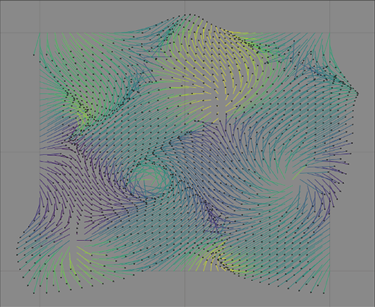
Never thought a figure from a paper of mine would appear on the cover of @PhysRevLett ! Who wants Vogue when u have PRL😅. Glad to have this work (part of my PhD @mpi_pks) with Benoit Doucot(@Sorbonne_Univ_ ) and Roderich Moessner (@mpi_pks) out now. Any comments are welcome 🙂
Volume 133, Issue 20
https://t.co/B8bYGDp7TE
Cover: Topological charge density structure for multicomponent textured crystals where spatial profiles of spin-pseudospin entanglement are varied by tuning the anisotropies
https://t.co/BGEvyInBSs
What is the zeptoverse, and what could it tell us about dark matter? ⚛️
A Cambridge-led team of physicists, working at @CERN, have detected an ultra-rare decay of a subatomic particle known as a beauty quark.
The results are at such tiny scales – trillionths of a billionth of a metre – that they could open the door to the zeptoverse, where new physics and subatomic particles could be hiding.
Find out more 👉 https://t.co/h9MPldzZaZ
Today Physical Superintelligence PBC is announcing a proof of the Aaronson-Ambainis conjecture, one of the central open problems in quantum complexity, with major implications for quantum computing speedup.
https://t.co/sAewkKdSOu
Thread 👇
Most non-academics assume that our job prospects are like those of doctors or lawyers. Yet (napkin math) there are likely a similar number of tenure track political theorists in the United States as there are active NFL and NBA players.
I have always believed better qubit architectures will eventually win the game even if they are harder to scale..cat qubits are a step in the direction. So yes, even though zero bit flip error estimates are absurd, this result definitely highlight this point well.
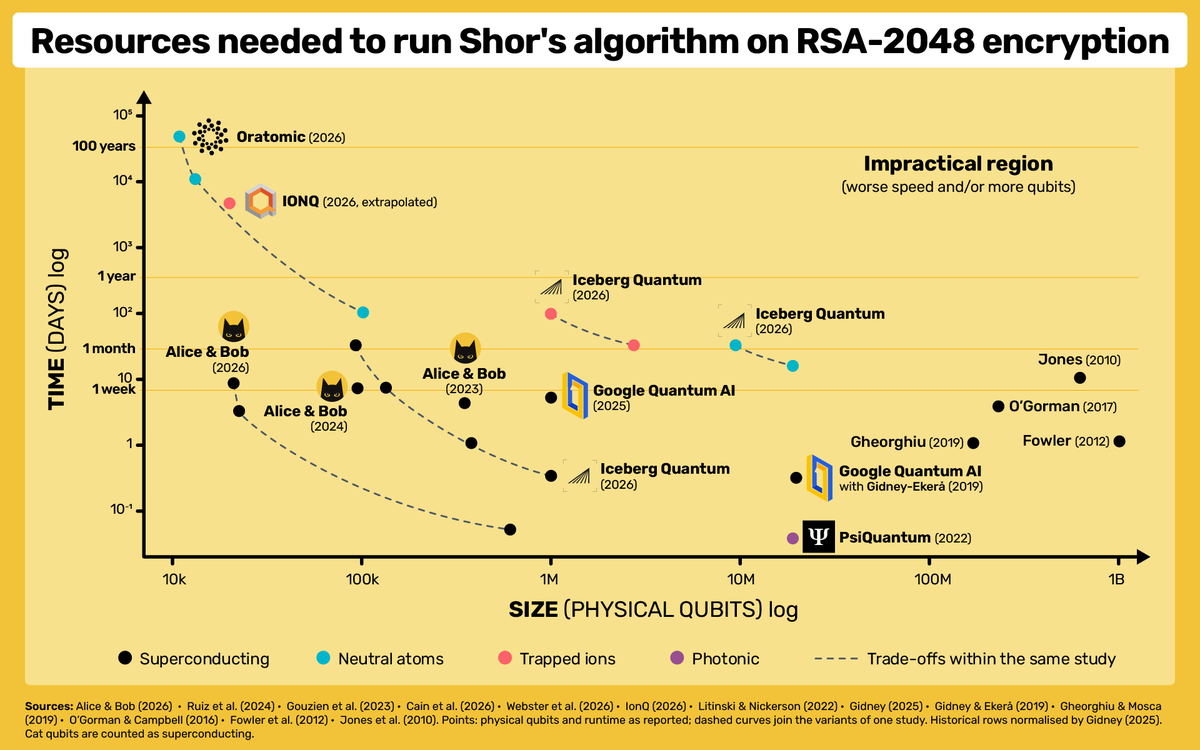
Breaking RSA-2048 with 23,000 cat qubits. 🐈 In 3.14 days
This is the finding of our new paper, the latest resource estimate for Shor’s algorithm, the benchmark the whole field uses to compare quantum hardware 📄
The results are a record low for total quantum resources at this speed of execution, about 40 times fewer physical qubits than @GoogleQuantumAI 's Craig Gidney 2025 estimate. 🏁
RSA-2048 is the lock behind secure websites, banking and software updates 🔐 Shor's algorithm has been able to break it, on paper since 1994. Nobody has built the machine yet, but every year the estimate of how big it needs to be gets a little smaller.
In 2019, the best estimate was 20 million qubits. In 2024, ours was just under 100,000. Now 22,593, in 3.14 days. Yes, pi 🥧
Small isn't enough. Fast isn't enough. The new study optimizes for both. 😼
Bitcoin, Ethereum and most blockchains aren't secure either, about 30,000 qubits would be needed to crack a Bitcoin key in about an hour ₿ ⏳
How we got here, what it means for cryptography, and when it all converges, our CEO Théau Peronnin talks about it in the blog 👇
📝 Blog - https://t.co/K3E5pxTUMv
📄 Paper - https://t.co/kiC9JZz66u
Stay curious, more info coming soon 👀
#QuantumComputing #CatQubits #ShorsAlgorithm #PostQuantumCryptography #Cryptography #FaultTolerance #DeepTech
We are announcing three new discoveries in mathematics, computer science, and physics about harmonic analysis, complexity theory, and quantum field theory.
https://t.co/9BX8HWQDTJ
New from our STEM Fellows Program: Designing more efficient quantum circuits with Claude.
Given plain-language instructions, Claude Mythos 5 designed quantum circuits that improve on the best published ones, sometimes by an order of magnitude or more.
More efficient circuits reduce the resources needed by quantum algorithms, which could bring quantum computing applications in chemistry and materials science within reach sooner.
Read more: https://t.co/QCvoJLDmBo
The @IonQ Quantum Innovation Centre is now open at the Ray Dolby Centre! 💻 🔬
Marking a new phase of the University's strategic partnership with IonQ, the Centre will bring together researchers from Cambridge and IonQ across a programme of collaborative quantum research, all the heart of the @DeptofPhysics.
https://t.co/4xprfrY0fb
A significant step forward for quantum in the UK.
IonQ and the @Cambridge_Uni have opened the IonQ Quantum Innovation Centre at the Cavendish Laboratory’s new Ray Dolby Centre, creating a physical home for the University’s largest corporate research partnership.
The Centre brings together Cambridge researchers and IonQ specialists across nine inaugural projects, from scaling quantum computers to exploring applications in finance, engineering and cancer research. It will also house a 256-qubit Superion quantum computer and quantum network, providing infrastructure to advance research and technology development.
More than a research partnership, this is a long-term investment in the UK’s quantum future. By bringing together technology, infrastructure and scientific expertise, IonQ is helping build the capabilities, skills and opportunities needed to translate quantum science into real-world impact for researchers, start-ups and industry.
Learn more: https://t.co/oAiIlLeFOP
#IonQ #QuantumComputing #QuantumIsNow #UniversityOfCambridge
What needs to change drastically, if the research enterprise is to continue, is evaluation and engagement with new ideas outside of immediate expertise- honestly this is welcome. Many researchers have had to box themselves up to foster easier metric based evaluation.
Really hope now theoretical physics becomes- either come up with a physical toy model that provides a genuine conceptual advance (not incremental) or explain experiment. Best case scenario- come up with a new conceptual framework that pushes the experimental frontier
Rigorous work based on creative intuition will be key, but with intuition being the main differentiator for contribution and understanding of the rigor being the main differentiator for exposition.
Some interesting proof that might be interesting to more “proof” minded physicists as well.but yet to see any new conceptual advance in physics.. most of the mathematical results relevant for physics are assumed to be true anyway by working physicists.
We’re releasing a broad range of new mathematical results produced by an internal frontier model.
We’ve been consulting with the independent Advisory Group on Mathematics and Artificial Intelligence at the Institute for Advanced Study, and we have drawn on their advice and public recommendations to inform how we release these results.
https://t.co/7N6TPlft1P
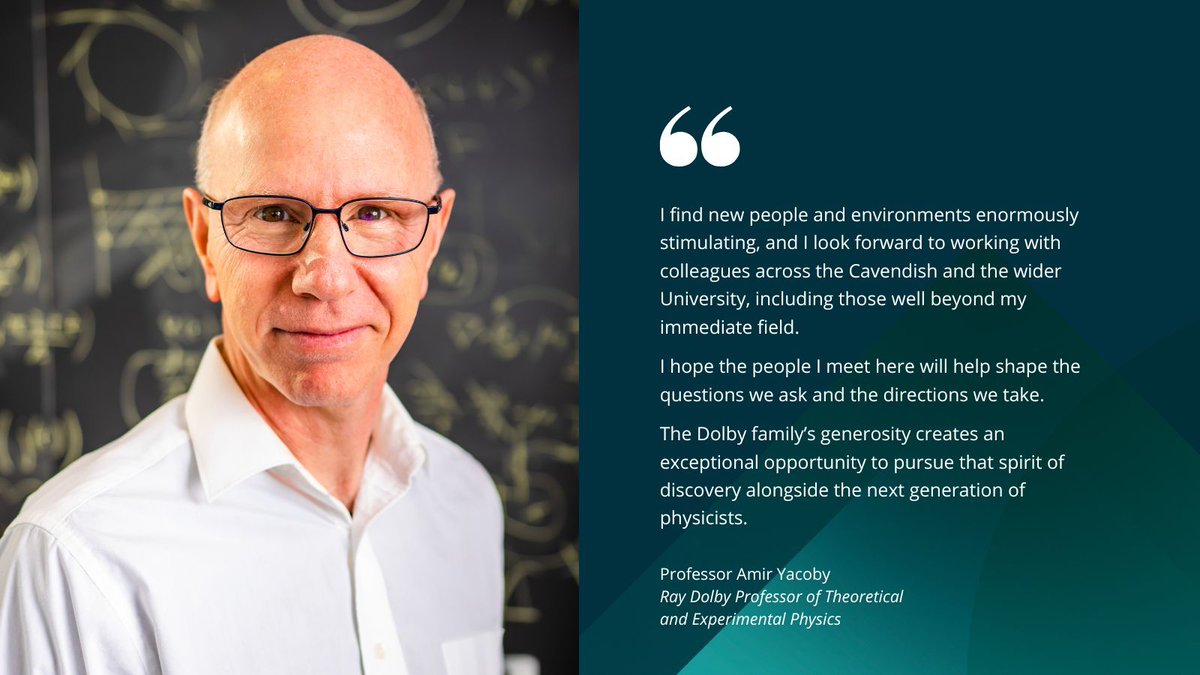
We are delighted to announce Amir Yacoby as inaugural Ray Dolby Professor of Theoretical and Experimental Physics. He is joining the Cavendish from Harvard to develop new ways of probing and understanding quantum matter.
A very warm welcome to him!
🔗 https://t.co/F6hHvDq82A
The reason your tea will never explode and your planes will keep having turbulence is that physics solved the Navier-Stokes problem long before math did