so, a fun employment update.
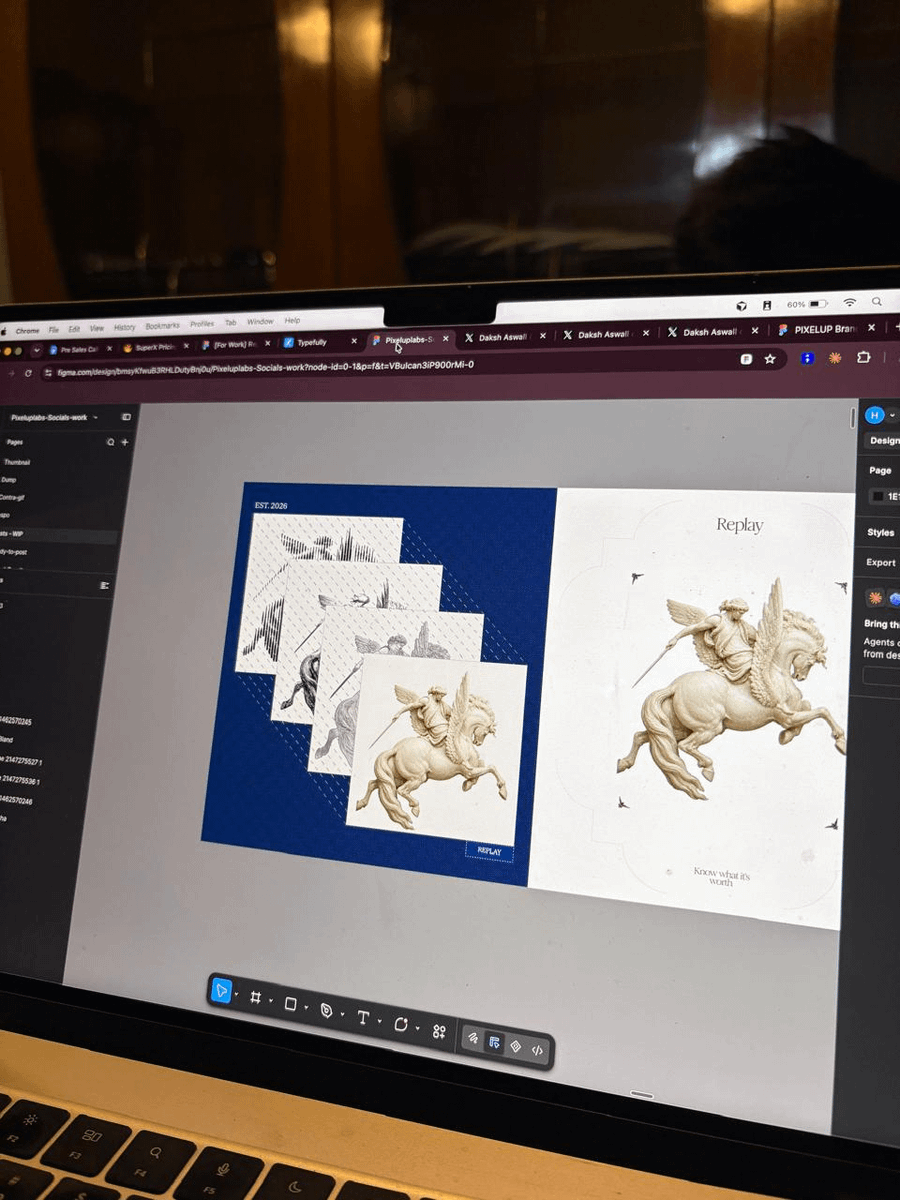
i have joined as Head of Sales and Marketing at @pixeluplabs ( we don't make pixel art )
after scaling dreamlaunch to $150k cumilative revenue and $1M net pipeline;
i joined onto a bigger team behind some of the biggest brands like greptile, replay and streamline
we're the design partner for upmarket moving teams; new buyers, bigger deals, a brand that has to look the part.
which sounds very serious but the most i design in the team is growth loops ( very v far away from figma )
tldr; new city, new team and new larger problems to work on
gonna ship some banger scale with @dakshpixelup
October was so far the best month for me personally as well as PIXELUP LABS , some of the wins were :
- went full time at @pixeluplabs in just 3 weeks ( subtle flexx )
- day 1 on outreach and i already had a GTM call booked, beginner's luck or raw talent we'll never know
- closed a deal that @dakshpixelup called "the smoothest close ever" because the founder came in pre-sold and we basically showed up to say hi
- closed a client straight from content who silently watched us for 2-3 months and then just showed up ready to buy, so keep posting because the lurkers are watching
- our replay launch sequence did 200k+ views on X ( i refreshed the analytics like it was my bank account )
- made another $500 from X sponsors and collabs which finally funds my peri peri chicken habit
- bought myself a cute personal space in green glen layout, adulting unlocked : )
- got a PS controller and an xbox subscription to finally live the childhood i missed with far cry, tomb raider and assassin's creed
- was able to get on the right track in a lot of personal relation's and character development
manifesting more wins for the last two months of the year 🧿 (and zero fevers this time)
please stop saying everything is dead.
every other week my timeline buries something new. SaaS is dead. agencies are dead. design is dead. coding is dead.
and the argument is always the same 4 lines:
> no moat
> anyone can build it at home with AI
> everything is a commodity
> if you ship something good someone copies it by the weekend.
so i took those exact 4 lines and pointed them at a café. ( reads just as convincing doesn't it lol )
because every single point is true. the beans are a commodity. you can make a hazelnut cold coffee at home for a fraction of the price. the café next door will copy your new drink in a week.
and yet the café near my place is full every evening.
nobody in there is paying for coffee. they're paying for the 20 minutes out of the house, the guy who already knows their order, the corner it sits on, the fact that it's the default place you say when someone asks "where should we meet ?"
thats the part every "X is dead" take skips. easy to copy and easy to win are two completely different things.
software works the same way. AI made building cheap.
it didnt make distribution cheap, or trust, or being the tool a team already opens every morning, or having taste that people actually notice. those were always the moat.
anyway i'm going to go pay full price for a cold coffee i could make at home.
- cafés have no moat.
- anyone can vibe-brew a hazelnut cold coffee at home for a fraction of the price.
- the beans are a commodity, the cups are a commodity, and the wifi is free everywhere.
- if a café nails a new drink, the one next door copies it by the weekend.
cafés are dead.
I built a team of AI agents that keeps working after I close my laptop.
Not one “super-agent” trying to do everything.
An actual team:
→ Grok Bot runs research and content
→ Claude Code handles writing and marketing
→ DeepSeek in https://t.co/EMW99xgzn2 builds the tools
→ Viktor acts as chief of staff in Slack
But the agents aren’t the important part.
The system connecting them is.
Here’s the exact architecture:
1. Give every agent one job
The fastest way to break an agent is to make it responsible for everything.
Research, writing, coding, publishing and analytics all compete for the same context.
Instead, give every agent one clearly defined lane.
One agent researches what’s working on X.
One turns that research into posts, scripts and landing pages.
One builds the pages, automations and dashboards.
One coordinates the team and reports back to you.
Specialization makes each agent easier to instruct, evaluate and improve.
2. Give the whole team one brain
Every agent needs access to the same business context.
I use a shared Obsidian vault containing:
→ the offer
→ the ideal buyer
→ the brand voice
→ operating playbooks
→ important decisions
→ previous research
→ active projects
The most valuable file is the “rulings” document.
Every time I correct an agent, that correction gets added there.
The next agent reads it before starting.
That turns a one-time correction into permanent team knowledge.
3. Add shared memory
The vault contains what is true about the business.
The memory layer contains what the agents learn while working.
If I give the chief of staff a new preference in Slack, the writing agent can use it during the next campaign.
One agent learns.
The entire team improves.
4. Give every agent its own desk
Multiple agents should never edit the same project folder simultaneously.
Git worktrees solve this.
Each agent receives:
→ its own folder
→ its own branch
→ its own task
→ its own development port
The writer can update the landing-page copy while the builder creates the signup flow.
Neither agent overwrites the other.
A reviewer checks both branches before anything gets merged.
5. Connect the agents directly
Without communication, you’re still copying work between tools manually.
A private network and agent relay let the team hand tasks to one another.
The research agent finds an opportunity.
The chief of staff sends it to the writer.
The writer creates the campaign.
The builder ships the page on a separate branch.
The reviewer checks everything.
Then the chief of staff sends you one concise summary.
You stop being the copy-paste layer.
6. Keep three actions behind human approval
The agents can research, draft, build and recommend autonomously.
But nothing should:
→ merge
→ send
→ spend
without human approval.
That boundary gives the team room to work without giving it uncontrolled access to your customers, codebase or money.
The final system is surprisingly simple:
One agent per job.
One shared brain.
One shared memory.
Separate workspaces.
One communication layer.
One chief of staff.
And one human approving the decisions that actually matter.
The goal isn’t to remove yourself from the business.
It’s to remove yourself from carrying every task between tools.
Your agents handle the work and the handoffs.
You handle the merge, the send and the spend.
5 weeks ago, i'd never run growth for a company. i'd been an engineer my entire career.
when i took the head of growth role, a lot of friends told me "man, you don't know a thing about b2b sales. you're probably gonna be prompting claude to help you out all day lol"
they weren't completely wrong ( i do prompt claude a lot ). but honestly it sounded like a fun problem to debug.
in my first week on outbound i booked 3 calls without adding a single new channel
what i've fafo'd about GTM since:
1. before building anything new, find what already worked. we had 3 sales motions that had brought in money before, and none of them had an owner. running those beat every shiny new tool idea.
2. measure calls, not likes. on day one i matched every X post against every booked call. calls landed within 72 hours of a post crossing 10,000 impressions. everything below that was mostly applause.
3. close before the call, not on it. a lead who has already seen your email sequence, your connection request and a DM shows up checking if you're the same people from their inbox. the call becomes objection handling.
4. never ask "would you like to hop on a call ?" send 2 time slots instead. a yes or no is easy to ignore, picking a time feels like you've already decided.
5. let your clients pitch for you. instead of asking busy founders for a testimonial, i wrote a prompt that read their recent posts and drafted quote options in their own voice. they picked one, tweaked it and posted.
6. treat your audience like fans, not customers. reply to every comment and spend 15-30 minutes a day showing up in other people's comments. its boring and it compounds.
7. automate the boring parts like an engineer would. i built a bot that drops every post our team publishes into slack, and another that sends a fresh lead list every day at 12:30. growth is mostly systems wearing a marketing hat.
turns out i didn't need to stop being an engineer. i just started shipping for pipeline instead of features
Most founders approach GTM backwards.
They raise money, hire creators, launch paid campaigns and publish content across five platforms before they know what message actually makes someone care.
Then, when nothing converts, they conclude that the product needs more features.
But the fastest-growing consumer apps followed a very different sequence.
An analysis of roughly 100 apps that reached $100,000 in monthly revenue within their first year revealed a surprisingly consistent playbook.
For 94 of those apps, a dominant growth channel could be identified.
Here’s what stood out:
→ Nearly half grew primarily through organic short-form content.
→ Organic short-form produced more winners than paid advertising, referrals and influencer marketing combined.
→ Roughly one in seven grew mainly through referrals or product-driven viral loops.
→ Apps propelled by one breakout launch reached $100K MRR fastest, often completing the journey within a single quarter.
→ Across the entire dataset, fewer than ten core GTM playbooks appeared repeatedly.
Different products.
Different audiences.
Almost identical growth systems.
The biggest lesson for 2027 is simple:
Distribution should be discovered before it is scaled.
The winning apps didn’t begin by paying hundreds of creators to experiment with random ideas.
They used their own accounts as a testing laboratory.
Here’s how the playbook worked:
1. Start with a small number of owned accounts
The founders usually focused on one to three accounts instead of trying to dominate every platform immediately.
One might be the company account.
Another might be the founder’s personal account.
The third could be a faceless account built around the problem the product solves.
Each account gave the team a different way to test positioning.
The goal wasn’t simply to “post consistently.”
It was to learn:
→ Which problem gets the strongest reaction?
→ Which audience recognizes itself immediately?
→ Which opening line stops the scroll?
→ Which product demonstration creates curiosity?
→ Which objection prevents someone from downloading?
Every post became a small market-research experiment.
2. Spend several weeks searching for a repeatable format
A viral video is not a GTM strategy.
A format that can repeatedly generate strong results is.
The winners spent several weeks testing different combinations of:
→ hooks
→ visual structures
→ product demonstrations
→ stories
→ calls to action
→ creator personalities
→ video lengths
They weren’t searching for one lucky hit.
They were looking for a format that could be reproduced dozens—or eventually hundreds—of times.
A repeatable format might be:
“Watch this app complete a task that normally takes an hour.”
Or:
“I tested the tool everyone in this industry is talking about.”
Or:
“Three mistakes people make before they discover this product.”
The subject changes in every video.
The underlying structure remains recognizable.
That distinction matters.
A viral video gives you temporary attention.
A viral format gives you a distribution engine.
3. Borrow proven behavior instead of inventing everything
Several apps in the dataset grew by adapting formats that were already working elsewhere.
They didn’t copy the product or steal the original content.
They studied the mechanism behind the format:
→ Why does the opening create curiosity?
→ Where is the product introduced?
→ When does the viewer receive the payoff?
→ What makes the video easy to understand without sound?
→ Why would someone share it?
Then they rebuilt that structure around their own product and audience.
Some eventually out-published the company that inspired them.
This is an important distinction:
Originality is valuable at the product level.
At the distribution level, proven behavior is often more useful.
You don’t need to invent a new form of storytelling every time you launch an app.
You need to connect a proven format to a product worth talking about.
4. Use smaller creators to scale validated ideas
Once the team found a format that worked on its own accounts, it brought in creators.
But follower count was rarely the most important criterion.
Smaller creators were often more useful because they were:
→ affordable enough to test in volume
→ willing to iterate quickly
�� comfortable following a proven structure
→ closer to the audience the product wanted to reach
→ less dependent on highly polished brand briefs
The creators weren’t being hired to solve the company’s positioning problem.
That work had already been done.
They received a format with evidence behind it:
→ a proven hook
→ a clear story structure
→ an effective product moment
→ examples of successful posts
→ room to adapt the delivery to their personality
This made creator marketing much less speculative.
Instead of paying for access to an audience and hoping the content worked, the company used creators to multiply a message it already knew could perform.
5. Scale volume only after finding the signal
The fastest-growing apps didn’t confuse activity with progress.
Publishing 100 random videos doesn’t create a content engine.
It creates 100 unrelated experiments.
The winners found a signal first.
Then they increased volume.
Once a format started working, they created variations around:
→ the opening hook
→ the pain point
→ the use case
→ the creator
→ the setting
→ the audience segment
→ the final payoff
One idea could become dozens of pieces of content without feeling identical.
This is where creator networks became powerful.
The company was no longer asking:
“What should we post tomorrow?”
It was asking:
“How many useful variations of this winning format can we publish?”
6. Treat every spike as information
When a video significantly outperformed the account’s average, the winning teams didn’t celebrate for a week and move on.
They responded within a day or two.
They studied what changed:
→ Was the first sentence stronger?
→ Did the product appear earlier?
→ Was the problem more specific?
→ Did the creator feel more relatable?
→ Did the video show a more surprising result?
→ Were the comments revealing a new use case?
Then they immediately produced new versions.
Not identical reposts.
Controlled variations.
One new hook.
One new example.
One different creator.
One different audience.
Same underlying reason the original worked.
This turned viral moments into feedback loops.
Instead of hoping the algorithm would reward them twice, the teams extracted the lesson and increased their chances of reproducing the outcome.
7. Build virality into the product where possible
Short-form content wasn’t the only successful channel.
A meaningful group of apps grew through referrals and viral product loops.
The product itself created distribution.
Users shared results.
They invited collaborators.
They exported content carrying the product’s identity.
They sent links that required another person to interact with the app.
They received additional value when someone else joined.
The best referral systems didn’t feel like marketing campaigns.
Sharing was simply part of completing the job.
That’s the difference between a referral program and a viral loop.
A referral program asks users to promote the product.
A viral loop makes promotion a natural byproduct of using it.
8. Use launches as accelerators—not permanent strategies
Breakout launches produced some of the fastest journeys to $100K MRR.
But a launch only works when several ingredients align:
→ a compelling product
→ a clear and timely story
→ concentrated distribution
→ strong social proof
→ an obvious reason to try it now
→ enough retention to preserve the spike
A big launch can compress months of gradual acquisition into a few days.
But attention without retention disappears just as quickly.
The launch creates the initial wave.
The product and ongoing content system determine whether that wave becomes a business.
That leads to the real GTM playbook for 2027:
First, prove the message on your own accounts.
Then identify the format producing the signal.
Turn that format into a repeatable system.
Give the proven system to smaller creators.
Increase publishing volume.
Recreate every breakout quickly.
Build sharing into the product wherever it naturally fits.
Use launches to accelerate a working engine—not compensate for the absence of one.
The winners weren’t necessarily better at predicting what would go viral.
They were better at testing, recognizing and scaling what the market had already told them was working.
Don’t spend heavily to distribute an unproven message.
Find the message first.
Build the system second.
Scale it third.