After co-inventing ChatGPT, I kept asking myself: why have superhuman chat models not led to AGI?
I’ve spent the last 2 years in stealth building a new way to train models (RLCD), and a new type of frontier AI model that we are releasing today: Jev
• 20-200x faster
• 40-400x cheaper (w/ output tokens free)
• Frontier composable intelligence optimized for decisions
AFAICT the shortest path to AI-based economic revolution
Introducing Genie 3, the most advanced world simulator ever created, enabled by numerous research breakthroughs. 🤯
Featuring high fidelity visuals, 20-24 fps, prompting on the go, world memory, and more.
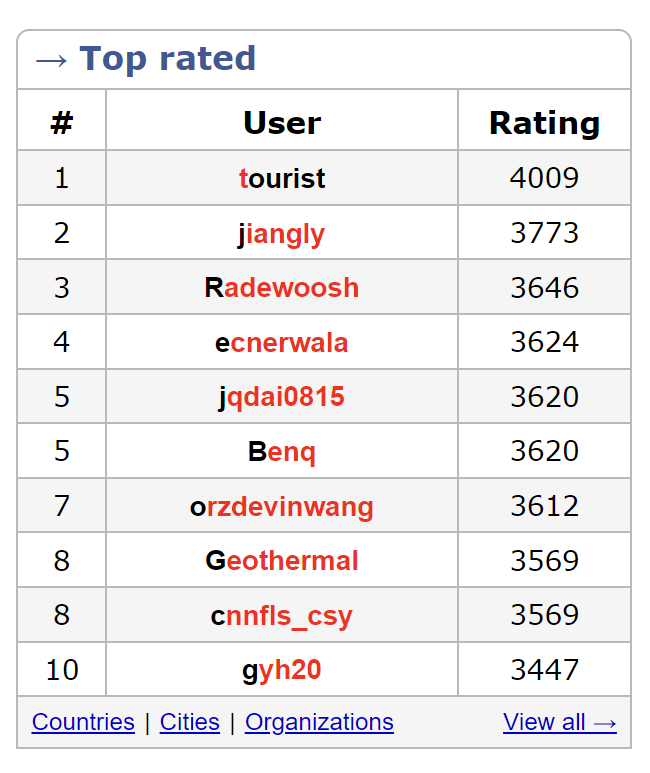
Humanity has prevailed (for now!)
I'm completely exhausted. I figured, I had 10h of sleep in the last 3 days and I'm barely alive.
I'll post more about the contest when I get some rest.
(To be clear, those are provisional results, but my lead should be big enough)
We’re presenting the first AI to solve International Mathematical Olympiad problems at a silver medalist level.🥈
It combines AlphaProof, a new breakthrough model for formal reasoning, and AlphaGeometry 2, an improved version of our previous system. 🧵 https://t.co/SYaLPSbIyj
NEET 2024 EXAM HAS BEEN A SCAM!
I will try to explain everything in the form of a thread. 🧵
Online registrations for NEET UG 2024 started on 9th Feb 2024 and were extended till 16th March.
Everything was well and good up to that point.
I gave Claude 3 the entire source of a small C GIF decoding library I found on GitHub, and asked it to write me a Python function to generate random GIFs that exercised the parser. Its GIF generator got 92% line coverage in the decoder and found 4 memory safety bugs and one hang.
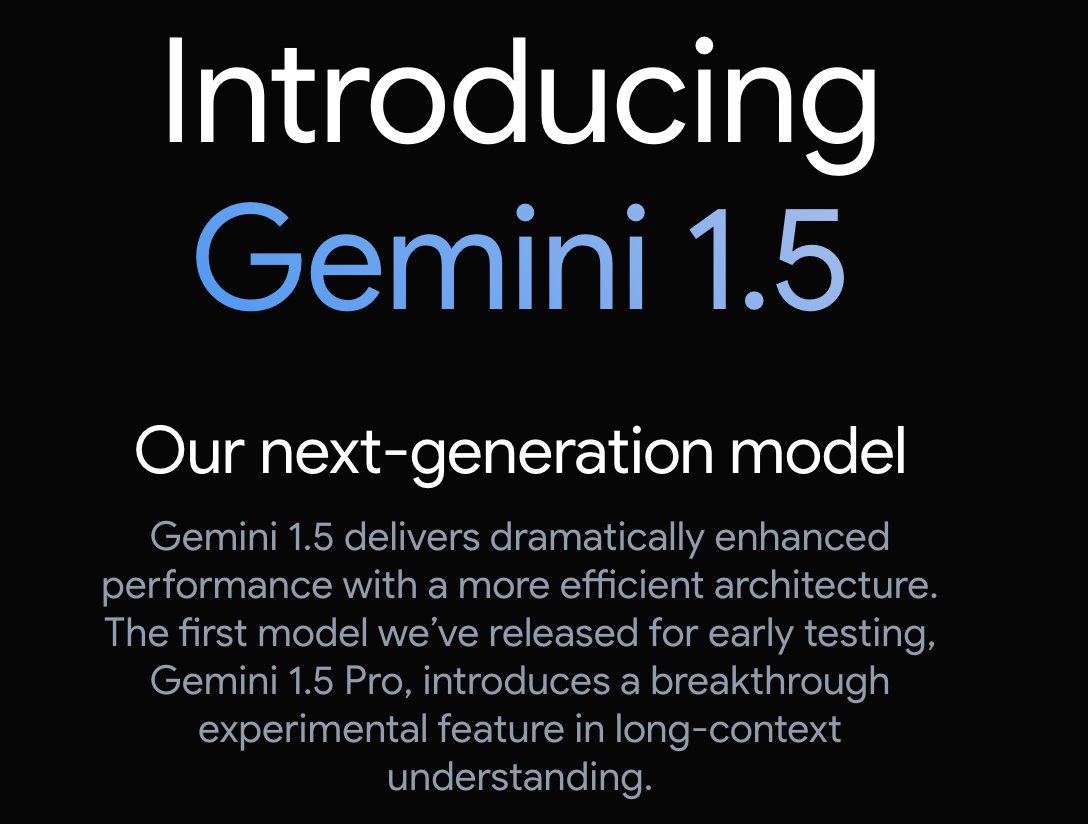
Gemini 1.5 Pro - A highly capable multimodal model with a 10M token context length
Today we are releasing the first demonstrations of the capabilities of the Gemini 1.5 series, with the Gemini 1.5 Pro model. One of the key differentiators of this model is its incredibly long context capabilities, supporting millions of tokens of multimodal input. The multimodal capabilities of the model means you can interact in sophisticated ways with entire books, very long document collections, codebases of hundreds of thousands of lines across hundreds of files, full movies, entire podcast series, and more.
Gemini 1.5 was built by an amazing team of people from @GoogleDeepMind, @GoogleResearch, and elsewhere at @Google. @OriolVinyals (my co-technical lead for the project) and I are incredibly proud of the whole team, and we’re so excited to be sharing this work and what long context and in-context learning can mean for you today!
There’s lots of material about this, some of which are linked to below.
Main blog post:
https://t.co/QAsDKXBdao
Technical report:
“Gemini 1.5: Unlocking multimodal understanding across millions of tokens of context”
https://t.co/CTzTHNDCdo
Videos of interactions with the model that highlight its long context abilities:
Understanding the three.js codebase: https://t.co/yq7d6OSD6c
Analyzing a 45 minute Buster Keaton movie: https://t.co/adyMgDYHoK
Apollo 11 transcript interaction: https://t.co/Pqvq3Eac1R
Starting today, we’re offering a limited preview of 1.5 Pro to developers and enterprise customers via AI Studio and Vertex AI. Read more about this on these blogs:
Google for Developers blog:
https://t.co/x73Vun0kVS
Google Cloud blog:
https://t.co/OlaTW6PYGn
We’ll also introduce 1.5 Pro with a standard 128,000 token context window when the model is ready for a wider release. Coming soon, we plan to introduce pricing tiers that start at the standard 128,000 context window and scale up to 1 million tokens, as we improve the model.
Early testers can try the 1 million token context window at no cost during the testing period. We’re excited to see what developer’s creativity unlocks with a very long context window.
Let me walk you through the capabilities of the model and what I’m excited about!
My understanding of AlphaGeometry:
1) Translate the problem statement to symbolic form.
2) Try to solve the problem with a symbolic solver.
3) If it didn't work, use a language model to suggest an "auxiliary point" somewhere, such as a midpoint, then go to (2).
To teach the model to generate good auxiliary points, they create a dataset of 100 million synthetic proofs. This is done by:
1) Generate random premises.
2) Find the closure of all statements that follow from the premises.
3) Sort them topologically, and pick a "downstream" statement. Then prune to only the necessary premises and steps.
If a point is only mentioned in the generated steps, and not in the selected premises, it becomes an "auxiliary point". 91% of the proofs generated this way don't have any auxiliaries, so they are used only for pre-training, whereas the "interesting" 9% are used for fine-tuning.
They compare with using "human heuristics" instead of the LLM for auxiliary point generation, and it gets only 18 IMO problems instead of 25 with the LLM approach.
Naturally the process can be slow, requiring hundreds of CPU workers to finish within a typical IMO 1.5 hour deadline.
Overall, super cool work. It's impressive they can get this kind of performance without training on any human proofs.
Introducing Gemini 1.0, our most capable and general AI model yet. Built natively to be multimodal, it’s the first step in our Gemini-era of models. Gemini is optimized in three sizes - Ultra, Pro, and Nano
Gemini Ultra’s performance exceeds current state-of-the-art results on 30 of the 32 widely-used academic benchmarks. With a score of 90.0%, Gemini Ultra is the first model to outperform human experts on MMLU.
https://t.co/yCsjfQKO9F
We are very excited to let you know that in early December, we will release the first trailer for the next Grand Theft Auto. We look forward to many more years of sharing these experiences with all of you.
Thank you,
Sam Houser
First claimed successful replication of LK-99
Accomplished by a team at the Huazhong University of Science and Technology and posted 30 minutes ago.
Why this is evidence:
The LK-99 flake slightly levitates for both orientations of the magnetic field, meaning it is not simply a magnetized piece of iron or similar 'magnetic material'. A simple magnetic flake would be attracted to one polarity of the strong magnet, and repelled by the other. A diamagnet would be repelled under either orientation, since it resists and expels all fields regardless of the polarity.
Caveats
There is no way to verify the orientation of the strong magnet in this video, also, there are yet to be published experimental measured values of this sample. Diamagnetism is a property of superconductors but without measured and verified data, this is just suggestive of a result.
Take-away
If this synthesis was indeed successful, then this material is easy enough to be made by labs other than the original research team. I would watch carefully for results out of Argonne National Lab, who are reported to be working on their own synthesis of a sample.
This overall corroborates two independent simulation studies that investigated the original Korean authors claim about material and crystal structure, and both studies supported the claims.
Lawrence Berkeley National Lab: https://t.co/1Blls3VcgL
Shenyang National Lab: https://t.co/I0NHAP3KsR
The attached video shows a small flake of their sample responding to an external magnetic field. I scroll through the video to skip to the relevant part.
original video credit to: @altryne