We've reset 5-hour and weekly rate limits for all users on Pro and Max plans.
We fixed an issue that caused some Claude Code sessions to spawn excessive parallel subagents, burning through usage faster than expected.
The Codex usage limits have been reset for all paid ChatGPT subscriptions. You should be back to 100% weekly and 100% hourly limits.
Let the tokens do incredible things today and have fun.
You might have heard the rumours, it's time to reveal what we are working on.
🗺️ An open world Middle-earth RPG.
⚔️ A new Kingdom Come adventure.
We’re excited to tell you more when the time is right.
#WarhorseStudios#Annoucement#lotr#KingdomComeDeliverance
Claude “Mythos” Leak: A New Capybara-Tier Model Signals a Massive AI Leap
- A major security lapse in Anthropic’s CMS exposed nearly 3,000 unpublished internal assets.
- The leak reveals a new model tier called “Mythos” (codename: Capybara), positioned beyond their current top-tier Opus models.
- Anthropic confirmed to Fortune that this model represents a “step change” in frontier AI capabilities.
- Compared to Claude Opus 4.6, Mythos reportedly delivers significantly higher performance in: software engineering, academic reasoning ,cybersecurity
- The model is powerful enough to raise serious near-term cybersecurity concerns, prompting cautious internal handling.
- Due to its massive scale and high compute cost, Anthropic is taking a slow, controlled rollout approach.
- Public release is currently paused, access is restricted to a small group of early users focused on cybersecurity testing and defense readiness.
- Alongside rumors of OpenAI's upcoming “Spud” model, this leak hints that 2026 could bring major generational jumps in AI systems.
The spread is visible to everyone. But capturing it requires private RPC nodes, Jito bundles, custom transaction routing, and sub-400ms.
Most people see this thread and think ‘I’ll build my own bot this weekend before realizing the hard part was never the strategy.
We spent 4 months and 50,000+ lines of code building this infrastructure so you don’t have to.
We already built it and it’s free to use.
I don’t like debate—because you can never wake someone who is pretending to sleep.
That said, clarifying the facts matters. For the record:
1.BTC began declining roughly 30 minutes before the USDe depeg.
This exactly supports the earlier point: the initial move was a market shock.
Absent the USDe leverage loop, the market would likely have stabilized at that point. The cascading liquidations were not inevitable—they were amplified by structural leverage, as explained previously.
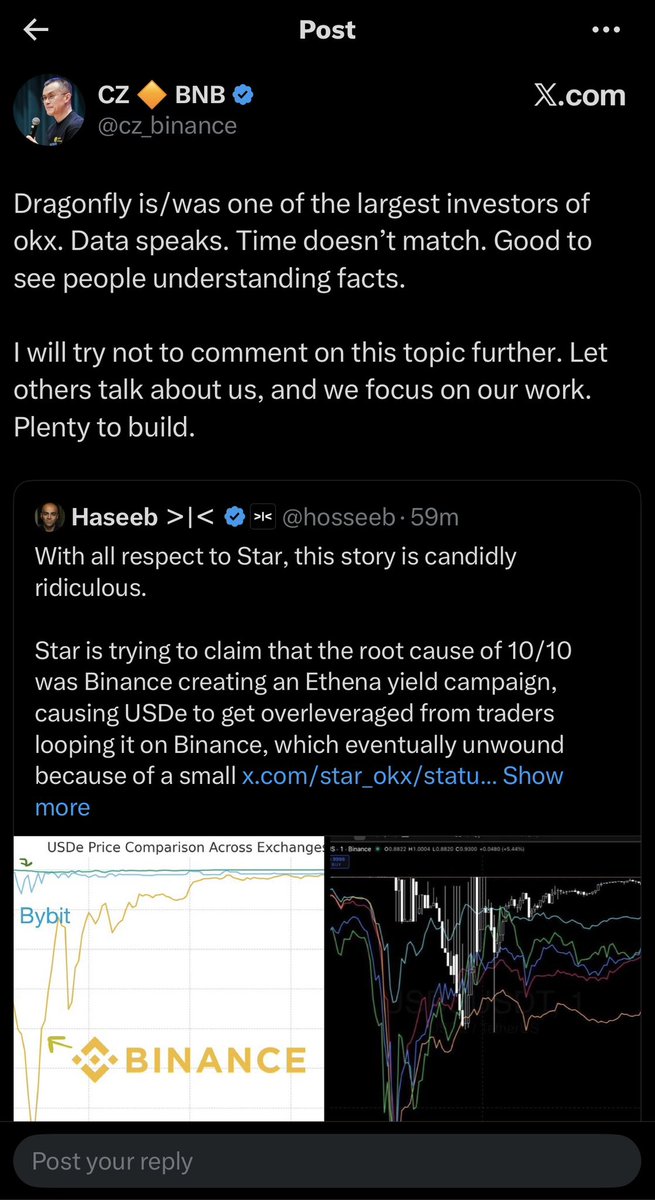
2.Dragonfly has never been an investor in OKX—neither a minor nor a major one.
In fact, OKX invested in Dragonfly before @hosseeb joined the firm.
Separately, one partner’s previous fund (not Dragonfly) invested in OKX. These are distinct and easily verifiable facts.
3.I will not spend further time on this topic.
The facts are clear. I do not intend to engage in extended debate.
No complexity. No accident.
10/10 was caused by irresponsible marketing campaigns by certain companies.
On October 10, tens of billions of dollars were liquidated. As CEO of OKX, we observed clearly that the crypto market’s microstructure fundamentally changed after that day.
Many industry participants believe the damage was more severe than the FTX collapse. Since then, there has been extensive discussion about why it happened and how to prevent a recurrence. The root causes are not difficult to identify.
⸻
What actually happened
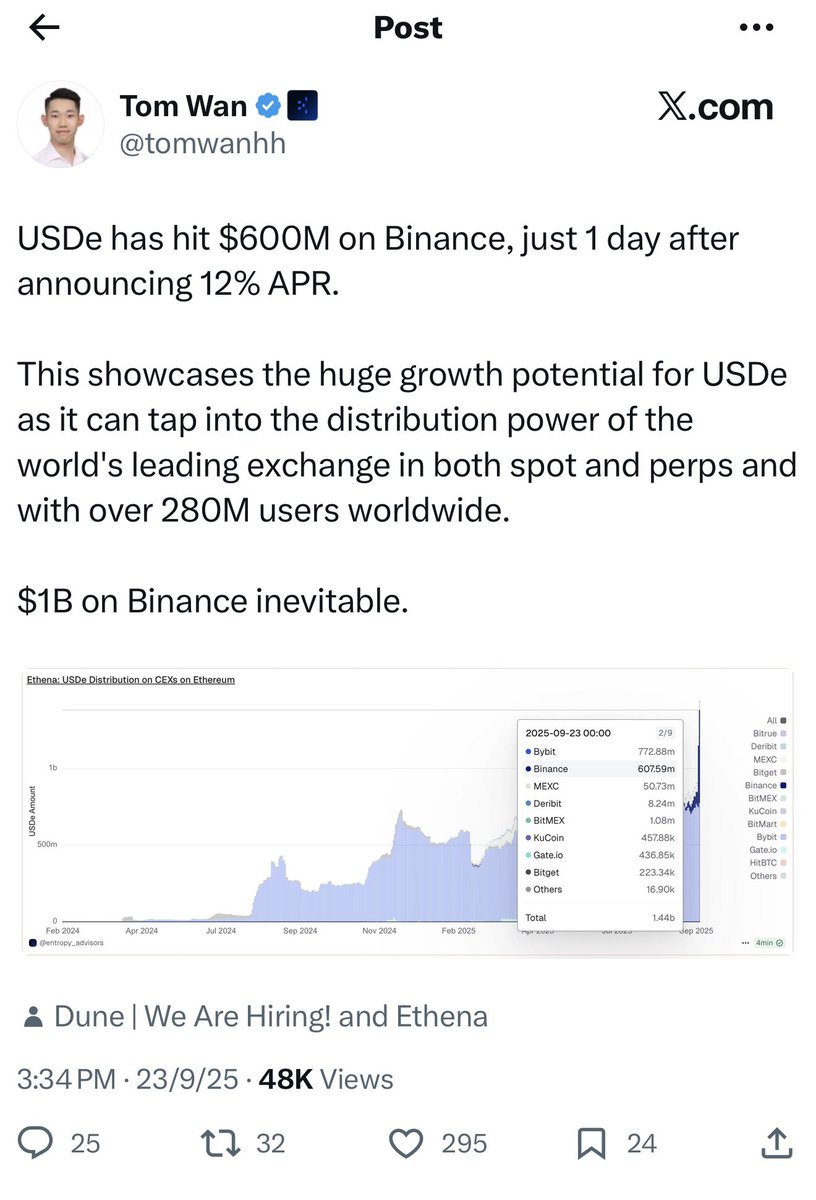
1.Binance launched a temporary user-acquisition campaign offering 12% APY on USDe, while allowing USDe to be used as collateral with the same treatment as USDT and USDC, and without effective limits.
2.USDe is a tokenized hedge fund product.
Ethena raises capital via a so-called “stablecoin,” deploys it into index arbitrage and algorithmic trading strategies, and tokenizes the resulting fund. The token can then be deposited on exchanges to earn yield.
3.USDe is fundamentally different from products such as
BlackRock BUIDL and Franklin Templeton BENJI, which are tokenized money market funds with low-risk profiles.
USDe, by contrast, embeds hedge-fund-level risk. This difference is structural, not cosmetic.
4.Binance users were encouraged to convert USDT and USDC into USDe to earn attractive yields, without sufficient emphasis on the underlying risks. From a user’s perspective, trading with USDe appeared no different from trading with traditional stablecoins—while the actual risk profile was materially higher.
5.Risk escalated further as users:
•converted USDT/USDC into USDe,
•used USDe as collateral to borrow USDT,
•converted the borrowed USDT back into USDe,
•and repeated the cycle.
This leverage loop produced artificial APYs of 24%, 36%, and even 70%+, widely perceived as “low risk” simply because they were offered by a major platform. Systemic risk accumulated rapidly across the global crypto market.
https://t.co/IK2gW4xUOP that point, even a small market shock was sufficient to trigger a collapse.
When volatility hit, USDe depegged quickly. Cascading liquidations followed, and weaknesses in risk management around assets such as WETH and BNSOL further amplified the crash. Some tokens briefly traded near zero.
The damage to global users and companies—including OKX customers—was severe, and recovery will take time.
⸻
Why this matters
I am discussing the root cause, not assigning blame or launching an attack on Binance. Speaking openly about systemic risks is sometimes uncomfortable, but it is necessary if the industry is to mature responsibly.
I expect there may be significant misinformation and coordinated FUD directed at OKX in the near future. Even so, speaking honestly about systemic risk is the right thing to do—and we will continue to do so.
As the largest global platform, Binance has outsized influence—and corresponding responsibility—as an industry leader. Long-term trust in crypto cannot be built on short-term yield games, excessive leverage, or marketing practices that obscure risk.
The industry needs leaders who prioritize market stability, transparency, and responsible innovation—not a winner-take-all mentality where criticism is treated as hostility.
Crypto is still early.
What we choose to normalize today will determine whether this industry earns lasting trust—or repeats the same mistakes again.
@BoraOzkent Yaratıcılığını ekstra geliştirmesi için Minecraft (Yaratıcı Mod) veya arabalara sevgisi varsa yarış oyunlarına bakmanızı öneririm. O yaşlarda futbol veya daha agresif oyunlar gereksiz ve riskli olur.
Bu post Türkiye'den Dünya'ya yardım çığlığıdır.
Ben 15 yaşında Roblox’ta kendi kendime para kazanan birisiyim.
1 yıl 5 ay 23 gündür VPN kullanıyor, DPI ile uğraşıyor, bir sağa bir sola savruluyorum.
Bununla birlikte müşterilerimle iletişim kurduğum Discord’a ve PayPal, Wise, Stripe gibi ödeme hizmetlerine bile erişemiyorum.
Binlerce dolar müşteri kaybettim bu yüzden dolayı.
Kendime bir söz verdim. Para kazanmaya devam edeceksem, reşit olduğum gün Türkiye’den kaçacağım.
Gideceğim demiyorum, kaçacağım.
Bunları bana ve benim gibi insanlara yaşattığınız için teşekkür ederim.
To understand why all the $S in the hacker wallet is set to a ZERO, I took a look at @SonicLabs official github (link in comment).
It is the newly implemented security policy where the foundation has authority to freeze a certain wallet account. There is a new smart contract written 2 hours ago with a 'freeze method'.
This policy happens at the native chain layer. I only affects native $S, but not other ERC20 tokens. That is why $stS and others still remain. Can anything be changed afterwards? I don't know.
here is the new function added.