

Top Tweets for #DisruptionIsNow


⚡️The Big Unstoppable Transition to EVs⚡️
No longer are EVs a niche market car, yet just 10 years ago they were.
Just think about this for a moment, 10 years ago the EV pool was small and so were their ranges. The infrastructure was just about mobilising and in the winter, heating was sometimes forfeited in order to get home.
Look where we are now. Every manufacturer, more or less, is onboard with EVs from Dacia to Ferrari, but also there are manufacturers who until recently were unknown. But what is clear here is the determination to attract market share in this segment to the detriment of ICE sales.
Gateway drug cars like hybrids and PHEVs are also on the rise indicating more electrification and not less.
What we can now see is that the world is in the midst of an enormous market disruption event similar to how the motorcar disrupted the horse.
The FUD that the media spouted then is almost a copy and paste of the FUD EVs get daily from our media now.
What is striking about a market disruption is that seldom do the incumbents triumph. Take a look at Nokia who had the mobile phone market cornered until not-a-mobile-phone company Apple introduced the iPhone.
Much FUD from the media and Wallstreet did nothing to stop the unstoppable and a new era of the smart phone arrived with legacy companies like Nokia and BlackBerry collapsing who, ultimately, failed to adapt.
Kodak didn’t adapt to the digital age.
Blockbusters didn’t adapt to streaming services.
Legacy car manufacturers have failed to adapt at pace and with compelling products. Some tried to slow and frustrate the transition to EVs, they lobbied politicians, their employees went on strike, or their products are not compelling enough in this new digital car era. EVs have to be built differently from ICE cars to make them compelling.
Investments during the 2010’s when debt was cheap went into producing niche ICE models, crossovers, coupe crossovers, convertible crossovers, big SUVs, micro-SUVs, 4-door coupe’s - every segment and sub-segments where the niche products were found, but what was lacking was a serious investment in EVs.
They could see the rise but did not think for a moment it would end here. Their worse case scenario - the disruption really is only just getting started now and not ending.
We’ve heard alarm bells ringing from VW, Mercedes, Stellantis, Ford, General Motors, Polestar and more who are offering profit warnings.
But why does a market disruption affect incumbents so much?
The answer is new, better and more compelling products arrive. They may be expensive at first, but over time costs reduce and more people benefit who advocate them to their peers.
We’re now approaching price parity with ICE cars. Some are there already and some are not far off.
At the same time the incumbents fail to recognise and embrace a disruption happening until the alarm bells start ringing. And this is where we’re at now.
What happens next with this disruption actually accelerates as more compelling products arrive and owning an ICE car is comparatively expensive and lacking the key features their EVs can offer, like V2L or V2G, cheap fuel, low maintenance costs and super reliability.
Compelling EVs now entering the used car market en masse is where the disruption really is hotting up. Affordable EVs that are cheaper to run and maintain are now accessible to many more people. The trickle down effect is well underway.
It could be said that the warning signs are a maturing EV market, a maturing charging infrastructure and hurdles to adoption being removed one-by-one.
It won’t be long before folks without driveways will have little problem charging publicly and for less than liquid fuels.
Mass adoption is just 5-10 years away as my best estimate.
Let’s hope we see legacy manufacturers rising to the challenges ahead and not resisting it or frustrating it.


Tyler Perry Raises Alarm on #AI, Puts $800M Studio Expansion on Hold 😐
The actor, filmmaker and studio owner is raising the alarm about the impact of the tech
#DisruptionIsNow 🤖
https://t.co/YgO1T9henI

Warning: VERY long post
Warning: VERY old article...written in August 2020
Reward: Still VERY relevant, perhaps even more than it was back then.
The Valuers Dilemma: Understanding the Tesla Stock Valuation
This morning I watched a fascinating debate on the YouTube channel “Tesla Daily” between Rob Maurer and David Trainer. Rob is a self-confessed Tesla Bull, a columnist on The Street who hosts this excellent and influential YouTube Channel. (full disclosure – I am a subscriber and Patreon supporter of his). David is a respected, long time Wall Street analyst, the founder and CEO of New Constructs, an independent financial analyst, and a self-confessed fan of the Tesla car and its founder Elon Musk. However, in contrast to Rob, David has a very sober view of the current stock price, considering it highly speculative. His firm has authored a note warning that Tesla is “the most dangerous” stock for the investors with fiduciary responsibility.
What struck me as I listened to the debate was that both Rob and David appear to talk past what I consider to be the root cause of the current Tesla stock value. Elon Musk is famous for insisting on looking at every problem from first principles – and even more famous for being so successful in the application of those principals. Let’s follow Elon’s dictum here to learn why Tesla’s stock has reached such stratospheric levels and evaluate whether it is likely to remain as high or even grow further.
In the matter of the Tesla valuation, I believe the first principle that governs is the Innovators Dilemma, which for brevity we will refer to as InDi. It underpins the entire value proposition represented by Tesla, not just in the gigantic global automotive market, in transportation in general, and perhaps – ultimately even more importantly – in the global energy markets.
InDi is not well understood by the analysts, and is seldom accorded significant value, which is perplexing as it is an extremely well understood process. It was formulated by Clayton M. Christensen while Professor of Business Administration at the Harvard Business School and popularized by him in many writings. Christensen writes:
“When disruptive technologies emerge, dominant, well-run companies often stumble. These companies tend to use the same sound business judgment that has guided them through previous changes, including:
· Listening to what current customers want
· Providing more and improved versions of what customers want
· Investing in projects that promise the highest returns
However, in the face of disruptive innovations, these strategies don’t produce the same results. This is the innovator’s dilemma: The approaches that lead to success in adopting most innovations lead to failure when confronting disruptive innovations.”
Elucidating on those key finding, Wikipedia adds the following woes to the incumbent’s situation, (each of which readily identifiable with the OEMs!):
· Small markets struggle to impact an incumbent's large market
· Disruptive technologies have fluid futures, as in, it is impossible to know what they will disrupt once matured
· Incumbent Organizations' value is more than simply their workers, it includes their processes and core capabilities which drive their efforts
· Technology supply may not equal market demand. The attributes that make disruptive technologies unattractive in established markets are often the ones that have the greatest value in emerging markets
On the other hand, consider the position of the challenger:
· They develop the disruptive technology with the 'right' customers. Not necessarily their current customer set
· They place the disruptive technology into an autonomous organization that can be rewarded with small wins and small customer sets
· They fail early and often to find the correct disruptive technology
· They allow the disruption organization to utilize all of the company's resources when needed but are careful to make sure the processes and values were not those of the company
It is easy to recognize the role of Tesla in these qualities. Finally, Wikipedia points out:
· Disruption is a process, not a product or service, that occurs from the fringe to mainstream
· Originate in low-end (less demanding customers) or new market (where none existed) footholds
· New firms don't catch on with mainstream customers until quality catches up with their standards
· Success is not a requirement and some business can be disruptive but fail
· New firm's business model differs significantly from incumbent
Success, in simple terms, Christensen says, is “correlated with a business model that is unattractive to its competitor". This is brilliantly true in the case of Tesla vs. OEMs.
A telling example of the business model problem of incumbents becomes apparent in the YouTube debate when Rob Maurer points to the direct sales model of Tesla, capturing the profit margin that would otherwise go to the dealer. David Trainer argues that the dealership network of the OEMs is a strength, allowing the OEMS “concentrate on their main business”, providing them with broad distribution.
What eludes him is that this same dealer network becomes uneconomic in an EV world, as the service and spare parts business on EVs are not 10% of that of an ICE vehicle. In simple terms, the dealership can only be run at a loss, and Tesla’s online sales are a significant advantage. Early evidence is that OEMs have been unable to persuade their dealership network to sell EVs. The dealership network is at the core of the OEM business model that would be legally, culturally and financially impossible to voluntarily sever; yet with it, the OEM EV future is probably doomed.
Another example of the business model problem is the “deep supply chain” mentioned by Trainer as a significant advantage to OEMs. This may be the most serious problem for the OEM business model. It is this supply chain that inhibits the development of a vehicle, with an integrated battery/drivetrain/HVAC/computer system, a vitally necessary step to creating a competitive EV offering (and the reason for the failure of so many “Tesla Killers” to date).
The key intellectual property that OEMs retain is their internal combustion engine designs, possibly the only component – apart from the sheet metal – that they manufacture in-house. Ironically this is the technology that is of least value – in fact no value – in this new market. To compound the problem, the engine is not just a matter of replacing an internal combustion engine with an electric motor, and simply adding a battery in the stead of a gas tank. It is a highly complex problem of redesigning the drivetrain and vehicle into a single, comprehensive whole.
Depending on a supply-chain network to provide this does not permit the iterative design/development necessary to rapidly evolve successful solutions to the very difficult problem.
In any case, large OEMs are not given to iterative design/development. This is a longer discussion, and perhaps key in differentiating Tesla from the incumbents. It is sufficient to point to the continuing and growing technological leadership of the company’s vehicles over the incumbents. It is instructive that the industry has not yet been able to manufacture a car to compete with the Tesla Model S, first sold seven year ago.
One could cite many other startingly clear examples of InDi in the Tesla v all the others debate. This is also true of Tesla’s work in the energy markets, but I won’t do that here, it is all well documented, and Rob is probably more of an expert than I am in this field. Instead I want to return to the question raised at the outset: the problem of valuation. How does one value stocks of InDi companies, stocks that David Trainer is sure to label, as he has with Tesla, as the “most dangerous” of all stocks.
The answer, of course, is “with great difficulty.” Aswath Damodaran, the “Dean of Valuation”, NYU professor famous for valuation methodology, talks about his struggle – and consistent failure – to value Amazon, that well-known bookseller (https://t.co/zISY8yq8Yt)
Oh yes, of course I know Amazon is not a bookseller. But in the early days we were told – by professors of valuation – that Amazon would have to sell all the books sold in the world to justify its valuation. Amazon taught us several important points. It proved the Christensen principles “Disruptive technologies have fluid futures”, and “Disruption is a process, not a product or service, that occurs from the fringe to mainstream”, and probably a few more besides. What is more important about the Amazon example, is the admission – in the above cited article – made by Damodaran of the extreme importance of this fact:
“Bezos …telling his stockholders that if Amazon built it (revenues), they (the profits and cash flows) would come. In all my years looking at companies, I have never seen a CEO stay so true to a narrative and act as consistently as Amazon has, and it is, in my view, the biggest reason for its market success.”
And further:
“I have consistently under estimated not only the innovative genius of this company, but also its (and its investors') patience.”
So here we arrive (finally) as my thesis. Like Jeff Bezos, Elon Musk is an innovative genius, who has defined clearly his objectives, methods and objectives. He has created an innovative, rapid learning machine to create products with enormous market appeal and success, in gigantic global markets, and delivered by a highly productive business model. The firm has found its stride in producing and delivering in mass and is in the process of demonstrating its ability to scale. It has built and successfully brought to production in a record time (at several times the speed of the legacy OEMs) a massive factory in China. It is in the process of – simultaneously – building three gigantic factories across the world and is demonstrating a confident touch in those buildouts. And, to top it all off, Tesla is finding ways to drastically reduce costs of manufacture (https://t.co/Glh1d9LQ5y).
All Good. Rob aced these points. Here is the miss. Tesla DOES NOT INTEND TO MAKE PROFITS in the foreseeable future. Tesla has said in many fora that is intends to minimize profits. Elon said in the last conference call that the objective to show no more than 1% or so of profits. He, like Jeff Bezos in the quote above, understands that the InDi is focused on market share, not profitability. Tesla is focused on and is on a clear track toward dominance of the Automobile market. And I confidently predict that Tesla’s shareholders, like Amazon’s before them (many of them, after all, are the same people and institutions) will be quite content with that.
Tesla already has a huge price advantage over its competition. Critics - David Trainer amongst them – do not yet realize that Tesla will shortly no longer be a “premium” priced vehicle – Tesla is persistently driving down the price of its vehicles, and their cars are rapidly approaching price parity with Toyota, even while their automotive gross margins are trending higher than the OEMs. Tesla has demonstrated significantly better price/value against their competition.
Why? Because of Wrights Law (The cost of a unit decreases as a function of the cumulative production - https://t.co/w1f2rXpPBD) is on Tesla’s side. They have 1 million EVs behind them. No other OEM approaches them, and they will deliver half a million vehicles this year, 5 times more than the nearest competitor, over a million next year, and on and on. VW hope to reach 1.5 million vehicles by 2025. At that point, Tesla are targeting to have delivered over 8 million vehicles (and have plants already built or in building stages) to enable them to deliver those numbers. Tesla’s production cost should be dramatically lower than that of other OEMs. (ARKinvest, a fund manager dedicated to disruptive innovation brought Wright’s Law to my attention - https://t.co/b1QYqcV7Pm)
Tesla could translate this advantage into profitability, but the point – according to Elon and the company – Tesla won’t. Tesla will drive the cost of the car down inexorably, while at the same time dramatically increasing the efficiency of their capital expenditure (https://t.co/8HQWM7qROy)
So, throw away your spreadsheets. All those CPAs and valuation specialists carefully compounding profitability and cash flow – its not going to happen. Prices are going to be driven down, free cash is going to be aggressively invested into plant, charging infrastructure, service centers, AI chip development for Autonomy, supercomputers for AI training, Powerwalls, Solar Roof, Autobidder energy trading platform, and on and on. But no profits, and no free cash flow.
Rob and David both rely on the spreadsheet method and apply a predetermined formula to arrive at a discount of some variation of combination of the profits/cash flow of a firm for a given (presumed) scenario. In this they are joined by the Dean of Valuation, Aswath Damodaran.
Damodaran should have learned from his Amazon experience. In the case of Amazon, he regrets selling his shares in 2012, and missing the huge run that stock has enjoyed since. Nonetheless, in January of this year he once again applied his spreadsheet formulas, this time to his investment in Tesla, resulting in him selling his stock at $640. He said:
“The momentum is strong, and the mood is delirious, implying that Tesla’s stock price could continue to go up. That said, I am not tempted to stay longer, though, because I came to play the investing game, not the trading game, and gauging momentum is not a skill set that I possess. I will miss the excitement of having Tesla in my portfolio, but I have a feeling that this is more a separation than a permanent parting, and that at the right price, Tesla will return to my portfolio in the future.”
In this, I believe he is wrong. I don’t believe this is a “story” stock, nor is it a “momentum” stock. It will certainly fluctuate very widely over time, given the emotions of its supporters and detractors. But, now that Tesla has demonstrated its ability to execute, it is highly unlikely that it will return to the “right price” according to his formulations.
Tesla today, like Amazon in the early 2000s, is a company that has proven its ability to both innovate at the extreme, and to execute. It truly deserves the Innovators title. It is on a clear path to dominance – not just in the EV market – but in the Auto market, and beyond that in the energy market.
What is missing in the Rob, David, and Aswath’s calculus, is the formula that values an Innovator that can disrupt large, established markets. We must re-examine the arc of Amazon, Google, Microsoft (in the early Gates years, and yet again, now), Apple (in the Jobs years) and the sparse number of firms that have demonstrated the characteristics of Innovators. The characteristics are not ephemeral – they take some years to evidence themselves – and they have clear markers. They do not occur frequently, certainly not as frequently as Venture Capital sponsors would have us believe, given the number and frequency that they berth their “Unicorns”. But for legitimate disruptors the appropriate valuation is a function of their Total Addressable Market (TAM).
The ability to access those firms in the public markets is a rare privilege…they should not be forfeit by investors – even those that consider themselves “investors and not traders”, or those with fiduciary responsibilities – for the wrong reasons.
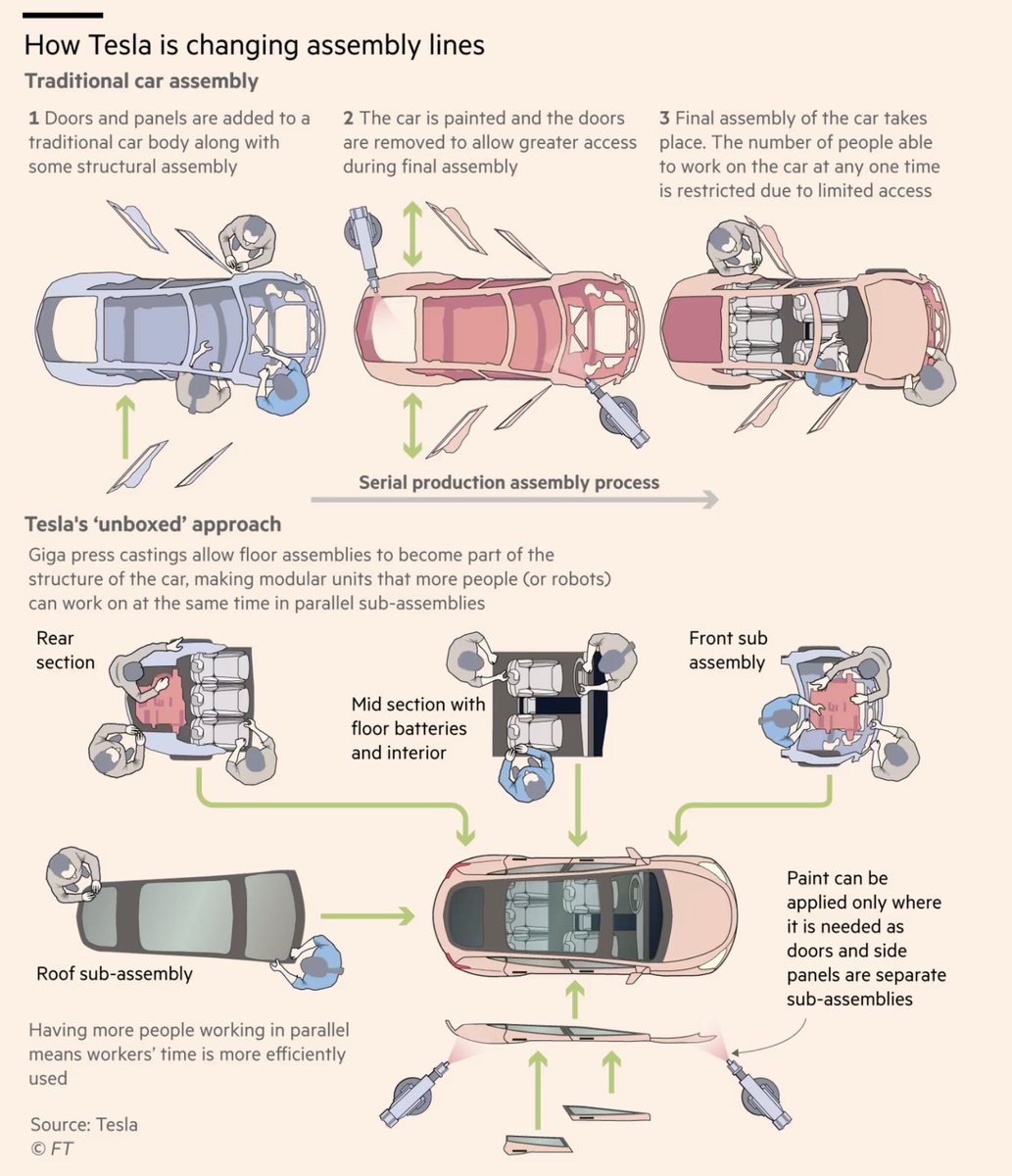
With its unboxed manufacturing process, @Tesla is about to render the @Toyota production system obsolete
https://t.co/TdQTLzLoSp
🚗🔋⚡️🤖🤩👏🏻
#DisruptionIsNow


I think holding on to a wrong assumption is creating a split narrative for EVs:
An assumption of many has been that when traditional automakers decide to make EVs it will be a swift transition and they will dominate with their expertise and scale.
1) But now traditional automakers are saying it's too hard to make affordable EVs and are delaying plans.
2) At the same time, BYD and Tesla are demonstrating that it is possible to make affordable EVs profitably.
I would look at points 1 and 2 and say the assumption is incorrect.
But, if you still hold the assumption to be true then the explanation people are forced into is that EVs aren't ready for prime time because if they were then the traditional automakers would be succeeding with them. As you can see that's circular and bad logic.
In my opinion, disruption is happening.
2023: the end of @volkswagen #FossilCars sales in Norway 🇳🇴
Be prepared to see many more events like this, all over the world 🌍
#DisruptionIsNow
#FossilCarsDeathWatch 🦤
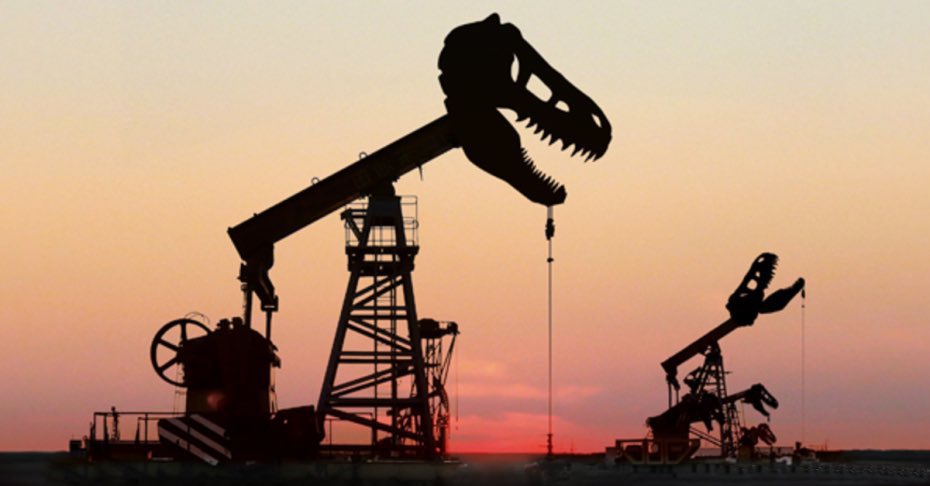

Volkswagen will from Oktober 21st 2023 stop sales of ICE cars in Norway 🇳🇴
This is the 75th anniversary for VW’s start in Norway.
«It may seem strange to mark the milestone by removing model icons from our portfolio, but this has been an ambitious and important investment over time. The purpose has been to drive forward changes that we believe are of crucial importance, says Ulf Tore Hekneby, managing director at Volkswagen importer Harald A. Møller AS»
Se the press release here: https://t.co/onwq0UAmZm
Electric plane battery unveiled by CATL achieves staggering 500 Wh/kg energy density
✈️🔋⚡️🤩👏🏻
#DisruptionIsNow https://t.co/e1MJPbQ0YZ
I had grasped the amount of issues arising from selling more unprofitable #EV while selling less profitable #FossilCars while having to invest heavily in the transition but this is way worse than I imagined 🤯
#DisruptionIsNow
#FossilCarsDeathWatch 🦤

DOUBLE DISRUPTION IN ICE INDUSTRY!
Let's say you're an OEM planning to make 50-50 ICEV-EV by 2025, 2028, 2030 - you name the date
Till now I thought you're screwed bc demand will go full EV soon, but even disregarding demand fall, you're still screwed bc of DOUBLE DISRUPTION
1/
Tesla on Track to Become The World’s Largest Company
☀️🏠⚡️🔋🚗🤖🤩👌🏻
#Solar #Storage #EV #Robocars #AI
#PaceOfInnovation
#DisruptionIsNow
https://t.co/nLXb17c3Or
Tesla now has more than 600 European Supercharger sites and 6,000 stalls
🚗🔋⚡️🔌🤩👌🏻
#EV #DisruptionIsNow https://t.co/Yr6UTgx2MX
Just saw a 100% electric @Volkswagen #eCrafter operated by @Chronopost
🚚🔋⚡️📦🤩👍🏻
#EV #DisruptionIsNow

There are clearly a few differences in #EV & #PHEV penetration throughout the world 🌎🌍🌏🤔
#DisruptionIsNow
#FossilCarsDeathWatch 🦤

#DisruptionIsNow 🤩👍🏻

New narrative in the auto industry is that they have a software problem. Same as Nokia ten years ago. “We just need to invest in software to get back in the game”. Unfortunately this strategy failed; Nokia disappeared (in smartphones). Why? Thread below. $TSLA $BMWYY $DMLRY etc

AND HERE’S THE REALLY INTERESTING QUESTION THAT NOBODY IS ASKING :
“Why are the shares of Legacy Automakers not worth more ?”
Let’s think about it . . .
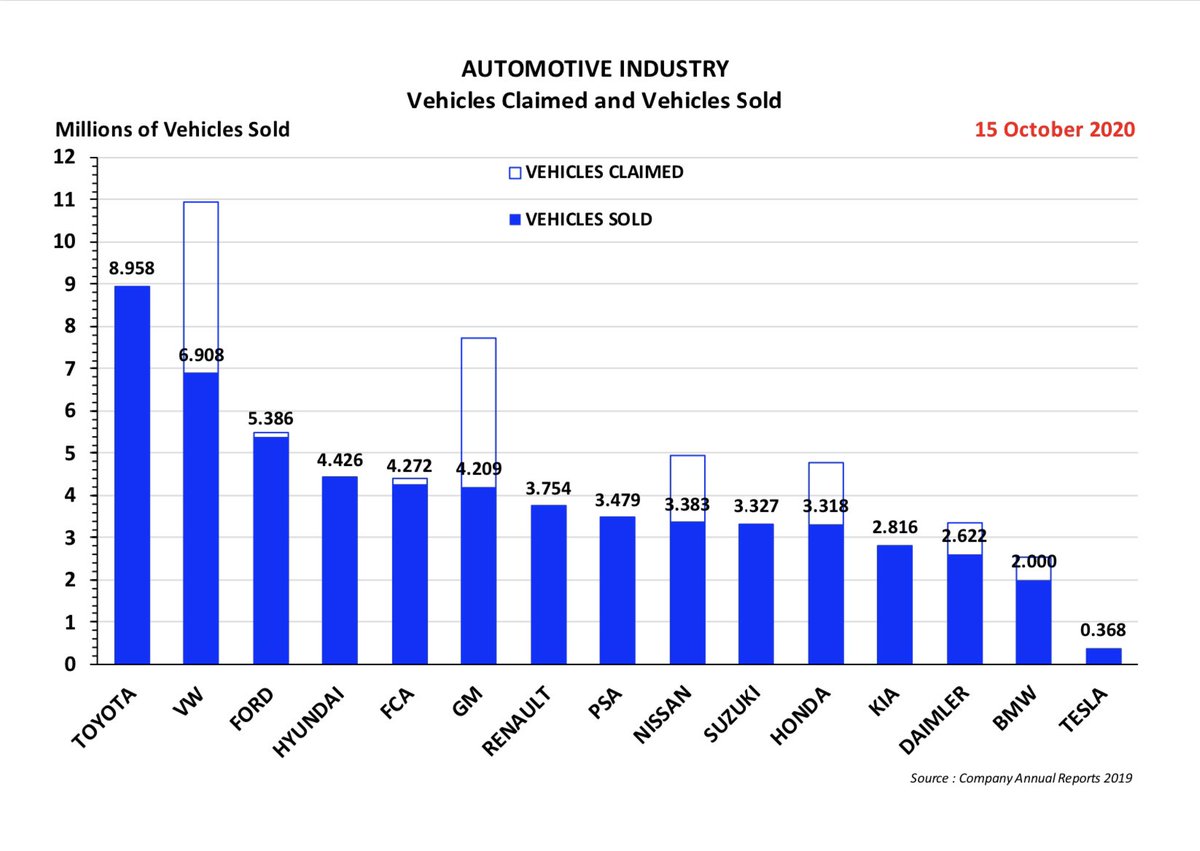
1. Let’s say you are selling 4 million automobiles every year
2. The Average Transaction Price in the USA is over $39,000
Tesla Model 3 ‘refresh’ goes live with 353-mile range, Überturbine wheels, powered trunk, and more
🚗🔋⚡️🤖🤩👍🏻
#MostImportantCarEver
#DisruptionIsNow
#EV #RoboCars https://t.co/PO3Y2LsNVo
En Allemagne, les ventes de voitures électriques atteignent un niveau record
🚗🔋⚡️🤩👍🏻
#EV #DisruptionIsNow https://t.co/dux2outXrN
Ford and GM's $302 Billion Debt Crisis (Bankrupt Soon?) 📉💥🤔
#DisruptionIsNow
https://t.co/RL9eGplmi4
Tesla Model S Plaid may be required to use a parachute when racing in drag strips
https://t.co/qQSiOrO9SB
🏎🔋⚡️🤖🪂🤪👍🏻
#DisruptionIsNow

Last Seen Hashtags on Sotwe
escapefromplaytime
Seen from United States
暴露癖
Seen from United States
verity
Seen from Germany
mobverity
Seen from Germany
losangelesdemaico
Seen from Guatemala
minichatt ()**** filter:videos
Seen from United States
mgai
Seen from United States
ntr
Seen from Brazil
김호중_리얼로드버라이어티_MBN_가보자GO_3월16일_첫방송
Seen from United States
anxiouspandaa(())(())(())(())
Seen from Netherlands
Most Popular Users

Elon Musk 
@elonmusk
241.5M followers

Barack Obama
@barackobama
118.8M followers

Cristiano Ronaldo
@cristiano
114.5M followers

Donald J. Trump
@realdonaldtrump
111.8M followers

Narendra Modi
@narendramodi
107.1M followers

Rihanna
@rihanna
98.7M followers

NASA
@nasa
92.3M followers

Justin Bieber
@justinbieber
91.8M followers

KATY PERRY
@katyperry
90M followers

Taylor Swift
@taylorswift13
84M followers

Lady Gaga
@ladygaga
75.5M followers

Virat Kohli
@imvkohli
73.5M followers

Kim Kardashian
@kimkardashian
70.9M followers

YouTube
@youtube
68.8M followers

Neymar Jr
@neymarjr
66.5M followers

Bill Gates
@billgates
65.3M followers

Selena Gomez
@selenagomez
63.1M followers

The Ellen Show
@theellenshow
62.2M followers

CNN
@cnn
61.7M followers

X
@x
60.7M followers