

Top Tweets for #OpenInfrastructure

OnRe Finance shared thoughts on how asset management is being rebuilt from the ground up.
The core idea is simple. Old models are fading. New platforms are being built on open rails where risk is verifiable, capital is transparent and onchain, and real cash flows from regulated assets such as reinsurance are connected to crypto through licensed structures.
They are not just hyping RWAs. They are pointing to a structural shift from closed end funds toward public, audited, and transparent models. This transition is already underway, and OnRe with ONyc positions itself at the center of that movement.
I appreciate the calm and confident tone. No claims about being the best in the world. Just a clear explanation of where the industry is heading. In 2026, as institutional capital becomes more active onchain, this narrative feels especially timely.
@onrefinance
#OnRe #ONyc #RWA #OpenInfrastructure


Why “Just Running a Node” Is the Wrong Mental Model for OpenMind
In most networks, running a node is an operational task. You install software, keep it online, and make sure it doesn’t crash. The value comes from uptime. With OpenMind, that framing feels incomplete.
After interacting with the system and debugging real deployment issues, it became clear that OpenMind nodes are closer to participants than passive workers. The software behavior suggests intent: nodes are expected to observe, process, and potentially interact with their surroundings.
This is subtle, but important. It explains why certain dependencies exist and why some failures feel surprising if you approach OpenMind like traditional infrastructure. The project seems less interested in raw scale and more interested in meaningful placement.
Where a node runs, what it can perceive, and how it’s configured all matter. Treating it like a generic container misses that point.
That’s not a common design choice, and it’s one worth paying attention to.
@OpenMindNetwork #Research #AIAgents #OpenInfrastructure

Turning latency into throughput in decentralized inference.
When models are sharded across home machines, universities, and data centers, inference is no longer compute-bound — it’s network-bound.
Each token becomes a distributed protocol, and GPUs spend more time waiting than working.
Parallax, built within the open infrastructure vision of @Gradient_HQ, introduces Decentralized Speculative Decoding (DSD) to break this latency wall.
Instead of synchronizing on every token, DSD:
• Verifies multiple speculative tokens per round (batch settlement)
• Applies strict checks only to semantically important tokens (adaptive verification)
The result: fewer global synchronizations, higher GPU utilization, and tighter tail latency — up to 2.6× end-to-end speedup on tasks like HumanEval and GSM8K, with accuracy preserved.
No retraining. Model-agnostic. Built for real, heterogeneous networks.
This is what scalable open intelligence looks like when latency is treated as something to optimize, not accept.
#ThinkOpen #DistributedAI #OpenInfrastructure


Tagging a friend who should definitely look into @IOPn_io.
I’m inviting you because I know you care about building, not just speculating. IOPn is focused on open participation, verifiable contribution, and infrastructure that actually empowers users instead of locking them in.
This is the kind of network that rewards long-term thinkers and active contributors. Feels early, and that’s exactly why it matters.
#IOPn #Web3 #OpenInfrastructure #BuildInWeb3


Ritual is not about a single product or a predefined use case. It is about the feeling of solid ground under your feet when you build something new and know that the foundation will not fail you.
Here, computation stops being cold and distant. It becomes honest. You do not ask for permission, you do not rely on someone’s goodwill, and you do not guess what is happening behind closed servers. Everything works openly, verifiably, and exactly as promised.
@ritualnet is built for people who think ahead. For those who do not want to adapt to the limitations of someone else’s systems, but want to create their own. Here, AI, security, and trust are not added later - they live inside the architecture itself, like breathing in a living organism.
This is a place where complex technologies stop being intimidating. They become natural, compatible with each other, and ready to use without friction. You can focus on the idea instead of fighting the infrastructure.
In the end, Ritual is about calm confidence. About knowing that what you build today will not collapse tomorrow because of someone else’s decision or a hidden rule. It is about a future where technology works for people, not the other way around.
#Ritual #OpenInfrastructure #FutureComputing


Identity as a Network Effect
Web3’s biggest moat won’t be liquidity - it’ll be shared identity rails.
When identity is portable, verifiable, and user-owned:
🔁 Every new app strengthens the network
⚡ Every reused verification removes friction
🚀 Every permission unlocks more utility
This is the flywheel Web3 has been missing.
idOS is building it — an open identity layer powering KYC, reputation, access, and anti-sybil without exposing data or creating new silos.
This is @idOS_network.
#idOS #NetworkEffects #Web3Identity #OpenInfrastructure #DigitalIdentity

Pulse of a New AI: why I decided to explore @ritualnet
Artificial intelligence today is like a vast fire that can warm entire civilizations or burn those who approach it too closely. Its power is immense, but the vessel containing it is still fragile. Centralized APIs, lack of privacy, vulnerability to censorship all of this feels like walls of thin glass through which light shines, yet which can shatter at any moment.
And one thought keeps echoing: if we are building the future on such foundations, how far can we really go?
That was the moment I first came across Ritual.
Not as another project with loud promises, but as an idea that carried a sense of honesty within it. They speak about AI that must remain open, collectively governed, rooted in trust and transparency. About evolution that cannot depend on closed gates and someone else’s permission.
It felt less like a technical solution and more like a return to the reason we create technology in the first place to serve people, not hide behind corporate walls.
And suddenly it felt as if I were looking at a map of an unknown land, where no roads have been drawn yet, but the direction is already visible.
I decided to look deeper, to feel what lies behind this mission, to understand why so many people see in it a chance to reshape the very nature of AI.
The more I read, the clearer it became: Ritual is not just building a network.
They are building a possibility.
A chance to create an infrastructure that does not break under pressure, does not bow to a single will, does not fear the light.
And perhaps this is exactly the kind of foundation we need if we truly want artificial intelligence to become a force open to humanity rather than a tool held by the few.
That is how my journey with Ritual began with curiosity that grew into respect, and with the sense that something genuinely important is being born here.
#Ritual #AIrevolution #OpenInfrastructure


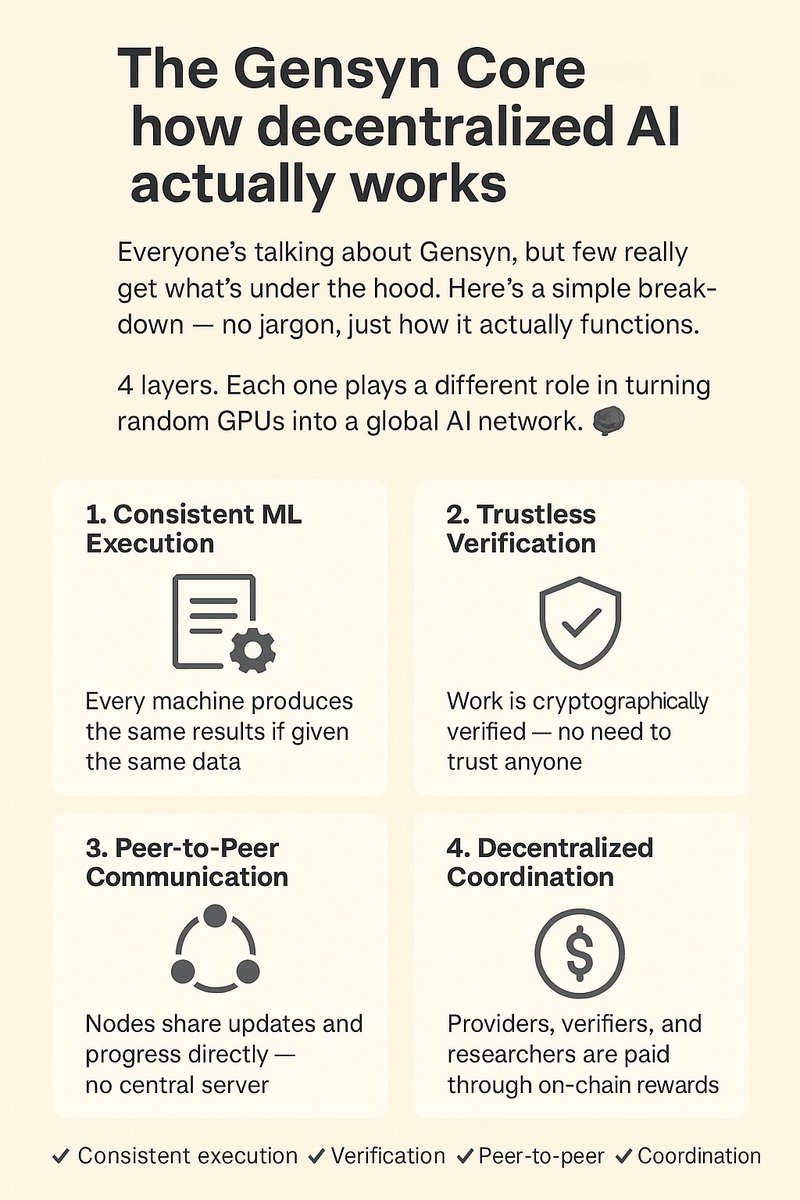
𝐓𝐡𝐞 𝐆𝐞𝐧𝐬𝐲𝐧 𝐂𝐨𝐫𝐞 𝐡𝐨𝐰 𝐝𝐞𝐜𝐞𝐧𝐭𝐫𝐚𝐥𝐢𝐳𝐞𝐝 𝐀𝐈 𝐚𝐜𝐭𝐮𝐚𝐥𝐥𝐲 𝐰𝐨𝐫𝐤𝐬 :
Everyone’s talking about Gensyn but few really get what’s under the hood.
Here’s a simple breakdown no jargon just how it actually functions.
4 layers.
Each one plays a different role in turning random GPUs into a global AI network.
𝟏. 𝐂𝐨𝐧𝐬𝐢𝐬𝐭𝐞𝐧𝐭 𝐌𝐋 𝐄𝐱𝐞𝐜𝐮𝐭𝐢𝐨𝐧
Think of it like a recipe.
If 1,000 people follow the same steps you expect the same dish not 1,000 versions of it.
That’s what Gensyn ensures for machine learning every machine no matter the hardware or software produces identical results if given the same data.
Without this you can’t trust distributed training it’d be chaos.
𝟐. 𝐓𝐫𝐮𝐬𝐭𝐥𝐞𝐬𝐬 𝐕𝐞𝐫𝐢𝐟𝐢𝐜𝐚𝐭𝐢𝐨𝐧 :
Now say someone claims they baked the perfect cake… but did they?
You can’t just take their word for it.
This layer verifies the work cryptographically.
If a node fakes its output or skips steps the network knows No middlemen no trust required.
It’s like having an automated quality checker that never sleeps.
𝟑. 𝐏𝐞𝐞𝐫-𝐭𝐨-𝐏𝐞𝐞𝐫 𝐂𝐨𝐦𝐦𝐮𝐧𝐢𝐜𝐚𝐭𝐢𝐨𝐧 :
Imagine a group project with 500 people working remotely some drop out others lose internet a few are slow.
This layer keeps the workflow going smoothly.
Nodes talk directly to each other sharing updates progress, and gradients without relying on a central server.
Even if a few go offline the system adapts.
That’s how Gensyn stays scalable and resilient.
𝟒. 𝐃𝐞𝐜𝐞𝐧𝐭𝐫𝐚𝐥𝐢𝐳𝐞𝐝 𝐂𝐨𝐨𝐫𝐝𝐢𝐧𝐚𝐭𝐢𝐨𝐧 :
Now why would anyone offer their GPU for someone else’s project?
Simple: incentives 💰
This layer handles the economy behind it all.
Providers verifiers, and researchers get rewarded for their roles transparently through on-chain payments.
It’s how the system motivates real people to contribute real compute power.
𝐏𝐮𝐭𝐭𝐢𝐧𝐠 𝐢𝐭 𝐭𝐨𝐠𝐞𝐭𝐡𝐞𝐫:
✅ Consistent execution → reliable results
✅ Verification → trustless accuracy
✅ Peer-to-peer → smooth collaboration
✅ Coordination → real incentives
Together they make Gensyn the world’s first verifiable decentralized compute network for AI training.
Example:
Let’s say you’re training a language model.
Instead of renting GPUs from AWS your job is split across 1,000 independent nodes worldwide.
Each node trains a small part of the model sends verified results and gets paid automatically no middlemen no cloud contracts.
That’s the Gensyn difference.
𝐈𝐧 𝐬𝐡𝐨𝐫𝐭:
Gensyn isn’t just building infrastructure.
It’s redefining how machine learning happens open, fair, and verifiable from the ground up.
Real compute. Real rewards. Real decentralization.
@gensynai
#Gensyn #DecentralizedAI #AICompute
#Web3AI #OpenInfrastructure

Deep Dive into Gensyn : Day 3rd /
Today I spent time learning more about Gensyn and honestly, it feels like one of those projects that’s quietly building something huge something that could change how AI is built and shared in the long run.
At its core, Gensyn is creating the network layer for machine intelligence basically, a decentralized compute protocol that lets anyone with hardware from powerful GPUs to normal systems, help train AI models and actually get rewarded for it.
Right now AI training is mostly controlled by a few big companies with massive infrastructure. Gensyn is trying to flip that system to open up access to compute and connect thousands of independent devices into one transparent, verifiable, and fair global network. That’s what decentralization should feel like.
⚙️ What They’re Building :
Their protocol is designed to coordinate and verify AI training without any central authority.
It automatically assigns tasks, verifies performance, and even handles payments all through blockchain, so everything stays trustless and transparent.
Their public testnet is already live, and they’ve crossed 100,000 models trained through RL-Swarm.
They’re also developing tools like:
Verde – to verify AI computation on untrusted hardware
NoLoCo – to make distributed training faster and more efficient
BlockAssist – a fun project where an AI learns directly from your gameplay
It’s not theory anymore this stuff is actually running.
🌍 Vision :
What really caught my attention is their long-term vision.
Gensyn isn’t trying to be another AI company they want to make AI open, fair, and accessible for everyone.
Their belief is simple: the future of intelligence should be powered by people not locked behind a few corporations.
By decentralizing compute they’re building a system where:
Anyone can train or host AI models
Contributions are verified and rewarded
AI grows collectively, not in silos
That line really sticks “AI grows collectively.” It’s the right kind of energy for where tech should be heading.
👥 Team & Backing :
The founders Harry Grieve and Ben Fielding are both builders who understand AI and distributed systems deeply.
They’re backed by some serious players a16z, Protocol Labs, CoinFund, and Galaxy raising over $40 million to build decentralized AI infrastructure.
It’s not just about funding though it’s the conviction they carry. Every update feels like a step closer to something meaningful.
Why It’s Different :
Most AI or Web3 projects chase hype or focus on building apps and models.
Gensyn is working on the foundation the infrastructure that could power all of them in the future.
It’s open, verifiable, and community-driven.
They’re not just training machines they’re building a system where culture, code, and compute blend into one living ecosystem.
And honestly, that’s the part that hits home the community around Gensyn feels alive.
Every day there’s more energy, more discussions, and more builders joining in.
Crossing 100k trained models on RL-Swarm isn’t just a milestone it’s a reflection of how fast this community is growing and how much support is flowing in.
This feels early but real.
And if they keep going at this pace Gensyn might become the backbone of decentralized AI sooner than most expect.
@gensynai
#Gensyn #DecentralizedAI #MachineIntelligence #AICompute #OpenInfrastructure #FutureOfAI #AIForEveryone


🔗 @OpenLedger is not just another blockchain.
🧱 It's a modular ledger framework for trust — built for
📈 Scale, 🔒 Security, and 🔁 Interoperability.
#DecentralizedTech 🌐 #OpenInfrastructure 🛠️


OpenLedger makes every step of the AI journey visible and fair.
From data input to model deployment, each contributor is credited and rewarded automatically.
No hidden pipelines. No lost effort. Just a transparent, modular system that values every role.
This is how decentralized AI should work.
Explore the full process at @OpenledgerHQ
#OpenLedger #Web3AI #AIeconomy #DataAttribution #ModularAI #OpenInfrastructure


Today let's talk about The World’s First Shared Computer.!
-Cost $0.
-Funding Raised: 8M$.
-Time 3 mins.
@theblessnetwork
is the world’s first shared computer built on the Solana blockchain.
Bless is a decentralized edge compute network that delivers on-demand CPU & GPU resources close to end users, facilitating access to AI, machine learning, advanced data tools, & the evolving internet landscape.
We have been on bless Testnet since last year.
How to get started.?
-Visit https:https://t.co/AOG8RxdzlN
-Sign-up with your mail.
-Connect your X"Twitter".
-Connect your discord.
-Download Bless Chrome extension.
https://t.co/gxSwqAIQcC
-Login & active your extension.
-Complete Quiz.
1 B. 2 B. 3 A. 4 B. 5 B.
6 B. 7 B. 8 C. 9 B. 10 B.
-Click on submit & you're done.
Note that:- this is an incentivized Testnet, your Total Time point will be converted to $Bless token on TGE.
#DecentralizedCompute #Web3Infra #DePIN #EdgeCompute #OpenInfrastructure #AIForAll #BlessNetwork #TheNewCloud #OwnTheCloud #FutureOfCompute #blessnetwork

🏙 AYDO x Smart Cities: Decentralized by Design
AYDO turns everyday IoT devices into trusted data nodes for smart cities.
📡 Air, light, motion, traffic - streamed securely on-chain
🤝 Citizens contribute, earn, and stay in control
🌍 From sensors to city-wide intelligence - with @AYDO_AI
#AYDO #SmartCity #DePIN #IoT #Web3 #OpenInfrastructure

Last Seen Hashtags on Sotwe
ป่าไผ่หทัยราษฎร์
Seen from Thailand
minichat((((()))))*********************
Seen from United States
evlikadınlar
Seen from Netherlands
gaysex
Seen from Brazil
kontolinfoto
Seen from Malaysia
teenager
Seen from Netherlands
rape
Seen from Saudi Arabia
sissy
Seen from Germany
放屁
Seen from France
معصيتّيَ_رِحّتِي
Seen from Turkey
Most Popular Users

Elon Musk 
@elonmusk
240.1M followers

Barack Obama
@barackobama
118.6M followers

Cristiano Ronaldo
@cristiano
114.4M followers

Donald J. Trump
@realdonaldtrump
111.7M followers

Narendra Modi
@narendramodi
106.9M followers

Rihanna
@rihanna
98.6M followers

NASA
@nasa
92.1M followers

Justin Bieber
@justinbieber
91.7M followers

KATY PERRY
@katyperry
89.9M followers

Taylor Swift
@taylorswift13
83.9M followers

Lady Gaga
@ladygaga
75.4M followers

Virat Kohli
@imvkohli
73.3M followers

Kim Kardashian
@kimkardashian
70.8M followers

YouTube
@youtube
68.6M followers

Neymar Jr
@neymarjr
66.3M followers

Bill Gates
@billgates
65.2M followers

Selena Gomez
@selenagomez
63M followers

The Ellen Show
@theellenshow
62.1M followers

CNN
@cnn
61.7M followers

X
@x
60.6M followers