

Top Tweets for #PathogenicVariants

Prediction of human pathogenic start loss variants based on self-supervised contrastive learning @BMCBiology
1. A novel method called StartCLR has been introduced to predict pathogenic start loss variants. This method combines self-supervised contrastive learning with supervised fine-tuning, effectively leveraging both labeled and unlabeled data to improve prediction accuracy.
2. StartCLR integrates embedding features from multiple DNA language models, including GPN-MSA and HyenaDNA, to capture variant context information from different dimensions. This dual-feature fusion approach enhances the model’s ability to identify pathogenic variants.
3. The study demonstrates that pre-training on a large amount of unlabeled data significantly boosts the model’s performance. Fine-tuning with high-confidence labeled data further improves prediction accuracy, highlighting the importance of high-quality labels.
4. StartCLR outperforms 13 other existing pathogenic variant prediction methods across two independent test sets. It shows superior generalization ability and robustness, even when trained with limited labeled data.
5. The method focuses on single nucleotide variants (SNVs) at the start codon and aims to address the challenge of limited labeled data. Future work will expand the scope to include other types of variants and refine the approach to minimize label noise.
📜Paper: bmcgenomics.biomedcentral.co…
💻Code: zenodo.org/records/15117521
#ComputationalBiology #Genomics #PathogenicVariants #SelfSupervisedLearning #ContrastiveLearning

pLM-SAV: A Δ-Embedding Approach for Predicting Pathogenic Single Amino Acid Variants
1.pLM-SAV introduces a simple yet effective strategy for predicting pathogenic single amino acid variants (SAVs) using Δ-embeddings — the difference between wild-type and mutant protein embeddings — as input to a compact convolutional neural network.
2.Unlike AlphaMissense or REVEL, pLM-SAV shows superior performance specifically on ambiguous variants — cases where current top models produce uncertain predictions — suggesting its strong utility in resolving gray zones in variant interpretation.
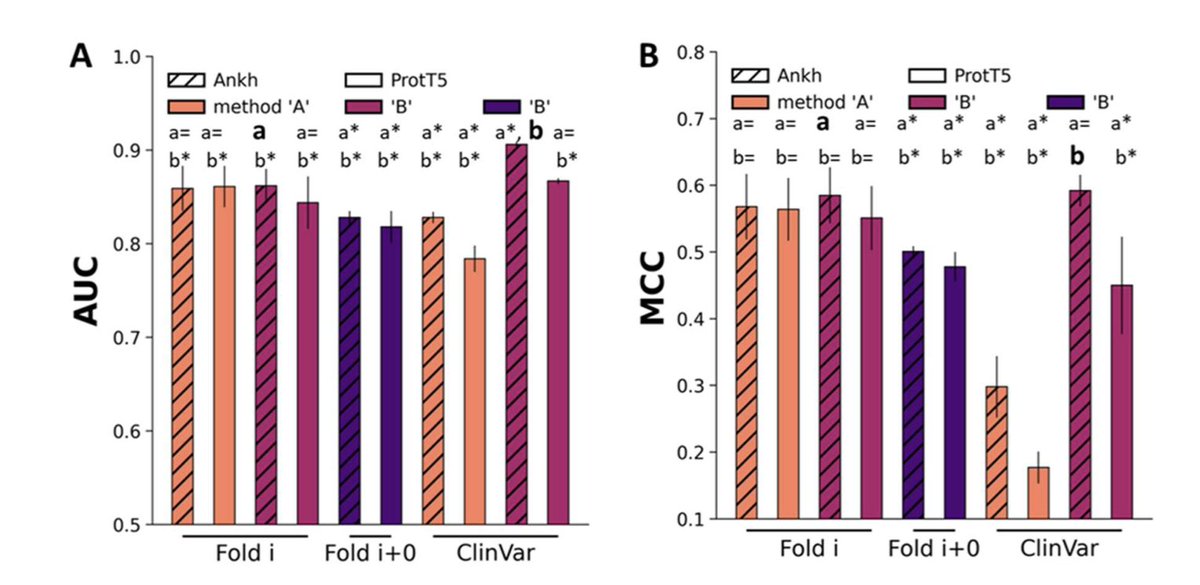
3.The model uses embeddings from two protein language models (ProtT5 and Ankh), with Ankh consistently yielding better performance, especially when trained using a method that excludes a problematic large data fold (method ‘B’).
4.Training was performed on the Eff10k dataset using nested cross-validation with strict sequence-level separation to avoid data leakage. Evaluation on independent ClinVar subsets demonstrated robust generalization.
5.pLM-SAV significantly improved predictions on ambiguous variants compared to AlphaMissense and REVEL, achieving higher AUC, MCC, and F1 scores across these difficult subsets. This makes it a valuable complementary tool.
6.Despite being a lightweight model, pLM-SAV performed comparably to complex supervised methods like SNAP2 and VESPA on standard SAV benchmarks (e.g., PMD4k), showing strong results on both human and non-human proteins.
7.In the ProteinGym deep mutational scanning benchmark, pLM-SAV did not outperform AlphaMissense but matched the performance of unsupervised models like ESM-1b, suggesting Δ-embeddings retain biologically meaningful signals even in regression tasks.
8.The CNN architecture is compact: it takes a 7-residue window around the mutation and uses 1D convolutions, residual connections, and dropout for regularization. This results in fast inference and easy deployment.
9.pLM-SAV was trained on a binary classification of variants as “neutral” or “effect,” while ClinVar data distinguishes “benign” and “pathogenic.” Despite this mismatch, the model maintained strong predictive power, especially on larger and more balanced test sets.
10.The authors integrated REVEL predictions into the AlphaMissense web application to leverage the strengths of both methods, and suggest that combining Δ-embedding-based models with ensemble approaches could enhance clinical utility.
💻Code: doi.org/10.5281/zenodo.15502…
📜Paper: biorxiv.org/content/10.1101/…
#ProteinLanguageModels #PathogenicVariants #SAVprediction #Bioinformatics #DeepLearning #Genomics #AlphaMissense #ClinVar
Deep learning tools predict variants in disordered regions with lower sensitivity
1. This study systematically benchmarks state-of-the-art variant effect predictors (VEPs) like AlphaMissense on missense mutations located in intrinsically disordered regions (IDRs), revealing a consistent drop in prediction sensitivity compared to ordered protein regions.
2. Using ClinVar data and five disorder predictors (AF2 pLDDT, AIUPred, metapredict, flDPnn, AF2-RSA), the authors show that over 30% of human protein variants fall within IDRs, and most are benign—yet over 10% of pathogenic mutations are also located in these regions.
3. VEPs including AlphaMissense, REVEL, VARITY, and others exhibit strong specificity but lower sensitivity on IDR variants, especially at the N-terminal methionine (start codon), where over 90% of mutations are pathogenic yet poorly predicted.
4. At the start codon, AlphaMissense achieves only 29% sensitivity, while VARITY reaches just 20% specificity. REVEL is the most balanced. These findings suggest start-codon mutations should be treated as a separate mutation class in VEP frameworks.
5. AlphaMissense and similar models rely heavily on structure and evolutionary conservation, which are weak signals in IDRs. Consequently, they tend to misclassify pathogenic IDR mutations as benign, increasing false negatives.
6. The imbalance between sensitivity and specificity is most pronounced in disordered regions—reaching 10–20% gaps depending on the disorder metric—highlighting the need for features specific to flexible and unstructured protein regions.
7. The study includes a detailed case of a pathogenic variant (P39L) in the N-terminal IDR of the HSPB1 protein. Despite strong experimental evidence, AlphaMissense, REVEL, and VARITY all predict it as benign, failing to capture its disease relevance.
8. AlphaFold3 models show that multimeric states of HSPB1 induce disorder-to-order transitions in the N-terminal region, suggesting that current VEPs overlook critical structural dynamics relevant for pathogenicity in IDRs.
9. The authors propose integrating tertiary and quaternary structure information and IDR-specific motif detection (e.g., via SHARK-capture) into future VEP pipelines to improve the detection of disease variants in disordered protein segments.
10. This work highlights a crucial limitation in current VEP tools and calls for the development of new paradigms and training data that specifically account for the biological functions and structural plasticity of IDRs.
💻Code: git.mpi-cbg.de/tothpetroczyl…
📜Paper: bmcgenomics.biomedcentral.co…
#VariantEffectPrediction #IDRs #AlphaMissense #ClinVar #ProteinDisorder #Bioinformatics #PathogenicVariants #DeepLearning #AlphaFold #VEPs

Last Seen Hashtags on Sotwe
Most Popular Users

Elon Musk 
@elonmusk
240.3M followers

Barack Obama
@barackobama
118.6M followers

Cristiano Ronaldo
@cristiano
114.4M followers

Donald J. Trump
@realdonaldtrump
111.8M followers

Narendra Modi
@narendramodi
106.9M followers

Rihanna
@rihanna
98.6M followers

NASA
@nasa
92.2M followers

Justin Bieber
@justinbieber
91.7M followers

KATY PERRY
@katyperry
89.9M followers

Taylor Swift
@taylorswift13
83.9M followers

Lady Gaga
@ladygaga
75.4M followers

Virat Kohli
@imvkohli
73.3M followers

Kim Kardashian
@kimkardashian
70.8M followers

YouTube
@youtube
68.6M followers

Neymar Jr
@neymarjr
66.3M followers

Bill Gates
@billgates
65.2M followers

Selena Gomez
@selenagomez
63M followers

The Ellen Show
@theellenshow
62.1M followers

CNN
@cnn
61.7M followers

X
@x
60.6M followers