

Top Tweets for #PreTrain

OpenAI's chief scientist published the company's internal pretraining loss curve, base model log-perplexity on a held out snapshot of its own codebase (lower is better), and proposed that labs agree on limits they will not train past.
○ GPT-3.5 sat at ~0.99, GPT-4 at ~0.91; below 0.8, Jakub Pachocki says "transformative capabilities" emerged in cybersecurity and mathematics
○ At ~0.76, a model "started producing groundbreaking results" on open math problems
○ An unreleased internal model plots near 0.73, below GPT-6.2 Astra
○ He expects further transformative capabilities in the ~0.68 to 0.7 window
○ Proposal: common limits on perplexity and other measures, not crossed until monitoring reaches a milestone such as a successor to CoT monitors; no number set yet
○ Microsoft AI overlaid its own base models on the chart: MAI-1 Base 0.878, MAI-2 Base 0.819
The post's own caveat: labs use different eval data, and chain of thought gains do not show up in perplexity.
Essentially as we approach .70 range at least by OpenAI’s metrics we may open Pandora’s box


OpenAI just published its internal pretraining scores. Chief scientist Jakub Pachocki says AI-driven research could set off an "avalanche" of advances by 2027, and wants labs to agree on perplexity limits until safety monitoring catches up.


@CyberRobooo The part I like is that it's open. The 50,000-hour egocentric corpus and model weights are going up on Hugging Face (still uploading, per the repo). In one real-robot test with new tablecloths and lighting, pretraining on human video hit 67.5% success vs 2.5% without it.

Kimi K4 is reportedly already in pretraining

🚨 RUMOR: Kimi K4 is reportedly already in pretraining
5.4 trillion parameters, build to beat Claude Fable 5.3
and apparently they "will never distill any Claude model"
this line is a direct shot at Anthropic lol
I have no confirmation of this, but my gut tells me Moonshot is cooking something big. If true, open weights catch up with the frontier again
what you think?


Code plus the native Mac app: https://t.co/Pz1UbBQza6 (weights: higurashi-ai/Haru-4B on HF). It's a pretrained base model for research, so it holds a natural call but won't follow instructions like an assistant.

Beyond Sequence and Structure: Pretraining PLMs on Continuous Biophysical Fields
1 The paper introduces the Biophysical Transformer, a small protein language model that adds a third pretraining signal: continuous electrostatic potential fields computed from structures (Poisson–Boltzmann / APBS), but learned to be predicted from sequence alone at inference time.
2 Key technical idea: instead of regressing voxel grids (which would collapse due to arbitrary structure orientation), the model is trained against a rotationally invariant spherical-harmonic descriptor of each token’s field, avoiding frame alignment during training and requiring no coordinates at inference.
3 Tokenization is stride-1 3-mers (k=3), chosen so covalent neighbors are inside the token while attention can capture through-space context. The encoder is lightweight (5-layer Transformer, d=64); a separate decoder predicts a 33^3 electrostatic grid per token only during pretraining.
4 The ablation is unusually strict: the “field” and “sequence-only” arms are bit-identical at initialization and differ by a single flag that turns the field objective on/off; downstream evaluations read only frozen encoder embeddings, isolating the effect of electrostatic supervision.
5 On FLIP Meltome thermostability, adding the field objective improves Spearman correlation on human splits with trained readouts (e.g., +0.024 to +0.025 on human for CNN/attention heads). The effect is not seen for trained heads on the organism-mixed split, consistent with mixed-split predictability being dominated by between-organism/phylogenetic signal.
6 The human-split gain survives strong confound controls: after residualizing 400-dimensional dipeptide composition from both predictions and labels (cross-fitted RidgeCV), partial Spearman improvements remain positive for both trained heads (attention +0.052, CNN +0.033), suggesting the effect is not simply amino-acid composition.
7 The Meltome gains also survive removing test proteins that overlap the pretraining corpus (3-mer containment criterion): on human, the composition-controlled deltas remain essentially unchanged, addressing a confound specific to structure-derived targets.
8 Transfer results suggest the field-shaped embeddings generalize beyond thermostability despite low benchmark overlap: CAID disorder prediction improves from AUC-ROC 0.73 to 0.76 and MCC 0.31 to 0.37, with only ~5% pretraining overlap (vs ~91% reported for ESM-2 under the paper’s audit).
9 For protein–protein interaction prediction (PLM-Interact), the field objective improves AUPRC on 2/3 tasks under low overlap (3–4%): +0.087 (cross-species) and +0.082 (virus–human), while the Bernett task remains near chance for both BioTransformer variants.
10 On MHC binding prediction, the 1.1M-parameter BioTransformer (field arm) outperforms frozen ESM-2 (650M) using the same regression head: Spearman 0.757 vs 0.639 (MHC I) and 0.613 vs 0.517 (MHC II), aligning with the hypothesis that explicit electrostatics is a useful inductive bias for charge/complementarity-driven tasks.
💻Code: https://t.co/5tXdxIBPe8
📜Paper: https://t.co/Isbnw79JF4
#ProteinLanguageModels #ComputationalBiology #MachineLearning #Biophysics #Electrostatics #SelfSupervisedLearning #ProteinEngineering #StructuralBiology #Bioinformatics

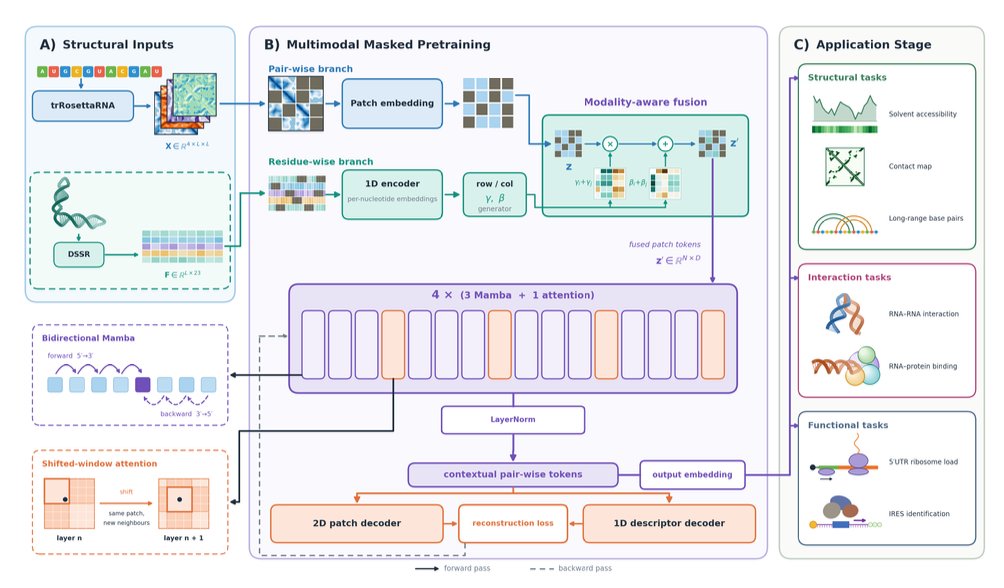
RNAtomy: A Structure-Aware RNA Foundation Model for Transferable Structural and Functional Representations
1 RNAtomy is an RNA foundation model pretrained directly on 3D-informed structure signals (inter-nucleotide distances/orientations + residue-level conformations), aiming to make RNA representations transfer better across structural, interaction, and functional tasks than sequence-only or secondary-structure-only pretraining.
2 The core idea is multimodal structural pretraining: a 2D pairwise geometry tensor (4 channels from trRosettaRNA: 1 distance-derived + 3 directional orientation channels) is paired with a 1D residue descriptor matrix (23 DSSR-derived features capturing backbone torsions α–ζ, glycosidic torsion χ, phosphate-placement geometry, and secondary-structure-context indicators like stems/junctions/hairpins/bulges/iloops).
3 RNAtomy’s self-supervised objective jointly masks and reconstructs both modalities: (a) masked patch reconstruction on the 2D geometry map with high masking ratios (0.45–0.65) and signal-aware weighting to emphasize informative regions; (b) span-masked reconstruction of residue descriptors (~15% positions) using losses tailored to feature types (circular losses for angles, robust regression for continuous geometry, BCE for binary indicators).
4 Architecture: a vision-style encoder that turns the L×L pairwise map into P×P patch tokens, then processes them with a hybrid Mamba–Transformer backbone (12 bidirectional Mamba blocks for efficient global context + 4 shifted-window attention blocks to restore local content-dependent interactions within neighborhoods of the pairwise map).
5 A key fusion mechanism is axis-aware FiLM conditioning: residue-wise embeddings are summarized along row/column segments aligned to the patch grid, then used to modulate pairwise tokens with separate row and column transforms, explicitly respecting ordered axes (i,j) vs (j,i), which matters because orientation channels are directional.
6 Robustness trick: modality dropout during pretraining (withholding the entire residue-descriptor modality for a subset of samples) forces the model to sometimes infer local conformations from pairwise geometry alone, improving transfer when residue descriptors are missing at inference time.
7 Data efficiency: pretraining starts from RNAcentral, reduces redundancy via CD-HIT-EST (95% identity, 80% coverage), filters to lengths 50–1024, and keeps only sequences where the full structural-feature pipeline succeeds; final pretraining set is ~200k RNAs—substantially smaller than many RNA foundation-model baselines—yet still yields strong transfer.
8 Embedding-space behavior: mean-pooled RNAtomy embeddings cluster RNAs by family membership (ArchiveII and Rfam seed families), suggesting the learned structural representation captures family-level organization without using family labels.
9 Downstream results span 7 tasks and multiple granularities (nucleotide, nucleotide-pair, RNA-pair, whole-RNA). Highlights include strong structural performance with a frozen backbone: improved RNA solvent accessibility prediction (PCC 0.51 vs 0.43 for a strong LSTM/profile baseline) and top long-range 3D contact precision on RNAcontact across L/k cutoffs (e.g., 0.94 at L/10).
10 Transfer beyond structure: RNAtomy representations help interaction tasks (miRNA–target prediction with strong recall after fine-tuning; RBP binding across 17 datasets via replacing experimental structure channels in PrismNet) and functional tasks, notably 5'UTR mean ribosome load prediction (best R2 on both in-distribution synthetic and out-of-distribution human UTRs) and competitive IRES identification with large gains from full fine-tuning.
💻Code: https://t.co/WdJQ1Wk13t
📜Paper: https://t.co/4UOXTRjjX1
#RNA #FoundationModels #SelfSupervisedLearning #RNAstructure #ComputationalBiology #Bioinformatics #DeepLearning #RepresentationLearning #Mamba #Transformers
RNA Small-Molecule Binding-Site Prediction by Integrating RNA Language Models and Structural Geometry
1. RSMBind is a nucleotide-level RNA–small-molecule binding-site predictor that fuses pretrained RNA language model embeddings with local 3D geometric descriptors inside a graph attention framework, aiming to work well even when RNA–ligand complex data are limited.
2. The method represents each RNA as a heterogeneous graph: nodes are nucleotides; edges include (i) backbone adjacency, (ii) secondary-structure base pairs (dot-bracket), and (iii) 3D spatial proximity edges for nucleotide pairs within 8 Å, with normalized distances used as edge attributes.
3. Node features are multimodal: 9 handcrafted structural descriptors (centroid distance, normalized sequence position, local neighbor density and distances, solvent accessibility, and graph topology measures) plus projected embeddings from RNA language models (RNA-BERT, ERNIE-RNA, RNA-FM). The LMs are frozen; only small projection layers are trained.
4. The core network is intentionally simple: a single edge-aware GATv2 layer (4 heads, residual connection) followed by an MLP classifier. The design choice is motivated by small training data and the risk of over-smoothing from deeper message passing.
5. Training data are expanded by combining TR60 with HARIBOSS, yielding 358 RNA chains and 24,107 nucleotides (28.5% binding labels using a ≤4 Å heavy-atom distance rule). Evaluation uses stratified 5-fold CV and an ensemble of the 5 fold models for external test predictions.
6. On independent benchmarks (RB9, TE18, TL12, JL10), RSMBind reports MCC = 0.652, 0.350, 0.655, 0.398 and AUROC = 0.909, 0.764, 0.869, 0.768, respectively. It achieves the highest MCC among compared methods on RB9, TL12, and JL10, and is competitive on TE18.
7. Training-set expansion matters: TR60+HARIBOSS improves MCC on all four benchmarks versus TR60-only (e.g., TL12 MCC 0.248 → 0.655; JL10 MCC 0.254 → 0.398), supporting the idea that broader structural diversity improves generalization.
8. A key practical result: the model retains predictive capability without explicit tertiary-structure features by using only LM embeddings plus backbone + base-pair edges. Among LMs, RNA-FM performs best alone; RNABERT+RNA-FM is the strongest LM-only combination overall, while adding all three LMs does not consistently help.
9. Ablations show geometric descriptors consistently add value on top of RNA-FM embeddings, while SASA features do not reliably improve performance (often decreasing MCC). The final recommended configuration is RNA-FM + geometric features, excluding SASA.
10. Biological/structural analysis: binding nucleotides are enriched in loops relative to stems, and RSMBind predicts loop-associated binding sites more reliably than stem-embedded sites. 100 ns MD case studies link high predicted probabilities to persistent ligand proximity in some complexes, while also highlighting failure modes where static-structure-based predictions disagree with trajectory behavior.
💻Code: https://t.co/IFqoVGBuWT
📜Paper: https://t.co/WvTtqvRnnm
#RNA #DrugDiscovery #DeepLearning #GraphNeuralNetworks #GAT #RNALanguageModels #StructuralBiology #ComputationalBiology #Bioinformatics #RNALigand

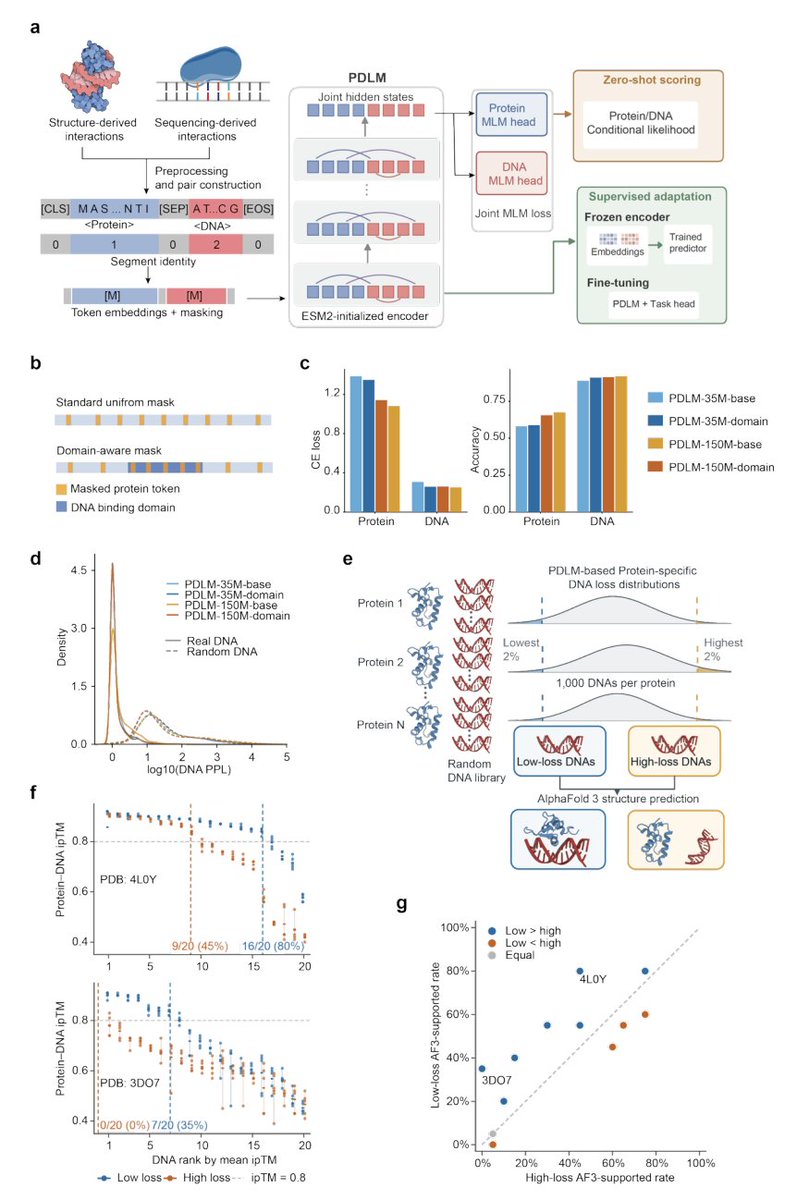
Joint Protein–DNA Language Modeling Enables Prediction And Engineering Of DNA Recognition Specificity
1 PDLMs introduce interaction-aware pretraining that jointly encodes protein and DNA sequences in a single Transformer context, enabling both (i) zero-shot conditional scoring of DNA given a protein (and vice versa) and (ii) transferable joint representations for downstream prediction tasks.
2 The pretraining data are experimentally characterized protein–DNA pairs (51,329 after filtering) curated from BioLiP2, AptaDB, REBASE, and CIS-BP, split so identical proteins appear in only one partition—aiming to measure generalization beyond protein memorization.
3 Architecturally, PDLMs are continued-pretrained from ESM2: amino-acid embeddings are inherited, DNA embeddings are newly learned, and modality-specific MLM heads reconstruct masked residues/bases while a shared encoder lets protein tokens condition DNA tokens directly.
4 A key training tweak is domain-aware masking: residues inside annotated DNA-binding domains (Pfam/HMMER) are masked more often (0.30 vs 0.10 outside), pushing the MLM objective toward recognition-relevant regions rather than uniformly distributing learning signal across the whole protein.
5 Beyond reconstruction, the models show evidence of learning protein-dependent DNA preferences: cognate DNA has lower pseudo-perplexity than random DNA under the same protein context, and low-loss DNA candidates show a modest enrichment for AlphaFold 3-supported protein–DNA contacts (variable across proteins).
6 For pair-specific binding prediction, frozen PDLM representations outperform dual-encoder baselines (ESM2 + DNABERT-2 or a separately pretrained DNA encoder), especially when negatives are “hard” (mismatched/shuffled/random DNA). Example: PDLM-150M-domain reaches AUROC 0.940 and AUPRC 0.903 vs 0.823/0.683 for the strongest baseline.
7 PDLM joint embeddings also capture mutation effects on interaction strength: for predicting mutation-induced binding free-energy changes (ΔΔG) from ProNAB, PDLM-35M-domain performs best overall, with a clearer advantage for DNA mutations (Pearson 0.523 vs 0.459 for the best independent-encoder baseline), consistent with explicit protein-conditioned DNA modeling.
8 Zero-shot conditional DNA scoring is used to recover and extend nuclease specificity in a genome-editing context: PDLM-35M-domain correctly reflects the known MutH shift from recognizing GATC to broader GATN contexts in the engineered E91A/F94A background, without task-specific training.
9 The same zero-shot framework enables practical variant prioritization: scoring 4,123 additional single substitutions in the E91A/F94A background across 16 GANN contexts yields 82 candidates; experiments show 6 variants significantly improve editing at a challenging non-GATN context (GACA), illustrating a model-guided reduction of experimental search space.
10 PDLMs transfer to other editing systems and to TF specificity readouts: joint representations improve cross-study TadA activity prediction (positive correlations on an external dataset where baselines fail), and fine-tuning on CIS-BP enables predicting TF PWMs directly from protein sequence, including some mutation-associated shifts in base preference (with noted failure cases such as FOXA1 R219S).
💻Code: https://t.co/KeFAwGZ7LL
📜Paper: https://t.co/YZI2RS9GjF
#ComputationalBiology #Bioinformatics #ProteinDNA #LanguageModels #DeepLearning #GenomeEditing #TranscriptionFactors #ProteinEngineering #BaseEditing
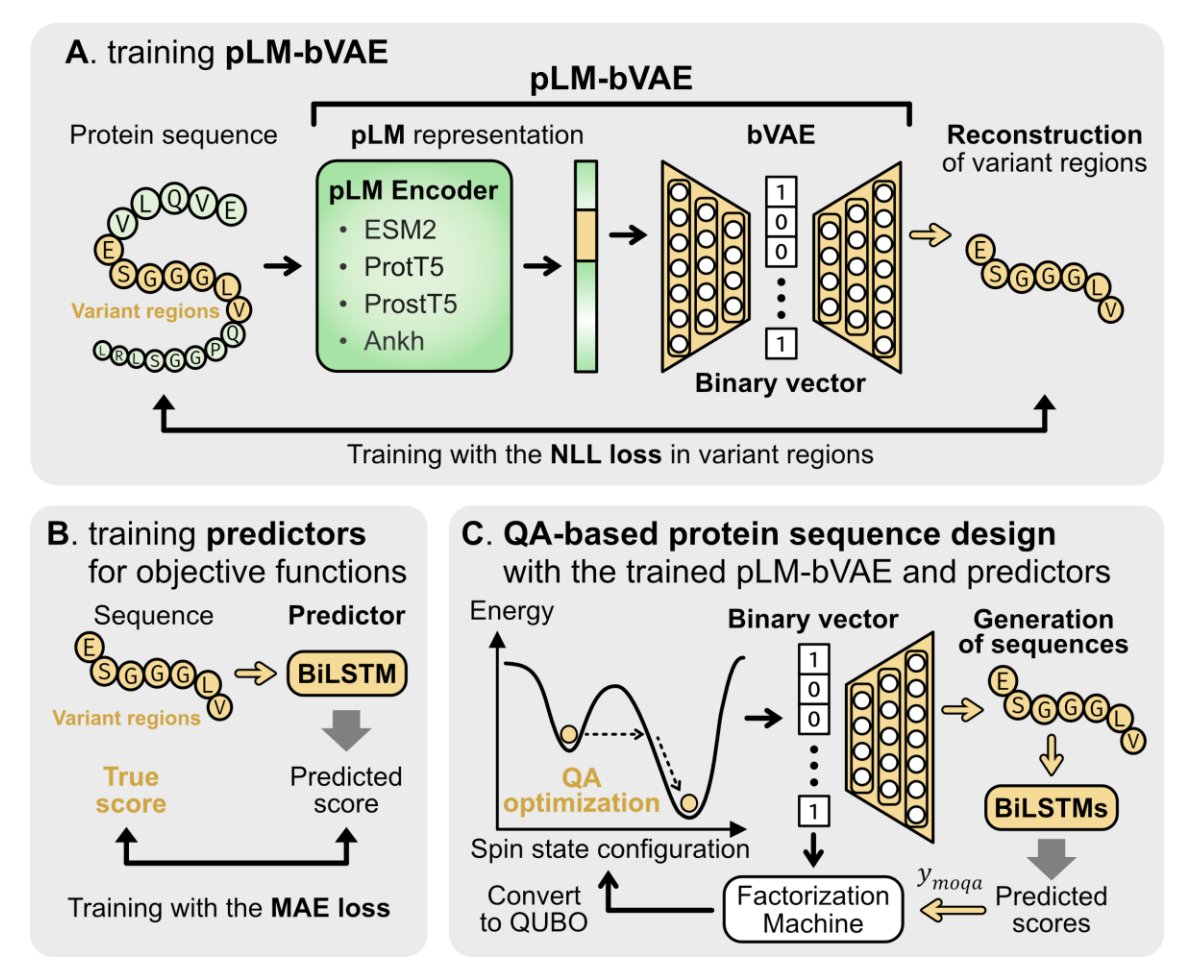
pLM-bVAE: Protein language model-enhanced binary representation improves quantum annealing-based protein sequence design
1. The study introduces pLM-bVAE, which injects pretrained protein language model (pLM) residue embeddings into a binary VAE pipeline, aiming to make protein sequences easier to encode into binary vectors (for quantum annealing) and reliably decode back into amino-acid sequences.
2. Motivation: quantum annealing (QA) optimizes over binary variables, so QA-based protein design critically depends on (i) binary encodings that preserve meaningful sequence relationships and (ii) decoders that reconstruct valid sequences accurately. Prior work used bVAE from NLP, but its protein suitability was not systematically validated.
3. Architecture: a frozen pLM encoder embeds full-length proteins; residue-level representations for the user-defined variant region are extracted and fed into a bVAE that outputs 64-bit binary latent vectors. The decoder reconstructs variant-region sequences from those binary vectors using an autoregressive NLL objective.
4. Evaluation spans three public variant datasets with different design regimes: HLA-A*02:01 MHC-I binding peptides (12,160), Trastuzumab scFv CDRH3 variants (9,591), and AAV2 capsid surface region variants (16,743). Splits are 80/10/10 train/val/test.
5. Reconstruction gains: compared with baseline bVAE, pLM-bVAE improves test-set reconstruction measured by exact match (Levenshtein distance 0) and by similarity-aware alignment scores (BLOSUM62). Bayesian hyperparameter optimization (Optuna, 200 trials) further improves reconstruction, approaching near-perfect exact reconstruction on the peptide dataset.
6. Better binary geometry: pLM-bVAE improves how well distances between sequences are preserved after binarization. It increases Spearman correlation between pairwise sequence distances (Levenshtein) and pairwise latent distances (Hamming), and strengthens the expected negative correlation between BLOSUM62 similarity and Hamming distance—indicating a more protein-faithful binary latent space.
7. Which pLM works best here: multiple encoders were tested (ESM2 8M/650M/3B, ProtT5, ProstT5, Ankh-base/large). ESM2_650M combined with bVAE plus hyperparameter optimization achieved the best averaged total score across datasets, and larger pLMs did not necessarily outperform medium-sized ones.
8. QA-based design integration: pLM-bVAE is plugged into the MOQA framework (multi-objective optimization by quantum annealing). Sequence scoring uses an ensemble of three BiLSTM predictors (PARROT) trained on the same splits; predicted scores drive non-dominated sorting, while a factorization machine surrogate is converted to QUBO and solved on D-Wave Advantage System 6.
9. Practical outcome for design: across all three datasets, QA using pLM-bVAE (HPO) yields (i) more unique generated sequences with oracle scores exceeding the Train+Val “top-10th” threshold and (ii) higher novelty among high scorers, quantified by larger nearest-neighbor Levenshtein distance to Train+Val—suggesting improved exploration without collapsing to known sequences.
10. Mechanistic insight: UMAP visualizations of sampled 64-bit vectors show QA trajectories that shift more strongly when using pLM-bVAE (HPO). This is quantified by larger MMD between initial random samples and QA-sampled vectors, and it aligns with larger gains in best-oracle-score over iterations—consistent with a more directed and efficient search in binary latent space.
💻Code: https://t.co/Y9eHOt2wG3
📜Paper: https://t.co/oQ323P28FX
#ProteinDesign #ProteinLanguageModels #QuantumAnnealing #DWave #GenerativeModels #VAE #ComputationalBiology #MachineLearning #Bioinformatics
CPDD: Adapting an autoregressive DNA language model for bidirectional phage genome modeling
1. The paper introduces CPDD (147.5M params), a bidirectional discrete diffusion DNA language model for bacteriophages initialized from a pretrained autoregressive model (CreatiPhage, 144.5M). The key goal is scaffold-conditioned modeling: filling or editing uncertain regions while conditioning on both upstream and downstream flanks.
2. Core technical move: converting a left-to-right Transformer into a non-causal denoiser while reusing most pretrained weights. CPDD keeps Block Attention Residuals (depth-wise mixing) and Engram conditional memory, but switches attention to bidirectional (global layers attend full-window; local layers attend within ±4096).
3. A notable architectural detail is making Engram “MASK-aware”: k-mer lookup is extended from base-4 to base-5 indexing so k-mers containing MASK can still retrieve memory rather than being discarded. Memory refinement also becomes bidirectional via a centered depthwise convolution (adds right-context taps initialized to zero).
4. Training is designed for realistic corrupted scaffolds, not just missing data. Besides random masking, CPDD uses GIDD-style uniformly substituted bases (a fraction of corrupted sites are replaced by random A/T/C/G rather than MASK), so the model learns both imputation and correction when errors remain visible.
5. Supervision combines nucleotide cross-entropy with an amino-acid negative log-likelihood computed from the same base probabilities (no separate protein head). The AA loss pools synonymous codons (genetic codes 4/11/15 supported) and clamps visible bases, encouraging codon-consistent predictions within coding regions.
6. Curriculum learning scales context from ~10 kb to 32 kb and then to whole-source contexts up to 98,304 tokens. Corruption targets are selected from CDS intervals with spacing constraints, mixing “full corruption” intervals with partial masking rates sampled per update.
7. On standard sequence-analysis benchmarks, the pretrained AR base (CreatiPhage) is competitive vs a size-matched megaDNA reference: higher AUROC on phage λ essentiality perturbation tests, better infA mutational-effect correlations, and strong bacteria/archaea/phage fragment classification.
8. For scaffold restoration on a screened panel of 522 phage CDSs, CPDD improves random-mask restoration accuracy over a comparable diffusion model (PhaGen) and stays well above codon-level heuristic baselines. It also supports downstream tasks via frozen embeddings, including infA fitness prediction and 7-class phage virion protein subtype classification.
9. Mixed-corruption (visible-error) testing highlights the effect of substitution-aware training: when 30% positions are corrupted and 10% of corruptions are left as visible substitutions, CPDD restores 42.4% of visible incorrect bases (vs 22.7% for the masking-only reference). The paper also documents limitations: performance in long contiguous gaps trends toward codon-usage statistics, and controlled “distant copy” experiments show limited transfer of copy-based recovery without more targeted training/objectives.
💻Code: https://t.co/EyxZIJj7HC
📜Paper: https://t.co/RDQnWh5kHn
#ComputationalBiology #Bioinformatics #Genomics #Bacteriophage #DNAFoundationModels #DiffusionModels #LanguageModels #SyntheticBiology #SequenceModeling #Transformers


DeepSeek is reportedly planning to pretrain its next model, V5, mainly on Huawei's Ascend 950 chips, according to Chinese outlets Caiwen and STAR Market Daily earlier this month. Neither @deepseek_ai nor Huawei has confirmed it, and until now those chips have mostly been used for inference.
It got me thinking about stack choices. Building on the dominant hardware and its tooling is faster today. Keeping your code portable costs time up front but leaves you options if prices or supply change. For AI work, do you go all in on one stack or pay to stay portable?
$NVDA #AI
Efficient and Accurate Zero Shot Generation of Symmetric Protein Complexes
1. The paper introduces ZEUS (Zero-shot Unified Symmetrization), a framework that turns any pretrained SE(3)-equivariant protein backbone generator into a symmetric complex generator with no retraining and no weight changes, targeting cyclic (Cn), dihedral (Dn), and polyhedral (T/O/I) symmetries.
2. Core idea: generating a G-symmetric assembly is equivalent to generating a single canonical subunit in the quotient space X/G, because the full complex is just the orbit of that subunit under the symmetry group action.
3. ZEUS realizes quotient-space generation in existing architectures via “phantom subunits”: the model runs primarily on one canonical subunit while consulting symmetry-transformed copies as geometric context, so internal operations remain symmetry-aware without explicitly processing the whole complex.
4. Theoretical foundation: for models that are SE(3)-equivariant and chain-permutation-equivariant, a full-complex generator “descends” to a well-defined quotient-space operator, and ZEUS’s phantom-copy computation is proven equivalent to that quotient operator (formalized as descent and expansion theorems).
5. Practical payoff: memory and runtime drop by O(|G|)=O(k) for finite symmetry groups. Node features reduce from kN to N, and pair/edge features reduce from k^2 N^2 to k N^2 by exploiting the block-permutation structure induced by symmetry in pairwise interaction matrices.
6. Implementation spans two major backbone-generator families: (i) IPA-based models (FrameDiff, FoldFlow) using symmetry-aware IPA attention where queries come from the canonical chain and keys/values come from phantom copies; (ii) axial-attention-based RFdiffusion using a block-row representation and group-indexed shuffles to avoid materializing the full (kN)x(kN) pair tensor.
7. Empirical evaluation on cyclic symmetries (C2/C3/C4/C6/C8/C12) shows minimal quality change versus full-complex symmetric inference: designability (scTM/scRMSD via ProteinMPNN + ESMFold), diversity (pairwiseTM), and novelty (pdbTM via Foldseek) remain distributionally similar, typically within ~1 standard deviation.
8. The work also clarifies an important caveat: if the base model breaks chain-permutation equivariance (e.g., RFdiffusion’s signed relative-index/chain-offset encodings), ZEUS matches an “equivariant ablation” baseline more directly than the default inference; observed differences are attributed mainly to restoring permutation invariance rather than the symmetry reduction itself.
9. Scaling result: ZEUS enables exact (untruncated) attention for symmetric assemblies exceeding 10,000 residues on a single GPU—demonstrated with large C50 and D50 complexes (~10k residues), plus polyhedral (icosahedral I) and helical (H) examples—pushing symmetric generation into a size regime previously impractical for explicit full-complex forward passes.
📜Paper: https://t.co/krY2OAqXmp
#ProteinDesign #DiffusionModels #EquivariantML #StructuralBiology #ComputationalBiology #GenerativeAI #Symmetry #NeurIPS2026

Joint Protein–DNA Language Modeling Enables Prediction and Engineering of DNA Recognition Specificity
1 PDLMs introduce interaction-aware pretraining that jointly encodes protein and DNA sequences in one shared Transformer context (continued pretraining from ESM2), enabling conditional likelihood scoring of DNA given protein (and vice versa) plus transferable pair representations for downstream tasks.
2 The pretraining corpus aggregates 51,329 experimentally supported protein–DNA pairs (BioLiP2, AptaDB, REBASE, CIS-BP), split by protein identity to avoid leakage; inputs are formatted as a single sequence with segment embeddings and modality-specific MLM heads (protein tokens inherit ESM2 embeddings; DNA tokens are newly learned).
3 A key methodological tweak is domain-aware masking: residues inside annotated DNA-binding domains (Pfam/HMMER) are masked more often (0.30 vs 0.10 outside), aiming to concentrate learning signal on interaction-relevant regions rather than uniformly across the protein.
4 Conditional DNA pseudo-likelihoods are meaningfully partner-dependent: cognate DNA has lower pseudo-perplexity than length-matched random DNA across PDLM variants, and low-loss DNA candidates show a modest enrichment for AlphaFold 3–supported protein–DNA contacts in a targeted evaluation.
5 Frozen joint PDLM representations improve protein–DNA pair classification versus dual-encoder baselines (ESM2 + DNABERT-2 or a separately pretrained DNA encoder), especially when negatives require true pair compatibility (mismatched/shuffled/random DNA). Example: PDLM-150M-domain reaches AUROC 0.940 and AUPRC 0.903, outperforming the strongest baseline.
6 Joint embeddings also capture mutation effects on binding energetics (ProNAB ΔΔG). PDLM-35M-domain gives the best correlations overall, with a clearer advantage on DNA mutations (where partner-conditioned DNA representation matters most) than on protein mutations.
7 Zero-shot specificity transfer is demonstrated on MutH nickase used in mitochondrial base editing: PDLM-35M-domain recovers the known shift from strict 5′-GATC-3′ recognition to broader GATN compatibility for the engineered E91A/F94A variant by scoring protein-conditioned DNA likelihood changes.
8 The same zero-shot DNA scoring is used for virtual screening: 4,123 additional single substitutions in the E91A/F94A background are scored across 16 GANN contexts; 82 variants are prioritized for experiments, and multiple candidates significantly improve editing at a non-canonical GACA context.
9 Protein-side zero-shot scoring (masked amino-acid likelihoods without DNA input) enriches for activity-enhancing MutH substitutions: PDLMs correlate better with measured editing activity than ESM2 and a DBP-adapted baseline, and consensus selection yields 11/11 functional variants with 5 showing improved activity.
10 PDLM representations transfer beyond MutH: for TadA base editors, supervised models trained on one study generalize to an independent dataset where separate-encoder baselines fail (negative correlations), and protein-conditioned DNA scoring (PDLM-150M-domain) correlates with sgRNA-independent off-target activity across TadA variants (SCC ~0.66).
11 Fine-tuning adapts PDLMs to transcription factor motif prediction: by masking all DNA positions and predicting PWMs from protein sequence, partial encoder fine-tuning (last third of layers) boosts motif agreement; PDLM-35M-domain performs best under the tested setup and can capture some mutation-driven specificity shifts (e.g., FOXA1 deletion trend).
💻Code: https://t.co/KeFAwGZFBj
📜Paper: https://t.co/YZI2RSae9d
#ComputationalBiology #Bioinformatics #ProteinDNA #LanguageModels #FoundationModels #GenomeEditing #BaseEditing #TranscriptionFactors #ProteinEngineering #DeepLearning


Few-shot regulatory sequence design with a genomic language model
1. The study reports that Evo 2, a pretrained genomic language model, can perform generative in-context learning (ICL): given only tens of example regulatory sequences in the prompt, it generates novel, diverse regulatory DNA with the desired functional class, without any parameter updates.
2. Evo 2’s few-shot prompting works across multiple regulatory modalities, spanning yeast promoters, human 5′ UTRs, human IRES elements, human promoters, and human enhancers; in silico quality improves as more examples are provided (ICL scaling), often plateauing after modest shot counts for some tasks.
3. For cell-type-conditioned human regulatory design, Evo 2 can be prompted with sets of active promoters or enhancers from a target cell line to generate new sequences predicted to be active in that same cell type; prompting with enhancer sequences themselves outperformed prompting with upstream genomic context.
4. Mechanistic evidence suggests genomic ICL relies on induction-like circuitry: the authors identify candidate “induction heads” (attention heads that exploit repeated structure/patterns across examples) and show that ablating these heads reduces predicted enhancer activity compared to ablating random heads.
5. Nucleotide-resolution influence mapping (categorical Jacobian) indicates that as the number of in-context examples increases, Evo 2’s generations become less dominated by any single example and instead integrate signal distributed across multiple examples—consistent with a synthesis/induction mechanism rather than simple copying.
6. The paper strengthens ICL via lightweight reinforcement learning (GRPO), using sequence-to-function predictors as experiment-derived virtual rewards (plus constraints like GC content, validity, and novelty). This improves predicted activity for 5′ UTRs, promoters, and enhancers, and can improve enhancer specificity via objectives like MinGap (on-target minus strongest off-target).
7. Notably, reward-aligned improvements can transfer: promoter-focused post-training improves enhancer generation quality, and enhancer specificity training on two cell lines generalizes to a held-out third line, suggesting learning of broader regulatory rules rather than memorization.
8. Experimental validation in three human cell lines (K562, HepG2, SK-N-SH) using a barcoded reporter assay shows Evo 2-designed enhancers are functional and tend to be more active in the intended target line than off-target lines; reinforcement learning improves measured specificity in some settings and greatly increases the pass rate under in silico selection filters.
9. For in vivo design, the authors fine-tune AlphaGenome to predict brain cell-type chromatin accessibility across 107 human brain cell types, then use it as a reward model to post-train Evo 2 to design cell-type-specific candidate cis-regulatory elements; orthogonal Borzoi+Enformer ensembles are used as additional filters to reduce reward hacking.
10. In mice, AAV delivery of selected Evo 2-designed enhancers yields functional brain expression; two designs targeting layer 5 extratelencephalic neurons (L5-ET) show high specificity by scRNA-seq readout (reported 73% and 95% of labeled cells mapped to L5-ET), with one design showing stronger fluorescence than a published natural enhancer comparator.
📜Paper: https://t.co/873jTVj7jX
#Genomics #SyntheticBiology #ComputationalBiology #MachineLearning #DeepLearning #LanguageModels #EnhancerDesign #GeneRegulation #InContextLearning #ReinforcementLearning


Same Transformer building blocks, six different pretraining games: predict the next word (GPT), fill the blank (BERT), rebuild dropped spans (T5), match text to images (CLIP), predict two tokens ahead (DeepSeek-V3), or denoise a whole sentence at once (Mercury). Which objective do you think ages best?
Fraud models have gone through four generations: hand-written rules, boosted trees on engineered features, sequence models that read a card's history in order, and now foundation models pretrained on billions of transactions. Each step moved work from feature engineering into the model. Which generation is your team on?

What Matters in Quality-Aware VLA Pretraining
A Benchmark and Empirical Study
https://t.co/3Xn8XOjW5I
Paano dapat matuto ang mga VLA (Vision-Language-Action models) mula sa mga natural na demonstrasyon ng robot na hindi palaging perpekto o optimal?
Ipinapakilala ang AXIS-Bench: What Matters in Quality-Aware VLA Pretraining, isang benchmark at masusing pag-aaral kung paano dapat tukuyin, lagyan ng label, at gamitin ang kalidad ng mga robot demonstration sa proseso ng pretraining.
Sa pagsusuri sa tatlong VLA models at 24 na downstream tasks, sistematikong ikinumpara ng mga mananaliksik ang iba't ibang quality-aware learning approaches. Natuklasan nila na walang iisang pamamaraan na garantisadong epektibo para sa lahat ng modelo.
Ang pananaliksik na ito ay bunga ng kolaborasyon ng mga eksperto mula sa: from
@GeorgiaTech
@CarnegieMellon
@UCBerkeley
@NTUsg
@NUSingapore
@RiceUniversity
@UCRiverside
@TAMU
Kasama rin ang paglabas ng karagdagang detalye at companion dataset upang suportahan ang mas malalim na pananaliksik at pag-unlad ng robotic AI.
@axisrobotics #AxisRobotics #PhysicalAI
GPT guesses the next word, BERT fills in blanks, CLIP matches pictures to captions, and Mercury cleans up noise until a sentence appears. Six training games, one sentence, and when each one fits. If you were pretraining today, which game would you pick?
Few-shot regulatory sequence design with a genomic language model
1 Evo 2 (a pretrained genomic language model) is shown to perform generative in-context learning (ICL) for regulatory DNA: with only tens of example sequences in the prompt, it can generate novel, diverse regulatory elements without task-specific parameter updates.
2 The paper tests ICL across multiple regulatory modalities and organisms: yeast promoters, human 5′ UTRs, human IRES elements, human promoters, and human enhancers. In each case, adding more in-context examples generally improves predicted function until it plateaus.
3 For cell-type-conditioned human regulatory design, Evo 2 can be prompted with active promoters (9 cell lines) or enhancers (3 cell lines) and generates sequences with increased predicted activity in the specified cell type; natural enhancer examples in the prompt work better than providing upstream genomic context.
4 Mechanistic evidence for genomic ICL: the authors identify “induction” attention heads that recognize repeated structure in ICL prompts (examples separated by delimiters). Ablating candidate induction heads reduces predicted enhancer activity, consistent with causal involvement in inductive generation.
5 Nucleotide-resolution analyses using categorical Jacobians indicate that, in low-shot settings, generation can be dominated by a single example, but with more examples the influential positions become distributed across the prompt—suggesting Evo 2 increasingly synthesizes features across demonstrations rather than copying one template.
6 To strengthen functional conditioning, the study adds lightweight reinforcement learning (GRPO) where sequence-to-function predictors provide “virtual rewards” (plus constraints like GC content, validity, and novelty). This improves predicted quality for 5′ UTRs, promoters, and enhancers, and can transfer across regulatory classes (e.g., promoter-aligned models improving enhancer predictions).
7 For enhancer specificity, RL optimizes MinGap (on-target activity minus strongest off-target). Post-training improves predicted specificity not only in trained cell lines but also in a held-out line, suggesting learning of more general cell-type rules rather than simple memorization.
8 The authors also explore reward-model-free improvements: (i) classifier-free guidance via contrastive decoding between prompts with positive vs non-specific examples, and (ii) direct preference optimization (DPO) using preferred (specific) vs dispreferred (non-specific) enhancers with shared prompts.
9 Experimental validation in three human cell lines (K562, HepG2, SK-N-SH) using a barcoded MPRA shows Evo 2-designed enhancers are active and tend to be more active in their target cell type than off-targets; RL increases measured specificity in some settings and greatly increases in-silico pass rates/yields for selecting candidates.
10 In vivo extension: AlphaGenome is fine-tuned on human brain single-cell ATAC-seq across 107 cell types to create a cCRE classifier and an accessibility scorer; Evo 2 is RL-aligned using these rewards, and candidates are filtered with an orthogonal Borzoi+Enformer ensemble to mitigate reward hacking. AAV delivery to mice shows 7/9 designed enhancers drive detectable expression; two designs (EvoCre6/7) label layer 5 extratelencephalic neurons with high specificity (73% and 95% of YFP+ cells), with one showing stronger fluorescence than a published natural enhancer control.
📜Paper: https://t.co/873jTVj7jX
#ComputationalBiology #Genomics #DeepLearning #SyntheticBiology #GeneRegulation #EnhancerDesign #LanguageModels #InContextLearning #ReinforcementLearning #Neuroscience

AtomSteer: Test-time constraint steering for atomistic generative models
1. AtomSteer is a test-time inference framework that adds chemical and crystallographic control to pretrained atomistic generative models via constraint projections, without retraining or architecture changes.
2. Core idea: at scheduled sampling steps, the pretrained model’s endpoint prediction (the denoised/clean estimate the trajectory is heading toward) is projected toward a constraint set; the sampler then continues using the model’s native update so later steps can respond to the correction.
3. Constraints are formulated as residuals on an atomistic graph (atoms/sites as nodes; relations specify which atoms a constraint involves; labels store bond order, stereochemistry, species, etc.). Each constraint is paired with a structure-dependent projection that moves coordinates in the “right” coupled way (e.g., rigid fragment rotation vs local Cartesian tweaks).
4. AtomSteer enforces constraints with bounded corrections and acceptance checks: it only accepts updates that improve constraint satisfaction while limiting unintended distortion elsewhere (e.g., fixing a clash without breaking nearby bonds).
5. Three projection families cover a wide range of requirements: (i) Chemical Gauss–Newton (ChemGN) for local geometry, sterics, planarity, and stereochemistry; (ii) rigid-fragment / rigid-body projections for substituent flips (E/Z) and component packing (SE(3) moves); (iii) crystal symmetry & motif projections in fractional coordinates plus lattice-metric projections.
6. Crystal symmetry control (FlowMM): AtomSteer can infer a compatible space group from the model’s own predicted structure (hierarchy-aware symmetry selection that promotes to a feasible maximal parent group), then projects atomic orbits and lattice metric to increase symmetry consistency.
7. De novo crystal generation (MP-20): AtomSteer shifts FlowMM’s generated space-group distribution toward the dataset and broadens coverage (Unique SGs 89 → 105), improving symmetry success rate (71.47% → 77.91%) and reducing distribution distance dSG (0.554 → 0.508), with gains persisting after UMA relaxation.
8. Crystal structure prediction (MP-20): AtomSteer improves crystallographic correctness beyond structure match alone. For composition-only CSP it raises SG@1 (51.66% → 59.83%) and Joint@1 (structure match + correct space group) from 45.18% to 52.54% while keeping MR@1 essentially unchanged; a lattice-informed variant further improves to MR@1 66.33% and Joint@1 54.95%.
9. Motif-constrained crystal generation (Archimedean lattices): by projecting species, motif-site positions, and in-plane lattice parameters, AtomSteer turns unconstrained FlowMM into a motif-constrained generator (AL satisfaction ~96.6–99.2% vs ~0% for vanilla FlowMM) and achieves strong joint rates with SCIGEN-style prescreening; for triangular lattices it notably improves “AL detected after relaxation” (86.4% vs 31.5% for SCIGEN).
10. Molecular conformers (ET-Flow, GEOM-Drugs): AtomSteer improves stereochemical fidelity and validity while preserving ensemble coverage. It raises PoseBusters validity (93.17% → 96.93%), reduces median E/Z distribution error by 75.9% (W1 8.94 → 2.15), improves conformer precision (COV-P 73.52 → 75.49; AMR-P 0.559 → 0.529), and reduces errors of GFN2-xTB Boltzmann-weighted ensemble properties by ~10–36% depending on the property.
11. Protein–ligand complexes (Boltz-2): AtomSteer targets a known failure mode where models often keep the correct discrete E/Z label but produce inaccurate double-bond dihedrals. On StereoBench it improves “all E/Z bonds within 10°” to 79.1% (vs 59.5% for Boltz-steering) and halves median E/Z error (6.13° → 2.61°), while also improving PoseBusters validity (to 93.4%) and maintaining competitive docking success.
12. Practical takeaway: AtomSteer offers a unified, modular interface—adding a new requirement means defining a residual and a projection, rather than retraining the generative model. The same mechanism works across periodic crystals, small-molecule conformers, and protein–ligand complexes.
📜Paper: https://t.co/yiYSPKzAox
#ComputationalChemistry #MaterialsScience #GenerativeModels #DiffusionModels #FlowMatching #Crystallography #MolecularConformers #Docking #ProteinLigand #Stereochemistry

MLIPDiff: Guiding Denoising Diffusion Models for Structure-Based Drug Design via Machine-Learned Interatomic Potentials
1. MLIPDiff is an inference-time guidance method that steers a pretrained ligand diffusion model away from physically implausible poses (especially protein–ligand clashes) using a machine-learned interatomic potential (UMA), without retraining or architectural changes.
2. Core idea: during sampling, the diffusion model produces a one-step denoised “clean” structure prediction at every step; MLIPDiff evaluates physics-based energies on that clean prediction (not the noisy state) and uses the resulting gradients to shift the reverse-process mean.
3. Guidance is turned on only after a threshold (t ≤ 400) because MLIP forces are meaningful only when geometries are chemically valid; the paper justifies this by showing UMA force magnitudes and molecule reconstruction reliability improve sharply by that point.
4. The guidance objective is decomposed into four interpretable, independently tunable energy terms:
protein–ligand interaction (MLIP binding energy),
ligand strain (MLIP internal energy),
steric clash penalty (analytic, robust when overlaps occur),
pocket anchoring (analytic centroid restraint to prevent drift).
5. Practical stabilization details: gradients are rescaled by the diffusion noise scale and a cosine ramp so guidance grows as noise decreases; an additional cap ensures guidance cannot exceed the model’s own step size, preventing the physics term from dragging samples off the learned manifold.
6. On CrossDocked2020, MLIPDiff drives collision ratios (pairwise/atom/molecule-level) to zero after guidance activates, matching clash-focused methods like NucleusDiff but without requiring mesh-point diffusion or retraining.
7. Unlike NucleusDiff, MLIPDiff preserves local chemical geometry: it improves bond-length distribution fidelity versus the base TargetDiff (lower bond-length JSD across major bond types) and keeps rigid-fragment stability comparable to TargetDiff, while NucleusDiff roughly doubles rigid-fragment RMSD and distorts bond statistics.
8. Binding affinity metrics improve jointly with plausibility: MLIPDiff achieves the best median Vina Score, Vina Min, and Vina Dock among compared baselines, with a median 59.6% of generated ligands per pocket docking more strongly than the reference (by Vina Dock).
9. Pose validity and drug-likeness are not sacrificed: MLIPDiff matches the base model’s PoseBusters pass rate (0.62) while NucleusDiff drops sharply (0.12); QED/SA and diversity remain close to the base diffusion model, consistent with guidance acting on 3D geometry rather than 2D graph properties.
📜Paper: https://t.co/8wOSqWcp10
#DiffusionModels #StructureBasedDrugDesign #ComputationalChemistry #MolecularGeneration #DrugDiscovery #MachineLearning #InteratomicPotentials #MLIP #ProteinLigandDocking #GenerativeModels

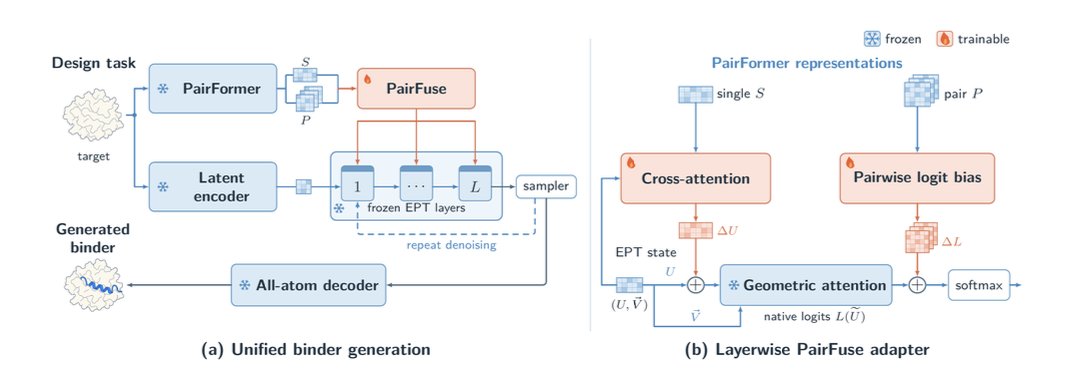
Towards Generalizing Pretrained All-Atom Representations to Unified Binder Design
1 PairFuse is a parameter-efficient way to transfer pretrained all-atom knowledge (single + pair representations from a frozen PairFormer, e.g., BoltzGen) into a separately pretrained unified geometric latent diffusion model (AnewOmni), enabling one framework to improve antibody, peptide, and small-molecule binder design with a shared fusion checkpoint.
2 Key idea: fuse not only token-level features but also pairwise interaction information into the diffusion denoiser. Prior lightweight adapters mostly condition on features; PairFuse additionally injects pairwise structural signals directly into the denoiser’s attention to steer geometric interactions during denoising.
3 Architecture: both backbones stay frozen; only small layerwise adapters (~4.03M trainable params) are trained. At every EPT denoiser layer, PairFuse (i) enriches invariant block features via cross-attention to pretrained single representations, and (ii) adds attention-logit biases derived from pretrained single and pair representations to modulate native geometric attention.
4 Scalar-feature fusion: current EPT scalar states query pretrained single representations; a pair-dependent bias derived from pretrained pair representations is included inside the cross-attention softmax. The update combines a cross-attention residual (can propagate donor info to blocks lacking direct correspondence) plus a masked direct projection for blocks that do correspond to PairFormer tokens.
5 Pairwise attention fusion: PairFuse adds an explicit bias term to the native attention logits, including (a) a single-conditioned term when the key has a donor token, and (b) a direct pair-representation term when both query and key blocks have donor-token correspondences. This is designed to guide denoising-time interactions without touching equivariant vector operations.
6 Geometric guarantee: the paper proves the augmented denoiser preserves rotational equivariance as long as transferred representations and masks are rotation-invariant. Because PairFuse only modifies invariant scalar features and attention logits (not the equivariant vector machinery), equivariance holds for arbitrary learned adapter parameters.
7 Expressivity guarantee: the paper proves that directly fusing pairwise information into attention logits can represent attention patterns that feature-only fusion cannot reproduce when native query–key projections have fixed width (under a rank condition). This formalizes why “pair-to-attention” transfer can add capability beyond enriching node features alone.
8 Results on unified binder design benchmarks (30 generations/target; shared checkpoint across modalities): on antibody HCDR3 design (RAbD), PairFuse improves complex RMSD (2.5563 → 2.3748 Å), increases DockQ (0.6853 → 0.7019), and raises native-contact recall (50.96% → 52.43%); RMSD≤2 Å rate rises notably (34.00% → 41.61%).
9 On peptide design (LNR), PairFuse achieves better structure/interface quality: complex RMSD (8.5619 → 8.2821 Å), DockQ (0.4280 → 0.4383), contact recall (33.19% → 34.10%), and interface lDDT (0.4197 → 0.4291), with a small drop in amino-acid recovery, highlighting a structure/interface vs sequence-recovery tradeoff.
10 On small-molecule design (CrossDocked2020 subset), PairFuse improves docking and composition metrics versus AnewOmni: Vina score (-5.1279 → -5.1517), Vina min (-5.9715 → -5.9841), High Affinity (44.82% → 46.83%), and Atom-type MAE (0.4188 → 0.3775). The paper notes a limitation: unknown generated ligand structures have limited donor-token correspondence, constraining how much PairFormer information can be transferred.
📜Paper: https://t.co/pPiegELUCy
#ComputationalBiology #ProteinDesign #AntibodyDesign #PeptideDesign #DrugDiscovery #DiffusionModels #GeometricDeepLearning #Equivariance #GenerativeAI #MachineLearning
VenusGenome: Genome-aware masked autoencoding for microbial genome representation learning
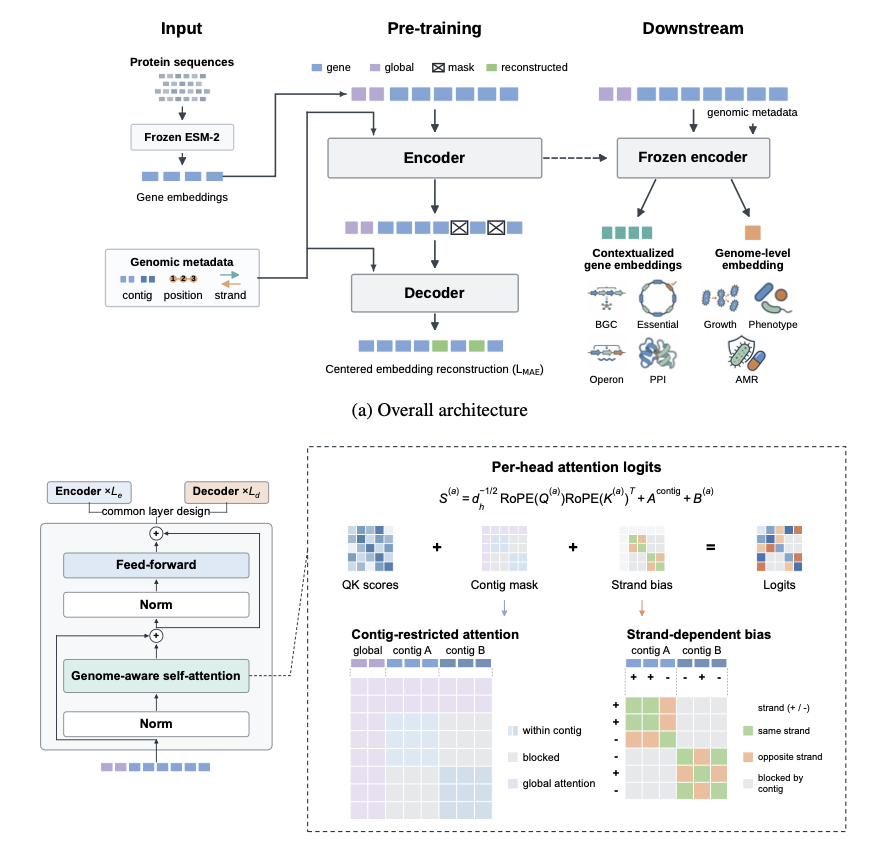
1. VenusGenome is a gene-resolution genome model that learns contextualized gene + genome embeddings from frozen protein embeddings, and it is pretrained at scale on >1.7M microbial genome assemblies (isolates + MAGs).
2. The key pretraining idea is high-ratio masked autoencoding (75% of genes masked): the encoder sees only visible genes, while a lightweight decoder reconstructs masked gene embeddings. This both forces reliance on sparser genomic context and cuts encoder compute (reported 65.2% forward–backward time reduction for 4,096-gene inputs vs 15% masking).
3. The model is “genome-aware” in attention, explicitly separating biology from assembly conventions:
- Contig-restricted attention blocks gene–gene attention across contigs (since contig concatenation does not imply adjacency)
- Relative strand bias encodes same-strand vs opposite-strand relationships (invariant to reference orientation flips)
- Within-contig positional information via RoPE, with random offset during pretraining
4. Global tokens provide controlled cross-contig communication: genes on different contigs do not directly attend to each other, but global tokens attend to all visible genes and can relay genome-wide information without pretending contigs are contiguous sequence.
5. Inputs are per-gene ESM2-35M embeddings (480D) plus metadata (contig ID, within-contig position, strand). Reconstruction targets are mean-centered protein embeddings to reduce anisotropy; the loss mixes MSE (0.3) and cosine loss (0.7).
6. In frozen-encoder evaluation across 11 primary metrics (6 genome-level phenotype tasks + 5 gene-level metrics), VenusGenome achieves the highest mean performance among compared models on 9/11 metrics, improving over both protein-only pooling (ESM2) and prior gene-context models (e.g., gLM, BacFormer).
7. Genome-level species-disjoint benchmarks show strong transfer to unseen species, including gains in traits where different baselines previously dominated:
- Doubling time Pearson: 0.336 (VenusGenome) vs 0.254 (Evo2)
- AMR macro AUROC: 0.682 vs 0.633 (NT-v2)
- Mixed phenotypes macro F1: 0.457 vs 0.421 (BacFormer)
8. Gene-level benchmarks indicate improved functional geometry in embedding space (not just probe-trainable signals):
- BGC detection AUPRC: 0.667 (VenusGenome) vs 0.536 (BacFormer)
- Zero-shot PPI ranking (STRINGDB genome-macro Spearman ρ): 0.300 vs 0.201 (BacFormer)
This highlights that contextual genome pretraining can improve cosine-similarity-based retrieval of functional relationships.
9. Controlled analyses support the main design choices:
- MAE-style visible-only encoding outperforms BERT-style full-sequence reconstruction at matched 15% masking (e.g., PPI Spearman 0.282 vs 0.192 at 512M)
- Removing contig-aware attention causes the largest drop (e.g., 0.293 to 0.203 at 512M, 75% masking)
- MAE representations spread variance across more dimensions than BERT-style models (less “representation deficiency”)
10. An exploratory zero-shot perturbation test links representation sensitivity to experimental fitness defects: replacing a gene’s input embedding with the organism mean and measuring neighborhood embedding change yields median AUROC 0.673 across 48 organisms (vs 0.631 for an Evo2 CDS-likelihood baseline), suggesting a route toward in silico functional screening.
📜Paper: https://t.co/uSieJLbwJK
#ComputationalBiology #Genomics #Microbiome #RepresentationLearning #Transformers #SelfSupervisedLearning #Bioinformatics #MachineLearning

The Bel rumors started with on Aug 25 2026. It claimed OpenAI finished a pretrain run codenamed Bel (successor to Doug) with over 10 trillion total parameters.Bel would serve as a foundation for post-GPT-6 models and possibly an AGI-threshold system after further RL. It’s coming!
Multi-objective protein optimization via modular diffusion steering
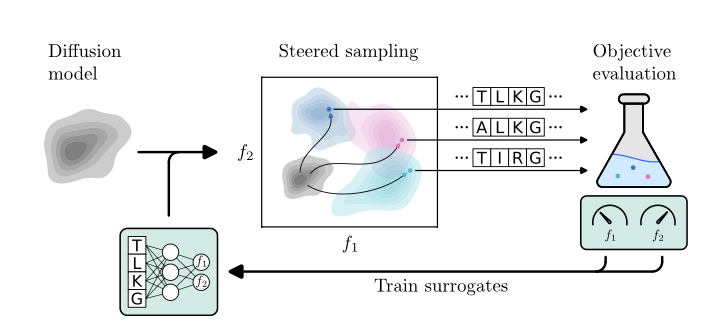
1 MODS is a modular framework that turns multi-objective protein design into inference-time steering of a fixed pretrained diffusion model, aiming to recover diverse Pareto tradeoffs under tight experimental-style budgets (few batched rounds).
2 Key idea: for each candidate proposal, MODS samples (a) augmented Chebyshev scalarization weights and (b) one member from a surrogate ensemble, combining them into a single scalar reward used for steering. Weight sampling explores different objective preferences; ensemble-member sampling explores predictive uncertainty.
3 The scalarization uses an augmented Chebyshev form: it emphasizes improving the worst-performing (weighted) objective while still rewarding progress on the others, helping recover tradeoffs on non-convex Pareto fronts where simple weighted sums can fail.
4 MODS separates “what to optimize” (multi-objective acquisition via scalar rewards) from “how to generate” (diffusion model + steering method). This makes the approach plug-and-play with different diffusion priors and compatible steering procedures.
5 Optimization loop: start with an initial evaluated set (100 sequences), then iterate 8 rounds of batched acquisition (100 sequences/round). After each round, MODS retrains only the fitness surrogate ensemble on accumulated observations, and reuses the same pretrained diffusion generator (no generator fine-tuning).
6 Implementations tested: two diffusion priors (MDLM masked diffusion LM; D3PM discrete diffusion) and two steering procedures (Classifier Guidance, CG; Decoupled Annealing Posterior Sampling, DAPS). Main comparisons focus on DAPS because it performed best across tasks.
7 Evaluation spans six assay-derived oracle benchmarks (5 two-objective tasks: GB1, ERBIN-PDZ1, NHERF3-PDZ2, KRAS, Src; 1 three-objective task: NHERF3-PDZ1). Oracles are CNN ensembles trained on experimental assay datasets with a distance-based penalty to discourage overconfident extrapolation far from labeled mutational neighborhoods.
8 Results: across all tasks, MODS improves substantially over unsteered sampling from the same diffusion model, and is competitive or best versus iterative baselines (ARLM+DPO, LaMBO-2, SAGE-Prot). In Table 1, MODS achieves the top mean final hypervolume on 5/6 tasks with D3PM+DAPS, and is close to the best baseline on Src with MDLM+DAPS.
9 Practical insight: steering strength matters. Too-weak regularization (oversteering away from the diffusion prior) can hurt on some tasks, consistent with reliance on less reliable surrogate predictions; the optimal setting depends jointly on task, diffusion prior, and steering procedure.
📜Paper: https://t.co/VSPsuiZkyU
#ProteinEngineering #DiffusionModels #MultiObjectiveOptimization #ParetoFront #BayesianOptimization #MachineLearning #ComputationalBiology #ActiveLearning

Guyss, yk I've built Focas using a pretrained Ollama model but I'm facing some problem 😭
when I host it, only the UI gets hosted soo What should I dooo? I'm hosting it for freee
I want anyone to be able to use it, even when my laptop is turned off.
If you have solution let me know

What Does Domain-Specific Pretraining Buy? A 170,000-Parameter Plant Peptide Language Model Against the ESM-2 Scaling Curve
1. The paper quantifies an “exchange rate” between domain-specific pretraining and generalist scaling for plant small signalling peptide (SSP) precursors: a 169,567-parameter domain model (PhytoPepBERT) buys roughly the same downstream performance as ~7.5M parameters of a generalist ESM-2 model on SSP family classification, but generalist scaling keeps improving beyond that point.
2. PhytoPepBERT is intentionally tiny (3-layer, 4-head, d_model=64) and implemented from scratch in NumPy (no deep-learning framework), including a custom autograd engine validated against finite differences (max abs error < 3e-4). It is pretrained with masked language modeling on 1,469 real UniProtKB plant SSP precursors (plus length-matched negatives used for evaluation).
3. A key methodological contribution is a homology-aware benchmark: sequences are clustered at 70% global alignment identity, and cross-validation folds are grouped by cluster to prevent homolog leakage. The authors report that ignoring cluster grouping inflates accuracy by ~3.8 to 8.6 points depending on representation, underscoring how sensitive peptide benchmarks are to leakage.
4. The dataset is designed to reduce shortcut signals: all sequences are real UniProtKB entries (not synthetic augmentation), negatives are real plant proteins length-matched and matched by organism and Swiss-Prot/TrEMBL review status, and retrieval is capped at 3 sequences per organism per family to limit taxonomic skew. Total corpus: 1,907 sequences across 278 organisms, lengths 52–178 aa (median 105), with 5 SSP families (RALF, PSK, CLE, PEP, RGF) plus NONSSP.
5. They also include an explicit leakage control: a zero-parameter exact-substring classifier built from class-specific motifs. It scores 35.7% (chance is 16.7%), showing the corpus is not trivially solvable by motif matching alone. One true biological discriminator exists (DYIYTQ in 90.5% of PSK), serving as a “sanity positive control” rather than a dataset artifact.
6. Pretraining clearly changes the model at the residue level: exact pseudo-perplexity style evaluation shows masked-residue recovery of 20.5% for the pretrained backbone versus 3.4% untrained (chance 1/21). Gains appear across all five SSP families, while NONSSP is lowest—consistent with learning peptide-precursor-specific structure rather than generic plant protein statistics.
7. Using frozen embeddings (mean-pooled final-layer token representations) and a simple kNN classifier (k=5) under cluster-aware 5-fold CV, PhytoPepBERT reaches 85.2% ± 2.4% six-class accuracy. The architecturally identical but untrained backbone reaches 58.0% ± 4.3%, so pretraining alone contributes ~27 accuracy points under a tightly controlled comparison (same architecture, initialization, seed, folds, pooling).
8. Against non-learned baselines, the pretrained domain model remains ahead: dipeptide composition 75.1%, length+AA composition 75.0%, BLOSUM62 mean-pooled rows 67.6%, length alone 31.0%. This supports the claim that even with <1.5k training sequences, MLM pretraining captures signal beyond composition and substitution statistics.
9. Head-to-head vs generalist representations under an identical protocol (zero-shot ESM-2/TAPE embeddings, same pooling, same folds): ESM-2 8M scores 86.1% ± 2.8% (rough tie with PhytoPepBERT), but larger ESM-2 checkpoints improve monotonically (35M: 87.7%; 150M: 92.1%; 650M: 96.8%), and TAPE (92M) reaches 88.7%. Interpretation: domain pretraining provides strong parameter efficiency at small scale (~40–44x), but does not beat continued generalist scaling.
10. Pretraining matters most when the backbone is used as a representation (frozen): linear probing yields 82.9% (pretrained) vs 67.6% (untrained), a +15.3 point gain; full end-to-end fine-tuning narrows the gap to 85.4% vs 83.6% (+1.8). The paper argues this reflects dataset size: with ~1.5k sequences, direct supervised training can partially “rediscover” what pretraining provides, but frozen-embedding use cases benefit strongly.
💻Code: https://t.co/dOCNdumjjb
📜Paper: https://t.co/iI7IBrCnWx
#PlantBiology #ProteinLanguageModels #Transformers #SelfSupervisedLearning #Peptides #RepresentationLearning #Benchmarking #Bioinformatics #ComputationalBiology #ESM2

Trends for you
Most Popular Users

Elon Musk 
@elonmusk
239.8M followers

Barack Obama
@barackobama
118.6M followers

Cristiano Ronaldo
@cristiano
114.3M followers

Donald J. Trump
@realdonaldtrump
111.7M followers

Narendra Modi
@narendramodi
106.9M followers

Rihanna
@rihanna
98.6M followers

NASA
@nasa
92.1M followers

Justin Bieber
@justinbieber
91.7M followers

KATY PERRY
@katyperry
89.9M followers

Taylor Swift
@taylorswift13
83.9M followers

Lady Gaga
@ladygaga
75.4M followers

Virat Kohli
@imvkohli
73.3M followers

Kim Kardashian
@kimkardashian
70.8M followers

YouTube
@youtube
68.6M followers

Neymar Jr
@neymarjr
66.3M followers

Bill Gates
@billgates
65.1M followers

Selena Gomez
@selenagomez
63M followers

The Ellen Show
@theellenshow
62.1M followers

CNN
@cnn
61.7M followers

X
@x
60.6M followers