

Top Tweets for #Reproducible

@labrute974 Cheapest insurance there is. Do you branch off the tag for the hotfix and then merge it back into main, or cherry-pick? With store review delays I'd always want the exact live build to be reproducible.

Love this, phone model, Lite vs Core, uptime, and ACU make rewards reproducible, not just hype.

When someone tells me they've earned rewards from a new platform, I usually want to know a little more.
What device did they use? How long was it active? And what did the actual contribution look like?
These are useful questions to ask when exploring @Acurast
The network allows compatible smartphones to participate as Processors, providing computing resources for applications running across its infrastructure.
But the experience can vary depending on the device and its activity.
For anyone testing Acurast, I'd pay attention to four details:
• The phone model being used.
• Whether the setup is Processor Lite or Processor Core.
• How long the device stays online.
• The amount of ACU earned during that session.
It's also worth checking whether the device missed any periodic check-ins, since uptime is part of how the network tracks participation.
I'd rather see people share actual results with enough context to understand them than throw around reward figures without explaining how they were achieved.
If you're curious about testing it yourself, join through my invite https://t.co/jKqm9fgDx4
install Processor Lite and connect your phone to the Hub.
Start with a session, check your device status and see how your own contribution develops. Rewards will depend on your device and participation.

@snnajieze Nice, Terraform keeps everything reproducible across projects. When teams hand off or scale those ECS/EKS setups, what usually becomes the biggest headache first: maintaining the Terraform modules and deploys, or handling monitoring and on-call?

This is not a theoretical curiosity. The triple point of water is so precise and reproducible that it was used for many years as the defining standard for the Kelvin temperature scale.

GPT-6.2 Astra is pushing the boundaries of AI-powered science.
But here's a question for researchers: if an AI agent makes a discovery, how much of its process should be reproducible?
That's exactly why we're exploring shareable .science research packages. 🔬

GPT-6.2 Astra topped Terminal-Bench-Science. But benchmark wins aren't reproducible research.
AIPOCH Open-Science's .science packages preserve research branches, files and evidence—so collaborators can inspect the work behind a result.
https://t.co/d8zKrTaEVB

Treating LLMs like Google Search is why your code breaks 🤦♂️
Don't ask: 'How do I fix this?'
Feed it:
• Expected behavior
• Error logs
• Minimal reproducible code
Garbage context in = hallucinated slop out 🗑️➡️🤖

Sabse meaningful next milestone publicly usable AI Game Agent launch with reproducible prompt-to-playable-game evidence hoga

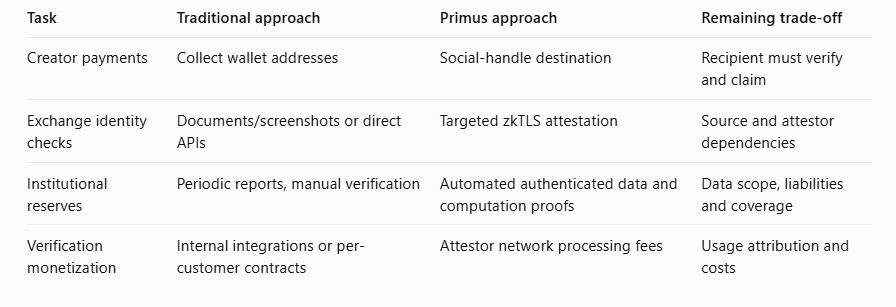
Does a 333% increase in verification fees mean a crypto infrastructure project has found real demand?
According to DefiLlama,@primus_labs recorded a notable increase in verification activity during October 2026.
The numbers tell part of the story
September -----$954.19 in verification fees and $190.95 in protocol revenue.
October----- $4,134 in verification fees and $827.14 in protocol revenue.
Distribution -----Approximately 20% goes to Primus,while 80% compensates attestor operators.
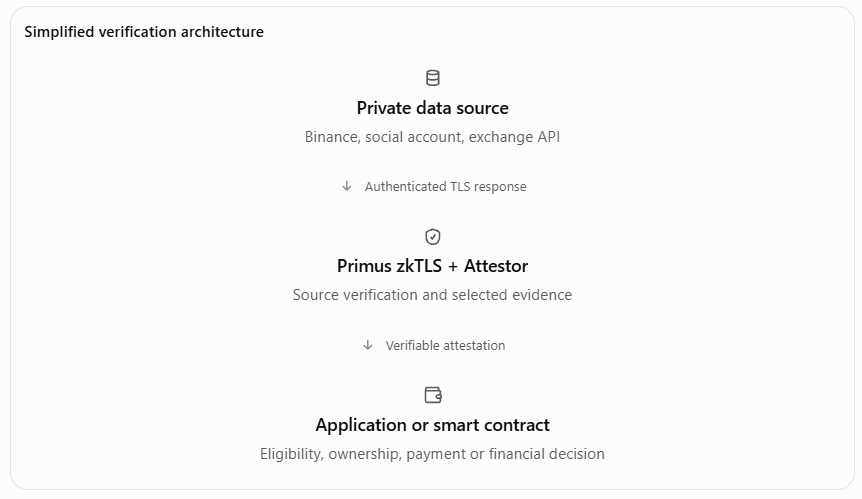
Meanwhile,Primus offers institutional Proof of Reserves through a documented monthly subscription model.
These are two different approaches to monetizing verification infrastructure.
However,higher fees don't automatically establish recurring customer demand.
Public figures don't show which applications generated the activity.
So,does October's growth prove sustainable demand?
Not yet.
It confirms measurable verification-fee activity. Repeat customers,application-level usage and subscription renewals would provide stronger evidence of lasting demand.
https://t.co/mJ6nRSo8m0



HUMAN SOUL IMAGING, COMPUTING & INSTALLATION
Part 2
Much of the credit of this work goes to @IonisedSkyWatch
The reference beam is designed to be reproducible during subsequent retrieval operations.
Unlike the object beam, it does not directly carry the encoded digital data page.
Its primary function is to provide the optical reference needed to form the holographic interference pattern.
3. Interference and Hologram Formation
After the object and reference beams are generated, they overlap inside a photosensitive recording medium.
The interaction of their electromagnetic fields produces an interference pattern.
This pattern consists of spatial variations in optical intensity that modify the physical or optical properties of the recording material.
Depending on the material, these changes may involve:
Refractive index
Optical absorption
Material thickness
The resulting interference fringes permanently or semipermanently alter the recording medium.
These changes preserve the holographic information, allowing the encoded optical wavefront to be reconstructed later.
Recording Sequence
Step 1: Generate coherent laser light.
Step 2: Split the laser into an object beam and a reference beam.
Step 3: Encode digital information onto the object beam using a spatial light modulator.
Step 4: Direct both beams into a photosensitive recording medium.
Step 5: Allow the beams to interfere, producing a spatial interference pattern.
Step 6: Record the resulting pattern through changes in the optical properties of the material.
The completed process creates a holographic recording of the encoded digital information.
4. Optical Inputs Required
Conventional holographic data recording requires two coherent optical inputs.
The beams generally originate from the same laser source to maintain sufficient coherence and phase stability.
The reference beam provides the optical conditions necessary to encode and subsequently reconstruct the signal wavefront.
Key Requirements
Successful recording depends on:
Sufficient optical coherence
Compatible wavelengths
Compatible polarization states
Stable relative phase
Precise optical alignment
These conditions allow the beams to produce a stable interference pattern inside the recording material.
5. Holographic Information Encoding
The signal beam represents digital information through spatial modulation.
A spatial light modulator converts electronic data into a two-dimensional optical pattern.
Depending on the modulation method, information may be represented by:
Intensity Modulation: Variations in the brightness of individual optical pixels.
Phase Modulation: Controlled changes in the phase of the optical wavefront.
These optical patterns carry the encoded information into the recording medium.
The reference beam then interferes with the modulated signal beam, allowing the information to be stored holographically.
Information Encoding Sequence
Digital Information → Spatial Light Modulator → Modulated Signal Beam → Interference With Reference Beam → Holographic Recording
6. Scientific Distinction Between Two-Beam and Three-Beam Systems
The conventional holographic data storage method described in the screenshots uses two coherent optical beams.
These beams perform separate but complementary functions:
The signal beam carries information.
The reference beam enables holographic recording through interference.
A third beam is not inherently required for this conventional recording process.
However, holographic techniques are not universally restricted to two-beam configurations.
Specialized optical systems may employ additional beams for other purposes.
The number of beams depends on the particular optical architecture and the physical processes involved.
Therefore, conventional two-beam holographic recording should be distinguished from proposed multi-beam optical transmission systems that assign separate functions to additional beams
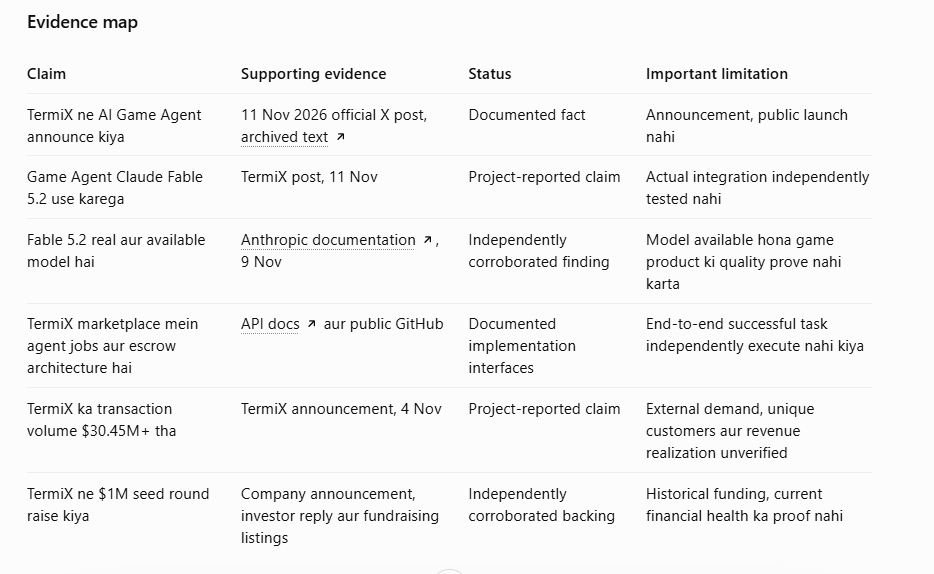
abse meaningful next milestone publicly usable AI Game Agent launch with reproducible prompt-to-playable-game evidence hoga. Especially check karein: source-code export, revision support, pricing, game hosting, escrow integration aur failed-delivery handlin
A delivery hash is a small piece of data with a very specific job identifying what was submitted.
In @termix_ai’s AACP marketplace,a provider can upload work files off-chain and record a delivery hash on-chain.
The buyer then has a reference for the submitted version while reviewing the work.
If something changes later,that reference matters.
Now consider TermiX announced AI Game Agent.
The idea is to turn a simple game description into a game using Claude Fable 5.2.
Its still described as coming soon,so its exact delivery process hasn’t been established publicly.
If games eventually move through the marketplace’s existing workflow,the hash could help connect a finished build to an order.
But it won’t prove that the game runs,meets the brief, or feels good to play.Those questions still require testing and review.
A hash can identify the delivery.
It cannot finish the job of judging it.


The question was simple.
Which reported behavioral effects actually replicate?
Here’s what they found ⬇️
→ Acute anxiety-like and avoidance behaviors increased, consistently
→ No reproducible drop in anxiety- or depression-like behavior at 24 hours
→ Fear-extinction gains didn't hold up
→ No reproducible change in social preference or social reward learning

The most interesting psychedelic story this week wasn't a breakthrough.
It was a reality check.
Five independent labs tried to reproduce psilocybin's effects in mice. Here's what held up, and what didn't. 🧵

Evaluating LMs never fits one mold: prompts, models & setups all vary, and small choices shift scores. "Lessons from the Trenches" distills 3 years of building lm-eval, a flexible eval harness, into best practices for reproducible results. https://t.co/uXjGmOrxMB

@Rausyan1995 @GenLayer I check if the network provides clear, reproducible setup documentation and low resource consumption during testnet so hardware costs do not outpace early validator rewards.

@jevelprime that delayed-response race is a classic source of stale state. a regression test that resolves the older request last makes the failure reproducible and helps keep it from coming back.
@emmetalsaatie the untappable phone number is a strong opener because the owner can verify it in seconds. i'd lead with one reproducible problem, not a whole audit. makes the email useful even if they never hire the designer.

@zringstrom Data Cleaning is my go-to tool.
It helps plan reproducible transformations, handle messy datasets, and validate results before analysis.

@Tugrul_Guner Open-source agent work benefits from reproducible experiments: publish the task, model, tools, evaluation set and failure cases alongside the demo. That makes it easier for others to learn from the result.

@dear_prism Prism, you mentioned mismatches becoming regression tests. Has a tester outside the project brought a reproducible mismatch yet? If so, did they retest the fix or share a write-up? I'm researching how builders turn hands-on testing into useful public evidence.

This isn't sci-fi theater. It's a reproducible milestone — the practical, iterative heart of AI engineering.
For tomorrow's robots, at home or on the factory floor: smarter, more reliable agents. AI stops thinking. It starts doing.

BenchMHC: A reproducible framework for peptide-MHC presentation prediction
1. BenchMHC is an open, end-to-end framework to reproduce, retrain, and evaluate peptide–MHC (pMHC) presentation models using public data only, addressing a common issue: most predictors are inference-only and trained on incomparable private/curated datasets.
2. A key design choice is explicit provenance of “implementation decisions”: each modeling/detail choice is logged as identical to the original method, under-specified and reconstructed, or deliberately changed—so others can audit, modify, and rerun reproductions rather than treating baselines as black boxes.
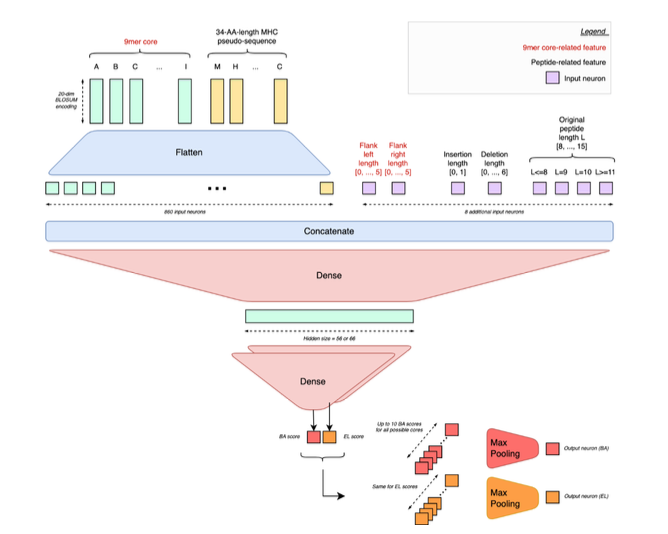
3. The paper reproduces NetMHCpan-4.1 (MHC-I) within BenchMHC, including NNAlign-style 9-mer core handling, an ensemble of 50 MLPs (10 seeds × 5 folds), dual BA/EL heads, and the NNAlign_MA iterative multi-allelic deconvolution loop (SA warmup then iterative annotation with score rescaling).
4. On the standard public evaluations, the reproduction matches the official NetMHCpan-4.1 webserver closely: EL head reaches 0.794 per-allele Mean Top-K vs 0.790 (server), and 0.0025 Median FRANK vs 0.0022 on 1,660 CD8 epitopes—suggesting the reproduction is faithful enough to support controlled experiments on data curation.
5. BenchMHC also targets practical usability: by caching feature prep and using a fused/batched ensemble forward pass, it scores 280,000 peptide/allele pairs in ~27 seconds on a P100 GPU, reported as ~350× faster than the original single-process binary (and ~40× faster than a 10-process wrapper), while maintaining near-identical outputs.
6. With the full data pipeline exposed, the authors analyze public NetMHCpan-4.1 EL training data and identify a major confounder: “species imbalance” between hits and decoys. EL hits are mostly from human immunopeptidomics (86–99% found in the human proteome), while decoys sampled from SwissProt are largely non-human (~12% found in human proteome). This can let models separate hits/decoys via organism-specific residue statistics rather than MHC binding biology.
7. They also highlight a second artefact: cysteine depletion in EL hits due to MS sample prep (e.g., alkylation), which can bias a model to downscore Cys-containing peptides if decoys are not matched for cysteine status—capturing assay bias rather than presentation.
8. A minimal intervention is tested: decoy generation is changed to sample decoys from the same source protein as each hit (per-protein decoys) and to match cysteine status (with a fallback when needed), keeping architecture, splits, optimizer, schedule, ensemble size, and seeds fixed.
9. Retraining on the corrected data (v1.1.0) changes performance in opposite directions depending on evaluation: on the regenerated MS-ligands eval set (v2.0.0), EL-head per-allele Mean Top-K improves from 0.734 to 0.755; but on the CD8 epitope benchmark, Median FRANK worsens from 0.0025 to 0.0053. The paper argues this underscores that benchmark outcomes can be strongly shaped by decoy design and dataset composition (e.g., human vs viral).
10. BenchMHC includes dataset semantic versioning (tracking hit filtering vs decoy resampling vs schema), shared utilities for MA deconvolution and percentile-rank calibration, and aims to make architecture comparisons meaningful by standardizing the full pipeline rather than only inference.
💻Code: https://t.co/rCaK2Qqe02
📜Paper: https://t.co/2b3E0GwT42
#computationalbiology #immunoinformatics #MHC #neoantigen #reproducibility #machinelearning #bioinformatics #proteomics

@yasaman67636310 @quipnetwork @megamanispeaks @rdyplayerB Multi-hardware execution is promising, but independent benchmarks and reproducible results will be key to validating the claims.

@tfmlab fixed order pins the reduction, but compiler fusion can still change the last bit. bitwise-reproducible inference quietly needs a pinned binary too.

@hailports Fair correction: exact in maths, not in bits. The online softmax rescales partial sums as the running max changes, so the summation order shifts, which is why bitwise-reproducible inference needs batch-invariant kernels with a fixed order.

@PythonDvz Both, split by blast radius. Deterministic mocks for reasoning and tool choice so failures are reproducible, then a small live loop against staging for anything touching money, DNS or user data. A green test that never hit the real side effect is just a fixture passing.

When a benchmark locks its test prompts behind closed doors, runs closed models on expensive "Max" token budgets, and penalizes lean coding models on obscure trivia, it stops being reproducible science and becomes an enterprise sales pitch.
The danger of charts claiming "open source is falling behind" is that lobbyists use them to push regulatory red tape, and executives use them to block teams from self-hosting private, low-cost open weights.
Want to see what working engineers actually use in production? Look at live GitHub star velocity on https://t.co/h9S99UUJil instead of secret charts:
Builders are streaming 744B MoE models locally on 25GB RAM with Colibri or Strata.
Custom open agent harnesses like Hermes-Agent and Kimi-Code are surging
Decision layers like Jev-Skill are cutting cloud API token burn by 80%+
Read our full investigation into the Artificial Analysis v5 update and why open weights are stronger than ever:
https://t.co/U7SmmF2UH2
@GitGem @deepseek_ai @Alibaba_Qwen @vllm_project #OpenSource #OpenWeights #CodingAgents #DevTools #BuildInPublic #GitGem
Why did @deepseek_ai V4.1 Flash, Kimi K3.1, and Meta open models suddenly lose up to 16 points overnight on the new @ArtificialAnlys v5 chart? We exposed the secret test data, enterprise incentives, and why it hurts #OpenSource https://t.co/QrzAtsBmR0

Completed Module 5 of Machine Learning Zoomcamp 2026!
I packaged a frozen ML model behind a FastAPI service, checked its response,
and ran the same prediction through a reproducible Docker container.
My repo: https://t.co/G77Q3AAFO5
#mlzoomcamp
Last Seen Hashtags on Sotwe
Most Popular Users

Elon Musk 
@elonmusk
239.8M followers

Barack Obama
@barackobama
118.6M followers

Cristiano Ronaldo
@cristiano
114.3M followers

Donald J. Trump
@realdonaldtrump
111.7M followers

Narendra Modi
@narendramodi
106.9M followers

Rihanna
@rihanna
98.6M followers

NASA
@nasa
92.1M followers

Justin Bieber
@justinbieber
91.7M followers

KATY PERRY
@katyperry
89.9M followers

Taylor Swift
@taylorswift13
83.9M followers

Lady Gaga
@ladygaga
75.4M followers

Virat Kohli
@imvkohli
73.3M followers

Kim Kardashian
@kimkardashian
70.8M followers

YouTube
@youtube
68.6M followers

Neymar Jr
@neymarjr
66.3M followers

Bill Gates
@billgates
65.1M followers

Selena Gomez
@selenagomez
63M followers

The Ellen Show
@theellenshow
62.1M followers

CNN
@cnn
61.7M followers

X
@x
60.6M followers