

Top Tweets for #SUBNETS

Good Afternoon Legends ❇️
Those who stayed through the quiet
will understand the noise that follows… 🙉💭
Signal > sentiment.
#Bittensor #TAO #AIInfrastructure #MachineIntelligence #AIEconomy #Subnets #AlignedAI #NetworkIntelligence

The
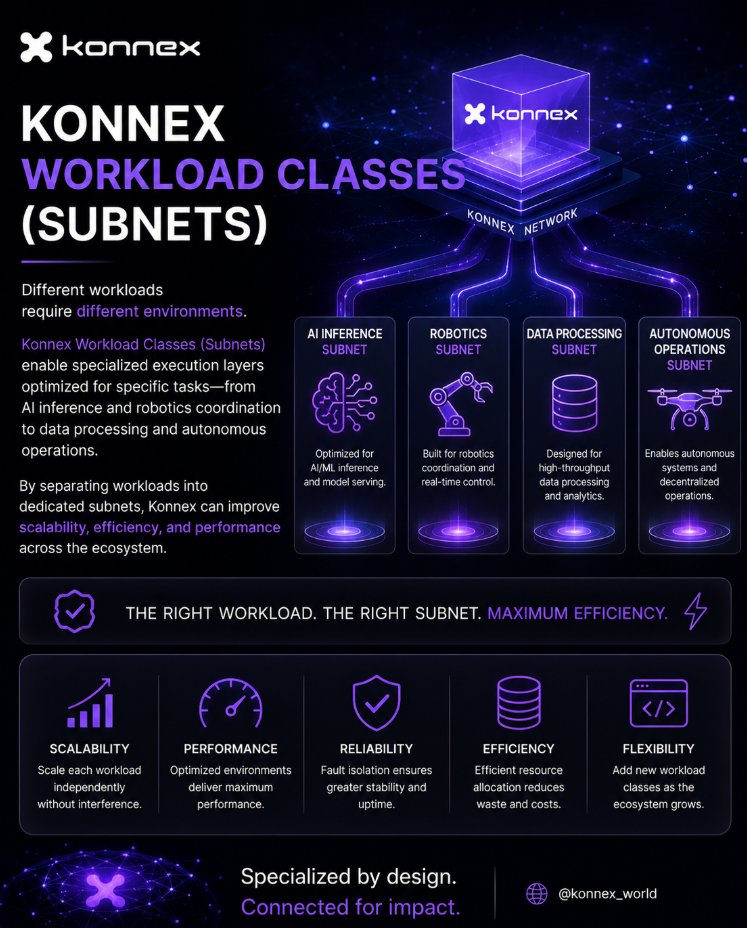
@konnex_world Workload Classes (Subnets) enable specialized execution layers optimized for specific tasks from AI inference and robotics coordination to data processing and autonomous operations. #Konnex #WorkloadClasses #Subnets #AI #Blockchain #Web3 #Robotics

The @konnex_world Workload Classes (Subnets) enable specialized execution layers optimized for specific tasks—from AI inference and robotics coordination to data processing and autonomous operations.
#Konnex #WorkloadClasses #Subnets #AI #Blockchain #Web3 #Robotics #Scalability

This #Trump comment is classic “government wants a piece of #AI” news, and it plays directly into #Bittensor’s strengths. It positions the entire Bittensor ecosystem ($TAO + #subnets) as the decentralized hedge against centralized AI getting cozy with Washington.
Expect more eyes on @opentensor as a result 👀🇨🇳 🇺🇸

JUST IN: 🇺🇸 President Trump says he thinks AI companies will give the US government ownership stakes.


When the red line catches the blue line, if the cost of the blue products/companies don’t go down to be the same cost of the red products/companies, the red companies will win.


This post is an accidental (or very on-brand) validation of #Bittensor’s entire thesis. Human progress exploded once brains started trading ideas openly. Bittensor is doing the same for silicon brains—at global, permissionless, incentive-aligned scale.
The #subnets that treat themselves as nodes in a living, recombining intelligence network (instead of isolated kingdoms) are the ones that will capture the upside. It’s not just bullish for $TAO—it’s the operating manual

A British biologist looked at 200,000 years of human history and found that the entire reason humans broke out of poverty was not intelligence, not language, not even agriculture, but one mechanism so simple a 6-year-old could explain it.
His name is Matt Ridley.
He is a zoologist by training, an evolutionary biologist by career, and in 2010 he wrote a book called The Rational Optimist that quietly argued the most important fact about human progress had been hiding in plain sight for the entire history of economics.
Naval Ravikant has been telling people to read everything Ridley has ever written for the last 15 years. The reason is the argument inside this one book.
For 200,000 years, anatomically modern humans walked around with the same brain you have right now. Same skull size. Same neural architecture. Same raw capacity for language, planning, and abstract thought.
For roughly 190,000 of those years, almost nothing happened. Generation after generation lived and died inside the same Stone Age toolkit their great-great-grandparents had used. Then somewhere around 50,000 years ago, the line on the chart of human progress started to tick upward. Then it bent. Then it exploded.
The question Ridley spent years on was the only question that mattered. What changed.
It was not the brain. The brain had been the same for 190,000 years. It was not language, which had existed long before the takeoff. It was not even agriculture, which arrived only 10,000 years ago and was actually preceded by the upward bend, not the cause of it.
What changed was that humans started trading with strangers.
This sounds too small to be the answer. Ridley argues that it is the answer to almost everything. The moment one human exchanged a useful object with another human from a different group, something happened that no other species on earth had ever done.
Two ideas that had developed in isolation came into contact. The flint knapper learned what the spear maker had figured out. The fisherman from the coast learned what the hunter from the forest had figured out. The two pieces of knowledge fused into something neither side could have produced alone.
Ridley calls this ideas having sex. The phrase sounds frivolous and it is meant to. The point is that ideas, like genes, get better when they combine with other ideas from different lineages.
An idea sitting inside one head, no matter how brilliant the head, eventually hits a ceiling. The same idea exposed to ten thousand other ideas does something genes do under sexual reproduction. It mixes. It recombines. It produces offspring nobody planned.
The cleanest proof of this argument is the most uncomfortable case study in the book. Tasmania.
Around 10,000 years ago, rising sea levels cut Tasmania off from mainland Australia. A population of roughly 4,000 humans was now isolated on an island, with no possibility of contact with the rest of humanity. They had the same brains. The same language. The same starting toolkit as their cousins 150 kilometers north. The natural experiment was now running.
What happened next is something no economist or geneticist had ever predicted.
The mainland Australians kept inventing. Boomerangs. Spear-throwers. Fishing nets. Bone needles for sewing fitted clothes. Watercraft with paddles. Their technology compounded slowly across the centuries.
The Tasmanians went the other way. They did not just fail to invent the new tools their cousins were developing. They started losing the tools they already had. Fishing was abandoned within a few thousand years. Bone tools disappeared. Fitted clothing disappeared. They forgot how to make fire from scratch and started carrying lit firebrands from camp to camp instead, relighting their fires from a neighbor's whenever their own went out.
By the time European explorers arrived in the 17th century, the Tasmanians had the simplest toolkit of any human society ever recorded. Their material culture had gone backward for 8,000 years.
The archaeologist Rhys Jones called it a slow strangulation of the mind.
Joseph Henrich at Harvard later proved with formal mathematical models that there was nothing wrong with Tasmanian brains. There was something wrong with their network. A toolkit requires a critical mass of people exchanging skills to maintain itself.
The act of teaching a skill is imperfect. Every generation loses a small percentage of what the last generation knew. If your population is large enough and trading widely enough, those losses get caught and corrected by someone else who still remembers.
If your population shrinks below a certain threshold and stops mixing with outsiders, the small losses compound until entire technologies disappear.
This is the part that should haunt anyone reading this in 2026.
Intelligence is not a property of the individual brain. Intelligence is a property of the network the brain is connected to. A genius in isolation will produce less than a mediocre thinker inside a dense exchange of other mediocre thinkers.
The thing your ancestors needed in order to break out of 190,000 years of stagnation was not better brains. It was better connections between brains they already had.
The implication for any individual is direct and uncomfortable. If you are smart and isolated, you will be outproduced by people half as smart who are connected.
The most successful people in any field are almost never the smartest people in it. They are the ones positioned at the intersection of the most idea flows. They are reading more authors than their competitors. They are talking to more people from more disciplines. They are in the rooms where ideas from different lineages bump into each other.
Ridley ends the book on the line that sounds optimistic but is actually a warning its this "The future will be invented by people who connect ideas, not by people who guard them."


The future is not something you wait for; the future is what you MAKE happen…
#CryptoMonk #TAO #Subnets
#MachineInteligence #DePIN

@taostats Cutting the noise and rewarding real utility is directly driving up subnet quality. Bittensor’s governance is maturing perfectly right now 👏🔥
Bullish like never before on #Bittensor #Subnets $TAO! 🚀
Incredible momentum on the @opentensor network this week! Have you noticed the emissions doubling across the majority of the top 15 #Bittensor #subnets? The $TAO flow is actively adapting, proving the dynamic scaling capabilities of the ecosystem in real-time 🚀

This is precisely why @opentensor + its 128+ #subnets exist…
Decentralized intelligence. Market-driven alignment. No single point of failure. No guardian class.
Subnets compete openly to deliver useful #AI that serves people, not power.
The Vatican sees the problem.
Sacks sees the trap.
Bittensor is the live solution!
#Bittensor $TAO #DecentralizedAI #opensource

The Pope rightly warns that AI must serve human dignity, not become a tool of domination or exclusion.
But if we hand governments sweeping power over AI development in the name of safety, how do we prevent it from being used to censor, surveil, and control citizens — as Orwell foretold in 1984?
This is the real alignment problem.
“Quis custodiet ipsos custodes.” Who will guard the guardians?
“Power tends to corrupt, and absolute power corrupts absolutely.”
The oldest questions of human nature and authority don’t disappear in the AI age. They become newly relevant.
#Bittensor $TAO was built for exactly this moment: a permissionless, incentive-aligned marketplace for the intelligence reshaping the global economy…
Expect rising demand for top #subnets, greater participation from the next-generation workforce, and a powerful flywheel effect for TAO as the currency of decentralized intelligence.
This is no longer abstract futurism — it’s already showing up in payroll data.

THE AI JOB BLOODBATH HAS STARTED 🚨
Goldman Sachs says AI is already destroying around 16,000 US jobs every single month.
The biggest losers are Gen Z workers as companies rapidly automate entry level white collar jobs with AI.


The success of #Bittensor is tied to the success of its #subnets!
That’s why I am optimistic about the top subnets
$TAO 👑

Subnet 5, HONE
I don't like to be that kind of guy but I told you so. Still early.
$TAO
#SUBNETS
#SN5
#Bittensor


.
$TAO
Strong macro support
Bullish on weekly
Beautiful chart
$477 is a matter of time 🕰️
.


subnets on @eCash $XEC eCash are awesome
Learn more here
#Subnets #Drivechains #Bitcoin #crypto
https://t.co/UvYJq7TL1e


Last Seen Hashtags on Sotwe
Trends for you
Most Popular Users

Elon Musk 
@elonmusk
240.2M followers

Barack Obama
@barackobama
119.3M followers

Donald J. Trump
@realdonaldtrump
111.6M followers

Cristiano Ronaldo
@cristiano
109.4M followers

Narendra Modi
@narendramodi
106.9M followers

Rihanna
@rihanna
97.4M followers

NASA
@nasa
92.1M followers

Justin Bieber
@justinbieber
90.7M followers

KATY PERRY
@katyperry
87M followers

Taylor Swift
@taylorswift13
80.9M followers

Lady Gaga
@ladygaga
72.4M followers

Kim Kardashian
@kimkardashian
69.5M followers

Virat Kohli
@imvkohli
68.9M followers

YouTube
@youtube
68.6M followers

Bill Gates
@billgates
63.5M followers

The Ellen Show
@theellenshow
62.5M followers

CNN
@cnn
61.9M followers

Neymar Jr
@neymarjr
61.5M followers

X
@x
60.9M followers

Selena Gomez
@selenagomez
60.1M followers