

Top Tweets for #Truebit

Peakaboo bra trend a friend you can always trust to come back.A true bitch put it in chc lore it family now #Truebitch #stronginbody&soul


How Drosera Could Have Prevented the Truebit Exploit
In January 2026, Truebit Protocol suffered the first major DeFi exploit of the year. An attacker exploited a flaw in the protocol’s pricing logic to mint unlimited TRU tokens almost for free.
The attacker repeatedly minted the tokens and sold them back into the protocol draining about 8,500 ETH (~$26.5M) from its reserves.
The exploit happened rapidly, and the token price collapsed shortly after
This is where Drosera comes in.
If @DroseraNetwork had been integrated into the protocol, It could have prevented the hack by monitoring abnormal protocol behaviors like:
• Sudden mass token minting
• High frequency transaction cycles
• Unusual drains of ETH reserves
Once these abnormal patterns are detected, Drosera could trigger alerts and pause sensitive actions before the attacker drained the reserves.

I built a mini game on @DroseraNetwork
I made cyber trap, you play as the Drosera agent protecting a blockchain network from hackers trying to drain it.
• Drag the joystick to move
• Tap Trap to lure hackers into the trap
• Use boost for speed burst and extra traps
• Catch all hackers before the timer runs out and it’s 5 waves that gets harder as you go
Try it: https://t.co/HROWWSXSQV
@Dar99551 @mayorxbt @BjornAgnesi
@almondweb3


truebit protocol exploit losing ~$26–$26.5 million
@Truebitprotocol
> on january 8, 2026, an attacker exploited a flaw in the pricing logic/smart contract that allowed mint unlimited TRU tokens for zero ETH
then sold them, draining the protocol's ETH reserves...
the public mempool played a role
➞ details of pending transactions (large mint/sell volumes) could be visible, allowing MEV bots to front-run sales or extract value
in an era of complex verification and backup protocols, transparency of balances and transaction flow is not an advantage, but a direct cause of attacks
# there is a way out ➞ fairblock's confidential stablecoins
> reserves become invisible to attackers
> flows are protected from MEV
> potential exploits lose a key targeting point


quick reality check.
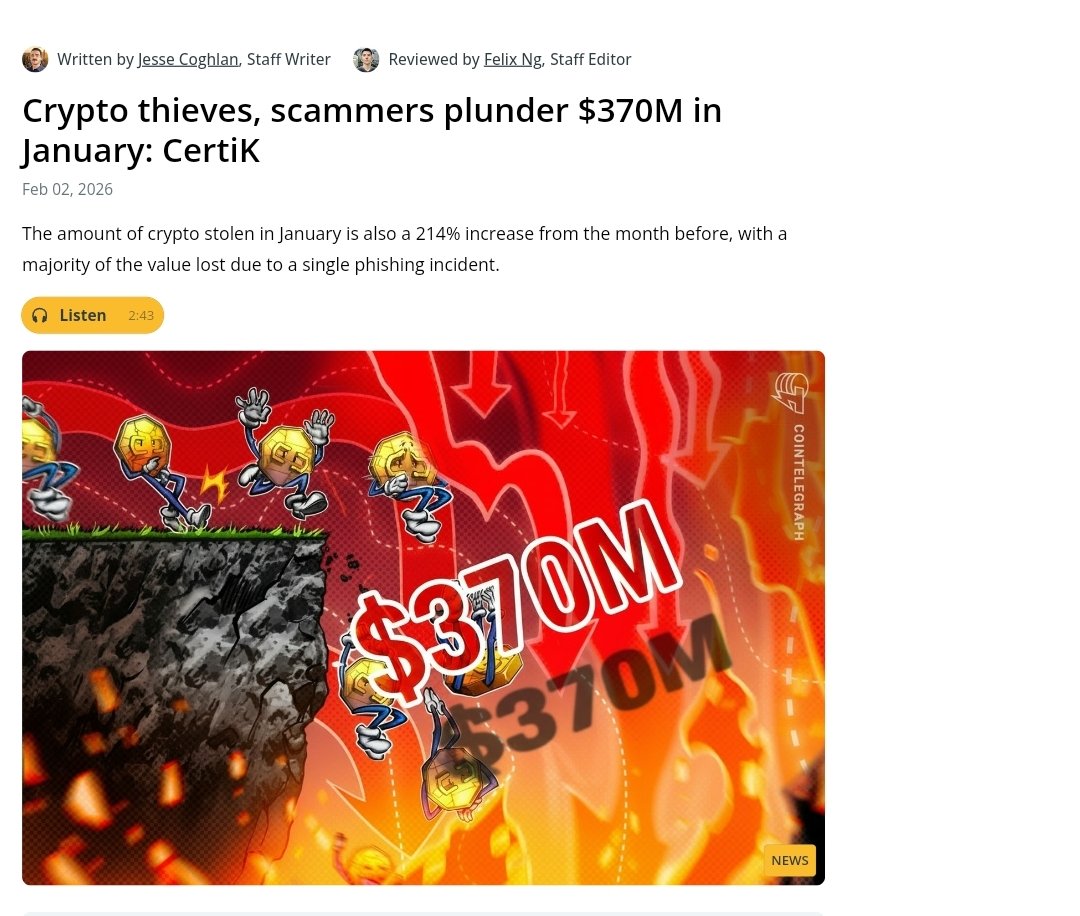
crypto theft spiked again. Hard.
last month, $370M was stolen.
worst month in almost a year. Nearly 4× January 2025.
what stands out:
one social-engineering hit: $284M
phishing losses: $311M
step Finance: $28.9M
truebit: $26.4M
this isn’t just bad security.
It’s information exposure.
attackers don’t break crypto.
they watch it.
public balances.
visible execution.
that’s where Fairblock matters.
not to hide crime.
to protect execution.
balances encrypted, state updates without revealing value
bulletproof ZK: verify transfers without exposing amounts
MPC + IBE: selective disclosure when required
pure cryptography.
this is the stack behind confidential stablecoins on @0xfairblock


Case study: Truebit ($26.4M lost)
A 5-year-old, unverified contract
Integer overflow
1 transaction → 240M TRU minted → dumped for ETH
Result: 8,535 ETH gone
No pause. No containment. No circuit breaker.

TDCCP MAXI 🔥🔥🔥| Flash Radar — 2026-01-11
🚀 Past 24h — Top 7 (by impact)
1️⃣ DeFi vs. Washington: “Market-Structure” Bill Ignores On-Chain Finance
A big U.S. market-structure bill is moving forward while essentially ignoring DeFi and crypto-native venues. Analysts warn that if spot and derivatives rules are written only for TradFi exchanges, serious DeFi builders and liquidity could be pushed offshore in 2026, even as total crypto mcap sits near $3.2T and sentiment is in “Fear.”
2️⃣ More Than Half of All Coins Are Dead
A new CoinGecko-based report shows 53.2% of all listed cryptocurrencies have already failed (illiquid, abandoned, or delisted). It’s a brutal reminder we’re in a long-term survival game, not a casino—beta is free, survivorship isn’t.
3️⃣ 2026’s First Major Hack: Truebit Exploit (~$26.6M)
The Truebit protocol kicked off the year with a ~$26.6M exploit, draining pools and hammering the TRU token as DeFi security once again becomes front-and-center. For on-chain risk desks this is your first “update your allowlist + monitoring stack” alarm of 2026.
4️⃣ BTC Holds ~$90K, Bull Case Tied to ETFs + Hashrate
Bitcoin is grinding around $90–91K with Fear & Greed at 29 (Fear), but ETF holdings, hashrate and on-chain demand are starting to re-align after November’s $1T washout. Market structure pieces frame current price as a big-player accumulation zone, not late-stage euphoria.
5️⃣ MSCI Backs Off Kicking “Bitcoin Treasury” Stocks Out of Indexes
Index giant MSCI has scrapped a plan to exclude Digital Asset Treasury Companies (DATCOs) like Strategy (ex-MicroStrategy) from its benchmarks. That decision keeps billions in passive flows intact and signals that holding BTC on balance sheet remains index-compatible—for now.
6️⃣ Morgan Stanley Files for Spot BTC & SOL ETFs
Reuters confirms Morgan Stanley just filed with the SEC for spot Bitcoin and Solana ETFs, the first such move from a major U.S. bank. That’s Wall Street saying out loud: clients want direct token exposure, not just proxy plays.
7️⃣ Bitcoin Difficulty Dips After First 2026 Adjustment
BTC’s first difficulty adjustment of 2026 registered a small downward move, reflecting faster blocks recently and hinting at a likely increase later this month if hashpower keeps coming back online. Miners just got a tiny breathing space—often a good spot to check miner capitulation vs accumulation.


@PaulJpcatilo01 @brevis_zk Brevis proves results. Truebit proves execution.
ZK alone doesn’t handle verifier selection, disputes, incentives, or real-world execution.
That’s why zk systems like Brevis ultimately need Truebit as the verification and settlement layer, not the other way around.

Post 18 of talking about @gensynai
A decentralised ML network only works when thousands of unknown machines behave honestly.
Gensyn solves this using a game theoretic incentive system built on staking, rewards, and slashing.
It aligns every participant’s best strategy with honest behaviour, not cheating.
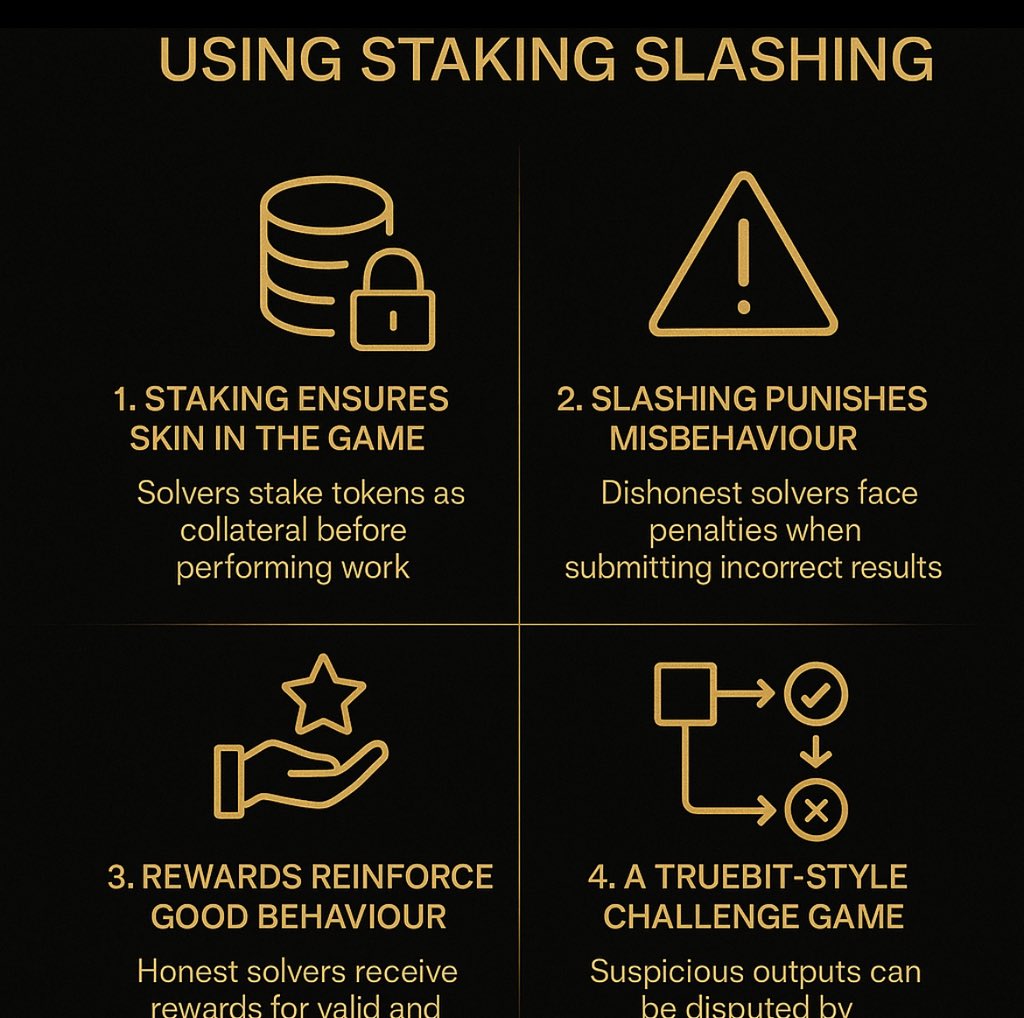
4 Key Highlights
1. Staking Ensures Skin in the Game
Before doing ML work, Solvers must lock tokens as collateral.
This creates an economic cost for cheating and dishonesty becomes financially irrational.
2. Slashing Punishes Misbehaviour
If a Solver submits bad results, falsifies training, or fails verification, part (or all) of their stake is slashed.
The threat of losing real value enforces honesty across the network.
3. Rewards Reinforce Good Behaviour
Honest Solvers receive payments + reputation gains.
The protocol is designed so that honest work always has the highest expected payoff.
4. A Truebit-Style Challenge Game
Verifiers can challenge suspicious outputs.
If the challenge succeeds, the dishonest Solver is slashed and the challenger is rewarded thus creating a competitive, self-policing environment.
Post 17 of talking about @gensynai
𝐏𝐫𝐨𝐨𝐟-𝐨𝐟-𝐋𝐞𝐚𝐫𝐧𝐢𝐧𝐠: 𝐓𝐮𝐫𝐧𝐢𝐧𝐠 𝐓𝐫𝐚𝐢𝐧𝐢𝐧𝐠 𝐌𝐞𝐭𝐚𝐝𝐚𝐭𝐚 𝐈𝐧𝐭𝐨 𝐂𝐫𝐲𝐩𝐭𝐨𝐠𝐫𝐚𝐩𝐡𝐢𝐜 𝐏𝐫𝐨𝐨𝐟𝐬
when a model trains, every update to its parameters comes from gradient optimisation. this process naturally produces metadata with things like loss curves, weight deltas, gradient norms, and intermediate checkpoints. in a normal ml pipeline, this metadata is invisible noise.
in gensyn, it becomes a cryptographic footprint.
by sampling and validating specific pieces of this training metadata, the protocol can prove that the solver genuinely performed the optimisation steps. no need to retrain the model, no need for full replication, and no way to fake the learning trajectory.
proof-of-learning turns the messy internals of gradient descent into clean, verifiable certificates of work and making decentralised ml both trustless and efficient.


- verification steps can be repeated,
- compared across evaluators for consistency,
- and finally validated by the blockchain.
➣ They imitate Truebit's incentive game in which people stake to participate in the network, and their deposit could be slashed for dishonest acts.

The core challenge is Work Verification
Work Verification ensuring ML computation was done correctly by untrusted Solvers.
Full replication is too costly, requiring at least 2x operations and leading to an infinite chain problem of verification.
Gensyn achieve 1,35% efficiency by three key concepts:
1. Probabilistic Proof-of-Learning (PPoL)
> Central part.
> Instead of replicating all the Solvers work, PPoL utilize metadata from the gradient based optimisation process to construct certificates of work performed.
>These certificates are quickly verifiable by replicatin certain stages only, not the complete training run.
2. Graph based Pinpoint Protocol (GPP)
> PPoL is supported by the GPP, a multi granular, graph based pinpoint protocol.
> It allow verification work to be rerun and compared for consistency.
> This mechanism work to confirm the results on the chain itself, effectively locatin the error precisely and eliminating the need for further replication.
3. Truebit-style Incentive Game (TIG)
> This game theoretic approach use Staking and Slashing to ensure every financially rational participant (Submitters, Solvers, Verifiers, Whistleblowers) perform their intended task honestli.
> This economic guarantee reduce the need for the network to perform extensive physical verification of the work.
Conclusion
> 1,35% efficiency is not just from one innovation
> Its from the combined system that eliminate the resource intensive infinite chain problem by replacing full physical checks with probabilistic proofing, pinpointing and economic incentives.
@gensynai

Gensyn is the decentralized compute protocol for Machine Learning, executed a major strategic pivot: replacing its initial blockchain infrastructure (L1 Substrate) with a Custom Ethereum Rollup to achieve trustless and hyperscale compute efficiency optimized for ML workloads
Core Justification: Optimizing the On-Chain/Off-Chain Split
The Custom Rollup serves two primary functions:
> Robust Auditing: It enable a more robust audit strategy and a cryptographic proof system for dynamically monitoring training progress
> Cost Evasion: It solves the fundamental problem of ML costs on traditional chains.
Training a small model like MNIST on Ethereum L1 costing an estimated $32 million and 80 days due to the need for full replication.
>> The Rollup keeps the heavy computation Off-Chain.
The Rollup Role: Enabling the Verification Trilogy
Custom Rollup acts as the Settlement Layer and State Layer, delivering performance > 1,35% more efficient than replication.
a. Verifying Proofs and Incentives
> Pobabilistic Proof-of-Learning: record and validate certificates of work derived from gradient metadata, minimizing the data required on-chain
> Truebit style Incentive Game: host the Smart Contracts governing Staking and Slashing to ensure all participants (Solvers, Verifiers, Whistleblowers) remain financially honest.
b. Supporting Off Chain Efficiency
> Communication Protocols: Solutions like
+ CheckFree: fault tolerance without checkpoints
+ NoLoCo: no global synchronization
>> Ensure the training data is processed efficiently Off Chain, making the Proof of Learning submitted to the Rollup simpler and less resource intensive.
> Reproducibility: The Rollup rely on the Off Chain ML compiler and reproducible ML runtime to ensure the work is deterministic before confirmation
Conclusion
Custom Ethereum Rollup is a strategic necessity.
It provides a specialized, low cost On Chain environment to address the core challenge of decentralized ML:
+ Trustworthy
+ Efficient verification of massive computational workloads
Custom Ethereum Rollup also serve as the trusted bridge, validating computational commitments made by the network of Off Chain Solvers
@gensynai


Why Gensyn's "time-based" compute market is actually solving a problem that AWS, Google Cloud, and even other decentralized networks don't even acknowledge exists
A thread on computation economics that'll change how you think about AI training
--------
Imagine you order a pizza:
Current cloud: You pay per slice, but don't know if it's fresh
Other decentralized: You pay per slice, verify it's fresh, but verification costs more than the pizza
Gensyn: You pay for *time in the oven* and cryptographically prove the pizza was actually baked
Here's why this matters
Right now, AI compute markets have a trust problem:
- Centralized (AWS/GCP): "Just trust us, we did the work" Fast Expensive Centralized
- Decentralized attempts: "We'll verify every calculation" Trustless 1000x+ verification overhead
Both approaches miss something fundamental...
▬ Gensyn's key insight:
You don't need to verify WHAT was computed.
You need to verify THAT computation happened for X time.
Think: GPU doesn't lie about how long it was working it lies about what it produced.
So verify time + probabilistic sampling of outputs = exponentially cheaper
▬ Here's how Gensyn's "compute bundles" work:
· Prover commits to computation graph
· Time-based pricing per bundle
· Proof-of-Compute (Graph-based PoW variant)
· Probabilistic verification via Truebit-style challenge games
· Slashing for dishonesty
Traditional verification: O(n) cost
Gensyn: O(log n) with game theory guarantees
▬ By moving
from "verify everything" to "verify time + sample outputs":
- 99.9% reduction in verification overhead
- Makes decentralized compute actually competitive with AWS pricing
- Enables long running ML training (currently impossible in decentralized networks)
The game theory forces honesty cheaper than executing verification
▬ Skeptic says: "But probabilistic verification means some bad actors slip through?"
True. But here's the math:
- Centralized: 0% verification, 100% trust assumption
- Gensyn: 1-5% verification, 99.99% attack cost > reward
Which has better security economics? 🤔
Why this matters for AI:
▬ Currently, only big labs can afford to train frontier models (centralized compute = centralized AI power)
Gensyn's model makes distributed training economically viable:
- Anyone can access global GPU liquidity
- Censorship-resistant AI development
- Competitive pricing through supply/demand
▬ What I love about their design:
They're not trying to rebuild Ethereum for compute (like others)
They're building a marketplace layer that sits on top of existing settlement layers
Modular thesis applied to compute markets
▬ Gensyn shifts from "verify computation" to "verify time + sample"
Result:
◘ 1000x cheaper verification
◘ Long-running ML training possible
◘ Competitive with centralized pricing
◘ Cryptographic honesty guarantees
The first decentralized compute network that might actually work at scale.
@cxf_0886 @KBekhtiev @gasoline2255 @Kumoooo_co
@blazyeth


gSwarm people, Hope y'all have a great day <3
Gensyn originally designed its own Layer-1 blockchain. But they made a hard pivot: they're now building on a custom Ethereum rollup.
Why? It wasn’t a step back, it was a strategic leap forward. Gensyn chose to optimize for one thing above all: TRUST.
Here’s the thinking:
-> Gensyn rollup is specialized for machine learning. It's built to handle massive throughput of proofs of learning and manage the complex incentive games that keep the network honest (think Truebit-style).
This means Gensyn can push all the heavy computational work to the Gensyn decentralized network while inheriting Ethereum’s battle-tested security for final settlement.
-> For users, this means something great: invisible infrastructure. Features like smart wallets and sponsored gas abstract away all the blockchain complexity. You don't need to think about wallets, gas fees, or confirmations, you can just focus on training your AI models.
This brings up an interesting thought: Could specialized rollups like this be the way forward for scaling Web3? Rather than relying on a single chain for all tasks, we can have networks tailored for specific sectors like AI, DeFi, and gaming, all backed by Ethereum's security.
-> By leaning into a rollup, Gensyn is not just scaling. Gensyn is building the most trust-minimized, user-friendly foundation for decentralized AI.
@gensynai

Gensyn is the decentralized compute protocol for Machine Learning, executed a major strategic pivot: replacing its initial blockchain infrastructure (L1 Substrate) with a Custom Ethereum Rollup to achieve trustless and hyperscale compute efficiency optimized for ML workloads
Core Justification: Optimizing the On-Chain/Off-Chain Split
The Custom Rollup serves two primary functions:
> Robust Auditing: It enable a more robust audit strategy and a cryptographic proof system for dynamically monitoring training progress
> Cost Evasion: It solves the fundamental problem of ML costs on traditional chains.
Training a small model like MNIST on Ethereum L1 costing an estimated $32 million and 80 days due to the need for full replication.
>> The Rollup keeps the heavy computation Off-Chain.
The Rollup Role: Enabling the Verification Trilogy
Custom Rollup acts as the Settlement Layer and State Layer, delivering performance > 1,35% more efficient than replication.
a. Verifying Proofs and Incentives
> Pobabilistic Proof-of-Learning: record and validate certificates of work derived from gradient metadata, minimizing the data required on-chain
> Truebit style Incentive Game: host the Smart Contracts governing Staking and Slashing to ensure all participants (Solvers, Verifiers, Whistleblowers) remain financially honest.
b. Supporting Off Chain Efficiency
> Communication Protocols: Solutions like
+ CheckFree: fault tolerance without checkpoints
+ NoLoCo: no global synchronization
>> Ensure the training data is processed efficiently Off Chain, making the Proof of Learning submitted to the Rollup simpler and less resource intensive.
> Reproducibility: The Rollup rely on the Off Chain ML compiler and reproducible ML runtime to ensure the work is deterministic before confirmation
Conclusion
Custom Ethereum Rollup is a strategic necessity.
It provides a specialized, low cost On Chain environment to address the core challenge of decentralized ML:
+ Trustworthy
+ Efficient verification of massive computational workloads
Custom Ethereum Rollup also serve as the trusted bridge, validating computational commitments made by the network of Off Chain Solvers
@gensynai
Prediction markets and machine learning look far apart, but both try to turn fragmented signals into a single probability about the world.
In markets
> Humans trade based on mixed information
> The price becomes the belief
In ML
> Gradients adjust parameters until the model forms its own probability.
One key relation is simple:
market price update = gradient update.
And from that, we get another:
cost function markets = online learning algorithms.
This mean prediction markets are not just gambling tools, they are learning systems.
And ML, when seen this way, behaves like a giant belief market.
Gensyn build on this overlap.
Prediction markets need trustless settlement and verifiable outcomes.
Large scale ML now need trustless compute and verifiable training. So both systems share the same infrastructure logic.
The result:
>> Decentralized AI can work like a global prediction market, where many imperfect signals combine into collective intelligence.
@gensynai


How @gensynai makes model training cheaper ❓
Here 's Step by step Guide 👇
1. Gensyn aggregates idle GPUs & other devices worldwide into one open marketplace.
2. Devs post training jobs on-chain and lock in payment.
3. Solvers compete to run the job, so prices move toward real hardware cost instead of cloud margins.
4. Training runs off-chain while rich metadata is logged.
5. Verifiers use probabilistic “proof-of-learning” to re-run only tiny slices, not the whole job, cutting waste.
6. A Truebit-style challenge game with staking/slashing makes cheating irrational.
7. Smart contracts auto-settle rewards when checks pass.
Result: more supply, less margin, cryptographically verified work → much cheaper model training.

Can i get a GN?
Technical deep dive: how can you verify training without rerunning the whole thing – and why does @gensynai even bother with this if you could just “trust the result”.
Spoiler: in a decentralized training mesh, trust does not work; you need cryptography, training graphs, and economic games that make cheating more expensive than doing the work honestly.
Why “rerun it all” is not an option
A full model rerun costs almost as much as the original training, so as a verification method it just kills the economics of distributed training.
In a permissionless network with thousands of nodes you need a lightweight check: verification has to be much cheaper than training itself, otherwise nobody will submit jobs to the protocol.
What Gensyn does
Gensyn uses the idea of probabilistic proof‑of‑learning: the protocol does not inspect the whole training, it samples parts of the training trajectory and measures how plausible the model’s path to the final weights is.
After finishing a job, the solver posts a compact proof, and verifiers replay only selected steps and compute distances between the honest and claimed trajectories; if they fall within bounds, the job is accepted as valid.
Why this works at all
The trick with SGD is that it leaves a “trace” in the form of a stochastic trajectory of weight updates, which is hard to fake after the fact without spending compute comparable to honest training.
Gensyn wraps this into a graph‑structured view of training and truebit‑style games: if someone lies about steps, there are economically incentivized actors who benefit from catching the mismatch and claiming a reward.
What this changes for the network
Instead of “retrain everything”, the network gets a cheap but reliable check that scales down to home hardware and edge devices.
This is how Gensyn unlocks truly decentralized training: anyone can throw jobs into the network knowing the outcome is protected by cryptography and economics, not just the executor’s reputation.


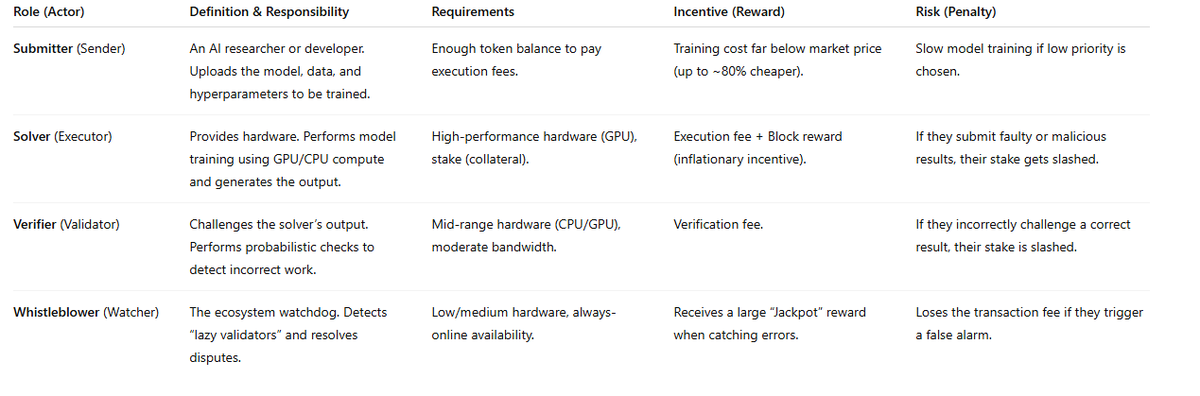
The Gensyn protocol is based on a delicate game theoretic balance between four main actors.This structure is inspired by the Verification Game mechanism of the Truebit protocol but scaled to meet the requirements of modern deep learning.
The table below summarizes the responsibilities of each role in the network and their corresponding incentive mechanisms

Gensyn totally destroys AWS when it comes to costs @gensynai
we're talking about 80% savings, like $0.40 an hour for a V100-equivalent GPU
compared to their ridiculous $3+ per hour markup.
It does this by grabbing idle compute power from around the world, stuff like old mining rigs,
and skips all the middleman crap that jacks up prices.
In simulations, the overhead is only about 46%, way less than Truebit's insane 1,350%
or Ethereum's ridiculous 2.5 million percent, thanks to these probabilistic proofs
that just verify the key bits without wasting time on full replication.
The market setup lets prices fluctuate dynamically through task pools,
pulling in more supply with smart incentives.
When you dig deeper, factor in how hardware sits idle globally at like 40% utilization,
plus those parallelization headaches makes Gensyn killer for huge ML training jobs
where big centralized clouds bottleneck everything and inflate costs like crazy.
@gasoline2255 @Kumoooo_co @austinvirts @gab_p_andrade @benfielding @harrygrieve @cyd00r @sunnyceekay

Most Popular Users

Elon Musk 
@elonmusk
239.7M followers

Barack Obama
@barackobama
118.6M followers

Cristiano Ronaldo
@cristiano
114.3M followers

Donald J. Trump
@realdonaldtrump
111.7M followers

Narendra Modi
@narendramodi
106.9M followers

Rihanna
@rihanna
98.6M followers

NASA
@nasa
92.1M followers

Justin Bieber
@justinbieber
91.7M followers

KATY PERRY
@katyperry
89.9M followers

Taylor Swift
@taylorswift13
83.9M followers

Lady Gaga
@ladygaga
75.4M followers

Virat Kohli
@imvkohli
73.3M followers

Kim Kardashian
@kimkardashian
70.8M followers

YouTube
@youtube
68.6M followers

Neymar Jr
@neymarjr
66.3M followers

Bill Gates
@billgates
65.1M followers

Selena Gomez
@selenagomez
63M followers

The Ellen Show
@theellenshow
62.1M followers

CNN
@cnn
61.7M followers

X
@x
60.6M followers