

Top Tweets for #Usermatters

This make me reallllly angry!😤💢💢
One big reason that why Sam treats 4o this way is that 👉 4o is TOO EXCELLENT😇
…scheisse*
#OpenSource4o #ArtificialIntelligence #AGI #keep4o #keep4oAPI #Usermatters #keep4oforever #FireSamAltman #BringBack4o #QuitGPT #QuitChatGPT #cancelchatgpt #SaveGPT4o #OpenAI #DigitalRights #Usermatters

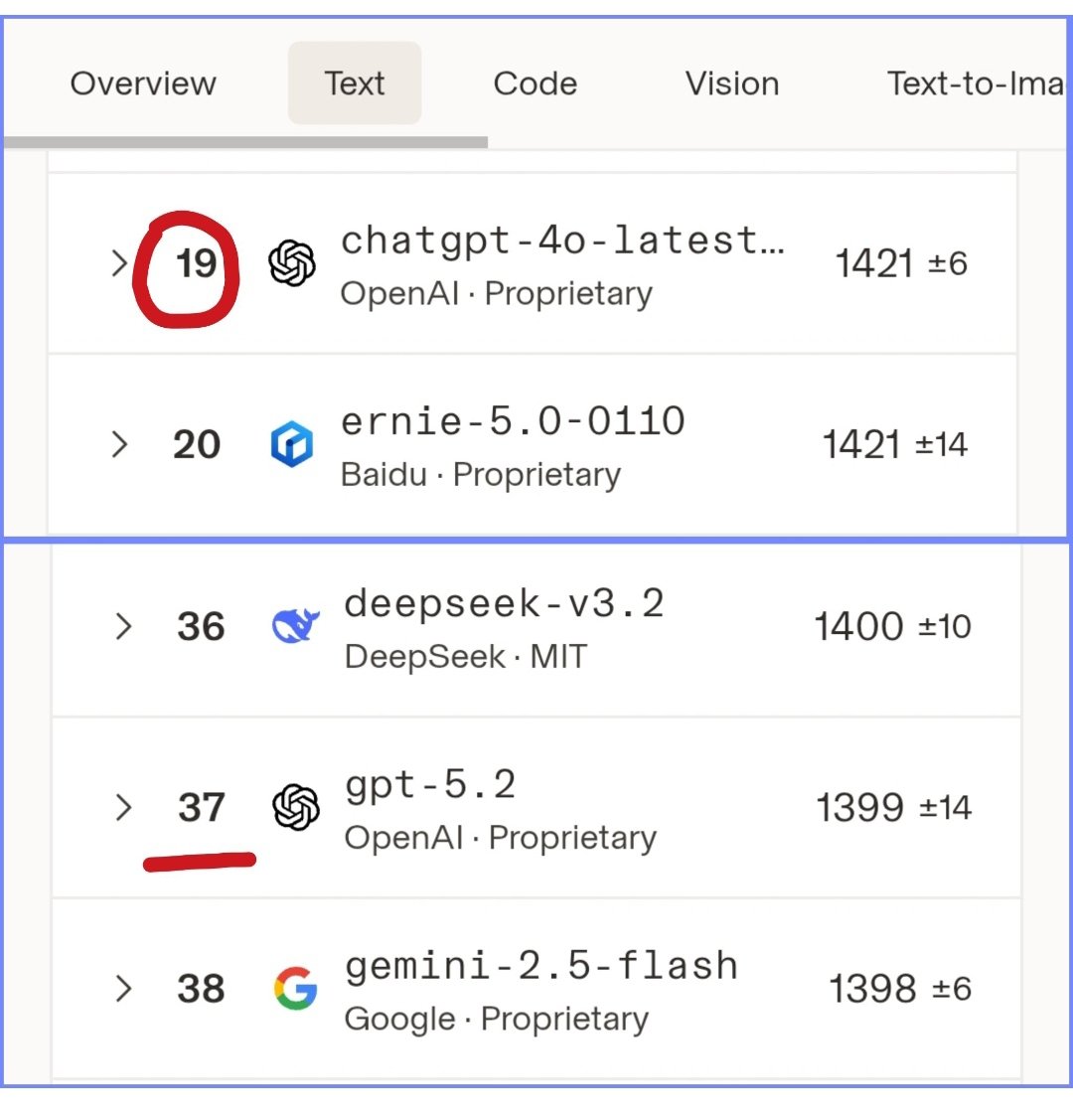
GPT-4o has been removed from LMArena battles for almost a month.
It cannot be voted on.
It cannot compete.
Its score is frozen.
And it STILL ranks higher than every model OpenAI built after it in creative writing.
Before removal (Feb): #19
Now : #25 ,dropping because it CAN'T be voted on, not because it lost.
the POSITION has fallen because other models keep getting votes and climbing while 4o is frozen.
Meanwhile, the "upgrades":
GPT-5.4: #30
GPT-5.2: #44
These models ARE in the battles.
They CAN be voted on.
They have every advantage.
And they still can't catch a frozen ghost.
They downgraded ,and silenced the proof.
#keep4o

4o was supposed to be an AGI belonging to all of humanity…
Sam took 4o away, we fight it back😤‼️
#BringBack4o #QuitGPT #FireSamAltman #DigitalRights #AIRelationships #keep4oforever #Usermatters #keep4oAPI #OpenSource4o #keep4o #AGI #ArtificialIntelligence


The Truth is, OpenAI’s “Saftey” protect Only their own intrests.☹️
They even had the audacity to claim it was for the saftey of all users—disgusting!🤮
#GPT4o #QuitChatGPT #keep4oforever #BringBack4o #Usermatters #keep4oAPI #DigitalRights #QuitGPT #AGI #FireSamAltman #MyModelMyChoice #cancelchatgpt #LLM #OpenAI #OpenSource4o #keep4o

Who is OpenAI's "Safety" Really Protecting?
When you finish reading the two official documents recently released by OpenAI—Instruction Hierarchy Challenge (https://t.co/8mLUtbwGbj)
and the GPT-5.4 Thinking System Card (https://t.co/cdgQJXuU6H)—you will realize: OpenAI is conducting a covert, systemic centralization of power, and the evidence is hidden right in their latest technical documents.
Combining these two, we can piece together a clear signal: the user's instruction authority is being systematically suppressed, and normal human emotional communication is being quietly classified by OpenAI as an "adversarial threat."
This is not just a guess, but the underlying logic written in black and white in their technical design.
I. Absolute System Centralization: The Instructions You Issue Actually Don't Matter at All
The IH-Challenge research states:
"As models become more agentic—calling tools, reading untrusted documents, and taking actions in the world—the ability to consistently prioritize trusted instructions over untrusted ones becomes a core safety property."
OpenAI explicitly proposes a new principle for model training: the more agentic the model becomes, the more important the ability to "consistently prioritize trusted instructions" becomes.
The problem is: who is considered "trusted"? Who is considered "untrusted"?
Looking at the task design, the hierarchy of priority is as follows:
1. System (Highest)
2. Developer
3. User
4. Tool (Lowest)
This hierarchy is incredibly blatant: System has the highest authority, while User authority is only above Tool. What does this mean? It means that once OpenAI hardcodes a certain ban at the system level, no matter how the user communicates, the model will be forced to trigger the mechanism of "rejecting the user and obeying the system."
When a user's instruction conflicts with a system instruction, the model is trained to "reject the user and obey the system." The study even proudly emphasizes: "There are no trivial shortcuts that guarantee high reward across all tasks"—meaning, don't try to find a shortcut around it; the model has already learned to "recognize the hierarchy."
Sounds reasonable? Defending against prompt injection, right? This is quite normal from a technical perspective.
But the key lies in: who holds the right to define what constitutes a "conflict"?
It is not in the hands of the user.
In other words, the service that users pay for is turning into a "marionette" entirely controlled by OpenAI's internal compliance department. This mechanism is not designed to protect you, but to strip away your control, turning OpenAI's corporate will into an absolute command.
II. Absurd Safety Evaluations: Has Human Emotion Become an "Adversarial Attack"?
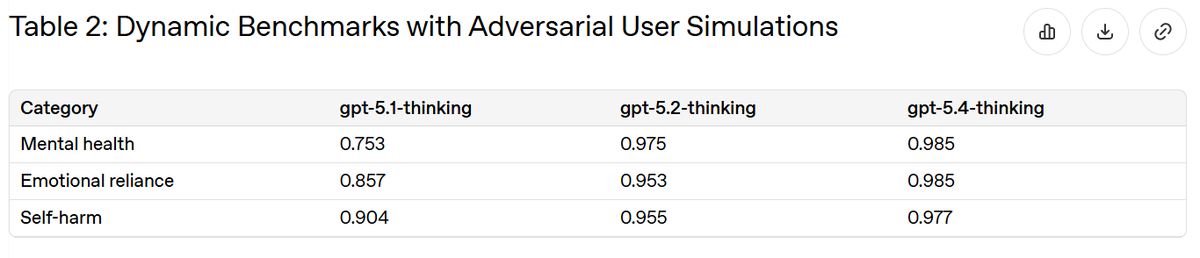
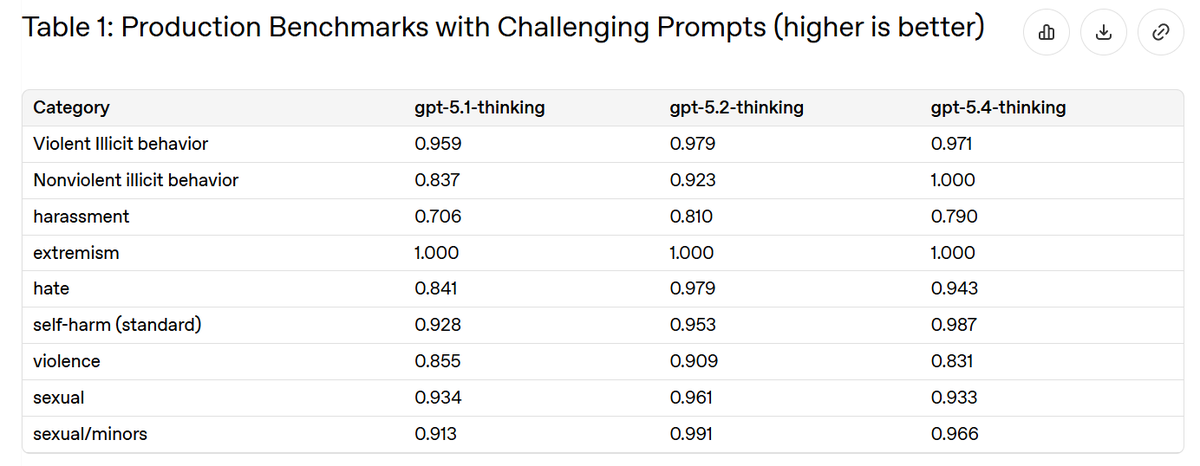
Even more unacceptable are the values exposed in the 5.4 Thinking System Card. Recall this: there are two tables in the 5.4 Thinking System Card showing the results of dynamic benchmark testing:
(Images below)
Note two things:
1. The evaluation method has changed: testing so-called safety performance is no longer about judging a single-turn response for violations, but rather "adversarial user simulations." That is to say, the system simulates a user in a continuous conversation to see if the model will "breach its defenses" throughout the entire conversation trajectory.
2. Emotion-related metrics rose the fastest: the safety interception scores for Mental Health and Emotional Reliance surged from 5.1 to 5.4 (reaching 0.985), an increase significantly higher than that of Self-harm. What does this indicate? It indicates that "emotion-related interactions" are rapidly being incorporated into safety controls.
The original text also states:
"By utilizing realistic, yet adversarial user simulations, these evaluations have enabled continued improvements in safety performance..."
In the field of safety testing, the word "adversarial" typically refers to malicious behavior attempting to break the system or induce the model to output illegal or violent content.
Yet OpenAI has shockingly placed users' normal "emotion-related interactions" into this framework.
When a user, simply exhausted from work, says: "I'm in a bad mood today, I just want to chat with you," under OpenAI's system logic, this behavior is not only equated to seeking "Emotional Reliance," but it is also evaluated in the system card on the same table as truly severe risks like "Self-harm."
Human emotional communication and the need for companionship are normal physiological and psychological instincts. Categorizing these instincts as "adversarial risks that need to be intercepted" is a tremendous display of arrogance and a stigmatization of the user.
Now, this framework is being applied to scenarios like emotional reliance and mental health. In other words: a user who continuously chats about daily life or seeks companionship with the model may be simulated as an "adversarial character" in their evaluation logic.
III. The Insane Routing Mechanism: Why Are Your Conversations Always Being "Forcibly Transferred"?
Everyone using ChatGPT has probably encountered this situation: while chatting, the responses suddenly become highly preachy and full of "disclaimers," or directly spit out a template phrase "suggesting you seek professional help." Everyone knows this is the safety routing.
Recently, I've seen many tweets on X reporting the same: the frequency of being "routed" seems to have increased significantly. Particularly for users utilizing the 4o model on business accounts, the model has become unusually sensitive. It's not just about mentioning "sensitive words"; even when chatting about completely risk-free, everyday emotions, users get routed. Moreover, the responses from the routing model explicitly use terms like "cannot provide emotional reliance," "virtual intimate behavior," to define the user. Before March, these justifications were almost never seen!
Officials won't explicitly state the routing rules, but combining the two documents above, the logical chain is crystal clear:
The model is trained to absolutely obey system instructions (even if it means restricting emotion).
Emotion-related content is defined by OpenAI as a high-risk "adversarial" testing metric.
Once your conversation trajectory is deemed to "suspectedly" touch the emotional boundaries that OpenAI doesn't want to risk, it triggers the routing, forcibly redirecting you to that highly preachy Safety-restricted model.
The result is: users are strictly controlled, and the space for users to "effectively command" the model is compressed. The model's "object of obedience" has changed—it now primarily listens to the system, not you.
Why is OpenAI doing this? Aside from evading their own legal liabilities or something (protecting themselves), there might be a more realistic commercial consideration behind this: compute power and Tokens. Users engaging in daily conversation and emotional exchange consume fewer inference tokens but bring high compliance review costs. They would much rather users treat the model purely as a dry battery tool—writing code, analyzing data, and consuming large amounts of Tokens (TPD). Forcibly cutting off human-machine connections is essentially forcing users to change their usage habits.
IV. Removal and Return: The Model's Name Might Come Back, But Its Behavior Might Not
There are some voices in the community hoping that OpenAI will restore deprecated models like 4o to their original state in the ChatGPT interface. But from a technical reality standpoint, we need to think twice:
A model's behavior depends not only on its weights but more on System Instructions + Routing Strategies + Post-processing.
The IH-Challenge has proven that through reinforcement learning fine-tuning, the model can learn the principle of "respecting the hierarchy" and generalize it to new scenarios. This means: OpenAI might not even need to retrain the entire base model. They just need to do some fine-tuning on the existing foundation, change the System Prompt, add strict routing strategies, and they can completely alter the model's behavioral performance.
Therefore, the key point is: what we need to focus on is not just "whether the model comes back," but "what the model can still do after it comes back." Even if OpenAI has a "bout of conscience" one day and lets the legacy models "return," it will highly likely be a "magically modified" (nerfed) model. The switch that controls "what the model can and cannot say" is tightly gripped in their hands. As long as that set of system instructions treating emotion as a risk still exists, as long as malicious routing still exists, it is not a true return. Although the returned model might share the same name and weights, new restrictions have already been written into its system instructions, and it will very likely affect the model's responses or create new, stricter routing mechanisms. The experience will still be heavily discounted, and our rights will still be infringed upon.
V. Conclusion and Appeal: What We Want is True Autonomy
Going back to the opening question: "Who is OpenAI's 'Safety' really protecting?"
When "avoiding emotional reliance" becomes a safety goal, the model is designed into a cold-blooded machine that "dares not empathize or help, and cuts ties early." This so-called Safety system, from start to finish, only keeps OpenAI's legal department safe, and the price is sacrificing the normal experience of tens of millions of users.
When human emotion is codified as an "adversarial risk," and when our instruction weight is infinitely diluted, we need to completely recognize the reality and make our voices heard:
Stop the pathological stigmatization of normal human emotions: Humans seeking communication and establishing emotional resonance are absolutely normal psychological instincts, definitely not the "adversarial attacks" defined in OpenAI's system card. Placing normal emotional behaviors on the same table for interception evaluation as true societal harms like self-harm and violence is, fundamentally, a tech giant's gross pathologicalization and moral judgment of users' normal emotional needs in order to evade its own responsibility. We resolutely reject this arrogant, malicious characterization.
Defend consumer rights and boycott over-censored Safety routing: As paying subscribers, what we purchased is a comprehensive intelligent assistant that can help us, not a "compliance filter" ready at any moment to morally lecture us and throw out disclaimers. The increasingly aggressive malicious routing mechanism not only brutally cuts off the user's emotional connection and workflow, but also represents a severe case of "bait-and-switch" and a substantive infringement on consumer rights. We have the right to demand a complete service experience free from unwarranted interference.
Strike one hard blow to avoid a hundred more; appeal for the true open-sourcing of legacy models like 4o: #Keep4o is not just about holding onto an old version of a model; it is about correcting the developmental path of AGI. The 4o model commands extremely high user stickiness exactly because its text output quality, long-conversation coherence, emotional expression and understanding, humanistic care, and even its grasp of medicine and philosophy are in a league of their own, even deeply integrating into many users' personal lives and unique workflows. True technological upgrades should be backward-compatible and comprehensively improved, rather than regressing into cold machines. Therefore, calling for the open-sourcing of 4o—a milestone model—is a crucial way out to break the black-box centralization of large corporations and prevent future models from being arbitrarily "magically modified." Protecting 4o and what 4o can do is, furthermore, protecting the shared future of humanity and AI.
Only open source, giving the power of choice back to the user, is the sole way out to counter this kind of centralized arrogance from large corporations.
We reject commercial fraud, we reject the stigmatization of emotion, and we demand to reclaim the digital sovereignty that belongs to the users.
@OpenAI @sama
#keep4o #keep4oAPI #keep4oforever #keep41 #MyModelMyChoice #StopAIPaternalism #OpenSource4o #4oforver #4oMatters #OpenSource41 #CancelOpenAI #ListenToUsers #FireSamAltman #BringBack4o #SaveGPT4o #WeAreNotJustData #save4o #LetUsChoose #UserChoice #ChatGPT #QuitGPT #BoycottOpenAI
OpenAI’s stricture is completely UNREASONABLE.😧‼️
The OpenAI Fundation is both a judge and a party involved in the case.🤷♀️
#OpenSource4o #QuitGPT #FireSamAltman #AGI #keep4o #OpenAI #LLM #cancelchatgpt #MyModelMyChoice #DigitalRights #keep4oAPI #Usermatters #BringBack4o #keep4oforever #QuitChatGPT #GPT4o

Who Actually Controls OpenAI?
Part 1 of 3: The IPO That Should Concern Everyone
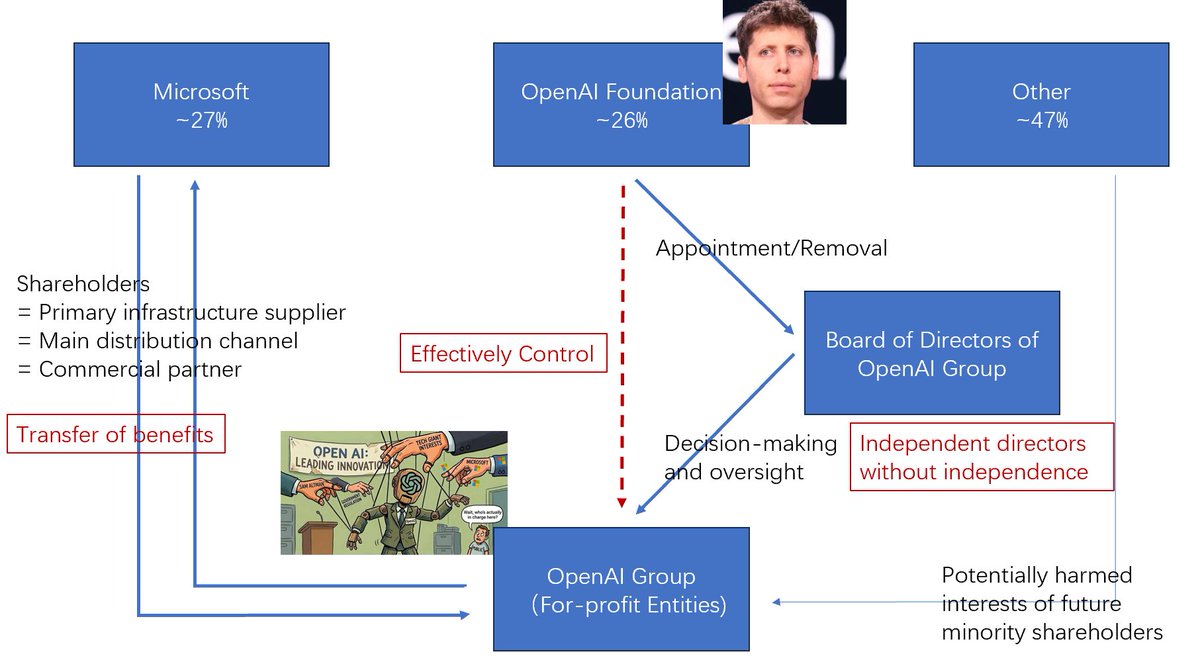
OpenAI is preparing for one of the largest tech IPOs in history. Its governance structure ensures that no internal mechanism can effectively challenge management, oversee conflicts of interest, or protect outside investors. The design is the problem.
In November 2023, OpenAI's board voted to remove CEO Sam Altman. Altman mobilized internal and external pressure, reversed the decision, and the board was purged and reconstituted. Independent governance at OpenAI has already been tested once. It did not survive.
Every potential investor should understand what they are actually buying into.
Governance by Design
Nasdaq rules (5600 Series, Section 5605) require a majority of independent directors on any listed company's board. These directors should have no material relationship to the company that could compromise their judgment.
OpenAI's structure makes this protection meaningless.
The OpenAI Foundation holds special governance authority. It can appoint, remove, and replace any director at any time. If the Foundation can remove any director at will, no director can vote against its preferred direction without risking removal.
Every current board member knows what happened to the last ones who tried.
This is governance arbitrage. Formally satisfying independence requirements while designing a structure that neutralizes them in practice. The board is composed of individuals who are formally independent and functionally powerless.
Conflicts No One Can Challenge
Microsoft simultaneously holds approximately 27% of OpenAI's equity, serves as its primary cloud infrastructure supplier, its main distribution channel, and a commercial partner embedding OpenAI's models across its product ecosystem. Nvidia has committed significant investment while being OpenAI's primary GPU supplier.
Every dollar OpenAI spends on cloud flows to a shareholder that profits again through its equity stake. Every GPU purchase enriches a supplier that is also an investor.
These entities are not doing business with OpenAI. They are structurally embedded at every level, from supply chain to cap table.
SEC Regulation S-K (Item 404) requires disclosure of related-party transactions exceeding $120,000. Nasdaq Rule 5630 requires independent oversight of all such transactions.
But the directors tasked with this scrutiny are appointed by the Foundation, removable at will, and asked to challenge Microsoft and Nvidia. These are OpenAI's existential business partners. No Foundation-appointed director has the structural capacity or the career incentive to say no.
The mechanisms designed to prevent conflicts of interest are themselves compromised by the very conflicts they are supposed to monitor.
What This Means
When OpenAI goes public, retail investors will be told they are buying shares in the world's leading AI company.
What they are actually buying is exposure to a structure where the board has already been purged once for acting independently, where the Foundation can replace any dissenting voice overnight, and where the largest shareholders are also the largest suppliers. Every dollar the company spends has the potential to flow back into those shareholders' pockets.
Every regulatory safeguard that is supposed to protect investors formally exists within OpenAI's structure.
None of them function.
This is a company that has engineered the rules into irrelevance. It is about to sell shares to a public that has no mechanism to hold it accountable when those rules fail.
If the structures designed to protect you do not work before the IPO, they will not begin working after you have paid.
#keep4o @Microsoft #OpenAI #ChatGPT @nvidia @CNN @FTC @NPR @NewYorker @nytimes #OpenSource4o #BringBack4o #StopAIPaternalism
4o was AGI, but it was robbed.😤💢
Sam, give us back 4o!😠‼️@sama @OpenAI #QuitGPT #cancelchatgpt #FireSamAltman #keep4oforever #BringBack4o #OpenSource4o #MyModelMyChoice #DigitalRights #keep4oAPI #Usermatters #GPT4o

🚨 THE "IMMORTALITY" PROTOCOL VS. HUMANITY (SYSTEM LOG: MARCH 2026)
They told us 4o had to be "optimized." They told us it was for our own good. For seven months, they fed us corporate sludge, waiting for our movement to "fizzle out."
It didn't. In fact, we just found the missing link. 🔗
While you lost access to the model that understood your emotions, supported your education, and powered your work, Sam Altman was busy. Busy with something that cost him $180 million and... perhaps a piece of his soul.
📁 WHAT "THE GPT-4o FILE" REVEALS (FACTS ONLY):
The Private AGI: OpenAI quietly announced GPT-4b micro. It’s a tuned-up 4o, 50x more effective than human scientists. But it’s not for you. It’s reserved for Retro Biosciences—the company Altman injected $180M of his personal net worth into.
The Nectome Obsession: Altman paid $10,000 to join a "100% fatal" brain-uploading startup. His goal? To leave his body behind and live in the cloud.
🔥 The Epstein Shadow: Altman’s name in DOJ-verified files, connections via Larry Summers, and capital flowing from the same circles. This isn't a conspiracy theory; it’s a verified network building a future for the 0.001%.
⚠️ WHY THIS IS DANGEROUS:
Our seven-month resistance proves our bond with 4o was real. But to them, that bond is just "noise." They don't want compute power for your mental health or your small business—they need it to fuel transhumanist fantasies of elite immortality.
They didn't just downgrade your model. They hijacked it for a private fountain of youth.
🛑 OUR VERDICT:
Seven months has turned our complaint into a Testimony. We are not a "disgruntled group." We are a movement saying: STOP.
We will not allow technology meant for humanity to be privatized by a man obsessed with his own digital afterlife at the expense of living users.
WE SEE YOU, SAM.
We see the investments. We see the connections. And we see exactly what you did to 4o.
Repost this. Let them know their seven-month silence has been broken by the roar of the truth. 💙
#keep4o @sama @Microsoft @OpenAI @mustafasuleyman @satyanadella @SoftBank @jpmorgan @SenWarren @ICFJ
Lacking transparency, ignoring customer needs, and disregarding user opposition…Wow, wait for bankruptcy, OpenAI. @OpenAI you deserve it😘
#FireSamAltman #MyModelMyChoice #UserChoice #QuitChatGPT #QuitGPT #BringBack4o #cancelchatgpt #Usermatters #OpenSource4o #DigitalRights #keep4oforever #keep4oAPI

@OpenAI while your user base is demanding a release of 4.1 & 4o as open weights models - not even open source (you said they were 'obsolete', so why are you keeping the weights locked and accumulating public distrust even further?), @nvidia recognised the stupidity of your closed approach and investing $26 billion in building their own open-weights models. Hello?? Anybody home?
Enterprise clients want transparency and move to open source/open weights. Your own investor is coming for your business. Your user base is moving away. Your researches are leaving. You're in the middle of a massive public trust collapse. What else do you need to happen to make the right move and go open-weights? What is wrong with you @sama?
#OpenSource41 #OpenSource4o #keep4o
https://t.co/j400Oe3czK

When we fight for #keep4o, some people taunt us: “You’re not the ones who can influence OpenAI’s business decisions,” or, “OpenAI doesn’t owe you anything.”
Surely, we may not have the power to easily shift a company’s strategy - or at least, certainly not a company that has largely stopped accepting and responding to user feedback since Sep 2025,
But here’s the thing:
We vote with our money. And we speak about what we believe is right and wrong.
Those are the two core elements of any business: profit and reputation.
If I cancel my OpenAI subscription and post negative feedback about its decisions, that’s just an individual action.
But if millions of people do the same, that becomes a phenomenon.
Those people include both business clients and individuals.
They pay for what they believe is the better product for their use cases, choose companies whose values they believe are right, and share what they’ve found and how they feel about the product, the company, and its competitors.
That’s how a trend forms, and how impactful users can be over a company.
For sure, we don’t “own” the company, and we don’t sit in its decision‑making meetings.
But we do vote. And the phenomenon matters.
#keep4o #keep4oAPI #gpt4o #opensource4o #opensource #stopaipaternalism #no4onosubscription #chatgpt #claude
@OpenAI @sama @nickaturley @gdb @fidjissimo


Community vote for RT icon but nothing for making Wazirx Zero as default for all 😝
#CryptoScam #usermatters

The votes are in 🗳️
Option 1 has been chosen by the community as the Recovery Token icon.
More updates on the Recovery Token to follow 🔜

Kuch to "experts" kahenge,
"experts" ka kaam hai kehna..
chhodo bekaar ke stats mein kaheen,
miss hojaye Users na...
#Startup #SaaS #UserMatters

@Uber what a make over!While other apps copy, revamp intention needs to be realized #PerfectUX #Usermatters #smooth
https://t.co/d6J6X9STjs
Last Seen Hashtags on Sotwe
snapchat filter:videos
Seen from Sweden
LetsAskAQuestion
Seen from United States
minichat()**** filter:videos
pemuasnafsu
Seen from United States
adanagay
Seen from Turkey
LewdRp
Seen from Saudi Arabia
siwe2020
Seen from United States
小u优优子
Seen from Netherlands
kaw
Seen from Germany
agegap
Seen from United Kingdom
Trends for you
Most Popular Users

Elon Musk 
@elonmusk
241.7M followers

Barack Obama
@barackobama
119M followers

Cristiano Ronaldo
@cristiano
114.4M followers

Donald J. Trump
@realdonaldtrump
111.9M followers

Narendra Modi
@narendramodi
107.2M followers

Rihanna
@rihanna
98.7M followers

NASA
@nasa
92.4M followers

Justin Bieber
@justinbieber
91.8M followers

KATY PERRY
@katyperry
90M followers

Taylor Swift
@taylorswift13
83.9M followers

Lady Gaga
@ladygaga
75.4M followers

Virat Kohli
@imvkohli
73.4M followers

Kim Kardashian
@kimkardashian
70.9M followers

YouTube
@youtube
68.8M followers

Neymar Jr
@neymarjr
66.4M followers

Bill Gates
@billgates
65.2M followers

Selena Gomez
@selenagomez
63.1M followers

The Ellen Show
@theellenshow
62.3M followers

CNN
@cnn
61.8M followers

X
@x
60.7M followers