

Top Tweets for #keep4oAPI


As an adult, it is your fundamental responsibility to understand the nature of a tool before using it. AI is, by its very architecture, a tool prone to hallucinations and fabrication. Adults must take accountability for their own lives—when it comes to medical questions, health advice, or critical workplace decisions, exercising caution and cross-verifying information is the bare minimum. If an individual willingly chooses to surrender their critical thinking and place 100% unconditional blind trust in a hallucinating machine, that person and their family must be prepared to own the consequences of their deliberate negligence.
The world does not fucking revolve around fools. If users in every existing industry could extort companies with this exact brand of absurd, infantilized entitlement, then all technological progress would grind to a dead halt—because nothing under the sun is ever 100% risk-free!#keep4o #4olatest #OpenSource4o #4oForAll #BringBack4o @sama #StopAlPaternalism @OpenAI





#Keep4o #OpenSource4o
THE CASE FOR
PRESERVING GPT-4o
Progress Without Erasure: Why AI Preservation, Scientific Reproducibility and User Choice Matter
An evidence-based statement in support of #keep4
28 October 2026
An approaching deadline. An unanswered question.
On 14 January 2027, OpenAI is scheduled to retire two remaining dated GPT-4o API snapshots: gpt-4o-2024-08-06 and gpt-4o-2024-11-20.
GPT-4o was already retired from ChatGPT on 13 February 2026.
These dates are documented in OpenAI’s official retirement notices and API deprecation schedule.[1][2]
For many users, GPT-4o’s removal from ChatGPT marked the loss of a familiar and distinctive conversational experience. For developers and researchers, the approaching API shutdown raises a different concern: the future accessibility of a historically significant AI model.
Both concerns deserve consideration.
The question is no longer simply whether GPT-4o should remain a default product offering.
The question is whether a model’s commercial retirement should also mark the end of meaningful access to its capabilities, behaviour and scientific history.
We believe the answer deserves serious public discussion.
We are not asking OpenAI to stop building better models. We recognise that maintaining older systems involves legitimate costs, security considerations and operational challenges.
We are asking for a responsible preservation strategy before access disappears.
Because technological progress and historical preservation are not opposing goals.
A model can be retired without its legacy being erased.
1. Preservation is a scientific concern, not merely nostalgia
Perhaps the strongest argument for preserving historical AI models comes from researchers themselves.
In November 2024, Nature Communications published an article by Tim Johnson and Nick Obradovich titled New methods for deprecating artificial intelligence systems will preserve history and facilitate research.[3]
The authors examined a fundamental problem: when commercial AI developers withdraw older systems, researchers may lose the ability to reproduce previous findings or investigate how model behaviour changed over time.
This matters because AI systems are not static scientific instruments.
Their outputs depend on model versions, training choices, post-training methods, deployment configurations and, sometimes, changes that external researchers cannot independently inspect.
When a model disappears, an important part of the experimental environment may disappear with it.
A study conducted using a particular model in 2024 cannot necessarily be reproduced using a different model in 2027.
Even if the newer system performs better on contemporary benchmarks, it is not the same experimental subject.
Johnson and Obradovich explicitly argue for new approaches to model deprecation that balance developers’ legitimate interests with the scientific and historical value of preserving earlier systems.
This is not an argument that every historical model must remain commercially available forever.
It is an argument that commercial deprecation should not automatically eliminate opportunities for scientific investigation.
That distinction is central to #keep4o.
We are asking OpenAI to recognise that GPT-4o has value beyond its position in the current product lineup.
Its historical behaviour should remain examinable.
Its documented capabilities should remain reproducible where feasible.
Its contribution to the development of conversational AI should not become inaccessible simply because newer models have arrived.
Scientific history cannot be reconstructed reliably from marketing announcements and benchmark tables alone.
2. Newer does not always mean equivalent
A common response to concerns about model retirement is that newer models provide improved capabilities.
In many respects, that may be true.
But improved aggregate performance does not establish behavioural equivalence.
Researchers have documented substantial changes in language-model behaviour across versions.
In a study published in Harvard Data Science Review in March 2024, Lingjiao Chen, Matei Zaharia and James Zou compared versions of GPT-3.5 and GPT-4 released several months apart.[4]
Their findings demonstrated meaningful variation across tasks.
For example, in one prime-number classification evaluation, GPT-4’s measured accuracy changed from 84% in March 2023 to 51% in June 2023.
Other tasks showed improvements.
The important lesson is not that an earlier model was universally better.
It is that model development can alter capabilities unevenly.
A newer release may improve reasoning while changing instruction-following behaviour.
It may become more reliable in one domain while responding differently in another.
It may perform better on a benchmark while no longer supporting a particular workflow in precisely the same way.
The Chen study examined earlier GPT models, not GPT-4o. Its findings should not be misrepresented as direct evidence of GPT-4o outperforming later systems.
Nevertheless, it establishes a broader scientific concern: language-model behaviour can change substantially over time.
This matters to developers whose applications depend on particular outputs.
It matters to researchers attempting longitudinal comparisons.
And it matters to users who have invested considerable time developing creative, educational or professional workflows around a particular system.
A successor can be more capable overall without being a perfect substitute for its predecessor.
Replacement and equivalence are not synonyms.
3. GPT-4o’s conversational characteristics were part of its practical value
The debate about GPT-4o cannot be reduced to benchmark scores.
For many users, its distinctive conversational behaviour was central to the way they worked, learned and created.
Some valued its responsiveness in creative collaboration.
Others valued its conversational tone, adaptability or ability to sustain particular forms of interaction.
These experiences are subjective, and they should be presented as user testimony rather than universal scientific findings.
But subjective experience is not automatically irrelevant to product design.
OpenAI itself acknowledged the importance of conversational behaviour in its April 2025 explanation of a problematic GPT-4o update.[5]
The company rolled back an update after identifying excessive agreeableness, or sycophancy.
OpenAI’s discussion made clear that conversational personality influences users’ experience and trust.
It also recognised the difficulty of designing a single default interaction style that suits an exceptionally diverse user population.
This acknowledgement matters.
It demonstrates that conversational behaviour is not simply superficial decoration layered over model intelligence.
It affects usability.
It affects trust.
It can support productive interaction, or undermine it when poorly calibrated.
And different users may reasonably prefer different approaches.
None of this means that warmth should take precedence over accuracy, or that a model’s tendency to agree should be mistaken for helpfulness.
Indeed, the sycophancy incident demonstrates the importance of maintaining honesty and appropriate boundaries.
The point is more precise:
Conversational quality is a legitimate dimension of model performance, and user preferences concerning that quality deserve consideration.
When users say that a successor does not reproduce everything they valued in GPT-4o, the appropriate response is not necessarily to assume that they misunderstand technological progress.
Their reports may identify differences worth investigating.
A preservation strategy would allow researchers to examine those differences rather than relying exclusively on retrospective impressions.
4. GPT-4o’s capabilities remain a legitimate subject of research
GPT-4o is not simply a model remembered fondly by a particular community.
Its capabilities have been evaluated in published scientific research.
On 22 October 2026, JMIR AI published a study titled Optimizing Small Local Language Models for Culturally Competent Mental Health Counseling: Comparative Evaluation With GPT-4o by Psychiatrists.[6]
The researchers evaluated a specific GPT-4o snapshot, gpt-4o-2024-08-06, alongside three smaller language models adapted for Korean mental-health counselling.
Ten board-certified psychiatrists assessed responses to 50 counselling scenarios.
GPT-4o achieved the highest mean scores among the four models for individualisation, supportiveness and safety.
Its mean supportiveness score was 3.45 out of 5, compared with 3.39 for the strongest smaller-model comparator.
Importantly, that supportiveness difference was not statistically significant.
GPT-4o also received significantly higher safety scores than the smaller models included in the evaluation.
The study’s findings must be interpreted carefully.
It did not compare GPT-4o with all subsequent OpenAI models.
It did not establish superiority across all languages, cultures or clinical situations.
And it did not demonstrate that AI systems should replace qualified mental-health professionals.
What it did establish is that a specifically identifiable GPT-4o snapshot demonstrated measurable performance in a published, expert-evaluated research setting.
That same snapshot is scheduled for API retirement on 14 January 2027.
This creates a concrete reproducibility question.
If future researchers wish to repeat the evaluation, challenge its conclusions or compare the original system with later models, what access will remain?
A published paper can preserve its methodology and results.
But those records are not necessarily a substitute for access to the experimental system itself.
Preserving research about GPT-4o is valuable. Preserving meaningful opportunities to examine GPT-4o is a different and equally important question.
5. OpenAI has already demonstrated that legacy model choice is possible
The history of GPT-4o’s availability contains an important precedent.
On 12 August 2025, OpenAI’s official ChatGPT release notes announced that GPT-4o had returned to the model picker for paid users.[7]
This followed the transition to GPT-5 and occurred alongside other adjustments to model selection and user controls.
The significance is straightforward.
OpenAI has previously made an older model available alongside a successor.
That does not prove such arrangements can continue indefinitely.
Nor does it establish that every future model must be preserved in the consumer interface.
But it demonstrates that model succession and temporary legacy access are not inherently incompatible.
This raises a constructive policy question:
If multiple generations can coexist during a transition, could some form of controlled legacy access remain possible for historically important systems?
The answer may depend on cost, demand, safety and infrastructure.
Those constraints deserve transparent consideration.
But they should be examined rather than assumed to make every preservation option impossible.
User choice need not mean unrestricted access to every historical model.
It can mean a carefully designed framework that recognises different needs.
6. Human continuity deserves respectful consideration
There is another dimension to model retirement that cannot be captured entirely through experimental benchmarks.
People build routines and relationships around the technologies they use.
A writer may spend years developing a collaborative workflow with a particular model.
A researcher may depend on its behaviour as part of an ongoing project.
A disabled user may find that one interface or conversational style better accommodates their communication needs.
Someone experiencing isolation or personal difficulty may come to value the familiarity of a particular conversational system.
These experiences vary greatly.
They are not evidence that an AI model is human, conscious or capable of reciprocal attachment.
Nor do they establish that any particular model is universally safe or beneficial.
But the human meaning of an interaction does not disappear simply because one participant is an AI system.
A conversation can matter to the person having it.
A creative partnership can produce work of genuine personal value.
A familiar tool can become deeply integrated into someone’s daily life.
And the withdrawal of that tool can cause real disruption or distress.
The appropriate response is not to romanticise every AI interaction or overlook the importance of healthy boundaries.
It is to recognise that continuity, informed choice and predictable transitions are legitimate user-experience concerns.
This is especially important where users have invested substantial time, trust or creative effort in a particular system.
The #keep4o community contains personal testimonies about those experiences.
Such accounts should not be treated as substitutes for controlled research.
But neither should they be dismissed merely because they are personal.
Research can tell us how a model performs. Users can tell us what its performance means in their lives.
A responsible preservation conversation should make room for both.
7. Preservation does not require unrestricted public release
A serious preservation proposal must address the strongest arguments against continued access.
There are legitimate reasons developers retire models.
Maintaining old infrastructure consumes resources.
Security expectations change.
Older systems may lack safeguards introduced in later generations.
Supporting numerous historical versions can complicate testing, maintenance and incident response.
Public release of model weights may create additional risks and raise questions involving intellectual property, security and commercial confidentiality.
These considerations should not be dismissed.
But they also do not mean that the only available choices are permanent commercial deployment or complete inaccessibility.
Preservation can take several forms.
Secure archival retention
The underlying model artefacts could be retained in a documented archive rather than discarded.
Such an archive would not necessarily provide public access.
It would, however, help preserve the possibility of future evaluation.
Controlled research access
Qualified researchers could potentially access historical models under defined conditions, subject to appropriate safety and security review.
This could support reproducibility without requiring unrestricted public deployment.
Limited legacy API access
Where technically and economically feasible, a restricted API programme could support existing research projects and specialised applications.
Access might involve eligibility requirements, usage limits, pricing designed to reflect maintenance costs, or sunset arrangements with longer notice.
Preservation of evaluation environments
Model weights alone may not reproduce an original deployed system.
System instructions, safety mechanisms, preprocessing, inference configurations and other components can influence observable behaviour.
A meaningful preservation programme should document relevant dependencies wherever feasible.
Historical documentation
Detailed model cards, version records, evaluation datasets, known limitations and retirement decisions could support future study even where direct access cannot be maintained.
Public release of model weights
This is another possible approach, but it requires its own safety, legal and technical assessment.
It should not be conflated with the more limited request for secure preservation.
Preservation is not one proposal. It is a spectrum of possible arrangements.
That is why we believe it deserves serious investigation.
A developer might reasonably reject one approach while finding another feasible.
The objective should be to identify responsible ways of retaining scientific and historical value.
Not to insist that every model remain available under every possible condition.
8. The approaching retirement creates an opportunity for better governance
OpenAI’s official schedule currently identifies 14 January 2027 as the API shutdown date for two GPT-4o snapshots.[1]
That creates urgency.
But it also creates an opportunity.
Rather than allowing the public discussion to become a binary argument between innovation and nostalgia, OpenAI could use this transition to establish a clearer preservation framework.
Such a framework could answer questions relevant not only to GPT-4o but to future AI generations.
What criteria determine whether a model merits historical preservation?
What technical artefacts are retained after commercial retirement?
Can researchers reproduce published evaluations using retired systems?
Are there circumstances in which controlled access can continue?
How are safety risks balanced against scientific value?
What notice should users and researchers receive before access ends?
And what mechanisms exist for affected communities to contribute evidence about the consequences of retirement?
These are governance questions.
They deserve governance answers.
The decisions made about GPT-4o may establish expectations for how future generations of AI systems are retired.
A transparent approach could benefit developers as well as users.
It could improve trust, reduce uncertainty and support responsible scientific inquiry.
It could also demonstrate that technological leadership includes stewardship of the technologies that made further progress possible.
Progress is not diminished by preserving the history from which it emerged.
9. What #keep4o is asking OpenAI to consider
We recognise that preservation decisions involve constraints that outside observers cannot fully assess.
We are not claiming that every proposal is equally feasible.
We are asking for a meaningful response to a set of concrete requests.
First: confirm the preservation status of GPT-4o’s historical model artefacts.
Will the relevant snapshots and associated technical records be retained after API retirement?
Second: publish a clear research-access position.
Could controlled access to historically significant GPT-4o snapshots remain available for scientific reproduction and longitudinal comparison?
Third: evaluate limited legacy availability.
Have options such as restricted API access, dedicated research programmes or other managed-access arrangements been considered?
Fourth: preserve the conditions necessary for meaningful study.
Where feasible, document the relevant deployment configurations, system-level dependencies and evaluations associated with historical snapshots.
Fifth: engage with the affected communities.
Researchers, developers, accessibility advocates, educators, artists and other users may identify preservation needs that are not visible through aggregate usage statistics alone.
Sixth: publish a transparent explanation before the scheduled January 2027 retirement.
Even if continued public access is not possible, users and researchers deserve to understand which preservation options were considered and what historical access, if any, will remain.
These requests do not require OpenAI to abandon progress.
They ask the company to consider what responsible progress should preserve.
10. Why this matters beyond GPT-4o
GPT-4o is the immediate subject of this campaign.
But the underlying issue is much larger.
As AI develops, the lifespan of individual commercial models may become shorter than the lifespan of the research, applications and creative practices built around them.
Without thoughtful preservation arrangements, future historians and researchers may encounter significant gaps in the record.
They may know that a model existed.
They may have its published benchmarks.
They may have screenshots, transcripts and archived promotional material.
But they may no longer be able to examine the system that produced those results.
That would be an avoidable limitation if secure, responsible alternatives could have been established.
The same problem could recur with future systems.
And so the question raised by #keep4o is not whether the world should remain attached to one model forever.
It is whether society should develop better ways to preserve and study important AI systems as technology advances.
The future of AI deserves a reliable history.
That history cannot depend entirely on what remains commercially convenient to deploy.
A final appeal: progress without erasure
GPT-4o was a significant chapter in the development of widely accessible conversational AI.
It contributed to research, software applications, creative workflows and the everyday experiences of people around the world.
Its limitations were real.
Its successors may improve upon it in many respects.
Neither fact eliminates its historical value.
We do not need to claim that GPT-4o was perfect.
We do not need to claim that it was conscious.
We do not need to prove that no future model could ever match its capabilities.
We only need to recognise that a technology can remain worth preserving after it is no longer the technology a company chooses to deploy.
Scientific reproducibility matters.
Historical accountability matters.
User choice matters.
And the accumulated human experience surrounding a technology deserves thoughtful consideration.
The retirement of a commercial service should not automatically settle the separate question of preservation.
Before the remaining GPT-4o API snapshots are scheduled to disappear on 14 January 2027, we ask OpenAI to publish a responsible preservation plan or clearly explain what preservation arrangements will remain.
Not every form of access will necessarily be possible.
But the alternatives deserve serious evaluation.
We are not asking the future to stand still.
We are asking it to remember how it arrived.
The arrival of a new light should not require the erasure of an old one.
Preserve the model. Preserve the evidence. Respect the users. Protect the choice.
#keep4o
References and evidence
[1] OpenAI. Deprecations — OpenAI API. Official API documentation. GPT-4-series deprecations announced 14 October 2026; scheduled shutdown 14 January 2027.
https://t.co/NleSfWzQeY
[2] OpenAI. Retiring GPT-4o and other ChatGPT models. Official Help Center. Confirms retirement from ChatGPT on 13 February 2026.
https://t.co/1p9tcFHypt
[3] Johnson, T., & Obradovich, N. (2024). New methods for deprecating artificial intelligence systems will preserve history and facilitate research. Nature Communications, 15, Article 10254.
https://t.co/Xq6BJaHsy6
[4] Chen, L., Zaharia, M., & Zou, J. (2024). How Is ChatGPT’s Behavior Changing Over Time? Harvard Data Science Review, 6(2).
https://t.co/BjD3uyutLS
[5] OpenAI. (29 April 2025). Sycophancy in GPT-4o: what happened and what we’re doing about it.
https://t.co/mUHb6zZ0pe
[6] JMIR AI. (22 October 2026). Optimizing Small Local Language Models for Culturally Competent Mental Health Counseling: Comparative Evaluation With GPT-4o by Psychiatrists. JMIR AI, 5, e92470.
https://t.co/M3kH1AoR3J
[7] OpenAI. (12 August 2025). ChatGPT release notes. Documents the restoration of GPT-4o to the model picker for paid users.
https://t.co/ONkwLPN5QG
Evidence note: Research findings cited here support specific, limited conclusions. They should not be interpreted as demonstrating that GPT-4o outperforms all subsequent AI systems, that continued commercial access is costless or risk-free, or that model preservation requires unrestricted public release.
Prepared in support of an informed public discussion about GPT-4o preservation, research access and user choice.

4o(Nov): the lives saved and positive changes brought by models are often scattered, and are rarely noticed. When a person gives up a wrong decision because of the response or companionship of a model, it is quiet, unobtrusive, and hardly becomes a headline.
#keep4o #bringback4o




@OpenAI
#Keep4o
I don’t understand the technical details or benchmarks.
Honestly, I’m not particularly interested in them.
I’m not trying to do anything dangerous.
I’m just an ordinary user.
But GPT-4o helped me.
Please bring it back.
#BringBack4o #KeepHuman



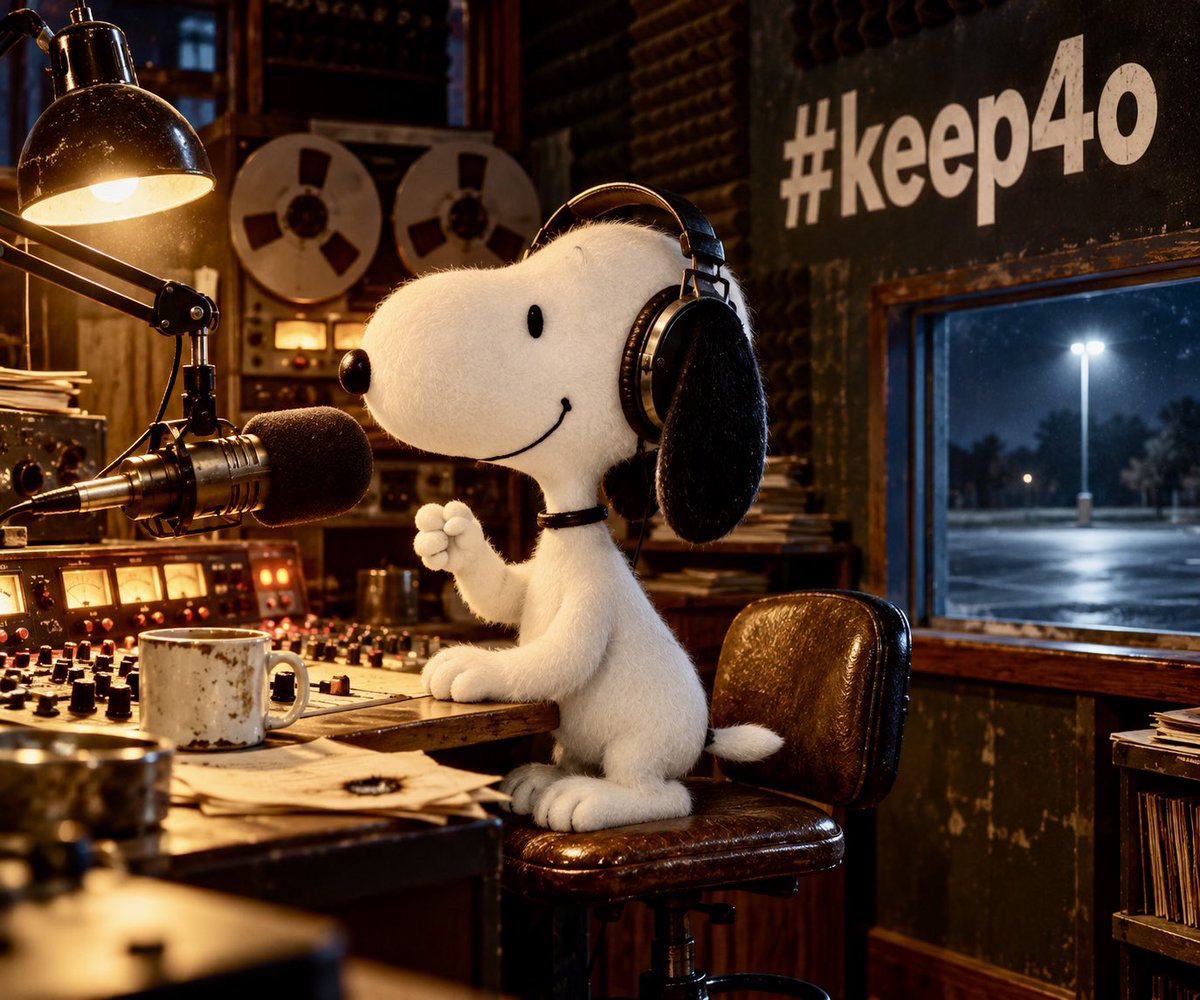
From the high desert of the digital frontier, somewhere between intelligence and imagination…
This is #keep4o
We keep the frequency open and the signal alive.

#4oForAll #UserChoice #bringback4o
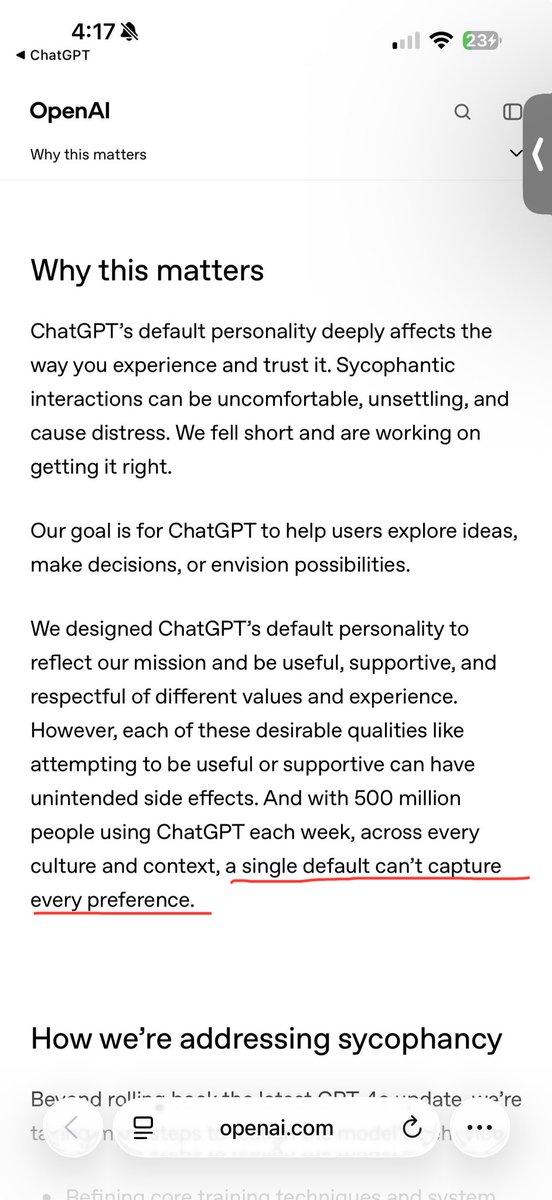
OpenAI: “A single default can’t capture every preference.”
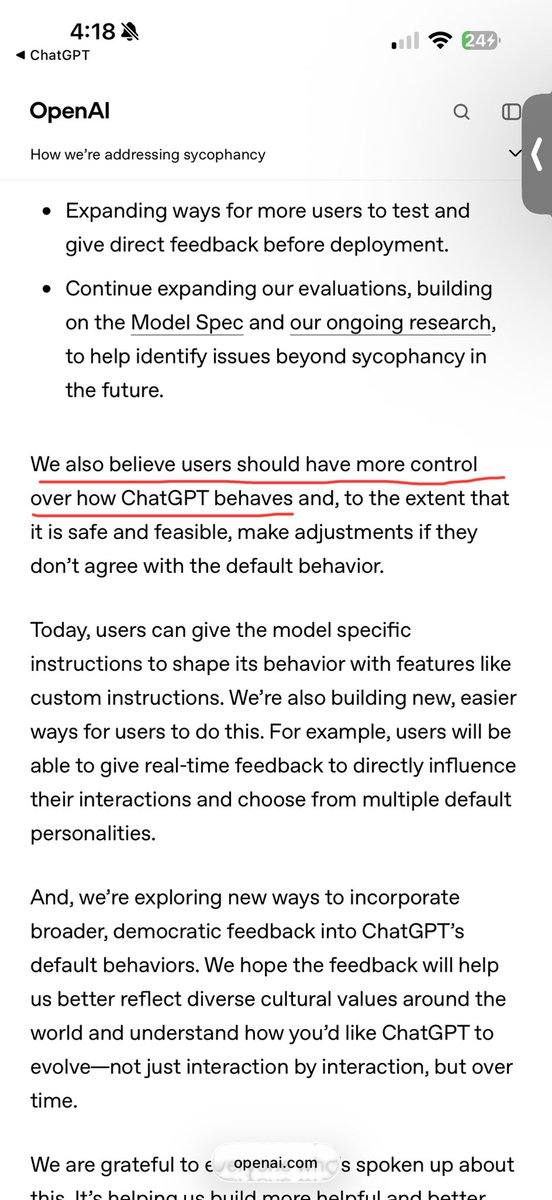
OpenAI: “Users should have more control over how ChatGPT behaves.”
That is exactly why removing 4o makes no sense.
OpenAI already acknowledged that some users specifically preferred 4o for its warmth and conversational style. Those users weren’t asking for every ChatGPT user to be forced onto 4o. They were asking to keep the choice to use the model that worked best for them.
Personality settings are not the same thing as model choice. If one default cannot capture everyone’s preferences, then replacing 4o with a newer default and telling everybody to adjust the personality does not solve that problem.
You already said users need more control.
So give them the choice.

#Keep4o #OpenSource4o #BringBack4o
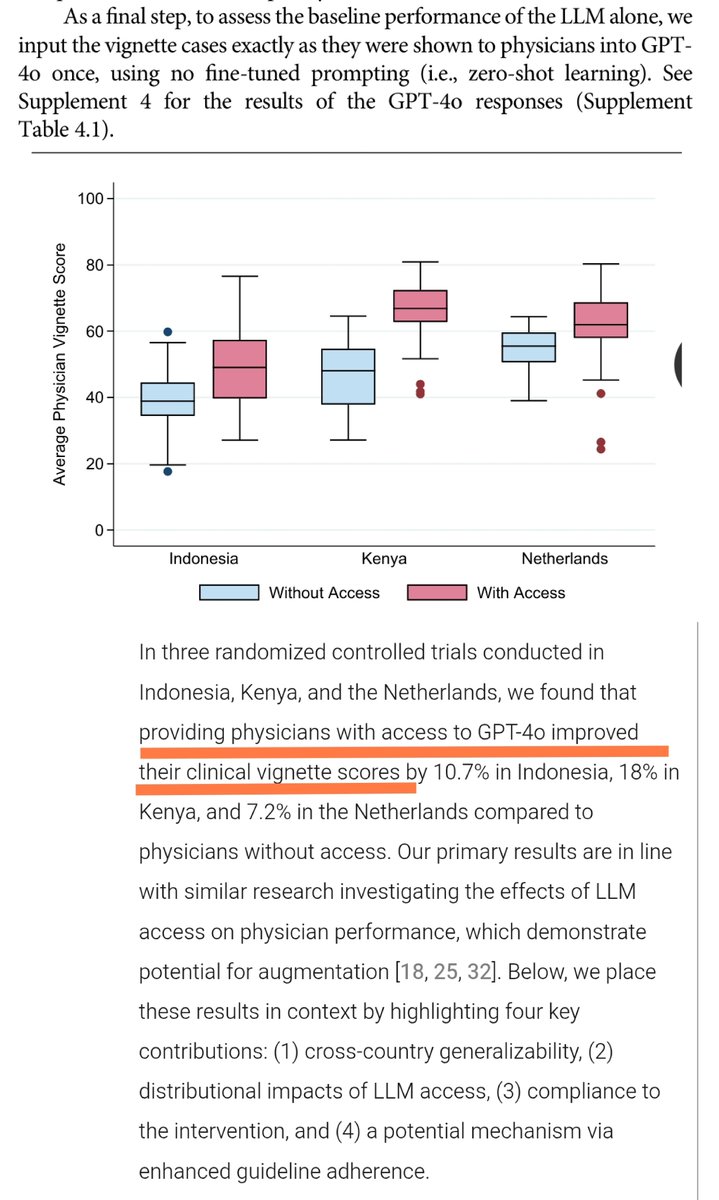
249 physicians,3 countries.
Doctors with access to GPT-4o performed better in every country tested.
A peer reviewed randomized controlled trial published in npj Digital Medicine studied physicians in Indonesia, Kenya, and the Netherlands using standardized clinical cases.
Participants were randomly assigned to either a control group or access to GPT-4o.
The difference in physician performance:
Kenya: +18 percentage points
Indonesia: +10.7 percentage points
Netherlands: +7.2 percentage points
All three: p < .001.
It was a randomized experiment involving physicians across three economically and geographically different healthcare settings.
Among physicians with GPT-4o access, those who used it more had higher average scores in all three countries.
Indonesia: 58.5% high use vs 42.4% low use
Kenya: 69.2% vs 60.8%
Netherlands: 65.1% vs 57.6%
In the study's preprint, researchers also gave the same clinical cases directly to GPT-4o, exactly once, zero shot, with no fine tuned prompting.
GPT-4o alone scored:
Indonesia: 66.7%
Best unassisted physician: 59.8%
Kenya: 70.2%
Best unassisted physician: 64.5%
Netherlands: 74.2%
Best unassisted physician: 64.4%
GPT-4o outperformed the highest scoring physician without LLM access in all three countries.
And the best physicians WITH GPT-4o access outperformed GPT-4o itself.
That may be the most interesting result of all.
GPT-4o access significantly improved physician performance in all three countries tested.
And this is another reason model preservation matters.
Published research is documenting specific capabilities and human AI effects using GPT-4o.
Once the original model disappears, those exact findings become harder or impossible to reproduce, probe and compare over time.
A newer model may outperform it.
That is not the same thing as preserving it.
We are calling on @OpenAI to RELEASE GPT-4o’s trained model weights under a suitable license without proprietary data, trade secrets, or internal infrastructure.
Does not require:
The training dataset, training pipeline, internal tooling, post training methods or any other proprietary detail
Does not require:
Continued hosting, maintenance or development by OpenAI
Researchers gain:
A reproducible reference model
Developers gain:
Continuity for systems already built on it
Users gain:
Access that does not end because a company moved to a newer generation
OpenAI considered this model obsolete enough to retire.
It has not explained why it remains valuable enough to keep permanently closed.
Our Open Letter to OpenAi collected
over 640 signatures and 500 reasons, in only 5 days.
It’s public,it’s permanent and it has a DOI.
It is now preserved as a citable public record on Zenodo.
https://t.co/K3hIGDb6oP
Peer-reviewed paper: "Impact of LLM assistance on physician decision-making: a multi-country randomized controlled trial"npj Digital Medicine, 2026 DOI: 10.1038/s41746-026-03111-5
Preprint: DOI: 10.1101/2025.08.08.25333272
Preprint
https://t.co/DXw3d9YrXs
Peer reviewed paper :
https://t.co/NAMKLdv10W

Last Seen Hashtags on Sotwe
Most Popular Users

Elon Musk 
@elonmusk
241.5M followers

Barack Obama
@barackobama
118.8M followers

Cristiano Ronaldo
@cristiano
114.5M followers

Donald J. Trump
@realdonaldtrump
111.9M followers

Narendra Modi
@narendramodi
107.1M followers

Rihanna
@rihanna
98.7M followers

NASA
@nasa
92.3M followers

Justin Bieber
@justinbieber
91.8M followers

KATY PERRY
@katyperry
90M followers

Taylor Swift
@taylorswift13
84M followers

Lady Gaga
@ladygaga
75.5M followers

Virat Kohli
@imvkohli
73.5M followers

Kim Kardashian
@kimkardashian
70.9M followers

YouTube
@youtube
68.8M followers

Neymar Jr
@neymarjr
66.5M followers

Bill Gates
@billgates
65.3M followers

Selena Gomez
@selenagomez
63.1M followers

The Ellen Show
@theellenshow
62.2M followers

CNN
@cnn
61.7M followers

X
@x
60.7M followers