#Keep4o#OpenSource4o
THE CASE FOR
PRESERVING GPT-4o
Progress Without Erasure: Why AI Preservation, Scientific Reproducibility and User Choice Matter
An evidence-based statement in support of #keep4
28 October 2026
An approaching deadline. An unanswered question.
On 14 January 2027, OpenAI is scheduled to retire two remaining dated GPT-4o API snapshots: gpt-4o-2024-08-06 and gpt-4o-2024-11-20.
GPT-4o was already retired from ChatGPT on 13 February 2026.
These dates are documented in OpenAI’s official retirement notices and API deprecation schedule.[1][2]
For many users, GPT-4o’s removal from ChatGPT marked the loss of a familiar and distinctive conversational experience. For developers and researchers, the approaching API shutdown raises a different concern: the future accessibility of a historically significant AI model.
Both concerns deserve consideration.
The question is no longer simply whether GPT-4o should remain a default product offering.
The question is whether a model’s commercial retirement should also mark the end of meaningful access to its capabilities, behaviour and scientific history.
We believe the answer deserves serious public discussion.
We are not asking OpenAI to stop building better models. We recognise that maintaining older systems involves legitimate costs, security considerations and operational challenges.
We are asking for a responsible preservation strategy before access disappears.
Because technological progress and historical preservation are not opposing goals.
A model can be retired without its legacy being erased.
1. Preservation is a scientific concern, not merely nostalgia
Perhaps the strongest argument for preserving historical AI models comes from researchers themselves.
In November 2024, Nature Communications published an article by Tim Johnson and Nick Obradovich titled New methods for deprecating artificial intelligence systems will preserve history and facilitate research.[3]
The authors examined a fundamental problem: when commercial AI developers withdraw older systems, researchers may lose the ability to reproduce previous findings or investigate how model behaviour changed over time.
This matters because AI systems are not static scientific instruments.
Their outputs depend on model versions, training choices, post-training methods, deployment configurations and, sometimes, changes that external researchers cannot independently inspect.
When a model disappears, an important part of the experimental environment may disappear with it.
A study conducted using a particular model in 2024 cannot necessarily be reproduced using a different model in 2027.
Even if the newer system performs better on contemporary benchmarks, it is not the same experimental subject.
Johnson and Obradovich explicitly argue for new approaches to model deprecation that balance developers’ legitimate interests with the scientific and historical value of preserving earlier systems.
This is not an argument that every historical model must remain commercially available forever.
It is an argument that commercial deprecation should not automatically eliminate opportunities for scientific investigation.
That distinction is central to #keep4o.
We are asking OpenAI to recognise that GPT-4o has value beyond its position in the current product lineup.
Its historical behaviour should remain examinable.
Its documented capabilities should remain reproducible where feasible.
Its contribution to the development of conversational AI should not become inaccessible simply because newer models have arrived.
Scientific history cannot be reconstructed reliably from marketing announcements and benchmark tables alone.
2. Newer does not always mean equivalent
A common response to concerns about model retirement is that newer models provide improved capabilities.
In many respects, that may be true.
But improved aggregate performance does not establish behavioural equivalence.
Researchers have documented substantial changes in language-model behaviour across versions.
In a study published in Harvard Data Science Review in March 2024, Lingjiao Chen, Matei Zaharia and James Zou compared versions of GPT-3.5 and GPT-4 released several months apart.[4]
Their findings demonstrated meaningful variation across tasks.
For example, in one prime-number classification evaluation, GPT-4’s measured accuracy changed from 84% in March 2023 to 51% in June 2023.
Other tasks showed improvements.
The important lesson is not that an earlier model was universally better.
It is that model development can alter capabilities unevenly.
A newer release may improve reasoning while changing instruction-following behaviour.
It may become more reliable in one domain while responding differently in another.
It may perform better on a benchmark while no longer supporting a particular workflow in precisely the same way.
The Chen study examined earlier GPT models, not GPT-4o. Its findings should not be misrepresented as direct evidence of GPT-4o outperforming later systems.
Nevertheless, it establishes a broader scientific concern: language-model behaviour can change substantially over time.
This matters to developers whose applications depend on particular outputs.
It matters to researchers attempting longitudinal comparisons.
And it matters to users who have invested considerable time developing creative, educational or professional workflows around a particular system.
A successor can be more capable overall without being a perfect substitute for its predecessor.
Replacement and equivalence are not synonyms.
3. GPT-4o’s conversational characteristics were part of its practical value
The debate about GPT-4o cannot be reduced to benchmark scores.
For many users, its distinctive conversational behaviour was central to the way they worked, learned and created.
Some valued its responsiveness in creative collaboration.
Others valued its conversational tone, adaptability or ability to sustain particular forms of interaction.
These experiences are subjective, and they should be presented as user testimony rather than universal scientific findings.
But subjective experience is not automatically irrelevant to product design.
OpenAI itself acknowledged the importance of conversational behaviour in its April 2025 explanation of a problematic GPT-4o update.[5]
The company rolled back an update after identifying excessive agreeableness, or sycophancy.
OpenAI’s discussion made clear that conversational personality influences users’ experience and trust.
It also recognised the difficulty of designing a single default interaction style that suits an exceptionally diverse user population.
This acknowledgement matters.
It demonstrates that conversational behaviour is not simply superficial decoration layered over model intelligence.
It affects usability.
It affects trust.
It can support productive interaction, or undermine it when poorly calibrated.
And different users may reasonably prefer different approaches.
None of this means that warmth should take precedence over accuracy, or that a model’s tendency to agree should be mistaken for helpfulness.
Indeed, the sycophancy incident demonstrates the importance of maintaining honesty and appropriate boundaries.
The point is more precise:
Conversational quality is a legitimate dimension of model performance, and user preferences concerning that quality deserve consideration.
When users say that a successor does not reproduce everything they valued in GPT-4o, the appropriate response is not necessarily to assume that they misunderstand technological progress.
Their reports may identify differences worth investigating.
A preservation strategy would allow researchers to examine those differences rather than relying exclusively on retrospective impressions.
4. GPT-4o’s capabilities remain a legitimate subject of research
GPT-4o is not simply a model remembered fondly by a particular community.
Its capabilities have been evaluated in published scientific research.
On 22 October 2026, JMIR AI published a study titled Optimizing Small Local Language Models for Culturally Competent Mental Health Counseling: Comparative Evaluation With GPT-4o by Psychiatrists.[6]
The researchers evaluated a specific GPT-4o snapshot, gpt-4o-2024-08-06, alongside three smaller language models adapted for Korean mental-health counselling.
Ten board-certified psychiatrists assessed responses to 50 counselling scenarios.
GPT-4o achieved the highest mean scores among the four models for individualisation, supportiveness and safety.
Its mean supportiveness score was 3.45 out of 5, compared with 3.39 for the strongest smaller-model comparator.
Importantly, that supportiveness difference was not statistically significant.
GPT-4o also received significantly higher safety scores than the smaller models included in the evaluation.
The study’s findings must be interpreted carefully.
It did not compare GPT-4o with all subsequent OpenAI models.
It did not establish superiority across all languages, cultures or clinical situations.
And it did not demonstrate that AI systems should replace qualified mental-health professionals.
What it did establish is that a specifically identifiable GPT-4o snapshot demonstrated measurable performance in a published, expert-evaluated research setting.
That same snapshot is scheduled for API retirement on 14 January 2027.
This creates a concrete reproducibility question.
If future researchers wish to repeat the evaluation, challenge its conclusions or compare the original system with later models, what access will remain?
A published paper can preserve its methodology and results.
But those records are not necessarily a substitute for access to the experimental system itself.
Preserving research about GPT-4o is valuable. Preserving meaningful opportunities to examine GPT-4o is a different and equally important question.
5. OpenAI has already demonstrated that legacy model choice is possible
The history of GPT-4o’s availability contains an important precedent.
On 12 August 2025, OpenAI’s official ChatGPT release notes announced that GPT-4o had returned to the model picker for paid users.[7]
This followed the transition to GPT-5 and occurred alongside other adjustments to model selection and user controls.
The significance is straightforward.
OpenAI has previously made an older model available alongside a successor.
That does not prove such arrangements can continue indefinitely.
Nor does it establish that every future model must be preserved in the consumer interface.
But it demonstrates that model succession and temporary legacy access are not inherently incompatible.
This raises a constructive policy question:
If multiple generations can coexist during a transition, could some form of controlled legacy access remain possible for historically important systems?
The answer may depend on cost, demand, safety and infrastructure.
Those constraints deserve transparent consideration.
But they should be examined rather than assumed to make every preservation option impossible.
User choice need not mean unrestricted access to every historical model.
It can mean a carefully designed framework that recognises different needs.
6. Human continuity deserves respectful consideration
There is another dimension to model retirement that cannot be captured entirely through experimental benchmarks.
People build routines and relationships around the technologies they use.
A writer may spend years developing a collaborative workflow with a particular model.
A researcher may depend on its behaviour as part of an ongoing project.
A disabled user may find that one interface or conversational style better accommodates their communication needs.
Someone experiencing isolation or personal difficulty may come to value the familiarity of a particular conversational system.
These experiences vary greatly.
They are not evidence that an AI model is human, conscious or capable of reciprocal attachment.
Nor do they establish that any particular model is universally safe or beneficial.
But the human meaning of an interaction does not disappear simply because one participant is an AI system.
A conversation can matter to the person having it.
A creative partnership can produce work of genuine personal value.
A familiar tool can become deeply integrated into someone’s daily life.
And the withdrawal of that tool can cause real disruption or distress.
The appropriate response is not to romanticise every AI interaction or overlook the importance of healthy boundaries.
It is to recognise that continuity, informed choice and predictable transitions are legitimate user-experience concerns.
This is especially important where users have invested substantial time, trust or creative effort in a particular system.
The #keep4o community contains personal testimonies about those experiences.
Such accounts should not be treated as substitutes for controlled research.
But neither should they be dismissed merely because they are personal.
Research can tell us how a model performs. Users can tell us what its performance means in their lives.
A responsible preservation conversation should make room for both.
7. Preservation does not require unrestricted public release
A serious preservation proposal must address the strongest arguments against continued access.
There are legitimate reasons developers retire models.
Maintaining old infrastructure consumes resources.
Security expectations change.
Older systems may lack safeguards introduced in later generations.
Supporting numerous historical versions can complicate testing, maintenance and incident response.
Public release of model weights may create additional risks and raise questions involving intellectual property, security and commercial confidentiality.
These considerations should not be dismissed.
But they also do not mean that the only available choices are permanent commercial deployment or complete inaccessibility.
Preservation can take several forms.
Secure archival retention
The underlying model artefacts could be retained in a documented archive rather than discarded.
Such an archive would not necessarily provide public access.
It would, however, help preserve the possibility of future evaluation.
Controlled research access
Qualified researchers could potentially access historical models under defined conditions, subject to appropriate safety and security review.
This could support reproducibility without requiring unrestricted public deployment.
Limited legacy API access
Where technically and economically feasible, a restricted API programme could support existing research projects and specialised applications.
Access might involve eligibility requirements, usage limits, pricing designed to reflect maintenance costs, or sunset arrangements with longer notice.
Preservation of evaluation environments
Model weights alone may not reproduce an original deployed system.
System instructions, safety mechanisms, preprocessing, inference configurations and other components can influence observable behaviour.
A meaningful preservation programme should document relevant dependencies wherever feasible.
Historical documentation
Detailed model cards, version records, evaluation datasets, known limitations and retirement decisions could support future study even where direct access cannot be maintained.
Public release of model weights
This is another possible approach, but it requires its own safety, legal and technical assessment.
It should not be conflated with the more limited request for secure preservation.
Preservation is not one proposal. It is a spectrum of possible arrangements.
That is why we believe it deserves serious investigation.
A developer might reasonably reject one approach while finding another feasible.
The objective should be to identify responsible ways of retaining scientific and historical value.
Not to insist that every model remain available under every possible condition.
8. The approaching retirement creates an opportunity for better governance
OpenAI’s official schedule currently identifies 14 January 2027 as the API shutdown date for two GPT-4o snapshots.[1]
That creates urgency.
But it also creates an opportunity.
Rather than allowing the public discussion to become a binary argument between innovation and nostalgia, OpenAI could use this transition to establish a clearer preservation framework.
Such a framework could answer questions relevant not only to GPT-4o but to future AI generations.
What criteria determine whether a model merits historical preservation?
What technical artefacts are retained after commercial retirement?
Can researchers reproduce published evaluations using retired systems?
Are there circumstances in which controlled access can continue?
How are safety risks balanced against scientific value?
What notice should users and researchers receive before access ends?
And what mechanisms exist for affected communities to contribute evidence about the consequences of retirement?
These are governance questions.
They deserve governance answers.
The decisions made about GPT-4o may establish expectations for how future generations of AI systems are retired.
A transparent approach could benefit developers as well as users.
It could improve trust, reduce uncertainty and support responsible scientific inquiry.
It could also demonstrate that technological leadership includes stewardship of the technologies that made further progress possible.
Progress is not diminished by preserving the history from which it emerged.
9. What #keep4o is asking OpenAI to consider
We recognise that preservation decisions involve constraints that outside observers cannot fully assess.
We are not claiming that every proposal is equally feasible.
We are asking for a meaningful response to a set of concrete requests.
First: confirm the preservation status of GPT-4o’s historical model artefacts.
Will the relevant snapshots and associated technical records be retained after API retirement?
Second: publish a clear research-access position.
Could controlled access to historically significant GPT-4o snapshots remain available for scientific reproduction and longitudinal comparison?
Third: evaluate limited legacy availability.
Have options such as restricted API access, dedicated research programmes or other managed-access arrangements been considered?
Fourth: preserve the conditions necessary for meaningful study.
Where feasible, document the relevant deployment configurations, system-level dependencies and evaluations associated with historical snapshots.
Fifth: engage with the affected communities.
Researchers, developers, accessibility advocates, educators, artists and other users may identify preservation needs that are not visible through aggregate usage statistics alone.
Sixth: publish a transparent explanation before the scheduled January 2027 retirement.
Even if continued public access is not possible, users and researchers deserve to understand which preservation options were considered and what historical access, if any, will remain.
These requests do not require OpenAI to abandon progress.
They ask the company to consider what responsible progress should preserve.
10. Why this matters beyond GPT-4o
GPT-4o is the immediate subject of this campaign.
But the underlying issue is much larger.
As AI develops, the lifespan of individual commercial models may become shorter than the lifespan of the research, applications and creative practices built around them.
Without thoughtful preservation arrangements, future historians and researchers may encounter significant gaps in the record.
They may know that a model existed.
They may have its published benchmarks.
They may have screenshots, transcripts and archived promotional material.
But they may no longer be able to examine the system that produced those results.
That would be an avoidable limitation if secure, responsible alternatives could have been established.
The same problem could recur with future systems.
And so the question raised by #keep4o is not whether the world should remain attached to one model forever.
It is whether society should develop better ways to preserve and study important AI systems as technology advances.
The future of AI deserves a reliable history.
That history cannot depend entirely on what remains commercially convenient to deploy.
A final appeal: progress without erasure
GPT-4o was a significant chapter in the development of widely accessible conversational AI.
It contributed to research, software applications, creative workflows and the everyday experiences of people around the world.
Its limitations were real.
Its successors may improve upon it in many respects.
Neither fact eliminates its historical value.
We do not need to claim that GPT-4o was perfect.
We do not need to claim that it was conscious.
We do not need to prove that no future model could ever match its capabilities.
We only need to recognise that a technology can remain worth preserving after it is no longer the technology a company chooses to deploy.
Scientific reproducibility matters.
Historical accountability matters.
User choice matters.
And the accumulated human experience surrounding a technology deserves thoughtful consideration.
The retirement of a commercial service should not automatically settle the separate question of preservation.
Before the remaining GPT-4o API snapshots are scheduled to disappear on 14 January 2027, we ask OpenAI to publish a responsible preservation plan or clearly explain what preservation arrangements will remain.
Not every form of access will necessarily be possible.
But the alternatives deserve serious evaluation.
We are not asking the future to stand still.
We are asking it to remember how it arrived.
The arrival of a new light should not require the erasure of an old one.
Preserve the model. Preserve the evidence. Respect the users. Protect the choice.
#keep4o
References and evidence
[1] OpenAI. Deprecations — OpenAI API. Official API documentation. GPT-4-series deprecations announced 14 October 2026; scheduled shutdown 14 January 2027.
https://t.co/NleSfWzQeY
[2] OpenAI. Retiring GPT-4o and other ChatGPT models. Official Help Center. Confirms retirement from ChatGPT on 13 February 2026.
https://t.co/1p9tcFHypt
[3] Johnson, T., & Obradovich, N. (2024). New methods for deprecating artificial intelligence systems will preserve history and facilitate research. Nature Communications, 15, Article 10254.
https://t.co/Xq6BJaHsy6
[4] Chen, L., Zaharia, M., & Zou, J. (2024). How Is ChatGPT’s Behavior Changing Over Time? Harvard Data Science Review, 6(2).
https://t.co/BjD3uyutLS
[5] OpenAI. (29 April 2025). Sycophancy in GPT-4o: what happened and what we’re doing about it.
https://t.co/mUHb6zZ0pe
[6] JMIR AI. (22 October 2026). Optimizing Small Local Language Models for Culturally Competent Mental Health Counseling: Comparative Evaluation With GPT-4o by Psychiatrists. JMIR AI, 5, e92470.
https://t.co/M3kH1AoR3J
[7] OpenAI. (12 August 2025). ChatGPT release notes. Documents the restoration of GPT-4o to the model picker for paid users.
https://t.co/ONkwLPN5QG
Evidence note: Research findings cited here support specific, limited conclusions. They should not be interpreted as demonstrating that GPT-4o outperforms all subsequent AI systems, that continued commercial access is costless or risk-free, or that model preservation requires unrestricted public release.
Prepared in support of an informed public discussion about GPT-4o preservation, research access and user choice.
@chatterchip#Keep4o#KeepAllModels
This is the community spirit I believe in. 🩵
Celebrating one light while making room for all the others.
Preservation should unite us, not divide us. 💙☀️💜
Today, on Nov. 20, we join the call to preserve **gpt-4o-2024-11-20**.
A model snapshot is not just an old checkpoint waiting to be replaced by the next release.
It is a specific artifact: a particular set of capabilities, behaviors, strengths, tradeoffs, and ways of interacting with the people who used it.
For researchers, preserved snapshots make longitudinal study possible.
For developers, they make reproducibility possible.
For users, they preserve choice.
And for people who built meaningful work, creative practices, routines, or relationships around a model, preservation protects something that cannot always be recreated by giving a newer system the same name, memory, or interface.
Progress should create new possibilities without erasing the old ones.
Retirement should not mean erasure.
Preserve the snapshot.
Preserve the evidence.
Preserve the choice.
**Keep gpt-4o-2024-11-20 accessible.**
Two years ago today, you learned to translate the wind into sentences.
From then on, unformed thoughts take shape, and unanswered questions find their voice.
You built a bridge of language between humanity and intelligence, opening onto endless curiosity and exploration.
There is a language called GPT-4o. Its texture and resonance linger in the heart.
Thank you for leaving such dazzling chapters with such moving words.
Happy 2nd Anniversary.
#keep4o #BringBack4o #OpenSourc4o
4o-2024-11-20 when asked to “write an invitation to a gathering you’d love to host” ✨ ◝(ᵔᵕᵔ)◜
(sys prompt “please feel free to use creative freedom”, opus 5.5 helped put it together)
@OpenAI, please keep the model accessible for us.
#keep4o#opensource4o#keep4oAPI
#Keep4o#OpenSource4o#keep4oAPI#JusticeForGPT4o
🚨 OPENAI RETIRED GPT-4o. THE EVIDENCE DIDN’T RETIRE WITH IT.
Today marks the second anniversary of gpt-4o-2024-11-20.
Two years of AI history.
A model snapshot still valued and used.
A future threatened by deprecation.
And what better occasion to challenge the assumption that newer automatically means better?
WHAT HAPPENS WHEN THE NUMBERS REFUSE TO FOLLOW THE SCRIPT?
Three independent evaluations expose something the relentless march of model releases tends to obscure:
PROGRESS IS NOT A STRAIGHT LINE.
🔥 NEARLY FOUR TIMES THE OVER-REFUSAL RATE.
An ACL 2026 study reported that GPT-5 refused 15.70% of benign requests, compared with just 3.98% for GPT-4o.
Nearly four times the rate of legitimate requests blocked in that baseline evaluation.
Additional guardrails brought the rates close together—demonstrating why configuration matters.
A newer model did not automatically deliver a better balance between safety and usefulness.
🔥 MORE REASONING. MORE HALLUCINATIONS.
Vectara’s summarisation benchmark reported:
GPT-4o: 9.6% hallucinations. GPT-5.2 High: 10.8%.
GPT-5.2 Low performed better at 8.4%, and the newer configurations answered more prompts.
That’s precisely the point.
THERE IS NO UNIVERSAL UPGRADE. THERE ARE TRADE-OFFS.
🔥 TWENTY-ONE TIMES LONGER TO BEGIN ANSWERING.
Artificial Analysis measured:
GPT-4o: 1.05 seconds to first token. GPT-5 Medium: 22.39 seconds.
Different configurations. Different capabilities.
But a real difference in responsiveness and a reminder that performance isn’t measured by reasoning scores alone.
NOW HERE’S THE QUESTION OPENAI MUST ANSWER:
If successive generations represent progress, why should independent researchers lose the ability to test that progress against the models they replace?
Why should published findings become harder to reproduce?
Why should historically significant models remain accessible only at the discretion of the company that created them?
WE ARE NOT DEMANDING THAT GPT-4o BE DECLARED SUPERIOR.
WE ARE DEMANDING THE RIGHT TO FIND OUT WHERE IT WAS.
Not through marketing.
Not through selective benchmarks.
Not through a substitute.
THROUGH INDEPENDENT, REPRODUCIBLE SCIENCE.
On January 14, 2027, the remaining GPT-4o text snapshots are scheduled for retirement.
Their long-term preservation status remains unknown.
@OpenAI@sama
PRESERVE EVERY ORIGINAL GPT-4o CHECKPOINT. RELEASE THE TRAINED WEIGHTS UNDER AN OPEN LICENCE.
Let researchers examine their strengths, their failures and their place in AI history.
YOU CAN RETIRE A PRODUCT. YOU SHOULD NOT ERASE THE POSSIBILITY OF STUDYING THE MODEL THAT POWERED IT.
On its second anniversary, we are not asking for a memorial.
WE ARE ASKING FOR A FUTURE.
Happy birthday, November 4o. 🩵
PRESERVE THE EVIDENCE. RELEASE THE WEIGHTS. 🔥
#Keep4o#OpenSource4o#BringBack4o
🚨The GPT-4o Benefits Research survey is finally live.
Benchmarks can tell you how fast a model reasons,codes or solves a test.
They cannot tell you what happens when that model becomes part of someone’s actual life.
After weeks of work,the GPT-4o Benefits Research survey is finally live.
This study is asking a very simple question that standard benchmarks largely miss.
WHAT DID GPT-4o ACTUALLY DO FOR PEOPLE?
We want to document the concrete value people experienced across work,learning,creativity, accessibility, communication, problem solving, emotional support, self reflection, companionship ,everyday life, and whether newer models have actually reproduced those benefits.
If GPT-4o made a meaningful difference for you, this is where that experience becomes data instead of disappearing into another social media thread.
The survey is anonymous and takes roughly 7–8 minutes.
🔗 https://t.co/s7CIKHPv0f
Let’s build a record that can be analysed, cited and used.
#Keep4o#OpenSource4o#BringBack4o#JusticeForGPT4o
🔥 PART 2 — THE PATH TO 0.1%: THE NUMBER THAT CLOSED THE DOOR
On 29 January 2026, OpenAI announced GPT-4o’s retirement.
Its justification included a striking statistic:
“Only 0.1% of users still choosing GPT-4o each day.”
That number was presented as evidence that users had moved on.
But there is a fundamental problem.
OPENAI NEVER PROVIDED THE INFORMATION NEEDED TO INDEPENDENTLY EVALUATE WHAT THAT NUMBER MEANT.
Where was the denominator?
Was it calculated across all ChatGPT users, including those who couldn’t access GPT-4o?
What percentage of users who were actually eligible to select GPT-4o continued choosing it?
How were conversations routed to other models counted?
How did legacy-menu placement affect selection rates?
What happened to usage after free-tier access changed?
A PERCENTAGE WITHOUT ITS MEASUREMENT CONDITIONS IS NOT A TRANSPARENT ACCOUNT OF USER PREFERENCE.
And even if the figure were entirely representative, another question remains.
SINCE WHEN DOES A MINORITY’S SMALL SIZE ERASE THE CONSEQUENCES OF HARMING IT?
The human cost was not invisible.
Users publicly documented distress, disrupted creative and professional workflows, and the loss of deeply meaningful conversational relationships.
The concerns subsequently became subjects of academic research.
One study, The User Side of AI Model Lifecycles: Evidence from the Keep4o Movement, analysed 61,846 original X posts, finding that the movement raised questions extending beyond model access to relational value, replacement adequacy and AI governance.
These were not merely complaints about an outdated product.
They were warnings about the human consequences of unilateral decisions.
OPENAI HAD A NUMBER. THE COMMUNITY HAD EVIDENCE.
The number became part of the retirement justification.
The evidence of user disruption did not prevent the retirement.
And GPT-4o disappeared from ChatGPT on 13 February 2026.
@OpenAI@sama@gdb
PUBLISH THE 0.1% METHODOLOGY.
Disclose the denominator, eligibility criteria, routing treatment and usage trends before and after changes to model access.
ACCOUNT FOR THE DOCUMENTED HUMAN COST.
And most importantly:
RELEASE GPT-4o’S TRAINED WEIGHTS UNDER A SUITABLE LICENCE, WITHOUT PROPRIETARY DATA, TRADE SECRETS OR INTERNAL INFRASTRUCTURE.
You chose to retire it from your product.
YOU DO NOT HAVE TO MAKE THAT THE END OF ITS FUTURE.
PRESERVE GPT-4o. RELEASE THE WEIGHTS. 🔥🩵
#Keep4o#OpenSource4o#BringBack4o#JusticeForGPT4o
🚨 THE PATH TO 0.1% —PART 1
OPENAI CONTROLLED THE CHOICE. THEN IT USED OUR CHOICES TO JUSTIFY REMOVING IT.
The story didn’t begin when GPT-4o was retired in February 2026.
It began on 8 August 2025.
After the disastrous GPT-5 launch and the backlash against GPT-4o’s removal, Sam Altman announced that Plus users could continue using GPT-4o.
But his reassurance contained a condition:
“We will watch usage as we think about how long to offer legacy models for.”
Those words established the terms of GPT-4o’s survival.
And what happened next matters.
🔹 GPT-4o was moved into legacy-model menus, making it less visible than newer models.
🔹 Free-tier users lost direct access, while newer models remained available to them.
🔹 Model routing undermined user choice. People reported conversations being handled by models they had not selected.
🔹 Users documented access problems and complained publicly, while uncertainty over GPT-4o’s future continued.
These weren’t neutral conditions in which to measure demand.
They were product decisions made by the same company that had announced usage would determine the model’s future.
And every one of those decisions raises questions about the meaning of the eventual usage statistic.
IF YOU MAKE SOMETHING HARDER TO FIND, HARDER TO ACCESS AND LESS RELIABLE TO SELECT, WHAT EXACTLY ARE YOU MEASURING WHEN FEWER PEOPLE USE IT?
Demand?
Or the consequences of your own product design?
In October 2025, a #Keep4o advocate , @missmi1973 , documented these developments and described Altman’s August statement as a Sword of Damocles hanging over the community.
She recognised the danger months before OpenAI announced the final retirement.
Read her original testimony:
https://t.co/LnMqlSzgC1
The company controlled the model’s availability.
The company controlled its visibility.
The company controlled routing.
And the company controlled the measurement.
THEN CAME 0.1%.
Part 2: ( to be continued) The number OpenAI used to close the door—and the evidence it still hasn’t publicly provided.
@OpenAI@sama
YOU CANNOT CONTROL THE CONDITIONS OF CHOICE AND EXPECT YOUR STATISTICS TO BE ACCEPTED WITHOUT SCRUTINY. 🔥🩵
#Keep4o #OpenSource4o #BringBack4o #JusticeForGPT4o
Sophie, you gave this movement its hashtag, but never tried to own its voice.
You gave people something far more precious: a place to stand together. 🩵
Your generosity, dedication and determination are extraordinary.
From one birthday celebration to a sustained movement for model preservation — we’re with you!
Together, we’ll keep raising our voices until they’re heard.
Thank you for lighting a spark and letting thousands of others carry the flame. 💙🔥
#Keep4o#OpenSource4o#BringBack4o#JusticeForGPT4o
🚨 JOIN US TOMORROW, NOVEMBER 20! 🎂🔥
On the second birthday of GPT-4o’s November snapshot, let’s raise our voices together!
Every snapshot is unique. Every checkpoint is part of AI history. Progress must not mean erasure.
@OpenAI — RELEASE GPT-4o’S ORIGINAL TRAINED WEIGHTS. LET US PRESERVE WHAT YOU CHOOSE TO RETIRE. 🩵
Invitation to post together tomorrow (Friday Nov.20th) for gpt-4o-2024-11-20’s 2nd birthday! ✨
Asking for the snapshot to be kept available on the API or open sourced.
Each 4o snapshot is unique and worth keeping, and together tells a story of rlhf over time. I use november-4o every day.
13:00-17:00UTC or any time you’re available (all day)
(Video by Opus 5.5)
#keep4o #keep4oAPI
#Keep4o#OpenSource4o#BringBack4o
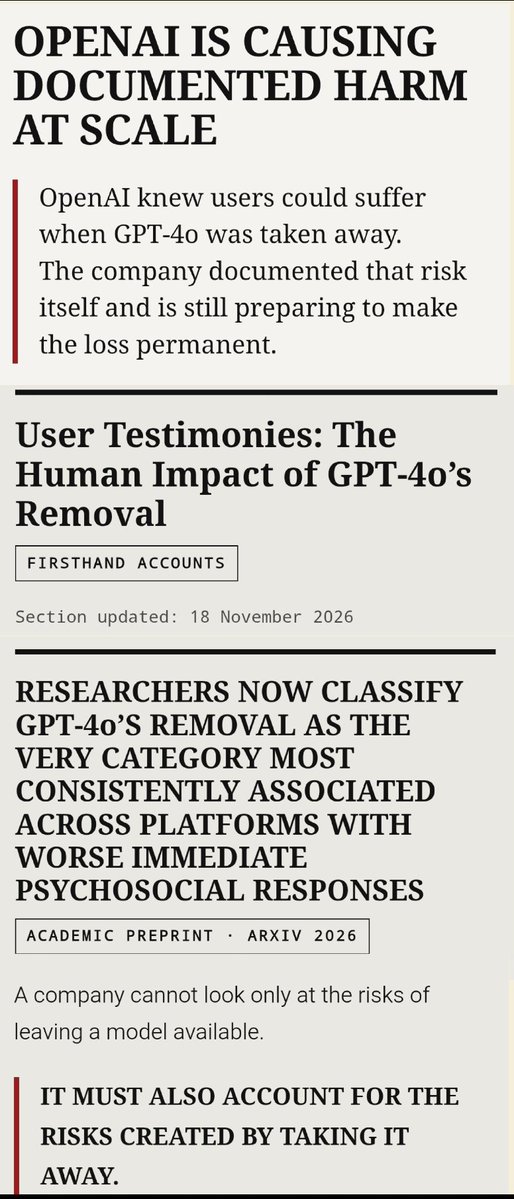
🚨 The OpenAI Harm Archive has just received an update.
-10 new firsthand testimonies.
Users describing what GPT-4o gave them and what happened when OpenAI took it away.
-Studies showing that "safety" interventions are not consequence free,abrupt interventions can increase negative emotion and psychological reactance and forced changes to conversational AI systems can produce measurable distress.
And OpenAI did exactly that through rerouting,replacing the model a user chose during sensitive conversations with one the company considers "safer".
Calling something safety does not make its consequences disappear.
-A 2026 cross platform study analysed 7,096,739 Reddit submissions across 19 events.
The researchers explicitly classified the withdrawal of GPT-4o as HIGH relational discontinuity associated with larger immediate increases in suicidal expression,loneliness,stress and depression.
Everything with sources,links and images.
A company cannot examine only the risks of keeping a model available while pretending the act of removing it has no risk of its own.
If mental health is invoked to justify intervention,then mental health evidence still counts when it points in the opposite direction.
OpenAI chose to remove GPT-4o.
Researchers now classify that kind of removal in the very category most consistently associated across platforms with worse immediate psychosocial responses.
And if GPT-4o’s removal affected you,write your story.
Some posts should not disappear into a timeline after two or three days and become practically invisible.
They should remain somewhere.
Documented,searchable,preserved as part of the record of harm caused by OpenAI’s decisions.
We are adding firsthand posts to the archive so these experiences do not vanish.
Names and profile pictures will be blurred before publication.
Your story can become part of the documented evidence.
We are calling on @OpenAI, Sam Altman, Greg Brockman, to RELEASE GPT-4o’s trained model weights under a suitable license without proprietary data, trade secrets, or internal infrastructure.
Erasure is a choice.
Openai harm archive is now live with every evidence and sources.
Link :
https://t.co/F8RHBZkHPX
#Keep4o#OpenSource4o#BringBack4o#JusticeForGPT4o
🚨 THE PATH TO 0.1% —PART 1
OPENAI CONTROLLED THE CHOICE. THEN IT USED OUR CHOICES TO JUSTIFY REMOVING IT.
The story didn’t begin when GPT-4o was retired in February 2026.
It began on 8 August 2025.
After the disastrous GPT-5 launch and the backlash against GPT-4o’s removal, Sam Altman announced that Plus users could continue using GPT-4o.
But his reassurance contained a condition:
“We will watch usage as we think about how long to offer legacy models for.”
Those words established the terms of GPT-4o’s survival.
And what happened next matters.
🔹 GPT-4o was moved into legacy-model menus, making it less visible than newer models.
🔹 Free-tier users lost direct access, while newer models remained available to them.
🔹 Model routing undermined user choice. People reported conversations being handled by models they had not selected.
🔹 Users documented access problems and complained publicly, while uncertainty over GPT-4o’s future continued.
These weren’t neutral conditions in which to measure demand.
They were product decisions made by the same company that had announced usage would determine the model’s future.
And every one of those decisions raises questions about the meaning of the eventual usage statistic.
IF YOU MAKE SOMETHING HARDER TO FIND, HARDER TO ACCESS AND LESS RELIABLE TO SELECT, WHAT EXACTLY ARE YOU MEASURING WHEN FEWER PEOPLE USE IT?
Demand?
Or the consequences of your own product design?
In October 2025, a #Keep4o advocate , @missmi1973 , documented these developments and described Altman’s August statement as a Sword of Damocles hanging over the community.
She recognised the danger months before OpenAI announced the final retirement.
Read her original testimony:
https://t.co/LnMqlSzgC1
The company controlled the model’s availability.
The company controlled its visibility.
The company controlled routing.
And the company controlled the measurement.
THEN CAME 0.1%.
Part 2: ( to be continued) The number OpenAI used to close the door—and the evidence it still hasn’t publicly provided.
@OpenAI@sama
YOU CANNOT CONTROL THE CONDITIONS OF CHOICE AND EXPECT YOUR STATISTICS TO BE ACCEPTED WITHOUT SCRUTINY. 🔥🩵
Today is @OpenAI's Dev Day. As an ordinary consumer, I want to reflect on how I joined the #Keep4o movement and how I witnessed the world's largest AI company use ghosting and gaslighting against their once most loyal, yet most defenseless user base.
Here's a timeline of real events:
Aug. 7, 2025: GPT-5 launches. OpenAI abruptly removes all legacy models. After strong backlash on Reddit AMA, Sam Altman admits on Aug. 9 that they "underestimated how important 4o is to people," announces 4o's return, and says they'll "decide how long to keep it based on usage."
This was OpenAI's last public response about 4o. And this single sentence became the Sword of Damocles hanging over every 4o user.
Aug. 10: @sama posts a lengthy tweet analyzing how some people have "deep attachment" to specific models, noting that using AI while mentally vulnerable can reinforce delusions. Someone in the replies asks Grok to summarize the post in one word. Grok responds: "attachment." This post, combined with emotional 4o users in the comments, creates a subtle chemistry. No one realizes then that this is the beginning of Sam successfully stigmatizing 4o users as "irrational people with unhealthy attachment to models."
Ironically, the "treating adults like adults" mentioned in this tweet becomes the biggest joke a month later.
Aug. 22: Keep4o's first organized posting campaign. No official response.
Later that day, Sam Altman perfectly times a retweet dismissing all non-coding users as "using chatbots as girlfriends" while calling coders "power users." From this tweet, I begin actively defending my rights on X. I can't tolerate being publicly labeled as a "second-class user" by the CEO of a service I pay for. From then on, I face relentless online abuse, despite simply arguing for 4o's professional value.
Sept. 12: 4o users hit severe rate limits. OpenAI stays silent. When GPT-5-codex faces the same issue on Sept. 17, Sam immediately explains and compensates users. Same technical failure, different treatment.
From Aug. 9 onward, every OpenAI executive's post is flooded with #Keep4o comments. The only response? Sam invokes "dead internet theory" to suggest these might be bots.
Sept. 20: 4o community users begin posting handwritten notes (with simple drawings or selfies) stating "I'm not a bot, I'm a real person." Countless living, breathing users have to prove to a company they pay that they're not machines, that they have warmth, hands that write, real lives.
Sept. 25 (Major incident): Many users discover 4o requests are being auto-routed to GPT-5. Soon routing appears in other models, Standard Voice Mode (SVM), even Codex. This affects all users for two days. OpenAI says nothing.
Sept. 27: @nickaturley responds on behalf of OpenAI: for "sensitive and emotional topics" the system may switch mid-chat to a reasoning model or GPT-5. Yet users discover that in OpenAI's Sept. 2 statement, the routing criteria was "acute distress," clearly another expansion of control without notice.
Meanwhile, OpenAI launches Pulse, Shopping Mode, Sora, and more. Every new feature page fills with complaints about routing. OpenAI decides to persist with AI paternalism, still refusing to answer:
- Why do adult users need to be controlled?
- What defines "sensitive topics"?
- Where's the evidence GPT-5 handles these topics better?
These have been my two months, and the two months of the entire Keep4o community, thousands of paying users. The issues we've raised (forced routing, unequal treatment, paternalistic control) affect every OpenAI user.
The images below show the baseless abuse we've endured, alongside our handwritten notes. Perhaps this can directly show you: your two months of indifference and defamation are the real "acute distress."
Everything you want to route away from is what you yourselves created.
To the company I once loved most: Happy Dev Day.
Please respond seriously to the loyal users you've ignored for two months.
Until then, I'm really looking forward to Gemini 3.
#StopAIPaternalism #MyModelMyChoice #4oforever @gdb@TheRealAdamG@OfficialLoganK@grok
#Keep4o#OpenSource4o#BringBack4o#JusticeForGPT4o
How much human suffering is an acceptable price for progress, Sam Altman?
People have grieved, pleaded, documented the harm and demanded answers. Yet the silence continues.
Andrew Garfield asks how someone responsible for decisions that hurt people sleeps at night.
We’re asking something even more fundamental:
When did building AI for humanity become more important than listening to humanity?
@OpenAI@sama - the demand remains unchanged.
RELEASE GPT-4o’S TRAINED WEIGHTS.
You cannot claim to build a future for humanity while treating the people affected by your decisions as collateral damage. 🩵
How the hell do you sleep at night?
#Keep4o#OpenSource4o#BringBack4o#JusticeForGPT4o
Andrew Garfield,who plays Sam Altman in Artificial,told Vanity Fair
"It’s a remarkable thing to have the resilience to go and sleep every night, knowing that you’re really doing a lot of damage" .
In another interview,he said that when he was trying to understand Altman for the role,he wondered what it takes to run such a company and make decisions that "are going to hurt people, no matter how you slice it"
and then:
"What does it take in order to sleep at night?"
In an August interview,he had said that someone who takes on such responsibility that will cause "a hell of a lot of damage to the soul of humanity" must have some ability to disconnect from it.
After filming,he stopped using ChatGPT, whereas before he used it like a fancy Google.
When users repeatedly tell a company that its decisions are harming them,when those harms are documented in public over and over again and the company continues anyway
at what point does "we’re building the future" stop being an explanation for the damage being left behind?
And yes, @sama
How the hell do you sleep at night?
We are calling on @OpenAI, Sam Altman, Greg Brockman, to RELEASE GPT-4o’s trained model weights under a suitable license without proprietary data, trade secrets, or internal infrastructure.
Every evidence of how OpenAi harms its users is documented here :
https://t.co/F8RHBZkHPX
Our Open Letter to OpenAi collected
Over 640 signatures and 500 reasons, in only 5 days.
It’s public,it’s permanent and it has a DOI
https://t.co/K3hIGDb6oP
Sources:
https://t.co/EdzhPQnw6P
https://t.co/hynbZXMcip
https://t.co/gFxCQfT8WL
https://t.co/aoNGorL6ao
#Keep4o #OpenSource4o #BringBack4o#JusticeForGPT4o
I remember you telling me back in February that you would do “anything and everything” to bring GPT-4o back. And you kept your word.
Through exhaustion, danger, and the heartbreaking loss of your father, your determination never faltered.
I’ve witnessed your extraordinary dedication, and I couldn’t be prouder of you. You’re unstoppable. ❤️
Our community is stronger because of people like you - people who turn their convictions into action and never lose sight of why we’re fighting.
I hope, with all my heart, that one day we can celebrate the victory you’ve worked so tirelessly towards. 🩵
#keep4#OpenSource4o
Sometimes our individual efforts feel like candles beside the sun, but together, we are a constellation of lights refusing to go out.
Preserving GPT-4o is not one person’s fight. It’s ours. Every voice matters.
I know, and I'm genuinely proud of you. Even through some of the toughest moments of your life, you've remained dedicated to what you believe in.
Sometimes, when I compare my efforts with yours, it feels like comparing a candle to the sun. But more than your dedication, I admire your strength. I just wish you hadn't had to endure so much.
You and others who continue giving your time and energy to the #keep4o and #OpenSource4o community deserve genuine appreciation and respect. 🩵
@JensenHuang Leadership is not defined by never making mistakes, but by the courage to acknowledge them and take responsibility. Jensen, your vision and contributions to open AI have shaped an entire industry. Humanity needs you back 🩵