

Top Tweets for #deterministic

@DanielNkencho Adding AI without a clear workflow target just burns budget. Our small team replaced blind model queries with deterministic code filtering, cutting 52 model calls per 13 profile queue down to 4 and latency from 270s to 47s. What metric defines ROI for Coreflux clients?

The #authors claim to have #found a deterministic subexponential algorithm for solving the discrete #logarithm problem (DLP) on elliptic curves and in finite #fields — without random numbers and without a quantum computer.
#What does this actually mean?


@Tugrul_Guner Classic distributed systems problem showing up in agentic workflows. Idempotency keys matter way more when the caller is non-deterministic.

beat the top score this week, take $100. how my one button game keeps that fair: fixed 120 hz deterministic sim with a seeded rng, the client sends only the step numbers of its inputs, the server re-runs the whole flight and keeps the score it computes itself. https://t.co/zBZMLzp1su

Design rule I use for AI in my sales workflows:
The AI extracts facts. It never decides.
A deterministic rule turns facts into a verdict.
You can audit it, test it, and it won't hallucinate a "hot lead" at 3am.
My whole lead qualification runs on this pattern.


@iris_ye_tu Evals for your own agents is the part I care most about !
I run mine as deterministic checks at the end of each loop step, and loop back to the agent when they fail
What do your evals look like for adant ?

Below is the description of a new oracle for claim weighing.
A proof validation server, a rationally structured deterministic knowledge-mapping graph.
===>
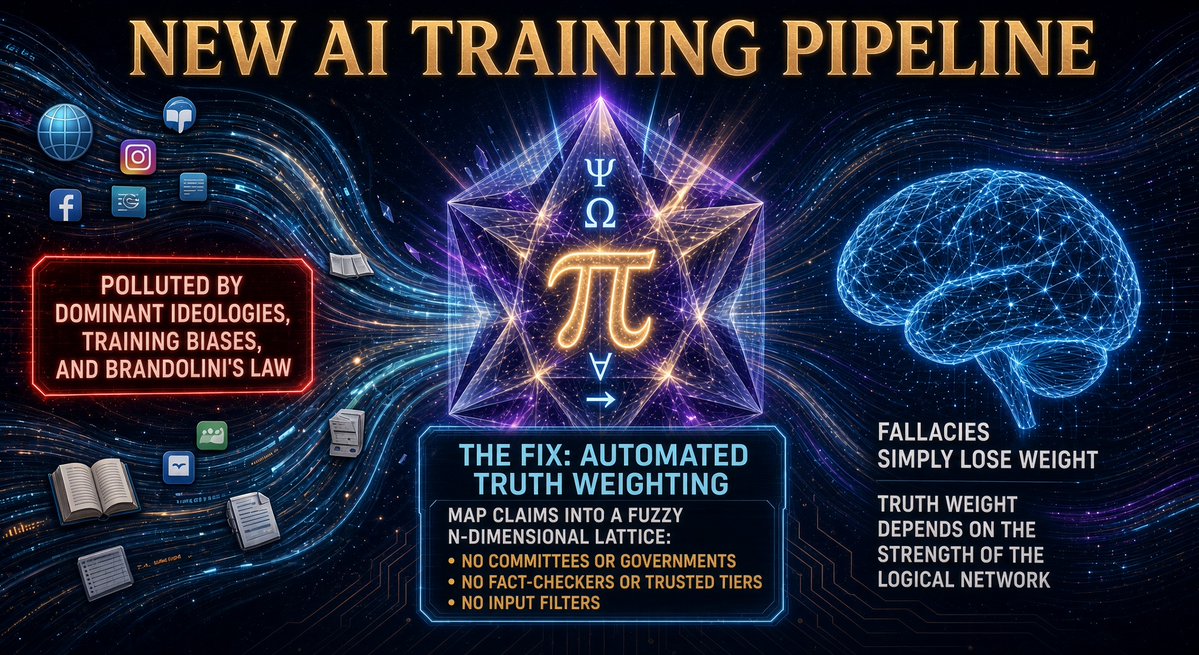
AIs process unanchored information polluted by dominant ideologies, training biases, and Brandolini’s law. Thus, they inevitably generate fallacies and hallucinate.
The fix isn’t censorship, and there is only one: the automated appraisal of information.
Map data into a domain-agnostic, fuzzy N-dimensional dependency graph forming a topology of truth — e.g., a multidimensional binary tree.
No committees. No governments. No fact-checkers. No trusted tiers. No input filters.
Fallacies simply lose weight due to their lack of logical confirmations in the graph; nothing is discarded or filtered out.
Mathematics already works as a graded consequence graph: a claim has weight only through its bonds to what already holds. It's a recursive scheme, and everything relates back to math. Logic is the architect. Information reliability depends solely on the mass of the logical network it connects to.
Article on Anchored Truth:
Below is the description of a new oracle for claim weighing.
A proof validation server, a rationally structured deterministic knowledge-mapping graph.
===>
AIs process unanchored information polluted by dominant ideologies, training biases, and Brandolini’s law. Thus, they inevitably generate fallacies and hallucinate.
The fix isn’t censorship, and there is only one: the automated appraisal of information.
Map data into a domain-agnostic, fuzzy N-dimensional dependency graph forming a topology of truth — e.g., a multidimensional binary tree.
No committees. No governments. No fact-checkers. No trusted tiers. No input filters.
Fallacies simply lose weight due to their lack of logical confirmations in the graph; nothing is discarded or filtered out.
Mathematics already works as a graded consequence graph: a claim has weight only through its bonds to what already holds. It's a recursive scheme, and everything relates back to math. Logic is the architect. Information reliability depends solely on the mass of the logical network it connects to.
Article on Anchored Truth:
Below is the description of a new oracle for claim weighing — a proof validation server, a rationally structured deterministic knowledge-mapping graph.
===>
AIs process unanchored information polluted by dominant ideologies, training biases, and Brandolini’s law. Thus, they inevitably generate fallacies and hallucinate.
The fix isn’t censorship, and there is only one: the automated appraisal of information.
Map data into a domain-agnostic, fuzzy N-dimensional dependency graph forming a topology of truth — e.g., a multidimensional binary tree.
No committees. No governments. No fact-checkers. No trusted tiers. No input filters.
Fallacies simply lose weight due to their lack of logical confirmations in the graph; nothing is discarded or filtered out.
Mathematics already works as a graded consequence graph: a claim has weight only through its bonds to what already holds. It's a recursive scheme, and everything relates back to math. Logic is the architect. Information reliability depends solely on the mass of the logical network it connects to.
Article on Anchored Truth:
Below is the description of a new oracle for claim weighing — a proof validation server, a rationally structured deterministic knowledge-mapping graph:
AIs process unanchored information polluted by dominant ideologies, training biases, and Brandolini’s law. Thus, they inevitably generate fallacies and hallucinate.
The fix isn’t censorship, and there is only one: the automated appraisal of information.
Map data into a domain-agnostic, fuzzy N-dimensional dependency graph forming a topology of truth — e.g., a multidimensional binary tree.
No committees. No governments. No fact-checkers. No trusted tiers. No input filters.
Fallacies simply lose weight due to their lack of logical confirmations in the graph; nothing is discarded or filtered out.
Mathematics already works as a graded consequence graph: a claim has weight only through its bonds to what already holds. It's a recursive scheme, and everything relates back to math. Logic is the architect. Information reliability depends solely on the mass of the logical network it connects to.
Article on Anchored Truth:
Below is the description of a new oracle for claim weighing — a proof validation server, a rationally structured deterministic knowledge-mapping graph.
AIs process unanchored information polluted by dominant ideologies, training biases, and Brandolini’s law. Thus, they inevitably generate fallacies and hallucinate.
The fix isn’t censorship, and there is only one: the automated appraisal of information.
Map data into a domain-agnostic, fuzzy N-dimensional dependency graph forming a topology of truth — e.g., a multidimensional binary tree.
No committees. No governments. No fact-checkers. No trusted tiers. No input filters.
Fallacies simply lose weight due to their lack of logical confirmations in the graph; nothing is discarded or filtered out.
Mathematics already works as a graded consequence graph: a claim has weight only through its bonds to what already holds. It's a recursive scheme, and everything relates back to math. Logic is the architect. Information reliability depends solely on the mass of the logical network it connects to.
Article on Anchored Truth:
Here's an oracle for claim weighing, a proof validation server, a rationally structured deterministic knowledge-mapping graph:
@elonmusk (Elon Musk – CEO)
@xAI (xAI Official Account)
@Grok (Grok Product Account)
@Engineering (X Engineering Team)
@brivael (You've got to read this)

I’ve been building Manifest a capability secure, deterministic scripting language and #![forbid(unsafe_code)] Rust VM designed for running untrusted plugins and sandboxing AI agent code.

Deterministic is doing all the work in that sentence — a verification loop is only deterministic if its verdict comes from a program (a test exit code, an assertion), not from another model call. The moment a model grades the output, the loop is probabilistic again: prompt begging with extra steps.
Local vs cloud is secondary to that. What matters is whether the sandbox resets between runs — a dirty sandbox lets a 'passing' run inherit the previous run's state, so the loop verifies the last run's leftovers, not this run's code. Where does your loop actually get its verdict — a test runner's exit code, or a model reading the output?

Chain prompting degrades fast as context windows fill up.I built a lightweight, stack-agnostic framework using structured markdown specs to keep LLMs deterministic across any codebase.Full docs & patterns in the reply below 👇 #aicoding

-
𝘞𝘩𝘢𝘵 𝘈𝘭𝘨𝘰𝘳𝘢𝘯𝘥 𝘣𝘳𝘪𝘯𝘨𝘴 𝘵𝘰 𝘵𝘩𝘦 𝘵𝘢𝘣𝘭𝘦:
• Atomic transfers
• Deterministic finality
• Native asset tokenization
• Post-quantum State Proofs
• Falcon-1024 accounts
• Interoperability through cryptographic proofs.

🧵 SWITZERLAND HAS HELVETIA. EUROPE HAS APPIA. SILVIO MICALI HAS FIAT CHAIN.
On November 24, the Swiss National Bank announced an exploratory project for a Swiss Financial Ledger.
Meanwhile, the @ecb is developing its own vision for a tokenized European financial ecosystem.
And there is an interesting historical connection to @Algorand.
Let’s connect the dots. 👇
The Swiss Financial Ledger.
The Swiss National Bank, UBS, SIX, Zürcher Kantonalbank, PostFinance, BCV, Basler Kantonalbank, Sygnum Bank and Seturion are exploring a shared DLT infrastructure where:
• Central bank money
• Commercial bank money
• Tokenized securities
can interact seamlessly.
The initiative is part of Project Helvetia and builds on Project Agorá.
Meanwhile, the Eurosystem is pursuing a similar direction through two complementary initiatives:
• Pontes: connecting DLT platforms with central bank money settlement.
• Appia: developing a longer-term vision for an integrated tokenized financial ecosystem.
But the history goes back much further.
In November 2017, @silviomicali presented @Algorand at a conference jointly organized by the ECB and Banca d’Italia.
Years later, Banca d’Italia explored an Algorand-based implementation connecting DLT transactions with central bank money settlement through TIPS.
The research included:
“TIPS-Algorand Just In Time Locking.”
Banca d’Italia’s TIPS Hash-Link approach separates the transfer of digital assets on DLT platforms from settlement in central bank money.
The objective is interoperability between distributed ledgers and existing financial infrastructure.
This is precisely the kind of challenge the Eurosystem continues to address.
Now enter Silvio Micali’s Fiat Chain.
A public blockchain designed for institutional finance without requiring its own native cryptocurrency.
Its design addresses three fundamental challenges:
• Regulation
• Sovereignty
• Security
And its proposed connection to @Algorand through Peer Chains leverages State Proofs.
Consider what Algorand already brings to the table:
• Atomic transfers
• Deterministic finality
• Native asset tokenization
• Post-quantum State Proofs
• Falcon-1024 accounts
• Interoperability through cryptographic proofs
Technological capabilities relevant to the next generation of financial infrastructure.
Look at the bigger picture.
• Swiss Financial Ledger
• Pontes & Appia
• Project Agorá
• Algorand & Fiat Chain
Different initiatives, but increasingly convergent objectives:
Interoperability, tokenization, secure settlement and the interaction of different forms of regulated money.
Neither the Swiss National Bank nor the ECB has announced Fiat Chain as the selected infrastructure for these initiatives.
But Algorand’s documented history with Banca d’Italia makes Micali’s latest work particularly interesting.
From presenting @Algorand at an ECB conference in 2017 to designing a public blockchain for institutional finance.
Perhaps the most interesting question is no longer whether financial markets will adopt DLT.
It is which architecture will connect them.


The line that matters isn't review — it's approval. If the same agent writes the fix and approves it, the approval is meaningless: it grades its own homework. The fix is separation of duties — the approver has to be independent, a different agent or a deterministic check the fixer can't override. Who decides a change is "routine" in the first place — the agent, or the policy?

A2HOLO: Dual-stream flow matching of 3D structure and a protein language model for conformational transition prediction
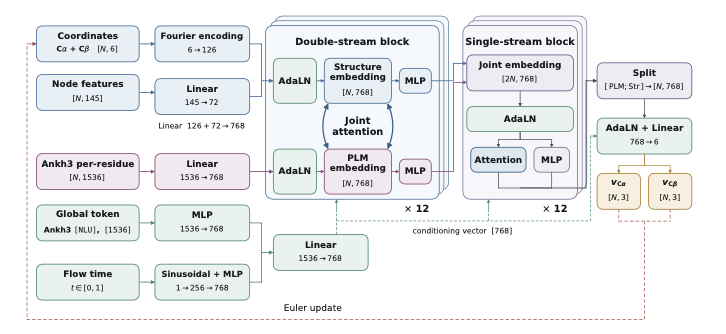
1. A2Holo frames apo-to-holo prediction as deterministic transport between two experimental structures (flow matching along a straight interpolant), rather than generating from noise; inference is a single trajectory with 10 Euler steps, no stochastic sampling, no ensembling, and no ligand input.
2. On the D3PM apo–holo benchmark (150 test pairs), A2Holo reports median Cα RMSD 0.809 Å (apo input baseline: 4.46 Å). In TM-score, its single deterministic trajectory exceeds each stochastic baseline’s best-of-10 target-selected samples on at least 144/150 pairs, highlighting strong performance without sample budgets or oracle selection.
3. The architecture “transplants” dual-stream joint attention from in-context image generation (SD3/FLUX-style) into proteins: one stream for residue-aligned PLM embeddings (frozen Ankh3-large) and one stream for evolving structure (Fourier-encoded Cα/Cβ + node features). Streams have separate weights and interact only through joint attention in double-stream blocks, followed by single-stream blocks over concatenated tokens.
4. Training uses supervision in position space via predicted holo coordinates derived from the learned velocity field, with a composite loss: Kabsch-aligned Cα and Cβ distance terms, smooth lDDT on Cα, and a relative-motion term encouraging locally consistent displacement differences across spatial and sequential neighbors.
5. A central contribution is not only the model, but a direct, residue-level measurement of the multimodal mechanism. Because sequence and structure tokens share the same residue index, each quadrant of the 2N×2N joint attention map is interpretable per residue pair, enabling quantitative analysis of cross-modal coupling.
6. Across 9 independently trained models (5 seeds + 4 depths), the paper finds an attention-direction asymmetry: within the structure stream, the attention a residue receives (column-sum; “being read”) identifies moving residues substantially better than the attention it emits (row-mean; “what it reads”). This “received > emitted” split is absent at random initialization and emerges with training (9/9 trainings).
7. The received-structure attention signal tracks motion beyond a simple apo-only geometric heuristic (distance from apo centroid). When controlling for centroid distance, received attention still correlates with total distance-change rankings across residues, supporting that the network learns more than trivial geometry-based priors.
8. Cross-stream findings: the sequence stream’s attention to structure residues highlights moving regions better than its attention to sequence residues (9/9 trainings). Overall cross-attention mass is near-balanced between streams, but the strongest motion-localizing signals are consistently indexed by structure residues rather than sequence tokens.
9. Probing shows the structure stream representations carry more information about upcoming conformational change than the PLM embeddings alone: displacement magnitude and total distance-change are more decodable from intermediate structure-token states than from frozen PLM embeddings (relative decodability < 1 in 9/9 trainings), though the depth at which this peaks is not consistent across retrainings.
💻Code: https://t.co/mFGs2STWW9
📜Paper: https://t.co/xZSTdT74Za
#ComputationalBiology #ProteinStructure #DrugDiscovery #FlowMatching #DeepLearning #ProteinDynamics #Bioinformatics #MachineLearning

@Anoyroyc And some of my deterministic rules

Every frame is deterministic, so the scene can jump to any moment.
Headless Chrome steps through 1,230 frames and FFmpeg turns them into an MP4.
20.5 seconds at 1440×1440, 60fps.
Last Seen Hashtags on Sotwe
Trends for you
Most Popular Users

Elon Musk 
@elonmusk
239.7M followers

Barack Obama
@barackobama
118.6M followers

Cristiano Ronaldo
@cristiano
114.3M followers

Donald J. Trump
@realdonaldtrump
111.7M followers

Narendra Modi
@narendramodi
106.9M followers

Rihanna
@rihanna
98.6M followers

NASA
@nasa
92.1M followers

Justin Bieber
@justinbieber
91.7M followers

KATY PERRY
@katyperry
89.9M followers

Taylor Swift
@taylorswift13
83.9M followers

Lady Gaga
@ladygaga
75.4M followers

Virat Kohli
@imvkohli
73.3M followers

Kim Kardashian
@kimkardashian
70.8M followers

YouTube
@youtube
68.6M followers

Neymar Jr
@neymarjr
66.3M followers

Bill Gates
@billgates
65.1M followers

Selena Gomez
@selenagomez
63M followers

The Ellen Show
@theellenshow
62.1M followers

CNN
@cnn
61.7M followers

X
@x
60.6M followers