

Top Tweets for #eigenDA

$MEGA - a story of a masterfully executed scam of the community
I think everyone already knows that today at 14:00 UTC+3 the $MEGA token will be listed on exchanges. I couldn’t find any proper, complete research on the project, so I decided to dig into it myself and share it with you.
MegaETH is a Layer 2 solution for Ethereum that positions itself as the world’s first “real-time blockchain.” The project claims to achieve speeds of 100,000+ TPS (spoiler - bullshit) and latency under 1 ms through deep node specialization and the use of EigenDA, aiming to bring Web2 server performance into a decentralized environment.
$MEGA Tokenomics
Total Supply: 10,000,000,000 MEGA
• Public Sale (Sonar): 500,000,000 (5%)
• Sonar Bonus Pool: 250,000,000 (2.5%)
• Echo Round (Prior investors): 500,000,000 (5%)
• Fluffle Round (Prior investors): 250,000,000 (2.5%)
• Team and Advisors: 950,000,000 (9.5%)
• Foundation/Ecosystem Reserve: 750,000,000 (7.5%)
• VC Allocation: 1,470,000,000 (14.7%)
• KPI Staking Rewards: 5,330,000,000 (53.3%)
Total: 100%
Change of listing conditions: rushing instead of technology
Initially, the TGE was promised only after reaching 100k TPS. In reality, the team switched gears: launch today, April 30, 2026, with actual speeds of 22k–35k TPS. Instead of a technological breakthrough, the project pushed the listing under the narrative of developing “Mafia Apps” (social and gaming apps with questionable value). Looks like a desire to cash out as quickly as possible on the listing rather than deliver a solid product (basic stuff).
Staking manipulation and allocation “haircuts”
In mid-March 2026, the project introduced a Turbo Staking mechanism that forced holders to lock tokens for the first 14–30 days after TGE in exchange for bonuses, artificially reducing supply at listing. The final act was a scandal 24 hours before TGE: the team began массово canceling allocations of Public Sale (Sonar) participants, simply refunding their deposits. Under the slogan of “fighting sybils,” the team effectively took cheap tokens away from retail to maximize supply centralization in their own hands before trading began.
Result:
• Expected Initial Supply: originally around 1.2–1.5B MEGA (~12–15%) should have been in the market.
• Real supply today: after Turbo Staking (14–30 day lock) and mass allocation revokes 24 hours before TGE, the actual initial supply was squeezed down to 400–500M MEGA (~4–5%).
Conclusion:
I think you’ve seen how the premarket price recently went from $0.12 to $0.22. My assumption: the team used the thin premarket order book to wipe out hedgers.
• Some people had been hedging their allocation for months and simply didn’t manage their positions — they got liquidated on the move up.
• Others hedged tokens at $0.12–$0.15, but at the last moment lost their allocation. Now they’re forced to cover their shorts at current prices at a loss, without tokens to offset it.
• The rest, at minimum, had their margin locked since last year due to constant delays.
In the end we have: a listing that bypassed promises, forced staking, and a direct robbery of the community via allocation removal. The project is just another fucking scam, and in the long run it’s worth zero - however, I wouldn’t rush to short it.
Numbers at launch:
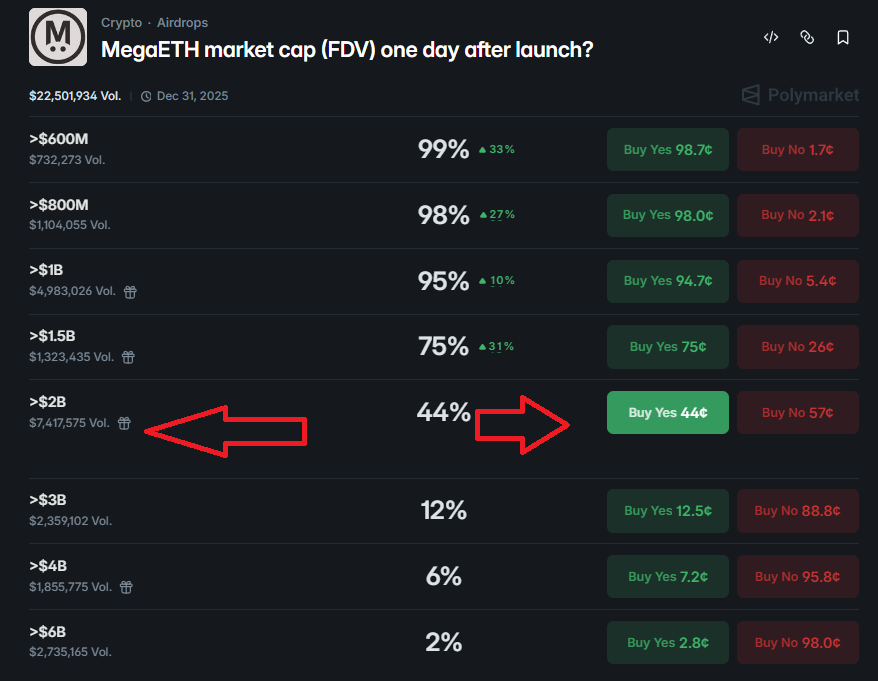
• FDV: ~$1.9–2.2B (overpriced for such an L2).
• MCap: only $80–100M, since the real initial supply after all manipulations is around 4–5%.
Almost the entire circulating supply is currently in the team’s hands. I don’t know about you, but I don’t want to either short or long this. The team can either start dumping seized allocations right at listing or pull some crazy move while having near-total control over supply. I’m leaning more towards MegaETH market cap (FDV) > $2B one day after launch? - NO on Polymarket.
But it’s a 50/50 risk, so DYOR.

If you want to know why the smartest money is moving here, just look at these numbers:
1. Execution: ~1ms Block Execution
This refers to the time the engine takes to process a single block of transactions. Most blockchains operate with block times ranging from 400ms to 12 seconds. By achieving ~1ms, RISE virtually eliminates execution latency.
2. Throughput: 100,000+ TPS
Transactions Per Second (TPS) measures the network's total capacity. To put this in perspective, Visa handles roughly 24,000 TPS. By supporting 100,000+ TPS, RISE is built for hyper scale and mass adoption. This massive throughput is unlocked via Parallel EVM architecture, which processes independent transactions simultaneously rather than in a single file line.
3. Data Availability: EigenDA
Data Availability is where the transaction data is stored so anyone can verify it. This is why gas fees on RISE stay incredibly low even during periods of extreme network activity.
4. Settlement: Ethereum L1
Settlement is the final layer where transactions become permanent and immutable. You get the speed of a supercar with the armored protection of a tank.
5. Proving: OP Succinct Lite (ZK Fraud Proofs)
By using OP Succinct Lite, RISE elevates the standard OP Stack (Optimistic) by utilizing Zero Knowledge (ZK) proofs for validity. This drastically reduces the "challenge period" (withdrawal time).
The @risechain & @risextrade spec sheet is a masterclass in blockchain engineering.


Research Prompt:
You are a Mantle DeFi analyst. Here is current data: [paste TVL, mETH APY, top pools from Dune/Mantlescan]. Analyze yield opportunities vs risks (liquidation, IL). Highlight what makes Mantle unique (low fees, ZK finality, EigenDA). Be honest about downsides
4/6

Mantle’s low-fee, modular design (EigenDA for cheap, censorship-resistant data availability + ZK finality) makes this reliable in production
When you combine Ai & On-chain data becomes signal.
Execution becomes automated.
Strategies become scalable


𝙐𝙣𝙞𝙛𝙞𝙚𝙙 𝙏𝙧𝙖𝙣𝙨𝙛𝙤𝙧𝙢𝙖𝙩𝙞𝙤𝙣 𝙤𝙛 𝘿𝘼 𝘼𝙨𝙨𝙚𝙩 𝙎𝙩𝙖𝙣𝙙𝙖𝙧𝙙, 𝘼 𝙉𝙚𝙬 𝙀𝙧𝙖 𝙛𝙤𝙧 𝙈𝙤𝙙𝙪𝙡𝙖𝙧 𝘿𝙖𝙩𝙖 𝘼𝙫𝙖𝙞𝙡𝙖𝙗𝙞𝙡𝙞𝙩𝙮
The Endless Protocol introduces a powerful concept: the Unified Transformation of Data Availability (DA) Assets. This is more than a technical upgrade, it’s a fundamental shift in how blockchain ecosystems treat data, liquidity, and interoperability.
Here’s what it means and why it matters 👇
🔹 1. 𝘽𝙧𝙚𝙖𝙠𝙞𝙣𝙜 𝙩𝙝𝙚 𝙁𝙧𝙖𝙜𝙢𝙚𝙣𝙩𝙖𝙩𝙞𝙤𝙣 𝙤𝙛 𝘿𝘼 𝙇𝙖𝙮𝙚𝙧𝙨
Different DA solutions (Celestia, EigenDA, etc.) often operate in silos. Endless proposes a unified standard that allows assets across DA layers to be transformed and utilized seamlessly reducing fragmentation and unlocking composability.
🔹 2. 𝙏𝙪𝙧𝙣𝙞𝙣𝙜 𝘿𝙖𝙩𝙖 𝙞𝙣𝙩𝙤 𝙇𝙞𝙦𝙪𝙞𝙙 𝘼𝙨𝙨𝙚𝙩𝙨
Traditionally, DA is passive, it stores data.
Endless transforms DA into an active asset class, where data itself becomes:
• Tradable
• Programmable
• Yield-generating
This introduces a new financial primitive: Data Liquidity.
🔹 3. 𝘾𝙧𝙤𝙨𝙨-𝙋𝙧𝙤𝙩𝙤𝙘𝙤𝙡 𝙄𝙣𝙩𝙚𝙧𝙤𝙥𝙚𝙧𝙖𝙗𝙞𝙡𝙞𝙩𝙮
Unified transformation enables DA assets to move across:
• Rollups
• Modular chains
• Execution layers
This creates a shared liquidity layer for data similar to how ERC-20 standardized tokens.
🔹 4. 𝙎𝙩𝙖𝙣𝙙𝙖𝙧𝙙𝙞𝙯𝙖𝙩𝙞𝙤𝙣 𝙇𝙖𝙮𝙚𝙧 𝙛𝙤𝙧 𝘿𝘼 𝘼𝙨𝙨𝙚𝙩𝙨
Just like token standards simplified DeFi, Endless proposes a DA Asset Standard that:
• Defines how data is packaged
• Enables consistent validation
• Allows universal access across ecosystems
This reduces complexity for developers and accelerates adoption.
🔹 5. 𝙋𝙧𝙤𝙜𝙧𝙖𝙢𝙢𝙖𝙗𝙡𝙚 𝘿𝙖𝙩𝙖 𝙐𝙩𝙞𝙡𝙞𝙩𝙮
Data is no longer static, it can be:
• Reused across applications
• Monetized via smart contracts
• Embedded into DeFi, AI, and gaming
This opens the door to DataFi a new category of decentralized finance.
🔹 6. 𝙐𝙣𝙞𝙛𝙞𝙚𝙙 𝙏𝙧𝙖𝙣𝙨𝙛𝙤𝙧𝙢𝙖𝙩𝙞𝙤𝙣 𝙀𝙣𝙜𝙞𝙣𝙚
At the core lies a mechanism that:
• Converts raw DA into standardized assets
• Bridges different DA systems
• Maintains integrity and verifiability
Think of it as a “universal adapter” for blockchain data.
🔹 7. 𝙄𝙢𝙥𝙡𝙞𝙘𝙖𝙩𝙞𝙤𝙣𝙨 𝙛𝙤𝙧 𝘽𝙪𝙞𝙡𝙙𝙚𝙧𝙨
Developers gain:
• Easier integration across DA layers
• Reduced infrastructure overhead
• Access to shared data liquidity
Result → faster innovation cycles and richer dApps.
🔹 8. 𝙄𝙢𝙥𝙡𝙞𝙘𝙖𝙩𝙞𝙤𝙣𝙨 𝙛𝙤𝙧 𝙐𝙨𝙚𝙧𝙨 & 𝙄𝙣𝙫𝙚𝙨𝙩𝙤𝙧𝙨
Users benefit from:
• New yield opportunities from data
• Greater transparency
• Interoperable ecosystems
Investors gain exposure to a new asset class: tokenized data.
🔹 9. 𝙎𝙘𝙖𝙡𝙞𝙣𝙜 𝙈𝙤𝙙𝙪𝙡𝙖𝙧 𝘽𝙡𝙤𝙘𝙠𝙘𝙝𝙖𝙞𝙣 𝙑𝙞𝙨𝙞𝙤𝙣
Endless strengthens the modular thesis by:
• Decoupling data from execution
• Making DA composable
• Enabling scalable, flexible architectures
🔹 10. 𝙐𝙣𝙡𝙤𝙘𝙠𝙞𝙣𝙜 𝙩𝙝𝙚 𝘿𝙖𝙩𝙖 𝙀𝙘𝙤𝙣𝙤𝙢𝙮 𝙍𝙚𝙫𝙤𝙡𝙪𝙩𝙞𝙤𝙣
Unified DA asset transformation could become:
➡️ The “ERC-20 moment” for data
➡️ The foundation of cross-chain data economies
➡️ A catalyst for the next wave of Web3 innovation
𝙒𝙝𝙖𝙩 𝙔𝙤𝙪 𝙉𝙚𝙚𝙙 𝙩𝙤 𝙆𝙣𝙤𝙬:
Endless Protocol turns fragmented, passive data layers into a unified, liquid, and programmable asset ecosystem unlocking DataFi and redefining how value flows in modular blockchains.
@EndlessProtocol #DataAvailability #ModularBlockchain #DataFi


Introducing the SecureAI Agent Project for Mantle Network: This project aims to build a secure AI agent using Zama's Fully Homomorphic Encryption (FHE) technology to operate on the Mantle Network – a Layer-2 Ethereum network focused on liquidity and DeFi efficiency. The agent will process sensitive data (such as personal financial data or risk predictions) without decryption, ensuring complete privacy. This is particularly useful for DeFi applications on Mantle, where user data needs to be protected while still allowing for autonomous AI computation.
We will use Zama's fhEVM to implement confidential smart contracts, and Concrete ML for FHE-compatible AI models.
Project Goals: Data Security: Use FHE to compute on encrypted data, preventing information leaks.
Integration with Mantle: Deploy on Layer-2 to leverage Mantle's high speed, low fees, and ZK proofs.
Practical Application: The agent automatically predicts DeFi debt risk based on encrypted user data, e.g., assessing solvency without revealing transaction history.
Scaleability: Supports autonomous AI agents (agentic AI) within the Mantle ecosystem, such as transaction automation or real-time data analysis.
Project Architecture: The project consists of three main components:
Backend AI (Off-chain with FHE): Uses Zama's Concrete ML to build an ML model running on encrypted data.
Smart Contract on Mantle (On-chain with fhEVM): Implements confidential smart contracts to process encrypted data and interact with the agent.
Frontend/Interface: A simple dApp for users to upload encrypted data and receive results from the agent.
Stack Technology:
FHE Layer: Zama's Concrete (for ML) and fhEVM (for confidential smart contracts).
Blockchain: Mantle Network (EVM-compatible, using Remix or Hardhat for deployment).
AI Model: A simple logistic regression model for risk prediction, compiled to FHE-compatible.
Tools: Python for off-chain, Solidity with euint types from Zama for on-chain.
Integration: Using Mantle's EigenDA for data availability, combined with FHE for enhanced security.
Below is a summary of the steps to implement the SecureAI Agent project (since this is a concept on paper, I will omit all sample code and specific technical details):
1. Prepare the development environment!
Install the necessary tools: Concrete ML, fhEVM, Hardhat/Foundry, Web3 libraries.
Establish a wallet connection (MetaMask) with Mantle Mainnet/Testnet.
Clone the repository and libraries from Zama, prepare the IDE and test environment.
2. Building an AI Model with FHE (Off-Chain)
Use Concrete ML to create and train a machine learning model.
Quantize the model for FHE compatibility, compile it into a circuit running on encrypted data.
Test prediction capabilities on encrypted data (without decryption).
3. Developing a Confidential Smart Contract on Mantle
Use Zama's fhEVM to write a smart contract supporting encrypted data types (euint).
Build logic: receive encrypted data, perform FHE calculations, and store the encryption results.
Deploy and test the contract on the Mantle Testnet.
4. Building an AI Agent (Integrating On-Chain & Off-Chain)
Create an automated agent: listen for events from the contract and retrieve encrypted data.
Run the FHE model off-chain to make predictions, then send the encryption results back to the chain if needed. Deploy the agent as a service (Docker, cloud server, or decentralized compute).
5. Testing & Security!
Perform unit tests and end-to-end tests on Mantle Testnet.
Security testing: access control, protection against replay attacks, overflow, and silent failures.
Performance measurement: latency FHE, gas cost, prediction accuracy.
The above is an idea for Mantle to build the project.
Note: The project does not exist; this is just an article presenting an idea to @Mantle_Official @scribble_dao


AI-Powered Network Congestion Predictor on @Mantle_Official
=========================
Proactive Intelligence for the Liquidity Chain
Mantle Network already stands out as Ethereum’s leading modular Layer-2 delivering ultra-low fees (paid in native MNT), high throughput, and institutional-grade security through its separated execution, EigenDA-powered data availability, and Ethereum settlement layers.
But even the most efficient L2s can face sudden spikes from DeFi surges, inscription waves, or mass wallet activity.
What if Mantle never had to react to congestion again?
Introducing the AI-Powered Network Congestion Predictor brought natively to @Mantle_Official. This system doesn’t wait for gas to explode or blocks to fill. It sees the spike coming and automatically fine-tunes the entire network in real time. The result? A blockchain that feels as smooth and reliable as traditional payment rails, perfectly aligned with Mantle’s vision of becoming the Liquidity Chain for on-chain finance and banking.
How It Works on Mantle (Seamless Integration with Modular Architecture)
===========================
Real Time Data Monitoring
The AI continuously ingests Mantle-native signals:
Mempool transactions (pending activity across the EVM execution layer)
MNT gas fees (which already start at ~0.001–0.06 Gwei but can spike under pressure)
Node traffic and validator behavior
Wallet activity patterns and cross-layer flows (L1 ↔ L2 bridging + EigenDA usage)
Because Mantle’s design is modular, the AI can monitor each layer independently execution, data availability (EigenDA), and settlement without any overhead.
Benefits for the @Mantle_Official Ecosystem
----------------------------------------
✔ Lightning-fast transactions even during peaks No more waiting in mempool hell.
✔ Predictably low MNT fees Users and dApps save money and can plan with confidence.
✔ Rock-solid stability Perfect for TradFi-DeFi bridging, tokenized banking, and institutional applications that demand uptime.
✔ Superior user & developer experience — dApps feel like Web2 apps; builders can focus on innovation instead of gas optimization.
In short, Mantle wouldn’t just be faster and cheaper than other L2s — it would be the first blockchain that feels proactive and intelligent, exactly what the Liquidity Chain of the future needs.


2. Off-chain Storage, On-chain Proofs:
The actual data lives in a modular storage environment like Arweave, IPFS, or EigenDA,
while only the cryptographic commitment or proof is stored onchain.

Data Throughput Is the Real Bottleneck of Onchain Orderbooks
Many assume onchain orderbooks struggle because of security constraints.
In reality, the bottleneck has always been data bandwidth.
High frequency trading produces an enormous stream of order updates often 100–1000× larger than ordinary transaction data. Most blockchains simply weren’t designed to handle that scale of continuous data flow.
This is where the partnership between $Reya and EigenCloud becomes structurally important.
@reya_xyz trading specific based rollup anchors execution to Ethereum validators while using EigenDA for high-throughput data availability. Transaction settlement remains on Ethereum, while massive orderbook data is handled by EigenDA.
The result is a system where high-frequency orderbooks remain verifiable, not just fast.
That distinction matters.
Speed without verifiability creates opacity.
Verifiable speed enables institutional-grade market structure.


Data bandwidth is the real bottleneck of onchain orderbooks
Security was never the real limitation for onchain trading.
Data was.
High frequency orderbooks generate a constant stream of updates:
• order placements
• cancellations
• liquidity adjustments
• price updates
This data can be hundreds of times larger than normal transaction data.
That’s the constraint most chains struggle with.
@reya_xyz approaches the problem differently.
Instead of compressing the market into limited bandwidth, the architecture expands the data layer:
• transaction settlement remains anchored to #Ethereum
• orderbook data flows through #EigenDA
• #zkproofs link both layers into a verifiable system
The result is a fully verifiable onchain orderbook capable of extremely high throughput.
Ethereum handles settlement.
EigenDA handles scale.
Reya connects both into a coherent trading system.


Previously, high-frequency trading failed on Ethereum not because of security but because of data bandwidth.
Reya and @eigencloud have partnered to solve exactly that.
Once live, EigenDA will power Reya with dedicated bandwidth to post and verify order data at scale, while transaction data continues to flow directly to Ethereum.
This will be the first onchain orderbook capable of 200,000 TPS.

Bottleneck 1: The Data Chokehold
High frequency orderbooks generate insane amounts of data. You can’t process that on a generic rollup without breaking it.
The Fix: Reya x EigenDA (@eigen_da)
Reya routes massive order data through EigenDA while keeping settlement anchored on Ethereum via ZK proofs.
The result? A fully verifiable on‑chain orderbook hitting 200,000 TPS. Millisecond execution without the centralized sequencer tax.

📘 올해는 이더리움이다
— 가격이 아니라 “구조”를 보라 (미래에셋증권)
📉 ETH는 ATH 대비 -60%
하지만 온체인은 정반대 신호.
1️⃣ 공급 쇼크 진행 중
전체 ETH의 50% 이상 스테이킹 잠김
→ 유통 물량 역사적 저점
→ 작은 매수에도 가격 Squeeze 구조 내재
2️⃣ 실사용은 ATH
월간 활성 주소 YoY +114%
연간 스테이블코인 거래량 33조 달러
→ Visa·Mastercard 수준
→ 투기 아닌 ‘정산 인프라’로 체질 변화
3️⃣ L2 내러티브 붕괴
가스비 99% 절감
블록 가스 리밋 2배 확장
→ ENS도 자체 L2 포기, 메인넷 복귀
→ L2는 “확장”이 아니라 “격리·특화” 모델로 재정의
4️⃣ AI 에이전트 경제의 핵심 인프라
x402 프로토콜: 기계 간 밀리초 결제
Blob / EigenDA → 수천만 TPS 잠재력
→ 수조 개 오토마타 경제의 정산 레이어
5️⃣ 기관의 선택
RWA·스테이블코인 유동성 집중
Stage 2 Rollup = Gold Standard 보안 구조
📌 정리
리테일은 떠났지만,
자본은 잠겼고 네트워크는 사상 최고치.
지금은 “무관심 속 구조적 잠금” 구간.
Great Divergence가 해소될 때를 대비하는 국면.
#이더리움 #ETH #AI에이전트 #Web4 #온체인데이터

Core Problem Mantle Solves.
Mantle addresses Ethereum’s high fees, slower speeds, and scalability limitations by batching transactions off-chain and using EigenDA for efficient data availability.
This enables over 500 transactions per second at low cost.


Reya: Bringing Institutional Trading Back to Ethereum (200k TPS + Real Liquidity)
Read the article to understand exactly how @reya_xyz powered by EigenDA, Ethena, and LayerZero, is building the full institutional-grade trading stack natively on Ethereum. 🔥
https://t.co/5Qiz2q9ntc

#Reya x #EigenCloud isn’t just a partnership it’s an architectural shift
Orderbook data at institutional scale doesn’t fit inside normal blockspace
EigenDA handles the data layer
Ethereum remains the settlement layer
zk proofs keep it verifiable
This is how HFT goes fully onchain

ICYMI: We announced a partnership with @EigenCloud to bring institutional-grade trading fully onchain.
High-performance orderbooks generate data 100x too large for standard chains, verifiable order data at scale was never possible.
EigenDA will provide the bandwidth to handle it, while settlements settle directly on Ethereum, fully verified via zk proofs.
HFT will be changed forever.

After a year of consistently using Arbitrum and Base, I know what good blockchain infrastructure looks like.
But Mantle isn't playing the same game everyone else is playing. More in my article 👇
$150M in vaults, Bybit integration, Robinhood listing and EigenDA technology that actually solves problems I've faced on other chains.
Some people will look at it and see another L2. I see institutional infrastructure being built in plain sight.
As someone who's been in the trenches. I recognised a pattern
Click the attached link to read more to see the full breakdown, my three-strategy approach and the compounding play most people will miss.
https://t.co/3VDn7DtKAM

https://t.co/GJTJp19nUw

EigenCloud has announced a strategic partnership with @reya_xyz which is building next generation trading infrastructure on Ethereum.
High performance onchain orderbook have long faced scalability issues due to massive data volume.
Reya addresses this by adopting a "based rollup" achieving L1 security and verifiability.
Through integration with @eigencloud EigenDA Big scale order data can now be posted and verified onchain efficiently.
The result is high speed execution while maintaining strong security.
It’s fair to say the foundation has now been completed from individual traders to institutions.
Programmatic traders: spot ETH is live in the Reya Python SDK 🧵
Here’s the simplest way to use it.
These two example scripts show the full flow ↓

Reya’s momentum this month underscores its identity as the first based rollup DEX on Ethereum.
Orderflow is now routed through EigenDA, indicating a deeper technical integration with Ethereum’s sequencing and data availability layers.
This architecture implies:
• high throughput handling of order data onchain
• verifiable execution with direct settlement guarantees
• multi sequencer resilience avoiding single points of failure
Instead of relying on isolated sequencers, @reya_xyz processes order data through EigenDA, leveraging Ethereum’s validator set to enforce finality and censorship resistance.
This shows that Reya is not just about speed, but credible onchain execution where every trade’s ordering and settlement can be audited and verified with Ethereum as the source of truth.
For traders and builders, this evolution suggests a future where orderbooks and execution logic remain transparent without sacrificing performance.


Opened Reya docs to understand DA setup. Executions go to Ethereum. Orders go to EigenDA. Two different places for data. Split seemed random at first.
Ethereum posting is expensive. Orderbook huge — every order, cancel, update. Executions are small, only what filled. If everything on Ethereum — uneconomical.
Orders are temporary data. Most cancel or expire without fill. Why pay L1 fees for what never executes? Executions are permanent — settlements, need on-chain.
Executions on Ethereum give finality from L1. Orders on EigenDA are cheap storage while pending. ZK proofs verify both. Security where needed, cheap where possible.
Not a technical split for the sake of split. Economics. Pay for what's important (settlements). Don't pay for temporary (pending orders). Both verified, trustless.
Studied the architecture, understood the logic. Hybrid DA is cost optimization, not compromise. Smart design for trading use case. Who else dug into DA structures?
@re


I bought into @megaeth because I trust my research, not some random KOL.
Honestly, even with a minimum allocation, it's not a small amount for me. In Asia, this allocation is roughly 7 months of an average salary.
So, how did I find MegaETH, and how did I get into the sale?
• I've been following @0xxbeacon. He's shared a lot of solid alpha before (the BadBunnz project was also his idea).
MegaETH was one of those alphas. Initially, the concept of a "Real-Time Blockchain" felt alien. Why care when we already have Arbitrum? Processing speeds are decent, and L2 gas fees are negligible for the average user now.
But I dug deeper. Their research on node architecture is genuinely clever.
Instead of dumping tons of data and execution on a single node type, they split the roles into 4 specialized layers: Sequencer, Prover, Full Nodes, and Replica Nodes.
They separated execution from storage. The Sequencer uses massive amounts of RAM to process transactions in-memory.
Result? Extreme speed.
This unlocks the ability to deploy true Web2-scale applications on-chain without latency issues (though, execution remains to be seen).
To visualize how "heavy" Web2 apps are, MegaETH's research breaks it down perfectly:
Take opBNB. It boasts 100 MGas/s. Sounds fast, right? Not compared to Web2.
* 100 MGas/s = ~650 Uniswap swaps or ~3,700 ERC-20 transfers per second. In contrast, modern database servers already exceed one million transactions per second.
* Complex apps can't come on-chain due to computational scarcity. A simple EVM contract calculating the nth Fibonacci number (n=10^8) consumes ~5.5 billion gas. At 100 MGas/s, that single calculation would clog the entire opBNB chain for 55 seconds.
Suddenly, "fast" L2s look tiny compared to Web2 complexity.
MegaETH's Solution: Extreme Specialization.
They achieve this by outsourcing security and censorship resistance to base layers like Ethereum and EigenDA.
Here is the breakdown:
Standard L1s force every node to do everything (Consensus + Execution). No specialization.
L2s started specializing. MegaETH takes it to the extreme by introducing "Replica Nodes" which strip away transaction execution entirely, differentiating them from traditional full nodes.
This gives us the 4 specialized roles I mentioned.
Traditional EVMs suffer from 3 bottlenecks: high state access latency, lack of parallel execution, and interpreter overhead.
MegaETH's Sequencers solve this by holding the entire blockchain state in RAM. No SSD read latency. Pure speed.
This isn't "just another L2". MegaETH enables apps that literally couldn't exist on Ethereum before.
High-Frequency Trading (HFT) DEXs? Real-time on-chain shooters like CS:GO? Have you seen the @hitdotone demo? 😂
Investing based on your own thesis always feels better than blindly FOMOing into a KOL's call.
Read the full research here: https://t.co/K5AYVg07si
They are actually changing the game, not just talking about it. GG!


2/3:@megaeth's Frontier mainnet beta is live and heating up. Mini-blocks at sub-10ms, sustained activity ramping on dashboards (EigenDA blobs climbing), day-1 infra locked (Alchemy RPCs, Chainlink/EigenLayer/Ethena partnerships, Mayan/Wormhole + Relay for instant multichain swaps). Ecosystem teams like @hellotradeapp & @brix_money
already shipping, @MagicEden NFTs ready from launch. Bonus campaign pulling in serious builders (top 5k can double allocations pre-TGE). Public mainnet + TGE hitting this month. Timing couldn't line up better for event-driven apps in DeFi/gaming that need real-time execution now.
Most Popular Users

Elon Musk 
@elonmusk
239.7M followers

Barack Obama
@barackobama
118.6M followers

Cristiano Ronaldo
@cristiano
114.3M followers

Donald J. Trump
@realdonaldtrump
111.7M followers

Narendra Modi
@narendramodi
106.9M followers

Rihanna
@rihanna
98.6M followers

NASA
@nasa
92.1M followers

Justin Bieber
@justinbieber
91.7M followers

KATY PERRY
@katyperry
89.9M followers

Taylor Swift
@taylorswift13
83.9M followers

Lady Gaga
@ladygaga
75.4M followers

Virat Kohli
@imvkohli
73.3M followers

Kim Kardashian
@kimkardashian
70.8M followers

YouTube
@youtube
68.6M followers

Neymar Jr
@neymarjr
66.3M followers

Bill Gates
@billgates
65.1M followers

Selena Gomez
@selenagomez
63M followers

The Ellen Show
@theellenshow
62.1M followers

CNN
@cnn
61.7M followers

X
@x
60.6M followers