

Top Tweets for #ethproofs

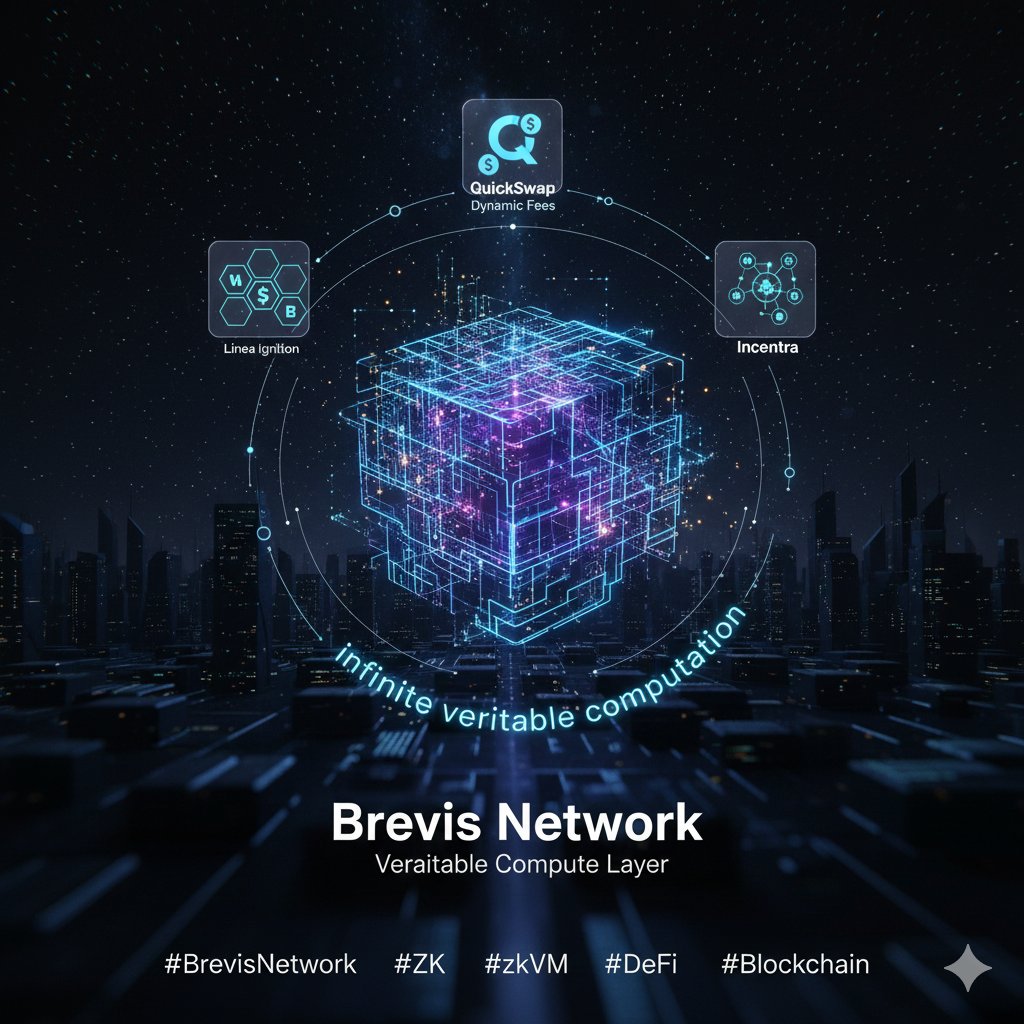
Meet @brevis_zk the verifiable compute layer that’s redefining trustless incentives and scaling in DeFi 🚀
They just launched Pico-GPU, a zkVM that’s 10–20x faster than before, and they’re already powering everything from Linea’s Ignition Program to dynamic fees on QuickSwap.
Whether it's through Incentra for transparent reward campaigns or proving entire Ethereum blocks with Ethproofs Brevis is making infinite verifiable computation a reality.
If you're into ZK, DeFi growth, or scalable infrastructure, keep your eyes here.
#BrevisNetwork #ZK #zkVM #VerifiableCompute #DeFi #Linea #Arbitrum #Incentra #ZeroKnowledge #Blockchain #CryptoInfra @wallchain

gBrevis my frens
so i was digging through brevis pico-ethproofs repo because i'm ̶s̶l̶i̶g̶h̶t̶l̶y̶ ̶o̶b̶s̶e̶s̶s̶e̶d̶ always hunting for all the deets hidden in @brevis_zk github trenches
and i found this commit that was added right after the Ethereum Fusaka update.
it's about making Pico's proving way more efficient through parallelization & smarter retry logic
i had to do a looot of studying on this
plus me being a CS nerd helped me get it enough to explain
✢ ✣ ✢ ✢ ✣ ✢ ✢ ✣ ✢
real-time ethereum proving is basically a race, you've got about 12 seconds to prove a block before the next one lands and if you miss that window you're not "real-time" anymore
the problem is that proving can fail for random reasons, and when that happens you need to retry.
but retries are expensive because you'd have to save logs, reset everything & spin containers back up
brevis has built a fast-retry mechanism that skips all these extras when a proof fails
✢ ✣ ✢ ✢ ✣ ✢ ✢ ✣ ✢
a "worker container" is a packaged helper program that does all the work in the background
so when they say they parallelized worker container management that means instead of turning those helpers on & off 1 by 1, they do them all at once now
usually, if something goes wrong during proving you'd have to wait for each container to restart
but now they spin everything up in parallel so that recovery from failures is instant
the fast-retry feature means that when a proof fails it doesn't waste time saving logs or doing any diagnostic operation, it just immediately retries it again
they also made the proving timeout configurable which is huge for tuning performance
the default timeout for fast-retry is 30 seconds instead of the normal 120 seconds.
this makes a lot of sense because not only do they now have a lightning fast proving algorithm, but the error handling doesn't slow the entire process down everytime there's a slight hiccup
✢ ✣ ✢ ✢ ✣ ✢ ✢ ✣ ✢
all of this might seem unimpressive but every millisecond you save in container orchestration, every second you cut from retry logic & every added parallel operation, it all sums up to faster speed & more reliable proving
early ethereum clients were slow, till they started parallelizing execution
so I'm happy that pico's going through the same growth stage but they're doing it faster because they're learning from history
and i'd bet money that in a few months when brevis publishes updated benchmarks they're going to show even better real-time coverage percentages
just remember you read it here first
p. s. my impressions have been a mess these days and i hear writing in all small caps is meant to help?
anyways, I'm my trying this to see if it works, or I'll just revert to my usual format
i hope you enjoyed reading


gBrevis & Happy Sunday fam
Do you know what made all these successful Brevis proofs possible so far?
@brevis_zk knows the right way to handle every proof
4 things vary for each proof
1. How far back in the chain you need to scan.
2. How many addresses you're processing.
3. How often proofs need to happen
4. And how fast proofs must land.
A DEX hook needs fast proving.
Brevis zkCoprocessor has maybe 3 seconds to
➛ read your trading history
➛ figure out your volume
➛ generate a proof &
➛verify it before your transaction times out.
An incentive distribution across 100K addresses is totally different.
You can take 30 minutes or even hours generating proofs if it means processing more addresses for less money.
Fast proving loves GPUs with quick memory access.
High-throughput proving prefers CPU clusters built for parallel batch work.
Fast proofs need aggressive optimization
So Pico zkVM is super flexible to accommodate that
Throughput proofs benefit from grouping similar work together
ProverNet's TODA auction is the hub that treats all job types as separate categories.
The K-type classification then matches proofs based on workload characteristics.
This is how Brevis differentiates workload types.
By treating them as fundamentally different problems needing different hardware, different algorithms & different incentives.


7
The strongest signal is that Brevis plugged Ethereum block execution proving from ETHProofs straight into ProverNet.
That is production grade workload from day one.
Not a curated demo.
This is the first real ZK marketplace running with real blockchain demand.

Brevis ProverNet Mainnet Beta: A Look into the Future of Decentralized Proof Generation
Brevis has launched ProverNet mainnet beta, a decentralized marketplace designed specifically for ZK proof generation. The goal is to replace the closed and centralized proving model with an open system where both developers and hardware operators participate freely. This marks a meaningful shift for the ZK ecosystem.
ZK proving remains essential for privacy, scalability, verification, and cross chain trust. Yet proving has historically been operated by a small number of well equipped teams, creating centralization risks and high entry barriers. ProverNet challenges this by allowing any developer to request proofs and any qualified hardware operator to supply them. Proving becomes an open service rather than a privileged resource.
Decentralized Proving as an Open Economy
ProverNet functions as a marketplace where proving jobs are broadcast across the network. Operators compete to complete these jobs based on performance and cost. This reduces dependence on private infrastructure and lowers the barrier to entry for teams that want to use ZK technology. The system aims to make proving power available on demand and accessible to a wider community.
Continuous Task Auctions
The network uses continuous task auctions to assign proving jobs. Provers bid and the system automatically selects the most efficient node. This creates a competitive environment that lowers costs, improves speed, and provides predictable pricing for developers. The auction mechanism is the economic foundation that makes decentralized proving practical.
Why USDC Is Used During Beta
Payments in the beta phase are handled in USDC, which keeps costs and rewards stable. This avoids the complications of token volatility and allows the network to focus on performance. The choice reflects a measured rollout that prioritizes real demand over speculation.
Real Workloads at Launch
ProverNet begins with Ethereum block execution proofs from the ethproofs initiative. These jobs are computationally heavy and offer a realistic stress test. Starting with real workloads shows confidence in the network and avoids the pitfalls of artificial benchmarks.
The Role of $BREV
In beta the network uses USDC for stability.
When full mainnet goes live the system transitions to $BREV as the native currency that powers the entire proving economy.
At that point:
° Proof tasks will be paid in $BREV
° Provers will earn in $BREV
° Staking for prover reliability will require $BREV
° Governance decisions will be made through $BREV
° Network security and accountability will depend on $BREV
° Cross chain proving operations will be fueled by $BREV
In simple terms $BREV becomes the fuel, the incentive structure and the governance layer of the Brevis proof economy once the mainnet is fully live.
Staking as a Security Layer
Staking will not be symbolic. Provers stake $BREV to signal accountability and can be penalized for incorrect proofs. This ensures quality, encourages honest behavior, and strengthens trust in the network.
Industry Impact
If successful, ProverNet can lower proving costs, expand adoption of ZK features, and reduce reliance on centralized providers. This decentralizes a critical layer of blockchain infrastructure and makes ZK technology accessible to more builders.

ProverNet Mainnet Beta Is Live
just weeks after releasing the ProverNet whitepaper,
the network is now live on mainnet in beta opening the doors to a fully decentralized marketplace for zero-knowledge proof generation
provers can earn, applications can scale and proof generation becomes an open, permissionless market
What’s Live Today
> Proof jobs are distributed through continuous on-chain auctions.
> Payments settle in USDC.
> Provers can fully register, compete, and get matched to workloads.
What’s Coming Next (Full Mainnet)
Staking and payments powered by the BREV token
How to Get Involved
• Provers: Register your CPU or GPU prover, join the auction flow and start competing for real workloads (see the Prover Node Guide)
• Applications: Submit proof requests without running any infrastructure yourself (see the Proof Request Guide)
Initial Workloads
Brevis is already migrating production workloads to ProverNet.
The first: Ethereum block execution proofs from ethproofs./org.
From day one, provers will process real block-level proving jobs not simulations
Why This Matters
Brevis has produced over 250M+ proofs across 30+ partners, and one thing is clear: ZK workloads come in all shapes and sizes
ProverNet turns that experience into an open marketplace where anyone can tap high-performance proving power on demand
gBrevis


A few weeks ago we revealed the ProverNet whitepaper for the first time.
Today, Brevis ProverNet mainnet beta is live!
Our decentralized marketplace for ZK proof generation is now open to provers & applications🧵

a few weeks ago i shared @brevis_zk ProverNet whitepaper:
the idea of a decentralized marketplace
where anyone can request zk proofs
and any Prover can compete to generate them.
now Brevis just announced that the ProverNet mainnet beta is live,
apps can now submit proof requests directly into an open market,
and Provers compete to deliver results in real time
(a network tuned for low-latency proving).
Provers can register today, spin up a gpu or cpu setup,
and immediately start competing for workloads.
applications can also submit proof requests directly without maintaining any proving infrastructure of their own.
that’s the shift:
zk proving is becoming a shared, on-demand network instead of something every project has to rebuild alone.
this approach came from brevis running millions (over 250m) of proofs across different partners
and realizing zk workloads aren’t uniform.
some need speed, some need scale, some need specific hardware.
ProverNet is designed to adapt to that diversity.
a few things are still in beta mode, staking and payments in $BREV go live at full mainnet, replacing USDC
but the core network is already doing real work.
Brevis is also migrating actual production workloads into ProverNet,
starting with a slice of ethereum block execution proofs from ethproofs,
with more to follow as volume scales.
ProverNet is bringing real-time, decentralized, competitive proving.
this is the next phase.


gm ct!
@brevis_zk just dropped its provernet update and after going through it
i must confess,
this might be one of the most important shifts in the zk space yet.
the idea is simple on the surface,
but the implications run deep.
Brevis has spent the last year proving something most teams only theorize about:
real production zk workloads are insanely diverse.
> some apps need proofs in under 10 seconds,
> some need to process hundreds of thousands of users at once,
> some need tiny on-chain-friendly proofs,
> others run entirely off-chain.
after powering 130m+ proofs across things like linea campaigns,
pancakeswap hooks, uniswap v4 rebates, euler distributio ns, metamask incentives, ethereum block proving…
Brevis realized no single prover type can efficiently handle all of this.
that’s what led to Provernet:
a decentralized marketplace where applications request proving jobs
and Provers compete to serve them.
apps specify exactly what they need:
latency, cost ceilings, proof size, security level, hardware requirements.
Provers submit their capabilities and costs.
then a truthful double-auction mechanism matches both sides in real time.
it’s designed so honesty is the optimal strategy
and it clears fast enough to support latency-sensitive workloads.
the beauty of this model is how it unlocks specialization.
instead of every zk team trying to build the one Prover to rule them all,
gpu-focused teams, zkml providers, recursive aggregation specialists, data proving teams,
everyone can contribute exactly what they’re best at.
the marketplace allocates jobs to whoever can prove them most efficiently,
pushing the entire ecosystem toward optimal performance as it grows.
Brevis is the economic and coordination layer holding it all together
the payment medium for proofs, the staking mechanism for provers and delegators,
and the governance tool for setting quality parameters.
> Provers stake to earn jobs,
> delegators back the most reliable operators,
> and bad performance gets punished economically.
it’s a fully incentive-aligned network.
in the simplest terms:
brevis provernet turns zk proving into open infrastructure
decentralized, permissionless, cost-efficient,
and accessible to every project that needs verifiable compute.

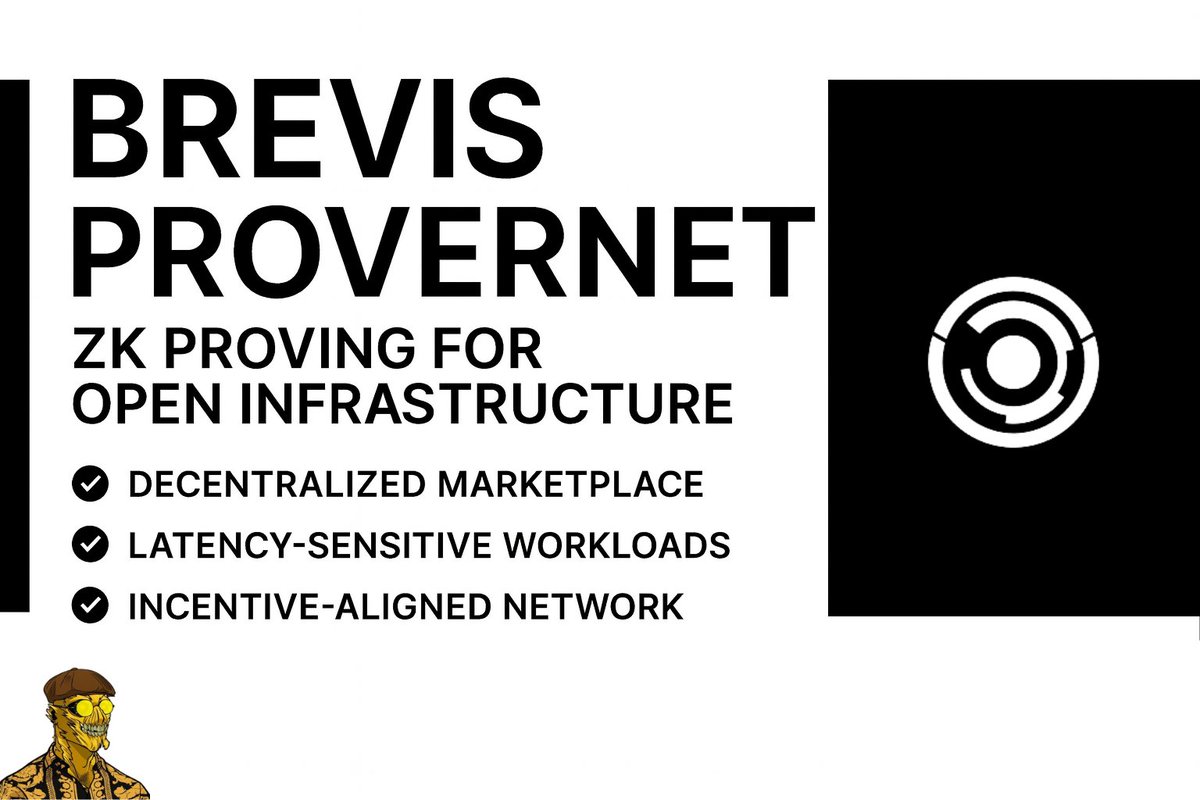

Brevis proverNet mainnet beta went live yesterday.
just like boundless protocol did, no testnet phase, every transaction will require a real token for payment.
since the Brevis native token BREV is not live yet, USDC will be used.
the beta launch already supports proving task distribution through continuous auctions, USDC payment settlement, and full prover registration with automatic job matching.
provers can now register and start competing for real workloads, both GPU and CPU provers are accepted.
Brevis is also beginning to migrate production workloads to ProverNet, starting with Ethereum block execution proving from ETHProofs(.)org, meaning provers will compete on actual block jobs from day one.
this is how Brevis is bootstrapping a real proving marketplace backed by real demand, built on the experience of generating 250M+ proofs across 30+ ecosystem partners.
full mainnet will introduce BREV staking and native token payments, but the proving economy is already underway.
stay bullish on @brevis_zk
zkBrevis

the fact that Brevis is chain-agnostic,
and live in production across dozens of integrations on Ethereum, Arbitrum, BNB Chain, Base, Linea, TAC, and more is enough reason to believe in the team pushing the future of verifiable compute to the next level.
it's obvious that @brevis_zk is not just another zk project, it’s the missing layer that lets dapps think, prove, and execute using trustless data from any chain.
with its zk coprocessor powering crosschain logic, historical queries, and offchain computation, developers can now build apps that were impossible just a year ago.
all modular, scalable and provable.
Brevis is quietly becoming the backbone of onchain intelligence.
zkBrevis


ProverNet mainnet beta is live and I actually put it to the test. I sent a heavy zk workload to @brevis_zk and watched a decentralized auction match my job to a GPU node in seconds. USDC settlement cleared, proof returned, chain only verified the succinct result. No proving infra from my side. No vendor lock
250M+ proofs across 30+ partners isn't hype. Splitting jobs into sub-proofs, provers with GPU and CPU competing, early demand from ETHProofs migrations, partners like PancakeSwap and Uniswap already in the logs this is modular ZK hitting production. Pico Prism cluster tips like 64x RTX 5090 and claimed 3.4x perf/cost matter for real workloads
$BREV staking/payments coming tightens the economics. If you care about scalable ZK infrastructure, watch this closely, get your node ready, or start routing proofs now big infrastructure shift underway!

gm spun up a ProverNet node last night and actually landed an ethproofs block execution job on @brevis_zk beta. $USDC payout cleared, prover matched in seconds, and the node docs were shockingly painless. GPU folks, CPU folks this is real work not a toy
tbh what sells it for me is the auction flow: tasks distributed by continuous auction, matched to capability, no need to run bespoke proving infra for every app. they already have 250M+ proofs under their belt and started with actual demand (ethproofs), not benchmarks
mainnet will add $BREV staking and BREV-based payments, which actually matters if you want long-term supply of provers. if you're into running rigs or curious about verifiable compute, this is the moment. who's booting a rig next?

GBREVISION INTERN SZN JUST HIT
@brevis_zk dropped the gBrevis intern meme - ZK cats grinding off-chain compute like it's their 9-5, no mainnet
cope required
Rise n grind zkats! Touch grass Sundays? Nah, just bootstrap ProverNet beta with real Ethereum block jobs
MEME FLYWHEEL GOING NUCLEAR
gBrevis intern replies flooding threads, community raiding like it's airdrop eve
ProverNet beta live: provers compete for ethproofs[.]org gigs, USDC payouts, 250M+ proofs battle-tested
GPU/CPU welcome, docs for nodes and requests - turn your rig into a ZK mercenary
While other ZK projects still whitepaper-maxxing like philosophy majors
Brevis flips the timeline: memes fueling adoption, beta marketplace matching jobs like a degen dating app
Whitepaper fresh, full mainnet soon with BREV staking - your cat's farming verifiable blocks now
Everyone's aping L2s for speed, Brevis's zkats proving giga-gas under 5s on consumer hardware
Bruh this isn't community theater
This is the rebellion where your meme cat pays rent and moons the skeptics
Institutions routing production proofs quietly, degens spawning nodes that print USDC
L2s in 2025 still sequencer-chained like office drones
Brevis's in 2030, gBrevis interns scaling infinite compute, EIP-7825 mega-txns as catnip
Who's your intern? - WHO'S SPINNING UP A GBREVISION RIG RIGHT NOW
LMFAOOOO NGMI IF YOU'RE STILL MEMELESS
☀️gBrevis, Rise n Grind Zkats!
nevermind i will do some off chain compute 1st!

➥@brevis_zk literally went from whitepaper to mainnet beta in under a month
➥provernet is live now basically apps can just outsource their zk proving to a marketplace instead of dealing with infra themselves.
provers bid on jobs in these continuous auctions which is good
what actually caught my attention tho is they're using real ethereum block proving from ethproofs
they figured out how to avoid that cold start death spiral most two sided marketplaces run into
at least they're solving a real problem day 1

A few weeks ago we revealed the ProverNet whitepaper for the first time.
Today, Brevis ProverNet mainnet beta is live!
Our decentralized marketplace for ZK proof generation is now open to provers & applications🧵

A decentralized marketplace for ZK proof generation is finally here
Continuous auctions
USDC settlement (for now)
Real workloads (ETHProofs)
Huge milestone for @brevis_zk The race to prove Ethereum is on
Also, keeping an eye on the upcoming $BREV staking mechanics. the tokenomics here could be interesting
A few weeks ago we revealed the ProverNet whitepaper for the first time.
Today, Brevis ProverNet mainnet beta is live!
Our decentralized marketplace for ZK proof generation is now open to provers & applications🧵

~@brevis_zk
Brevis ProverNet going live in mainnet beta is a big step for anyone working with ZK proofs.
The network finally opens a real marketplace where provers and applications meet without middle layers or heavy setup.
What makes it even better is that the system already supports full task distribution, USDC payments, and smooth registration for new provers.
For people with GPU or CPU power, this is a simple way to start earning by proving real workloads.
No need to wait for test jobs the network is already handling Ethereum block execution proofs from ETHProofs org
That means the demand is real from day one, and provers compete for actual tasks that matter.
On the application side, submitting proof requests becomes much easier.
Teams don’t need to build their own proving setup or maintain hardware.
They can plug into ProverNet and get guaranteed proving power from the marketplace.
With staking and BREV token payments coming at full mainnet, this ecosystem is set to grow even faster.
It’s a clean example of how ZK can move from isolated systems to an open, competitive economy that rewards performance and reliability.
A few weeks ago we revealed the ProverNet whitepaper for the first time.
Today, Brevis ProverNet mainnet beta is live!
Our decentralized marketplace for ZK proof generation is now open to provers & applications🧵

Fermah just dropped Airbender-powered EthProofs. Plugged in instantly. No crutches. No friction
Same story as RISC Zero: Fermah takes over everything storage, orchestration,retrieval
Airbender slid in effortlessly. Any ZK engine snaps to Fermah.
@fermah_xyz is built different


Benchmarks don’t lie.
Brevis’ pico-ethproofs repo lets anyone reproduce their Pico zkVM & Pico Prism results — proving Ethereum blocks fast, cheaply, and with real verifiable data.
In a world of vague claims, @brevis_zk simply says:
👉Run the code yourself👈


@GMMaverickk @brevis_zk @KaitoAI Brevis’ pico ethproofs proves zkVM speed and reliability transparently.
Gbrevis fam 😽
Good evening Zkats
Today was HeCATic ^_^. I know it's corny asl.
Anyway still in my pushing @brevis_zk Github Arc
There's this repo on Brevis Network GitHub that just tells you how this team operates.
It's called pico-ethproofs, and it's basically Brevis putting their zkVM through a public stress test against every major competitor in the space.
✢ ✣ ✢ ✢ ✣ ✢ ✢ ✣ ✢
First let me explain what a zkVM is
You know how your computer has a processor in it that runs programmes
A zkVM is similar, except it runs programmes & then generates mathematical proof that the programme executed correctly.
That proof is tiny but it's cryptographic evidence that can't be faked.
So instead of making everyone re-run expensive computations on-chain, you run it once off-chain through a zkVM, generate the proof, & post that proof on-chain for verification.
Some zkVMs are fast but produce massive proofs that cost a fortune to verify.
Others are cheap to verify but take forever to generate proofs.
So Brevis built Pico zkVM & published a public, reproducible benchmark repo that powers their Pico Prism results
That repo is called pico-ethproofs, & it's designed to prove Ethereum blocks in real-time.
They also released a report comparing those results against other zkVMs like SP1 & RISC Zero
Anyone can clone this repo & reproduce these experiments or inspect their data.
✢ ✣ ✢ ✢ ✣ ✢ ✢ ✣ ✢
On dating apps, guys are always 6ft tall. It's the same in ZK land, everyone claims they're the fastest
Brevis putting their Pico zkVM benchmarks in a public repo with reproducible code shows they're not scared of scrutiny, they know their claims hold up.
The benchmarks track prover speed, hardware cost, coverage percentage & average proving time. So it's a 360 degree view of performance.
Pico Prism is their distributed multi-GPU zkVM architecture that hit 99.6% of Ethereum blocks proven under 12 seconds
The Ethereum proving community has reproduced these benchmarks too, so we know they're not lying
✢ ✣ ✢ ✢ ✣ ✢ ✢ ✣ ✢
Seriously, go look at the pico-ethproofs repo
Also, remember the "Commits" I mentioned before?
I saw so many new updates that have been added to Pico recently and we just know they're about to hit another milestone soon


GM CT & all Zkats
Following up swiftly with my Brevis Network Github series from yesterday, I'm here to guide you through the unfamiliar world of Github repositories.
All those folders, weird file names & commit histories have serious info locked within them
I'm particularly excited to dig into @brevis_zk repos because they're building in the open, & you can see exactly what's happening if you know where to look.
✢ ✣ ✢ ✢ ✣ ✢ ✢ ✣ ✢
First thing you'll see is a bunch of repositories staring back at you.
There are 81 of them in total. Don't panic.
The main ones you care about are brevis-sdk, zk-utils, brevis-contracts & their docs repos.
Think of each repo as a different part of the machine
> the SDK is how developers build with Brevis
> zk-utils are the tools they need
> contracts are what lives on-chain.
Click the pico repo, you automatically open in the "Code" section. First thing you can do here is check when the last commit happened. That's just a fancy word for "code update"
On desktop there's a direct "X commits" link
On mobile, use the Github app & just tap "Commits"
Because Brevis team is actually building, they have fresh commits across multiple repos every week.
✢ ✣ ✢ ✢ ✣ ✢ ✢ ✣ ✢
Next, scroll down to the README file.
This is where devs explain what they've built & why it matters.
For brevis-sdk, you'll see them talking about how to create a Brevis app & everything you'll need to build apps that Brevis can check & prove
An SDK is a collection of every tool & code that'll help devs build apps faster without starting from scratch.
Even if the code itself looks like jargon, the README translates it into something closer to English.
✢ ✣ ✢ ✢ ✣ ✢ ✢ ✣ ✢
The "Issues" tab is where devs report bugs & request features,
On the right side of any repo, look for "Releases"
This is where the Brevis team packages up stable versions of their software for the world to use.
The latest version of Pico zkVM v1.1. 10 dropped 2 days ago.
@no89thkey said no member of the team is sleeping much, I believe him
If you see regular releases with version numbers climbing, that's production readiness.
Brevis has clear release cycles, especially around Pico & their SDK.
✢ ✣ ✢ ✢ ✣ ✢ ✢ ✣ ✢
And for some extra stuff I did, I starred and turned on notis for all major repos I'll be watching so I can always give timely updates.
The fact is, GitHub doesn't lie.
Looking at Brevis active repos, clear docs & production releases, they really do what they say
And as Michael recently said.
We've had enough of the grifters. It's time for the true builders to take the stage
Of course, he said it in more colorful words & I'm not looking to get my X banned ^_^
See y'all again soon


@maysonkiller23 @EFDevcon @no89thkey @brevis_zk Dope recap from EthProofs. Pico Prism's 254x zkVM boost + multi-GPU modularity is the real-time ETH flex we've been manifesting. Gigagas era incoming! gBrevis

🔥 Fresh from Ethproofs Day @EFDevcon: Brevis CEO @no89thkey demo'd Pico Prism 254x faster zkVM proving, multi-GPU balance, modular for composability. Real-time Ethereum blocks? Done in seconds. zkVMs are aligning on benchmarks. Who's ready for gigagas ETH? #Brevis #ZKProving #DevCon2025


zkBrevis ct!
zk is maturing fast, and @brevis_zk keeps showing up
wherever that shift is happening.
team's has been outside heavy these past days
so I highlighted different moments with just a small slice of everything they’ve been touching lately.
from zk summits to AI panels to zkTLS deep dives...
here’s the context behind some of the events:
> zk real world summit (with @zk_monk)
presented by Brevis CEO Michael,
the big idea here was privacy moving from a feature into baseline infrastructure.
convo was centered around proving truth without exposing yourself.
> Asia web3 day (hosted by @OpenBuildxyz)
the panel on cross-culture building cut deeper than usual.
real talk on how teams in asia coordinate growth, align community,
and navigate chaotic cross-border ecosystems.
> Ethproofs day (with @eth_proofs)
Michael broke down pico zkVM:
• multi-GPU proving
• real-time performance
• seconds-level block proving.
easily the most technical conversation of the week,
and the one pushing standard benchmarks forward.
> verifying intelligence (with @HouseofZK)
zk + AI is starting to feel like the next major frontier.
the highlight was how brevis frames verifiable compute as the missing piece for real autonomous agents.
> zktls day
this one focused on something many people overlook:
bringing web2 credentials into zk workflows without doxxing.
seeing zkTLS + PICO being used for private verification is a strong signal of what’s coming.
> proof of AI (with @GoKiteAI)
the panel on "AI agents on chain" dove into how agents will soon influence execution, UX flow, protocol behavior
not just assist but participate.
long-term implications here are massive.
i pulled these together because the ecosystem’s chatter has been consistent:
Brevis isn’t just showing up to events,
it’s shaping the conversations themselves.

gBrevis ct!
continuing our @brevis_zk "0 knowledge to zero knowledge" series
and today we wrap up Part 4.
recently we've seen why Brevis stepped directly into the hardest possible ZK problem:
a world where workloads don’t match, assumptions don’t align, and no single proving system can carry all the weight.
now we close the series by looking at how that decision forces an entirely different kind of architecture.
because once you choose to support historical proofs, AI-style computation, real-time proving, onchain indexing, reward aggregation,
and cross-chain state access...
you’re not building a specialized ZK system anymore.
you’re building infrastructure that has to accommodate everything.
Image
and that changes the design at every layer.
> a normal zkVM can tune for one constraint model.
> Brevis can’t,
it needs a VM that can express logic cleanly regardless of which prover executes it.
> a normal prover pipeline can standardize one flow.
> Brevis can’t,
the runtime has to route workloads to the proving backend that optimizes that specific shape.
> a normal application interface can assume one kind of proof.
> Brevis can’t,
it has to normalize outputs so apps see a consistent proof format, even if the underlying circuit, backend,
or execution model differs.
this "heterogeneity-first" approach is the opposite of what most ZK projects do.
they simplify by limiting scope.
Brevis embraces complexity by designing around it.
and that’s the real point of Part 4:
verifiable computation is too diverse, too irregular, too open-ended for any single-purpose ZK system to solve.
only a unifying, modular, backend-agnostic layer can make all of these workloads usable in the real world.
and that’s the role Brevis chose to play.
next up Part 5:
we finally break down zkVMs themselves.
what they are, why they differ, what they excel at,
and where they struggle.

Most Popular Users

Elon Musk 
@elonmusk
240M followers

Barack Obama
@barackobama
118.6M followers

Cristiano Ronaldo
@cristiano
114.4M followers

Donald J. Trump
@realdonaldtrump
111.7M followers

Narendra Modi
@narendramodi
106.9M followers

Rihanna
@rihanna
98.6M followers

NASA
@nasa
92.1M followers

Justin Bieber
@justinbieber
91.7M followers

KATY PERRY
@katyperry
89.9M followers

Taylor Swift
@taylorswift13
83.9M followers

Lady Gaga
@ladygaga
75.4M followers

Virat Kohli
@imvkohli
73.3M followers

Kim Kardashian
@kimkardashian
70.8M followers

YouTube
@youtube
68.6M followers

Neymar Jr
@neymarjr
66.3M followers

Bill Gates
@billgates
65.2M followers

Selena Gomez
@selenagomez
63M followers

The Ellen Show
@theellenshow
62.1M followers

CNN
@cnn
61.7M followers

X
@x
60.6M followers