

Top Tweets for #multiphysics

Agentic AI in chip design needs to earn trust inside the engineering loop.
Xpeedic announced Agent Evo, with agents for advanced packaging, packaging and PCB, and multiphysics coupling. The company says it can improve design iteration efficiency fourfold and reduce manual operations by 80%. Those are claims to test, not results I can verify.
I would want every handoff to carry the constraints and simulation evidence behind its decision. Otherwise, faster iteration may just produce a wrong design sooner.
How would you measure trust in an AI-assisted design workflow?
https://t.co/kskO4XnWIS

Rising power density and chiplet complexity drive thermal considerations earlier in the design process. https://t.co/bkUPx7lzwg
#thermal #datacenters #multiphysics #advancedpackaging #3DIC #semiconductor

Latest news: Amkor’s $1.5B deal; Intel Foundry revenue up 31%; Siemens’ dual buys; SiC plant dies; AMD’s big week; TSMC price hike; Nokia’s fab buy; earnings; $300M for accelerating inference; multiphysics; copper interconnect alternative..
https://t.co/LQylh4Kyxr
#semiconductor
Digital Twins: The Cloud’s The Limit
https://t.co/mYKs90FgpC
Chip industry leverages massive compute resources and AI for virtual sandboxes.
#digitaltwins #virtualtwins #multiphysics #AI #semiconductor #DFT #SLM


@0x7079 @ArchitectT57831 and then ofcourse there is also scientific simulation software
simscale, comsol multiphysics, ansys
And even open source versions of them https://t.co/hg2hqEG51b


"Arago creates a DeepSeek moment for AI chips. This technology has the potential to defy the laws of AI, using only a fraction of the resources." – Investor statement, highlighted in X post by Le Génie Humain, July 11, 2025.
The French deeptech startup Arago, established at Station F in Paris and also operating from San Jose, California, develops a photonic processor named JEF that leverages light properties to process data, generating minimal heat and promising energy consumption reductions by a factor of 10 to 30 compared to traditional https://t.co/Q2YZZsPWGX
- The core technology relies on lasers to handle data via photons, which produce far less heat than electrons in conventional processors, enabling the chip to achieve energy use ten times lower than current market GPUs.
- Early demonstrations show JEF executes AI models from standard software frameworks while maintaining full compatibility with existing AI ecosystems, computing infrastructures, and manufacturing processes, overcoming historical limitations of photonic alternatives.
The prototype stage of JEF positions it for potential market disruption in AI-dedicated chips, with investors convinced of its transformative impact amid rising demands for efficient computing.
- Funding of $26 million in seed round, led by Earlybird Venture Capital and Protagonist, supports accelerated product development, team expansion across engineering and operations, and commercialization https://t.co/kQ6UlhsqqN
- JEF integrates multiphysics aspects, combining analogue and digital electronics with photonics and optics, to address energy bottlenecks in AI inference.
Rapid production launch becomes essential due to competition from tech giants like Nvidia, AMD, and Intel, alongside well-funded startups such as Lightmatter, all pursuing photonic solutions.
- The industry executive notes, "In this industry, we don't have time to waste time," emphasizing urgency in scaling.
Photonics experienced an initial surge about a decade ago, with many projects failing due to premature timing, yet recent technological advancements alter the landscape.
- Components unavailable one or two years prior now enable progress, as photonics expands into quantum computing, microbiology, and communications.
Other French entities, including LightOn developing Optical Processing Units, explore GPU substitutes, reflecting broader innovation in the sector.
Underfunding threatens French startups at various development stages, with market access costs often underestimated, leading to acquisitions at undervalued prices.
https://t.co/ubUeQsldwN
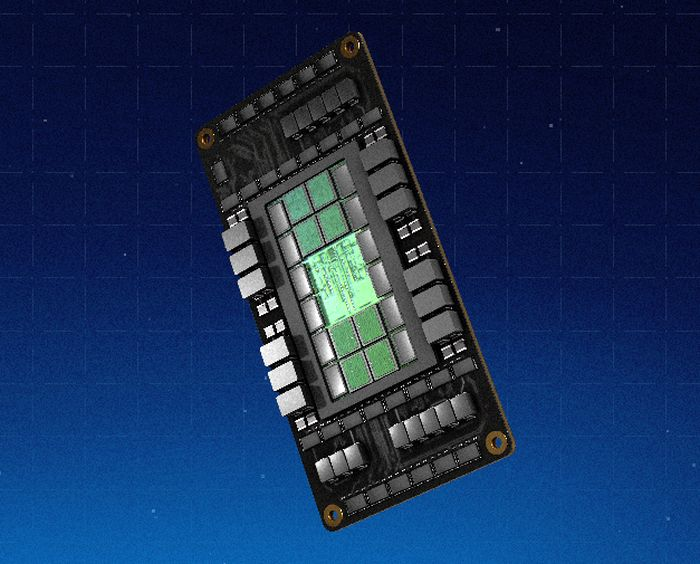

Installée à Station F, la deeptech 🇫🇷 Arago conçoit un processeur photonique qui exploite les propriétés de la lumière pour traiter les données, ce qui a l'avantage de générer très peu de chaleur, promettant une baisse de la consommation énergétique d'un « facteur 10 à 30 ».
L'ambition de l'entreprise est lettre sur le marché un processeur photonique baptisé « JEF ». Celle-ci repose sur l’utilisation de lasers pour traiter les données avec des photons, des particules de lumière qui génèrent beaucoup moins de chaleur que les électrons présents dans les processeurs traditionnels. De cette manière, la puce développée par la jeune pousse tricolore est en mesure d’offrir une consommation énergétique dix fois inférieure à celle des GPU actuellement sur le marché. Pour l’heure, la puce «JEF» est à l’état de prototype. Mais les investisseurs sont d’ores et déjà convaincus qu’elle pourrait bouleverser le marché des puces dédiées à l’IA. « Arago crée un moment DeepSeek pour les puces d'IA. Cette technologie a le potentiel pour défier les lois de l'IA, en utilisant seulement une fraction des ressources. »
Selon Arago, les premiers résultats démontrent que JEF est capable d’exécuter des modèles d’IA issus de frameworks logiciels standard, tout en restant 100% compatible avec l’écosystème d’IA, les infrastructures de calcul et les procédés de fabrication existants, contournant ainsi les obstacles techniques qui ont historiquement limité les performances des processeurs photoniques et alternatifs aux GPU. La prochaine étape sera de lancer la production. Et ce le plus vite possible car des géants de la tech (Nvidia, AMD, Intel, etc.) et des start-up bien financées (Lightmatter) planchent aussi sur des processeurs photoniques. « Dans cette industrie, nous n'avons pas le temps de perdre le temps », philosophe le patron.
Il y a une dizaine d'années, la photonique avait déjà connu un premier emballement, et beaucoup de projets ont échoué parce qu'ils étaient arrivés trop tôt. Mais l'évolution de la technologie change la donne, et un puissant renouveau souffle aujourd'hui sur la filière. « Les composants que nous utilisons n'étaient même pas disponibles il y a un ou deux ans », explique Arago. Et surtout, la photonique s'est déployée dans d'autres domaines, les propriétés de la lumière étant utilisées de nos jours dans l'informatique quantique, la microbiologie, les communications, etc.
https://t.co/mChuuxzSHB
https://t.co/5doz6mQvaP
https://t.co/GxLO7zixJc
https://t.co/zKPPPDWNtg


@therealotobong I would like to optimize products and give better solutions for development.
Just think, combining simulations, like multiphysics would be my dream job.
@therealotobong Hi, Otobong. Thank you for your question.
I'm still in Uni and going to take Design engineering as my masters.
I want to explore different parts of ME, but generally i'm interested in simulations, FEA, CFD or multiphysics.

We posted a poll on our social media accounts to see what type of chart that traders would like to see featured today.
The choices were:
- A S&P 500 Stock
- A NASDAQ 100 Stock
- A Warren Buffet Top Holding
- Bitcoin
The winner was a NASDAQ 100 stock...
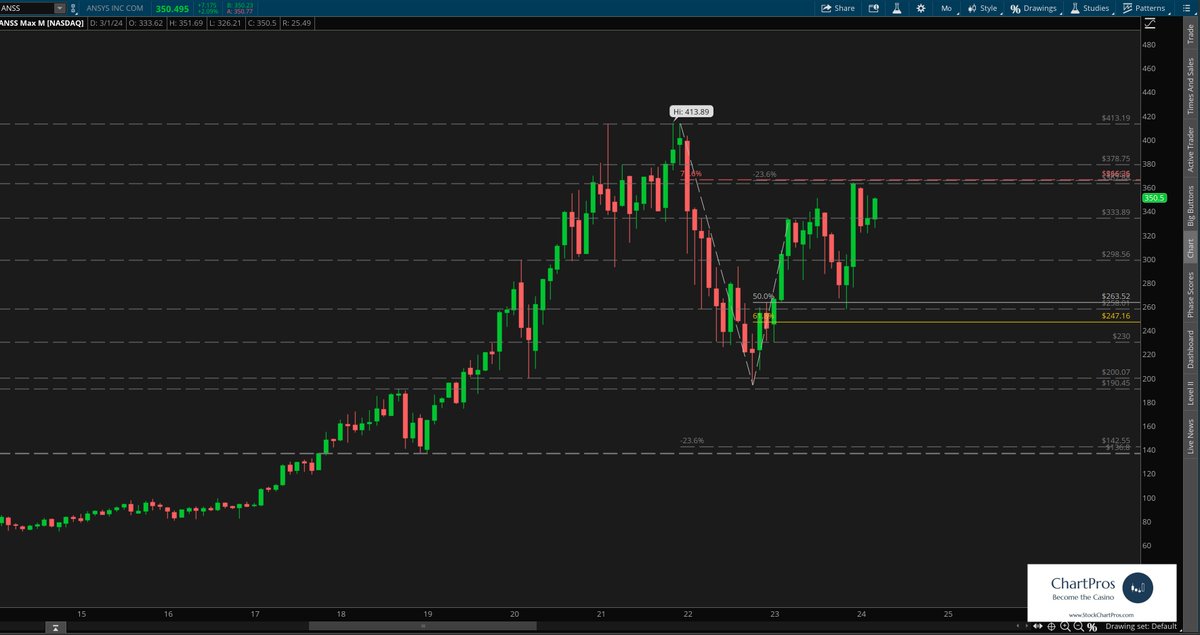
Ansys (ANSS), a NASDAQ 100 company, develops and markets CAE/multiphysics engineering simulation software for product design, testing and operation and offers its products and services to customers worldwide.
The company made headlines this week by announcing they recently strengthened their collaboration with NVIDIA (NVDA) to boost the advancement of simulation solutions backed by pioneering technologies like computing and generative AI.
Precision oriented price action technical analysis by far provides the best edges and most setups for traders across the markets so that's what we use for the basis of our reviews.
With this in mind we set out to review their chart from a price action technical analysis perspective.
On the monthly chart we can see over 25 years of historical chart data which we consider to be a positive when marking up any chart.
Trading around $350 earlier today, price is off its $413.89 all time high (ATH) set in late 2021 but up significantly after fading down to the $200 area in late 2022.
And since price is not trading at ATH and presents two sided price action we set out to identify levels of interest in both directions.
Down on the weekly chart we can see price making a series of higher highs and higher lows as it moves back up towards that ATH level.
We've layered in both bear and bull Fibonacci levels, support/resistance levels, and trend lines in both directions to narrow in where price could be heading.
Armed with precision oriented charts like these both traders and investors can formulate their respective plans.
So what's next?
We don't make predictions...

Last Seen Hashtags on Sotwe
Most Popular Users

Elon Musk 
@elonmusk
240.1M followers

Barack Obama
@barackobama
118.6M followers

Cristiano Ronaldo
@cristiano
114.4M followers

Donald J. Trump
@realdonaldtrump
111.7M followers

Narendra Modi
@narendramodi
106.9M followers

Rihanna
@rihanna
98.6M followers

NASA
@nasa
92.1M followers

Justin Bieber
@justinbieber
91.7M followers

KATY PERRY
@katyperry
89.9M followers

Taylor Swift
@taylorswift13
83.9M followers

Lady Gaga
@ladygaga
75.4M followers

Virat Kohli
@imvkohli
73.3M followers

Kim Kardashian
@kimkardashian
70.8M followers

YouTube
@youtube
68.6M followers

Neymar Jr
@neymarjr
66.3M followers

Bill Gates
@billgates
65.2M followers

Selena Gomez
@selenagomez
63M followers

The Ellen Show
@theellenshow
62.1M followers

CNN
@cnn
61.7M followers

X
@x
60.6M followers