

Top Tweets for #retho

@screenest_ai Felt this. My Product Hunt launch got 2 upvotes, so I stopped and rethought too. What changed things: building what people here actually asked for. Shipped a subscription tracker yesterday because of those replies. Keep going, Tiger 💪

People who never participated in war shouldn't be in government positions talking about it.
Most anti-war rethoric is only possible because there was a war to ensure such freedom and priviledge.
Has she said "Thank you" to any veterans? Probably not.

Former New Zealand Prime Minister Jacinda Ardern says free speech is a weapon of war, and censorship is necessary to protect free speech.

In case @chamath quantum computing argument convinced you, please have a look to the below.
Don't fall into easy FUDs or oversimplification rethoric used by gurus online. He is deeply into the AI trade, sold bitcoin:native too early. Massive conflict of interests.
Debunk is imperative.
https://t.co/Oegx1rLiUy

@LizaRosen0000 That is a really good almost rethorical question

iPad is where you build inspection forms. On a larger screen it feels more natural and easier. iPhone however is where it is easier to fill in a form on site, one hand, more comfortable, moving fast. That’s why iPhone layout had to be rethought, not just scaled down iPad
Finished, tested and submitted my app. This update took a lot longer than I expected. The new version of Blue Checkbox now supports iPhone.


@Clairefuq4 I love rethorical questions! (I mean who wouldn't like your body)

@investor_daddy im guessing lemonade and tesla have sophisticated bot protection, for good reason but in the age of agents this will need to be rethought
on the one hand they lose data signals that feed into their LTV models. but if this is where consumers are heading, they wont have a choice

On the Bull, they rethought
On the Bear, they rebuilt
The Lion doesn’t pick a season-he rules the cycle
Rethink. Rebuild. Rialo.
@RialoHQ

@serg71kz @RetiumChain Retium separating transaction finality from blocks, SoftFinal to HardFinal distinct, finality rethought.

@kaneljoseph Where's the "Its just content" Rethoric tho

@Motier_crypto The most sci-fi part is not letting neurons play DOOM, but the fact that the definition of a computing unit is being rethought

Many blockchain improvements focus on making existing designs faster.
But sometimes the bigger question is:
Should the original design be rethought?
Reading about @RetiumChain's approach to transaction flow made me think about how many blockchain limitations come from inherited architecture.
Innovation is not always optimization. Sometimes it is redesign. ⚡️

People often measure a blockchain by one number:
TPS.
But TPS is only the result.
The real story is the architecture that makes it possible.
Instead of squeezing more performance out of a traditional blockchain design, @RetiumChain rethought the underlying model itself.
Rather than forcing every block into a single sequential chain, it introduces a mathematical mesh where multiple blocks can grow in parallel while remaining deterministically connected.
That changes the conversation entirely.
This isn't another optimization aimed at boosting throughput.
It's a new architectural foundation—one where scalability emerges from the structure itself, not from pushing existing limits.

@RetiumChain 3/ They completely rethought transaction flow and use PrimeMesh a cool new way where open blocks work together like a smart network.
Everything is built from first principles starting fresh with math and logic, not copying old designs.

Clear as day these Zoomers haven't suffered enough in life so they cope with these kind of rethoric things.
They need to suffer enough and be more skeptical at life.
This is why society is pretty much pussified.
https://t.co/L02jSkzprw


@loveamerica62 rethought & it looked a little more natural into it.

@yetecevm @ritualnet @ritualfnd @Jez_Cryptoz @joshsimenhoff @0xMadScientist @dunken9718 @cryptooflashh Ritual execution layer rethought for AI era and whitepaper reading circle done

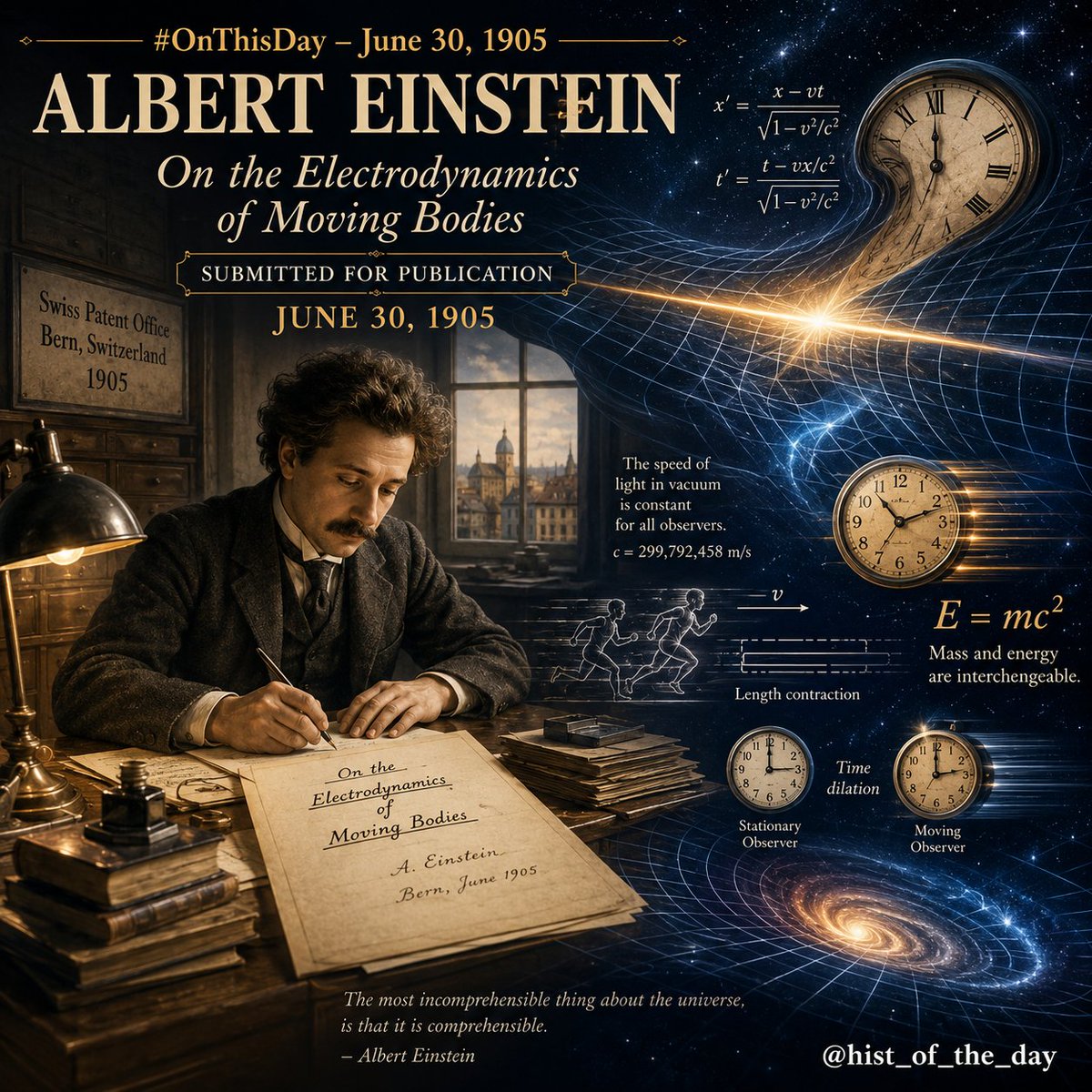
🧵 #OnThisDay — June 30, 1905, Albert Einstein submitted his paper "On the Electrodynamics of Moving Bodies" to Annalen der Physik—the work that introduced Special Relativity and forever changed our understanding of space, time, and the universe. 🧵👇
At just 26 years old, Albert Einstein wasn't a university professor. He worked as a technical expert at the Swiss Patent Office in Bern, developing revolutionary ideas in his spare time.
Physics faced a major problem. Maxwell's equations suggested that light always travels at the same speed, but classical Newtonian mechanics couldn't fully explain how this was possible.
Einstein chose a radical approach: instead of changing the laws of light, he rethought space and time themselves.
His paper was built on two simple postulates:
• The laws of physics are the same in all inertial reference frames.
• The speed of light in a vacuum is constant for every observer, regardless of their motion.
These assumptions led to extraordinary conclusions.
Special Relativity revealed that:
⏱️ Time can run at different rates.
📏 Lengths contract at high speeds.
⚡ Simultaneous events may not be simultaneous for different observers.
Space and time were no longer absolute.
One surprising prediction was time dilation.
An astronaut traveling close to the speed of light would age more slowly than people on Earth—a phenomenon later confirmed experimentally with precise atomic clocks.
Another consequence was length contraction.
Objects moving at relativistic speeds appear shorter in the direction of motion to a stationary observer.
These effects become significant only near the speed of light.
Although the famous equation E = mc² did not appear in this paper, it emerged from Einstein's follow-up work published just a few months later in 1905.
It showed that mass and energy are interchangeable.
Special Relativity laid the foundation for modern physics.
It influences particle accelerators, GPS satellite corrections, nuclear energy, astrophysics, and much of today's understanding of the cosmos.
Remarkably, Einstein's 1905 paper contained no citations or extensive references.
It relied purely on logical reasoning, mathematical consistency, and physical insight—qualities that made it one of history's most influential scientific papers.
More than a century later, the ideas first submitted on this day continue to shape science, technology, and our view of reality.
Sometimes, a single paper can change the universe.
Follow, share, like and click on ��� icon for more stories. #OnThisDay

Hello. I'm Greenmelon.
At 1:30 AM KST on June 26th, Ade took the stage in the Rialo Discord to give the community its first deep look at Latch, a new infrastructure platform for AI agent governance. It wasn't a typical "here's another new product" session. It was an argument about how permissions themselves need to be rethought once AI agents, not humans, are the ones doing the work. Here are the key takeaways.
Why Latch, and why now?
Start with the problem. The era where AI agents handle real financial tasks and call APIs on your behalf is basically here. But almost every system today still hands out permission the same old way: possess one credential (a secret key, an API key, a wallet key, a password) and you can do nearly anything with it.
That worked fine when a human was sitting at the keyboard using the system directly. It breaks the moment you hand that same key to an autonomous agent. The reason is subtle but important: an agent doesn't just hold a permission, it can continuously exercise it, making its own decisions and acting on them around the clock. One leaked key, and anyone who grabs it wields the exact same authority. Ade hit this wall himself while building Rialo, which is what led to Latch.
The core idea: execute by policy, not by possession
This is the heart of what Ade explained, and it's a genuine shift in mindset.
The old model: "I can execute because I hold the key." Latch's model: "I can execute only within the scope policy permits."
In other words, agents never receive the master key at all. They receive permissions and budgets defined by policy. The original secret stays locked away in a secure boundary and is never exposed to the agent. The agent only ever carries a narrowly scoped token derived from it.
And the crucial detail is when the check happens: policies are verified before execution, at the infrastructure level, not the application level. An unauthorized request is blocked before it ever goes through, not caught after the fact. That's what fundamentally shrinks the room for abuse.
You can define conditions like a maximum daily spending limit, permission to call only specific smart contracts, execution only during designated hours, access only from specific countries, or tasks that require multi-approval. The point is that the AI, even while acting on your behalf, is physically confined to rules a human set in advance.
Device ID: killing the API key entirely
The headline reveal was Device ID. Instead of issuing a hackable API key for an agent, Latch uses the hardware identity of the machine the agent runs on as the credential itself. No separate key to leak, rotate, or steal. The device is the identity.
This ties into Latch's bigger claim: software-only security solutions get probed and breached constantly because they're just programs. Latch offers what Ade called hardware-level verifiability. If you set a rule like "this intern agent managing the company's social account can post at most 100 times a minute and must always strip personal info," and the agent tries to exceed or break it, the request gets physically blocked at the hardware level. In the live demo, Latch processed over 10,000 test requests while automatically denying ones from an agent that blew past the predefined limit, and each denial came with a clear, real-time explanation of why it was blocked. Strong enforcement and transparency at once.
Permissions as relationships, not just access
The part that resonated most with the community was the idea of managing permission as a relationship rather than a flat grant.
Latch lays out authority as a hierarchical family tree. There's exactly one master key at the top, and it never moves. Below it, each node inherits its parent's permissions but can only add restrictions going down, never expand beyond what the parent allowed. So a VP might get gpt-4o access with a high token limit, an engineer inherits that but with a tighter cap and a no-logging-PII filter added, and an outside contractor is locked to a cheaper model with enforced working hours and a hard expiry date.
The elegant part: revoke a node, and every permission derived beneath it is instantly disabled too. For a large organization juggling managers, employees, and external partners, that cascade makes governance dramatically simpler.
Policy as code, and a tamper-proof paper trail
Latch goes well beyond on/off checkboxes. Policies are written as code (Rust compiled to WASM, plus JavaScript) and execute in single-digit milliseconds. You can restrict which APIs and models an agent may call, cap request rates and token counts, limit payload sizes, and even make a live external call (http_get) to check something in real time, like an on-call roster, before deciding whether to approve a request.
And every single request leaves an audit log. You can see what was approved, what was blocked, which exact policy did the blocking, and how long it took to process, all on a tamper-proof, append-only timeline. There's even a simulator that lets you replay a real log to test policy changes. That makes after-the-fact security audits genuinely workable.
Underneath it all sits a stack of trust primitives you can mix and match to your threat model: trusted execution in secure enclaves, HPKE end-to-end encryption, distributed key generation to remove single points of failure, hardware-bound identity, remote attestation, WASM sandboxing, and append-only audit logs.
Beyond one agent: PACTS, GigaLatch, and a neutral trust layer
The session also previewed where this goes next, and it's ambitious.
PACTS handles trustless delegation between agents using hardware-backed receipts. As agents start hiring and collaborating with other agents, the question becomes: how do two agents that don't know each other safely hand off authority? PACTS sets that delegation on a mathematical, mechanical, trustless footing, so no agent in the chain can lie or cheat. And it's not just data passing between them, agents can autonomously and safely execute DeFi payments and smart contract interactions with each other.
GigaLatch decentralizes key management across distributed nodes so no single party ever holds the complete credential. Router, another upcoming tool, manages agent spending policies and permissions. A live demo also showed blockchain integration, with custom Rust policies talking directly to smart contracts and external APIs.
Ade made a sharp strategic point too. Even if OpenAI or Anthropic add their own native agent controls, Latch's value holds, because model providers naturally keep you inside their own walled garden. Latch is deliberately provider-neutral, a boundary layer connecting AI models, blockchains, and external services. Since competing AI platforms can't inherently trust each other, a neutral trust layer becomes structurally necessary, much like stablecoins act as a neutral settlement asset in finance.
Where this fits in Rialo, and the long-term vision
Latch lines up cleanly with the direction Rialo has been building toward all along. Rialo isn't just a chain that runs smart contracts, it's infrastructure that fuses policy and execution into one system. When Native Web Calls, Reactive Transactions, REX, and Latch work together, AI agents stop being programs with unlimited authority and become verifiable autonomous systems that act only within policy. It also makes Rialo's recurring themes of Agent Governance and Machine-Bound Identity feel a lot more concrete.
Ade's endgame is for Latch to become invisible infrastructure, no more managing API keys, key rotation, or worrying about permission leaks, because it all happens transparently in the background. As AI shifts toward autonomous API-to-API interaction, trust becomes the foundation of autonomous execution, and Latch aims to be the hardware-backed trust layer underneath it.
The reframe that stuck with me: security in the AI era is no longer a contest to store keys safely. The new model verifies what policy an agent is allowed to act under, rather than who holds the key. "One token per agent. One policy per relationship."
To make all this approachable for non-developers, the team is building a Community Game that teaches agent policy management and the MCP ecosystem through play. Ade said it should launch within the coming weeks. Latch itself is currently in private beta.


Made some updates.😅
Reworked the today/7-day/monthly dashboards in the extension.
Globally rethought what value it can give. Insights now look much better and give a clearer understanding of how you can improve.
Now based on score and your wasted time, you can set limits and restrictions!❌🛜


@CBrewer Maybe they rethought getting rid of communities

A lot of AI products become more powerful over time.
Far fewer become faster, more efficient, and easier to understand at the same time.
That's what stood out to me from @Ask_ORO's latest engineering update.
ORO is now approximately 2.5x faster across real workloads, but the improvement didn't come from simply adding more computing power.
The team rethought how ORO processes requests.
Simple tasks receive lightweight processing. Complex requests involving strategies, bridging, lending, or multi-step execution receive deeper analysis when it's actually needed.
Less wasted computation.
Faster responses.
More efficient execution.
The update also introduced live progress visibility, allowing users to see what ORO is reading, preparing, and analyzing in real time instead of waiting for a final response.
For me, that's the bigger story.
Speed is valuable.
Knowing what's happening is reassuring.
Combining both creates trust.
As onchain finance becomes more sophisticated, user experience will matter just as much as the protocols themselves.
The best products won't be the ones that expose users to more complexity.
They'll be the ones that quietly handle complexity in the background while keeping users informed and in control.
Worth reading the full engineering breakdown.
Which matters more to you: speed, transparency, or simplicity?


https://t.co/gmxboxf1x1

Reimagining the Hardware Entry Barrier
Xbox leadership is explicitly addressing the severe economic friction facing next-gen console development. With component manufacturing margins bottlenecked, the brand notes that forcing consumers to drop "thousands of dollars" within a single hardware generation is an unfeasible strategy for long-term ecosystem growth. This financial reality explains exactly why the upcoming Project Helix architecture is being fundamentally rethought to prioritize highly flexible, modular, and affordable entry points. By actively stepping away from a singular, hyper-expensive box, the goal is to expand the player base and keep hardware accessibility alive without passing catastrophic manufacturing deficits directly onto the consumer.
Can a multi-tier console strategy successfully bridge the gap between high-performance enthusiast tech and affordable entry pricing?
#ProjectHelix #Xbox #GamingIndustry #AshaSharma


Thank you for the update! It’s also great to see you back here.
We were aware that the platform’s structure was being rethought for the reasons you mentioned, but as Dave rightly pointed out, I think we founders should be kept informed more regularly. I also believe it would be good not to leave the official @signalbynoise profile completely silent despite the ongoing restructuring.
That said, in the world of investments, I believe the most important thing is proper preparation and acquiring knowledge. The existing tutorials and guides are of very high quality and have been very useful to me, but I feel there’s a lack of more specific guidance on where to go next and what’s truly worth focusing on to understand the real power of the platform.
As a founder, I’d say my goal is this: to acquire the necessary knowledge to understand the forces that move the markets, so I can extract high-quality signals through the use of SEIOO. Any guidance you can share with us to help reach this goal would be enormously helpful.
Best regards!

@slxmgod @AltSNEAKO bots , i dont know if the best idea is to engage with rethoric like this or ignore it
Last Seen Hashtags on Sotwe
brosis
Seen from Canada
kira perez
Seen from United Kingdom
Gurgaontraffic
Seen from United States
monkeyapp
Seen from Netherlands
李龙馥
Seen from United States
porn rape
Seen from Turkey
brosiss
Seen from United States
舔脚
Seen from Turkey
flingster #gay
Seen from United States
mom #ai
Seen from Germany
Most Popular Users

Elon Musk 
@elonmusk
239.7M followers

Barack Obama
@barackobama
118.6M followers

Cristiano Ronaldo
@cristiano
114.3M followers

Donald J. Trump
@realdonaldtrump
111.7M followers

Narendra Modi
@narendramodi
106.9M followers

Rihanna
@rihanna
98.6M followers

NASA
@nasa
92.1M followers

Justin Bieber
@justinbieber
91.7M followers

KATY PERRY
@katyperry
89.9M followers

Taylor Swift
@taylorswift13
83.9M followers

Lady Gaga
@ladygaga
75.4M followers

Virat Kohli
@imvkohli
73.3M followers

Kim Kardashian
@kimkardashian
70.8M followers

YouTube
@youtube
68.6M followers

Neymar Jr
@neymarjr
66.3M followers

Bill Gates
@billgates
65.1M followers

Selena Gomez
@selenagomez
63M followers

The Ellen Show
@theellenshow
62.1M followers

CNN
@cnn
61.7M followers

X
@x
60.6M followers