

Top Tweets for #sidechains

@holland_ja9781 spent five years launching dozens new layer networks sidechains execution environments most

The crypto industry spent five years launching dozens of new Layer-2 networks, sidechains, and execution environments.
Most of them introduced the exact same flaws:
Centralized sequencer dependencies
Vulnerable multisig bridge honeypots
Yet another volatile token just to pay gas fees
Scaling Bitcoin was never about copying Ethereum's virtual machine model onto Bitcoin. It was about separating computation from consensus.
That is why the architecture powered by RGB Protocol, Lightning, and @utexocom is fundamentally different:
⚡ Off-Chain Computation: Smart contracts and state transitions execute client-side. Bitcoin's base layer never gets congested by token mints or contract execution logic.
⚡ Pure Lightning Velocity: Dollars route peer-to-peer at the speed of light for fractions of a cent, bypassing block times completely.
⚡ Native UTXO Security: Every transfer is bound to Bitcoin via single-use seals. No custodial bridge honeypots, no wrapped tokens, no synthetic assets.
⚡ Frictionless Cash: Hold USDT, send USDT. Users never have to buy or hold secondary gas tokens to move money.
We didn't need another speculative blockchain to scale global payments. We just needed to build the right rails on the most secure network on Earth.
Digital dollars. Native Bitcoin security. Zero gas friction. 🟧💚
@Utexoasia

12 years. 700+ million users. One full circle.
In 2014, USD₮ was born directly on Bitcoin to unlock liquidity for traders. Over the past twelve years, it transformed from a niche tool into the primary digital dollar powering financial access for hundreds of millions worldwide.
Now, USD₮ is returning to where its journey began: Bitcoin.
This homecoming isn't just nostalgia. It is an architectural upgrade powered by RGB Protocol, the Lightning Network, and @utexocom:
From trading tool to everyday cash: Built to support genuine everyday payment velocity for a 700M+ user economy.
Instant execution: Lightning channels settle transfers in milliseconds at sub-cent rates, leaving block wait times in the past.
Client-side confidentiality: RGB keeps balances and contract logic verified off-chain, anchoring cryptographic seals to Bitcoin UTXOs without clogging the base layer.
True single-asset UX: Hold USD₮, spend USD₮. No secondary volatile altcoins needed just to pay network fees.
Happy 12th birthday, @tether !
The most enduring financial revolution is coming back to its roots with an unstoppable infrastructure stack. 🎂🟧💚
@Utexoasia

Most "Bitcoin smart contract" solutions force bad compromises:
Federated multisig honeypots
Expiring virtual UTXOs
Mempool bloat and altcoin gas tokens
The world is waking up to the power of RGB on Bitcoin.
Instead of relying on fragile sidechains or clogging up the base layer, the architecture combining RGB Protocol, Lightning, and @utexocom solves scalability without sacrificing Bitcoin's core principles:
⚡ Client-Side Validation: Smart contract logic and state verification happen off-chain. Bitcoin's mempool stays lean, transactions remain strictly private, and zero junk data is published on-chain.
⚡ Eliminating Bridge Vulnerabilities: Assets are bound directly to native Bitcoin UTXOs via single-use seals, inheriting the full security and finality of Bitcoin L1 without centralized multisigs.
⚡ Permanent Sovereign Ownership: No arbitrary expiration windows or forced liquidity refreshes. You maintain sovereign custody over your assets indefinitely.
⚡ Zero Gas Token Friction: Move native USDT across Lightning channels with millisecond settlement and sub-cent fees - without buying, holding, or calculating volatile altcoin gas tokens.
Scaling finance on Bitcoin does not require compromising on security or trusting custodial federations. Real digital cash on Bitcoin is already here.
@Utexoasia @BitTaskerdotcom


Most "Bitcoin smart contract" solutions force bad compromises:
❌ Federated multisig honeypots
❌ Expiring virtual UTXOs
❌ Mempool bloat & altcoin gas tokens
We took a different path with BitTasker. 🛠️
By leveraging RGB client-side validation & Taproot UTXOs as cryptographic single-use seals:
The state machine executes 100% locally inside the app on your own hardware
• Zero data bloat on the Bitcoin blockchain
• Absolute self-sovereign spend authority
Smart, programmable escrow secured by pure native Bitcoin. Run it straight from your phone or laptop like any native app. No bridges. No federations.
Includes #USDT on @lightning
Full release dropping soon. 🟧
@Bitcoinbeach @utexocom @RGB_Hub @RGBAssociation @whbitcoin @paoloardoino @giacomozucco @mir_btc @bitcoinofficesv @VIhnatiuk @Namaskaram_Luca @birk1907 @Kurcide @mikegermano @michelleweekley @romanmartinezc

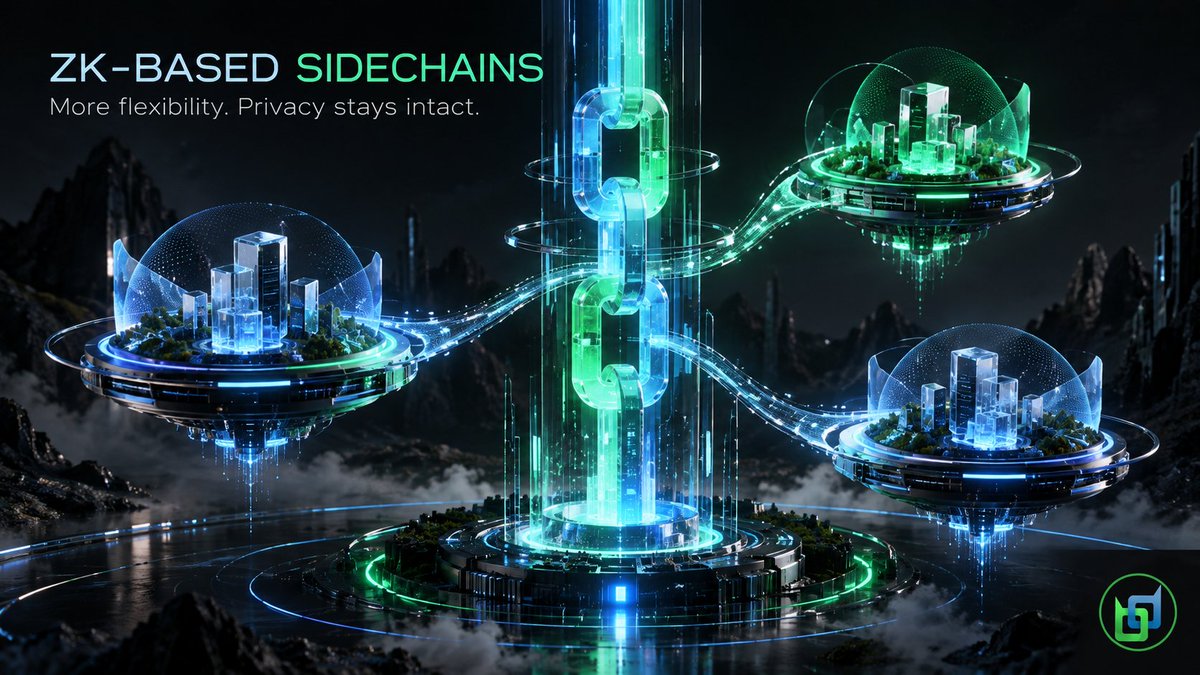
What if privacy focused applications could scale beyond one execution environment? ⛓️
Beldex Research Labs is exploring zk based sidechains as part of its next generation blockchain research. 🔐
More flexibility without losing sight of privacy. 🌐
@BeldexCoin

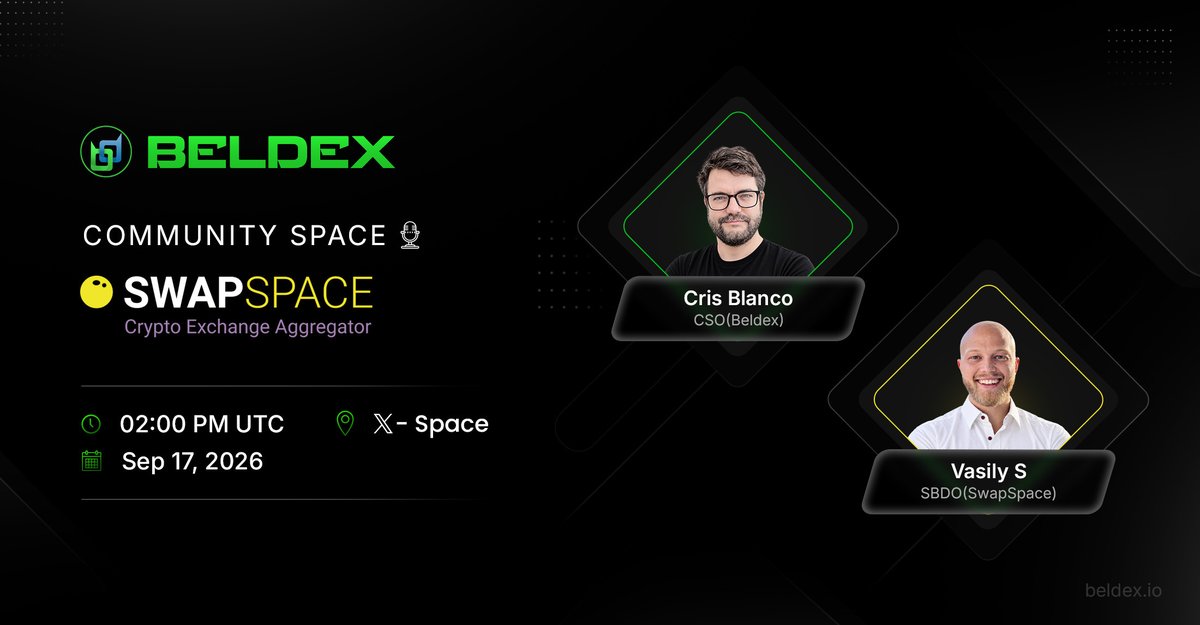
@Punithan33 @BeldexCoin @SwapSpaceCo @Bchat_official Bridging privacy tokens with EVM sidechains makes confidential transactions accessible to decentralized apps.

@Punithan33 @BeldexCoin @SwapSpaceCo @Bchat_official The combination of privacy tokens, EVM sidechains, and account-based addresses makes this AMA especially interesting. Looking forward to seeing how @BeldexCoin and @SwapSpaceCo continue building a more private and user-friendly ecosystem. 🚀

Gbeldex Fam 💚
Private Web3 is moving forward with @BeldexCoin and @SwapSpaceCo.
Their upcoming AMA explores privacy tokens, EVM sidechains and account based addresses
offering a closer look at the evolving privacy focused ecosystem.
@Bchat_official #Beldex
#Web3 #Privacy
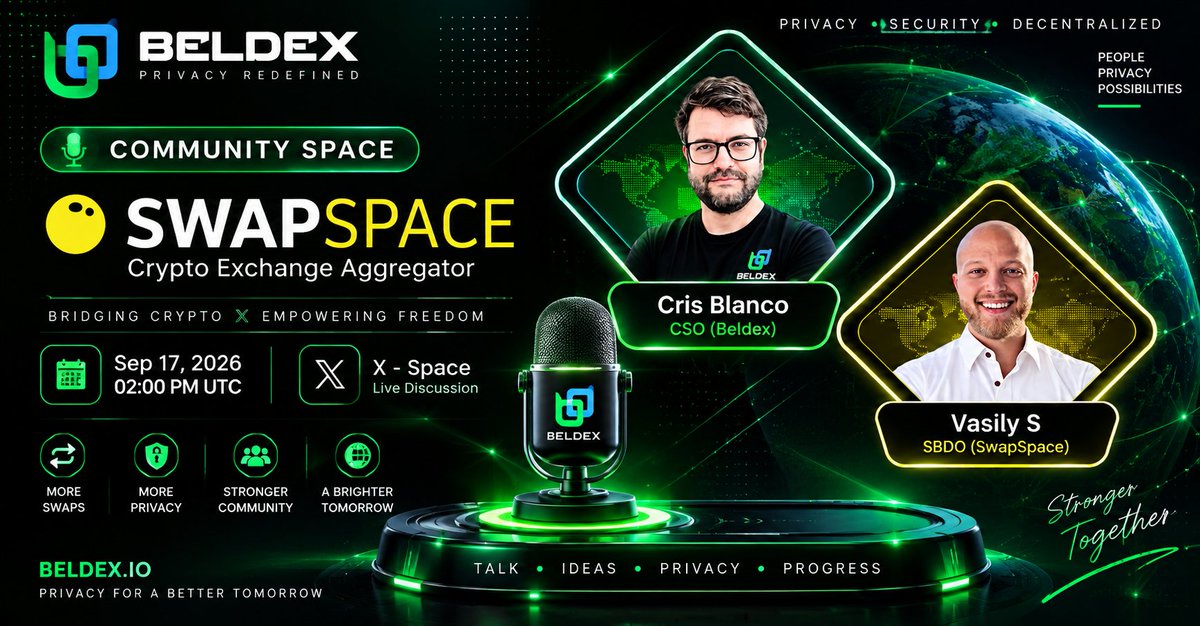

The next generation of Web3 is private.
Join our CSO @BDXcris and @SwapSpaceCo tomorrow as we discuss what's next for Beldex, from Privacy Tokens and EVM sidechain to account-based addresses.
🗓️Sept 17 | 14:00 UTC
🎙️ Set your reminder: https://t.co/mofTuwpqpO

Why build a blockchain from scratch?
With Canopy, existing apps can add dedicated sidechains for onchain functionality.
Less rebuilding. More flexibility.
A simpler path to bring proven products onchain. 🌿
@CNPYNetwork
Not every project needs to start from a blank blockchain architecture. 🧩
Canopy lets builders extend existing applications with a dedicated side chain for onchain functionality. 🔗
More ways to move existing products onchain. 🌿
@CNPYNetwork



🚨 If you learn one thing today, let it be this 👇
Zenith built THE FIRST atomically composable EVM.
No other network has ever added a new VM and made it truly atomically composable with its existing one. Subnets, appchains, rollups, validiums, sidechains, prividiums… none of them achieve this with the parent chain. They settle asynchronously, rely on bridges or message passing, introduce latency windows, trust assumptions, or partial-failure risk. Assets and logic live in silos. Liquidity fragments. Value leaks. Composability is a farce.
@ZenithFdn flips that model completely.
When you ship on Zenith, you ship on @CantonNetwork… not on top of it, not extracting from it.
This is fundamentally new architecture that alters how L1 scaling works.
Traditional scaling pushes execution off the L1 into isolated environments that trade atomicity for throughput. This is what Ethereum exemplifies today: fragmented liquidity, broken multi-leg operations, and economic value leaked to L2s that never returns to Ethereum all glued together with fragile economic bridges.
Zenith scales by extending the L1 itself with a new VM that remains fully native. You get Ethereum-compatible reliability and developer experience while preserving Canton’s privacy, compliance, and crucially, true atomic composability across these environments.
A single transaction can lock a Canton-native tokenized Treasury, invoke a Solidity lending vault on Zenith, mint an ERC-3643 receipt, and settle everything in one indivisible operation under the same consensus.
Liquidity stays unified. Risk is compressed. Capital velocity increases. Daml and EVM finally operate as one system instead of two parallel universes.
This is not just better interop.
This is the first atomically composable EVM.
This is the Zenith.
Zth.

Our Head of Product @NorbertVadas just joined the @indexed_pod for a wide-ranging technical conversation about what Zenith is building on @CantonNetwork and what it means for institutional DeFi.
If you want to hear Norbert walk through the architecture directly -why EVM compatibility matters for Canton, how CIP-56 assets work, what atomic composability between Canton and Zenith actually looks like in practice, and where the roadmap goes from here - this is the episode worth setting aside time for.
A few timestamps worth jumping to if you don't have the full hour:
(00:51) What is Zenith?
(17:14) Why EVM compatibility?
(39:13) RWA lending example
(42:15) Bringing DeFi to Canton
(56:46) Who is using Zenith?
Zth.

Highlighting two of the twelve sidechains.
Thunder which scales to 8 billion people, tests available on GitGub, so you can check and verify.
And zSide, which is a privacy sidechain using ZK-Proofs to bring privacy to transactions.
@Truthcoin
The ECX Hard Fork launching August 23rd.
Launching in three stages
1. Alpha: August 23rd - Block 963648
2. Beta: Sept 20th - Block 967680
3.Full Permanent Release: Oct 31st - Block 973,728
I would suggest listening to our interview with @Truthcoin to find out more about the drivechains launching with eCash such as Thunder for scalability, ZSide for privacy, and additional chains like CoinShift, BitNames, and Photon!
https://t.co/qxmEwLMTL1
For the full post with all of the information from Paul, see the link below.
https://t.co/IiAdhBw5he


Cross-chain bridges (XChainBridge): Native bridging to sidechains/other chains (account create, claim, attestations

@zano_project Thanks. I hate it.
1) L2's and sidechains are absolutely parasitic. ETH is a prime example.
2) Bridging is the one of the absolute WORST UI/UX experiences.
This should be built on the L1.
I'm not getting behind this.

Privacy layers added after deployment
Some ecosystems bolt privacy onto an existing blockchain through sidechains or external layers.
This often means:
• Extra integrations
• More infrastructure to manage
• Cross-layer complexity
• A less seamless developer experience
Privacy layers added after deployment
Some ecosystems bolt privacy onto an existing blockchain through sidechains or external layers.
This often means:
• Extra integrations
• More infrastructure to manage
• Cross-layer complexity
• A less seamless developer experience

The real endgame just got clearer
RGB isn’t just another asset protocol
It’s positioning itself as the meta asset standard that can connect every Bitcoin ecosystem and Layer 2.
One client-side validated layer
Anchored to Bitcoin
Able to move assets across Lightning, sidechains, and whatever comes next without fragmenting liquidity or security.
USDT on RGB is the first major proof of concept
Everything else follows from there
Connecting all Bitcoin ecosystems starts with a standard that doesn’t force you to choose one silo.
The meta layer is taking shape @utexocom @RGB_Hub

Connecting All Bitcoin Ecosystems

Infinite scalability isn't just about speed it's about rethinking blockchain architecture. ⚡
From Sharding to Rollups, DAGs, Parallel Execution, Sidechains, and Layer-2, Retium is building toward a future where scalability has no limits.


Why Retium’s Architecture Starts With Mathematics, Not Blocks
Most blockchains scale by adding layers, sidechains or external infrastructure.
@RetiumChain takes a different path.
Instead of building around a traditional linear blockchain structure, Retium introduces a mathematical architecture based on prime numbers and a mesh-based network design. The goal is simple: create a system where scalability, security, and efficiency can grow together without sacrificing decentralization.
What Makes Retium Different?
1. Prime Number Architecture Retium's foundation is built around prime-number mathematics, allowing the network to organize and process data differently from conventional chains.
2. Proof of Math (PoM) Rather than relying solely on traditional consensus mechanisms, Retium uses a model where mathematical validation plays a central role in determining network integrity.
3. No Traditional Mempool Transactions are routed directly into open blocks, reducing congestion and helping minimize opportunities for front-running.
4. Specialized Validator Roles The network operates through Workers, Suits, and Keepers, each contributing to security, validation, and network coordination.
5. Predictable Transaction Costs Instead of competing in gas auctions, Retium introduces a weight-based fee structure designed to provide more consistent transaction pricing.
Why This Matters
As blockchain adoption grows, scalability becomes one of the industry's biggest challenges. Retium's approach suggests that solving blockchain limitations may require rethinking the architecture itself rather than simply adding more layers on top.
Whether this model becomes a major breakthrough will depend on real-world implementation, but its mathematical-first design makes it one of the more unique infrastructure projects emerging in the Web3 space.
What aspect of Retium interests you most: Prime Number Architecture, Proof of Math, or the Validator System?


Most blockchains today are built around the same basic idea: a single chain of blocks processed in sequence. Over the years, developers have tried to improve that model with Layer-2s, sharding, sidechains, and countless optimizations. While these solutions help, they are ultimately enhancements to an architecture that was never designed to scale without trade-offs.
@RetiumChain takes a completely different approach.
Instead of inheriting decades of blockchain design assumptions, Retium was built from scratch around mathematics. Its architecture isn’t an upgrade to an existing network, it is a new foundation designed to solve scalability, efficiency, and decentralization at the protocol level.
One of Retium’s most distinctive innovations is its PrimeMesh Architecture. Rather than forcing every transaction into a single linear pipeline, the network organizes activity across a multi-dimensional mesh based on prime number mathematics. This allows many transactions to be processed simultaneously instead of competing for space in the same sequence.
The result is a protocol that scales horizontally rather than simply becoming more congested as demand increases.
Another major difference is that Retium doesn’t depend on bolt-on solutions to achieve performance. Many ecosystems rely on bridges, rollups, or external execution layers to keep up with growing usage. Retium integrates scalability directly into the Layer-1 protocol, reducing complexity while maintaining a unified network.
The protocol design also focuses heavily on deterministic execution. Transactions follow mathematically predictable paths, making network behavior more consistent and reducing many of the inefficiencies that arise when nodes compete over transaction ordering. This creates a stronger foundation for applications that require reliable performance.
Developers also benefit from an ecosystem designed with modern software engineering in mind. Retium is written entirely in Rust, prioritizing memory safety, performance, and reliability. Instead of maintaining compatibility with legacy virtual machines, the protocol is optimized for native execution and long-term scalability.
Security is equally foundational. Rather than treating security as an afterthought, Retium incorporates cryptographic rigor and protocol-level verification into its core architecture, ensuring that performance improvements never come at the expense of network integrity.
What makes Retium stand out isn’t just that it’s faster or more scalable. Many projects make those claims.
What makes Retium unique is that it questions the assumptions most blockchains are built on. Instead of continuously patching a linear system, it redesigns the system itself using mathematical principles as the starting point.
If blockchain infrastructure is going to support billions of users and real-world applications, it may require more than incremental improvements. It may require a fundamentally different architecture.
That’s the problem Retium is trying to solve.

This week marked another important step forward for @RetiumChain as we continue preparing for the next phase of development.
The biggest announcement is that Stage 1 of the Retium Public Testnet will launch on August 1, 2026. The first release will include the Retium Wallet and a test $RTM faucet, giving the community its first opportunity to interact with the network and help test the protocol.
To participate, users will need the Cadet role in the official Retium Discord. This helps prevent abuse, keeps the testing process fair, and allows the team to better support participants throughout the rollout.
On the technical side, we shared more about the architecture behind Retium. The network is built around Proof of Math, working together with the Multi-Dimensional Mesh Architecture, specialized validator roles, and logic-weighted transaction fees. Rather than patching existing blockchain designs, these components were built from the ground up to deliver scalability, security, and efficiency as a single system.
We also provided an update on RAI, Retium’s AI layer. RAI helps monitor network activity and validator performance, but it does not take part in consensus. The blockchain remains fully deterministic, while RAI serves as an intelligent tool for developers and network operators.
Community growth continues to be a major focus. The Ambassador Program is expanding, community participation remains strong, and preparations for the Early Validator Coin Reservation are still on track for July.
With Phase 3 of the roadmap now underway, the August testnet marks the beginning of a series of milestones leading toward the explorer beta, developer SDK, validator testnet, and eventually mainnet.


To the devs; EVM sidechains are a necessary gateway for developer onboarding but the long term future of XRPL smart contracts lies in native, lightweight non-EVM architectures
You shouldn't just clone Ethereum, you need to build something faster, reliable and safer

How @utexocom Brings Native USDT to Bitcoin: The End of Bridged Stablecoins?
For years, using USDT on Bitcoin came with tradeoffs.
Most users relied on wrapped assets, sidechains, or bridges that introduced extra trust assumptions, fragmented liquidity, and additional security risks. While Bitcoin remained the most secure blockchain, stablecoin activity largely moved elsewhere.
Utexo is taking a different approach.
Instead of bringing a wrapped version of USDT to Bitcoin, Utexo is building infrastructure for native BTC-settled USDT. It combines the Lightning Network for instant, low-cost payments with RGB for client-side validated assets, creating a payment experience that's fast, private, and secured by Bitcoin itself.
Why does that matter?
Because every bridge creates another point of failure. History has shown that bridges are among the most targeted pieces of crypto infrastructure, with billions lost to exploits over the years.
Utexo reduces that dependency by keeping settlement anchored to Bitcoin while enabling USDT to move with the speed users expect from modern payment networks.
For businesses, this means predictable transaction costs, near-instant settlement, and privacy by default without sacrificing compliance thanks to selective disclosure when needed.
For everyday users, it means sending digital dollars on Bitcoin can feel as simple as sending a message, without worrying about complicated bridging processes or switching between multiple chains.
This isn't just about moving USDT.
It's about turning Bitcoin into a practical global payment rail for dollar-denominated transactions. If successful, Utexo could help shift stablecoin activity back toward Bitcoin, proving that the world's most secure blockchain can also support fast, private, real-world payments.
The question is no longer whether Bitcoin can support stablecoins.
It's whether native infrastructure like Utexo makes bridged stablecoins increasingly unnecessary.

Speed has always been one of the biggest advantages in crypto.
The faster you can react, the more opportunities you can capture.
That's one of the reasons MEV exists in the first place.
But what happens when protocols don't have to wait for a bot, a keeper or someone watching the chain?
That's where @fermah_xyz introduces an interesting shift.
With Fermah Kernel, protocols can continuously observe onchain activity, execute predefined logic in secure sandboxed environments and return verifiable results onchain.
Instead of reacting after someone notices an opportunity, the protocol itself is designed to act when its conditions are met.
That doesn't mean MEV disappears.
It does mean the way value is captured could start to change.
If protocols become more autonomous, fewer opportunities may depend on who is fastest with a bot and more on how well the protocol itself is designed.
Crypto has spent years optimizing for faster humans.
We may be entering a phase where the focus shifts to smarter protocols instead.


𝐓𝐡𝐞 𝐦𝐨𝐫𝐞 𝐈 𝐬𝐭𝐮𝐝𝐲 𝐑𝐆𝐁 𝐚𝐧𝐝 𝐩𝐫𝐨𝐣𝐞𝐜𝐭𝐬 𝐛𝐮𝐢𝐥𝐝𝐢𝐧𝐠 𝐨𝐧 𝐭𝐨𝐩 𝐨𝐟 𝐢𝐭, 𝐭𝐡𝐞 𝐦𝐨𝐫𝐞 𝐜𝐨𝐧𝐯𝐢𝐧𝐜𝐞𝐝 𝐈 𝐛𝐞𝐜𝐨𝐦𝐞 𝐭𝐡𝐚𝐭 𝐦𝐨𝐬𝐭 𝐩𝐞𝐨𝐩𝐥𝐞 𝐚𝐫𝐞 𝐮𝐧𝐝𝐞𝐫𝐞𝐬𝐭𝐢𝐦𝐚𝐭𝐢𝐧𝐠 𝐰𝐡𝐚𝐭 𝐢𝐬 𝐡𝐚𝐩𝐩𝐞𝐧𝐢𝐧𝐠 𝐨𝐧 𝐁𝐢𝐭𝐜𝐨𝐢𝐧 𝐫𝐢𝐠𝐡𝐭 𝐧𝐨𝐰.
For years, the conversation around Bitcoin has been dominated by one narrative store of value. Bitcoin became digital gold, while payments, stablecoins, and financial applications migrated to other ecosystems. Ethereum, Solana, and Tron captured most of the activity because Bitcoin simply wasn't designed to handle complex assets or high-frequency transactions on its base layer.
But RGB changes that equation.
Unlike traditional smart contract platforms that rely on global state and public execution, RGB takes a fundamentally different approach. Instead of forcing every node in the network to store and validate every transaction, RGB uses Client-Side Validation.
Transaction data, balances, and ownership history remain with the participants themselves, while Bitcoin acts as the security and settlement anchor underneath.
The result is a system that is significantly more private, more scalable, and far more aligned with Bitcoin's original philosophy.
This is where Utexo becomes especially interesting.
Rather than building another blockchain, @utexocom combines three powerful technologies into a single payment stack:
>Bitcoin for security and final settlement.
>Lightning Network for instant execution and low-cost transfers.
>RGB for native assets and confidential ownership.
Together, they create something that has been missing from crypto for years a Bitcoin-native stablecoin infrastructure capable of supporting real-world payments at scale.
What stands out to me is that Utexo isn't trying to compete with Bitcoin. It's trying to unlock Bitcoin's potential.
Instead of putting every transaction on-chain, Lightning handles the movement of value. Instead of exposing every payment to the world, RGB keeps sensitive information private.
Instead of relying on bridges, sidechains, or external validators, everything ultimately settles back to Bitcoin.
That's a very different model from most of the industry.
And it matters because the next wave of adoption may not come from speculation. It may come from businesses, payment providers, wallets, exchanges, and even AI agents that need fast, private, and predictable ways to move value globally.
If that future arrives, infrastructure will matter more than narratives.
And from a technical perspective, RGB + Lightning + Bitcoin might be one of the most elegant architectures being built in crypto today...

Most Popular Users

Elon Musk 
@elonmusk
240.1M followers

Barack Obama
@barackobama
118.6M followers

Cristiano Ronaldo
@cristiano
114.4M followers

Donald J. Trump
@realdonaldtrump
111.7M followers

Narendra Modi
@narendramodi
106.9M followers

Rihanna
@rihanna
98.6M followers

NASA
@nasa
92.1M followers

Justin Bieber
@justinbieber
91.7M followers

KATY PERRY
@katyperry
89.9M followers

Taylor Swift
@taylorswift13
83.9M followers

Lady Gaga
@ladygaga
75.4M followers

Virat Kohli
@imvkohli
73.3M followers

Kim Kardashian
@kimkardashian
70.8M followers

YouTube
@youtube
68.6M followers

Neymar Jr
@neymarjr
66.3M followers

Bill Gates
@billgates
65.2M followers

Selena Gomez
@selenagomez
63M followers

The Ellen Show
@theellenshow
62.1M followers

CNN
@cnn
61.7M followers

X
@x
60.6M followers