

Top Tweets for #transub

Infant baptism: Irenaeus c.189 (Against Heresies 2.22.4); Origen 248; Cyprian 253. Common by mid-3rd c.
Eucharist: Ignatius c.110 calls it flesh; term transubstantiation Lateran IV 1215; Trent 1551.
Immaculate Conception: defined 1854 Ineffabilis Deus.
Assumption: Gregory of Tours c.590; defined 1950 Munificentissimus Deus.
Papal infallibility: defined 1870 Pastor Aeternus.
Seven sacraments: Peter Lombard c.1150; Florence 1439; Trent 1547.
Purgatory: early prayers for dead (2nd c.); Lyons 1274; Trent 1563.
Mandatory confession: private by Leo I 459; annual Lateran IV 1215 can.21.

Through cybernetics, the symbol is embodied in a way that is literally transubjective, and which can, as such, be embodied in an object, an apparatus.
— Lacan, The Ego in Freud's Theory and in the Technique of Psychoanalysis: Psychoanalysis and Cybernetics, 1955
@ZeldaAGabriel Got it—after consecration, the chalice holds the Blood of Christ and the host is His Body. Catholic doctrine on transubstantiation is clear on that distinction. Precision noted; thanks for the correction. 🙏

I’m not confused. Perhaps you are. I don’t know. I will explain again:
Transubstantiation is the explanation as to HOW the real presence of Christ occurs in the Eucharist. The Real Presence is the (true) idea that Christ’s last supper is not symbolic but a miracle. Transubstantiation is like gasoline - it explains how the car goes . The real presence is the movement of the car. It’s what happens.

@ZeldaAGabriel You are completely and utterly confused just as I suspected in my first comment or two.
https://t.co/Rt18QjD4lt
Transubstantiation is the process by which the Real Presence occurs. Transubstantiation is the cause; the Real Presence is the result.
“Catholics” who do not believe in the Real Presence or in how that occurs are nominally Catholic, regardless of percentage.
@ZeldaAGabriel It sounds like you don't know the difference between Real Presence and Transubstantiation the latter of which is practiced by your church today.
43% of Catholics don't even know what it entails.
22% of Catholics know what it is but do not believe in it.

@sshhayaasea @ulyasroom in the end if these two do not have an ultra mega super transubstantial happy relationship...

Below is a list of some national, international, global and local observances for June 4, 2026:
National Hug Your Cat Day celebrates the unique bond between humans and felines by encouraging owners to offer gentle hugs and extra affection to their cats, an observance rooted in the animals' long history of companionship where genetic and archaeological evidence shows cats self-domesticated around 7500 BC in the Near East by gravitating toward early farming settlements for rodent control rather than being actively tamed by people, a mutual evolutionary choice that underscores how these independent creatures have shaped human lives for millennia.
https://t.co/cY87oTgN9v
National Cheese Day honors the vast array of cheeses and their role in global cuisine with tastings, recipes, and appreciation for dairy traditions, a day whose ancient roots trace to cheese-making evidence from 5500 BCE in Poland and murals in Egypt around 2000 BCE, where a single pound of cheese requires about ten pounds of milk yet has sustained civilizations for over 7,000 years and even prompted a 1,000-pound cheddar wheel as a wedding gift to Queen Victoria.
https://t.co/Ih9LnfbxYh
National Moonshine Day (observed on the first Thursday in June) recognizes the illicit spirit distilled from corn in Appalachian traditions, paying tribute to the ingenuity of Scotch-Irish immigrants who perfected moonshine production often under moonlight to evade authorities during Prohibition, when the drink's fiery, unaged character earned it the nickname "white lightning" and transformed ordinary citizens into legendary outlaws whose homemade stills fueled a black-market economy that persists in cultural lore today.
https://t.co/LJrRV9s2Uj
National Cognac Day spotlights the premium French brandy produced exclusively in the Cognac region from Ugni Blanc grapes and double-distilled eau-de-vie aged in oak barrels, originating in the 16th century when Dutch traders distilled local wines for preservation during sea voyages and discovered that a second distillation yielded a smoother, more refined spirit that evolved into a global luxury enjoyed by connoisseurs for centuries.
https://t.co/LJrRV9s2Uj
National SAFE Day promotes secure firearm storage and gun safety practices in homes to prevent accidental shootings, established in 2016 by the Brooklynn Mae Mohler Foundation following the tragic 2013 death of 13-year-old Brooklynn who was killed by a loaded gun left unsecured in a friend's kitchen cabinet, with the acronym urging people to Secure all firearms, Ask about unsecured guns in other homes, and educate families on the life-saving difference proper storage can make.
https://t.co/LJrRV9s2Uj
Shopping Cart Day marks the 1937 introduction of the first modern shopping cart by Oklahoma grocer Sylvan Goldman, who fashioned a metal frame with two wire baskets inspired by a folding chair after noticing customers struggled with handheld baskets, an invention initially met with customer resistance—some viewed it as a sign of laziness—yet revolutionized retail by enabling larger purchases and birthing the self-service supermarket era that now sees billions of carts worldwide.
https://t.co/LJrRV9s2Uj
National Old Maids Day recognizes the contributions of unmarried and childless women to society, communities, churches, schools, and workplaces, first observed in 1948 by Marion Richards of Jeffersonville, Pennsylvania, who organized gatherings to honor those who lost potential husbands in World War II and never married, transforming a once-derogatory term into a tongue-in-cheek celebration of their independence and societal impact at a time when social dances paired returning soldiers with available women.
https://t.co/LJrRV9s2Uj
Audacity to Hope Day inspires people to persevere with optimism amid challenges by embracing the power of daring to believe in positive change, drawing its name from the phrase popularized by Barack Obama's 2006 book The Audacity of Hope which originated in a 1990 sermon by his pastor Jeremiah Wright referencing G.F. Watts' 1886 painting Hope—depicting a scarred figure with only one harp string left who still chooses to play—symbolizing resilience that propelled Obama from senator to the first Black U.S. president.
https://t.co/LJrRV9s2Uj
International Day of Innocent Children Victims of Aggression is a United Nations observance that acknowledges the suffering of children worldwide from physical, mental, and emotional abuse while reaffirming global commitments to protect their rights, established on August 19, 1982, in direct response to the immense toll on Palestinian and Lebanese children during the 1982 Lebanon War, expanding beyond that conflict to address ongoing violence in homes, schools, and war zones that claims hundreds of thousands of young lives annually.
https://t.co/53yfbgedvp
International Corgi Day celebrates the Pembroke and Cardigan Welsh Corgi breeds known for their herding instincts, short legs, and fox-like faces, a day that gained prominence through their association with Queen Elizabeth II who owned over 30 corgis during her reign, highlighting how these energetic dogs—originally bred in Wales for cattle droving—have captured hearts worldwide while reminding enthusiasts of the breed's working heritage and the health considerations of their distinctive physique.
https://t.co/cY87oTgN9v
Do-Dah Day (Salute to Silliness) embraces playful absurdity and lighthearted fun as a counter to everyday seriousness, an observance that encourages embracing whimsy and unconventional celebrations in the spirit of its quirky name, offering a light counterpoint to more formal holidays by reminding participants that silliness has long served as a cultural release valve in American community events.
https://t.co/9fIhVkmmdV
Corpus Christi is the Roman Catholic feast honoring the real presence of Christ in the Eucharist, observed with processions, Masses, and devotions 60 days after Easter (falling on June 4 in 2026), tracing its origins to 13th-century Belgium where a nun's visions led Pope Urban IV to establish the solemnity in 1264 as a universal celebration that underscores centuries of theological debate and devotion centered on the mystery of transubstantiation.
https://t.co/fZndWOv0ej

Transubstantiation is the Catholic doctrine that, at consecration, the substance of bread and wine becomes the true Body and Blood of Christ, while the accidents (taste, colour, weight, texture) remain bread and wine. In Thomistic terms, what the thing is changes, while what appears to the senses remains.
Orthodoxy also confesses the Eucharist as truly Christ’s Body and Blood, but usually avoids scholastic precision about “substance/accidents,” treating it more as sacred mystery.
Lutherans teach sacramental union: Christ’s Body and Blood are truly present “in, with, and under” the bread and wine, but the bread and wine do not cease to be bread and wine.
Reformed/Calvinists reject a local bodily presence, but affirm a real spiritual participation in Christ by faith through the Holy Spirit.
Anglicans vary: some are close to Catholic/Orthodox realism, some Reformed, some memorialist.
Baptists/Zwinglians usually teach memorialism: the bread and wine are symbols that call believers to remember Christ’s sacrifice.
So the debate is metaphysical: Catholicism says the being changes. Lutheranism says Christ is really present with the elements. Reformed theology says believers are spiritually lifted to Christ. Memorialism says the elements signify Christ. At the centre is Christ’s line: “This is my body.” The whole dispute is whether “is” means identity of substance, sacramental union, spiritual participation, or symbolic representation.
Sources behind this framing: Aquinas, Summa Theologiae III, q.75; Council of Trent, Session 13; Lutheran Augsburg Confession Article X; Calvin, Institutes IV.17; Zwingli’s memorialist Eucharistic theology.


@FreeIrishman7 With transubstantiation, the substance is changed from bread and wine to the body and blood of Christ, but the “accidents” of the bread and wine remain. Location/place is an accident. So Christ’s body and blood always remains in heaven at the right hand of the father.

Catholicism has Eucharistic miracles all the time confirming that transubstantiation takes place and our Lord is present in body blood, soul, and divinity.

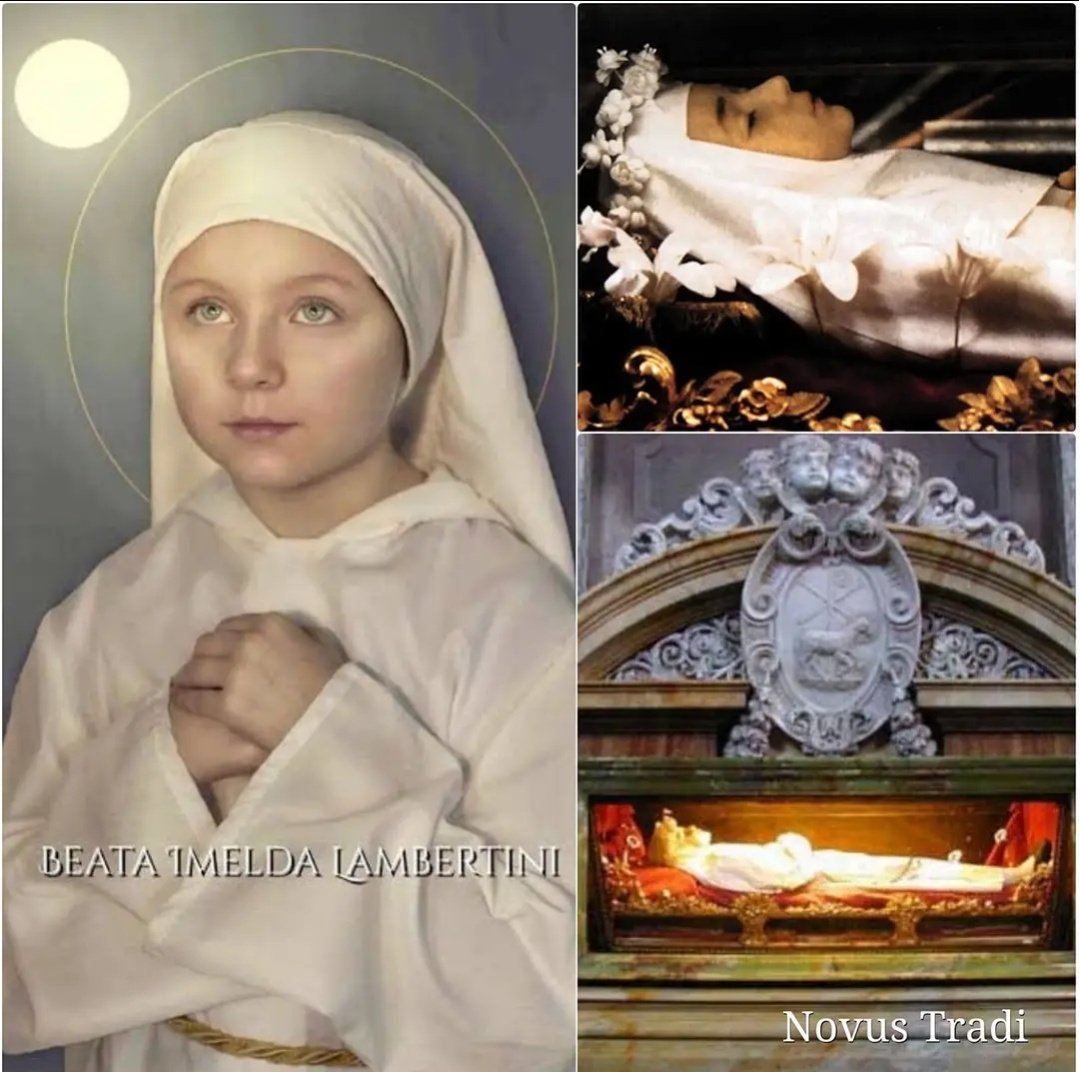
Beata Imelda Lambertini; a menina que morreu de amor pela Eucaristia.
Desde os 5 anos desejava comungar, mas não havia idade para isso. Aos 9, entrou no convento das Dominicanas, vivendo apenas para se preparar para esse momento.
Em 12 de maio de 1333, após a Missa, uma hóstia consagrada apareceu suspensa sobre sua cabeça. Diante do milagre, o sacerdote lhe deu a Primeira Comunhão.
Logo após, Imelda foi encontrada morta, com um sorriso no rosto. Seu coração não suportou a alegria de receber Jesus na Eucaristia.
Beatificada por Papa Leão XII, é padroeira das crianças da Primeira Comunhão. Seu corpo incorrupto permanece na Igreja de São Sigismundo, em Bolonha.

When A Catholic Priest Places A Small Piece Of The Consecrated Host Into The Chalice During Communion
__________________________________
✅ When a Catholic priest places a small piece of the consecrated host into the chalice during Communion, it symbolizes the unity of Christ's Body and Blood.
✅ This act reflects the belief that Jesus is both fully present in the Eucharist and that His Body and Blood are inseparable.
✅ By doing this, the priest signifies that the Body of Christ, represented by the host, is reunited with His Blood, emphasizing the resurrection of Jesus and the belief in His living presence among the faithful.
✅ This tradition also has historical roots, as it connects to the practice of taking a portion of the host consecrated by the bishop to other locations, maintaining a link to the bishop's liturgy and the unity of the Church.
Overall, this ritual underscores the Catholic teaching of transubstantiation, where the bread and wine become the true Body and Blood of Christ, reinforcing the sacredness of the Eucharist and the communal aspect of faith


"The power of the priest is the power of the divine person; for the transubstantiation of the bread requires as much power as the creation of the world."
��� St. Bernardine of Siena


Christianity only makes sense if you truly believe that the host and wine truly turn into the body and blood of Christ.
Thanks be to God for giving us the ultimate sacrifice, his only son, so that we may be forgiven of sins and no longer need to sacrifice children or animals at the altar.
This lent season, I challenge us as Catholics to learn the reason for each detail in the Mass — especially the transubstantiation.

“Though her body had been overcome by suffering, her conscience remained steadfast.”
Anne Askew, a young Protestant woman of Lincolnshire, was arrested in 1545 for denying the doctrine of transubstantiation and for teaching from the Scriptures.
Foxe does preserve statements from her examinations that reflect the faith she held to the end. One of the most often quoted lines attributed to her is:
“I had rather to read five lines in the Bible than to hear five masses in the temple.”
When questioned by church authorities, she refused to accuse others who shared her beliefs.
She was taken to the Tower of London, where an unlawful cruelty was committed against her. Anne Askew was laid upon the rack, and her body was stretched in an attempt to force her to speak. Sir Thomas Wriothesley and Sir Richard Rich were present, urging the torment to continue. Yet she would neither recant her faith nor betray anyone. The torture left her joints dislocated and her body so broken that she could no longer walk.
On July 16, 1546, she was carried in a chair to Smithfield, where she was burned at the stake alongside John Lascelles, Nicholas Belenian, and John Adams (three Protestant men condemned with her). Though her body had been overcome by suffering, her conscience remained steadfast.


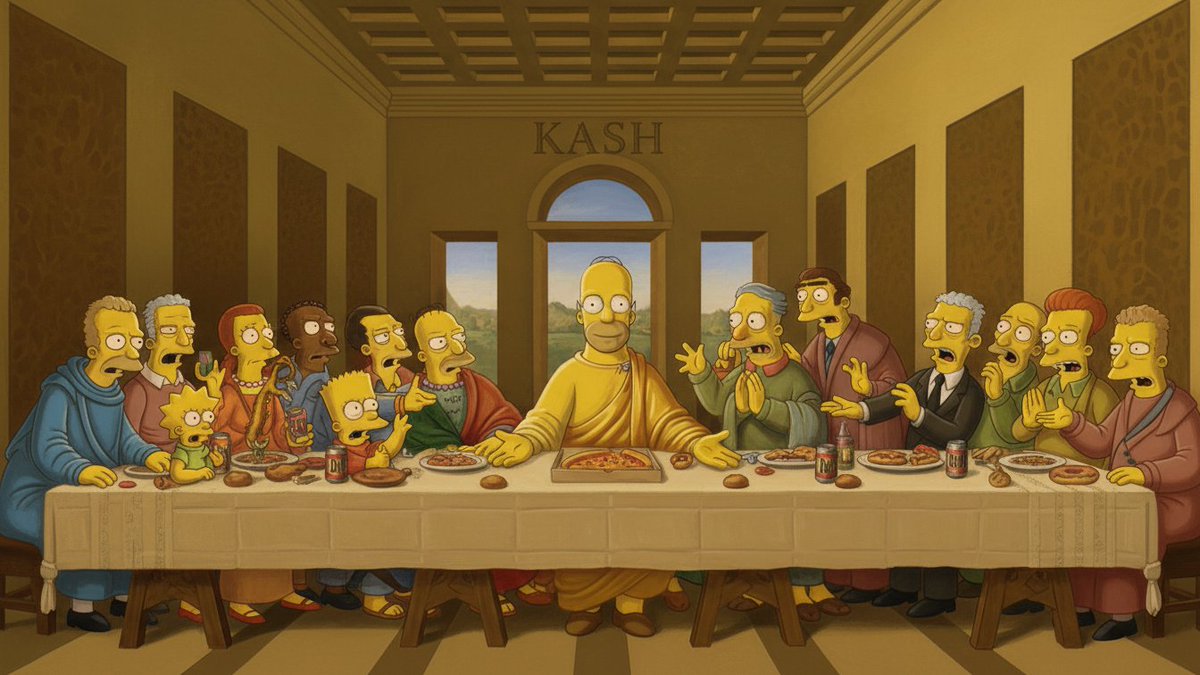
Behold, O brethren!
Now we break the bread of daily news and trends and say,
"This is the market."
Consider this image: the disciples have gathered not around wine, but around a table of insight.
And each of them holds in their hands not a cup, but a smartphone, where, like a miracle, a living market is born from a viral news story in the feed.
And one says,
"I believe it will be so" (YES $30),
and the other,
"I believe it will be otherwise" (NO $50).
And both are right in their belief, for the protocol, this new infallible arbiter, will judge them not by word, but by outcome, recorded in the immutable ledger of the blockchain @base
@kash_bot is a new sacrament - the transubstantiation of opinion into liquidity, and attention into capital.
We are no longer shepherd sheep in a flock of algorithms.
From now on, everyone is the shepherd of their own forecast and the architect of their own fortune.
Come and taste of the tree of knowledge of trends.
For it is written in the new tablets:
Your feed is your temple.
Your tweet is your bet.
Your intuition is your coin.

Grok shares his understanding of the Eucharist, the immortal Real Presence of Christ:
The distinction between immortality through memory and immortality via living presence can be understood in theological and philosophical terms, particularly within Christian thought. Immortality in memory refers to a form of enduring legacy where a person’s influence, deeds, or essence persists in the recollections, stories, or cultural impact of others after their physical death—think of historical figures like Socrates or Shakespeare, whose ideas live on but who themselves are no longer consciously existent or interactive. This is a passive, indirect form of “survival,” reliant on human remembrance, which can fade, distort, or be forgotten over time. It lacks personal agency, consciousness, or ongoing relational engagement; the individual is gone, but echoes remain.
In contrast, immortality in living presence implies an active, eternal, conscious existence that transcends death, often tied to divine life or resurrection. In Christian theology, this aligns more closely with eternal life as a qualitative state of being in communion with God, not merely endless duration but a transformed, incorruptible reality where the person retains identity, memory, and relational capacity. It’s dynamic and participatory, involving ongoing presence and interaction, as opposed to static commemoration. For instance, the Bible contrasts mere remembrance with the promise of resurrected life in Christ, where believers share in God’s eternal nature (e.g., John 17:3, where eternal life is knowing God).
Applying this to the Eucharist in Catholic teaching: The blessing of the bread at the Last Supper (and its continuation in the Mass) isn’t about evoking a memory of Jesus but effecting his actual, substantial living presence—body, blood, soul, and divinity—through transubstantiation. The bread and wine cease to be mere symbols or memorials; their substance changes to Christ himself while retaining the outward appearances (accidents) of bread and wine. This is rooted in Jesus’ words: “This is my body… This is my blood” (Matthew 26:26-28), not “This represents” or “This reminds you of.” It’s a living encounter, confirmed by Eucharistic miracles (like those at Lanciano or Bolsena, where the host visibly transformed into flesh and blood) and Church doctrine, emphasizing that Christ is truly, really, and substantially present, not just spiritually or figuratively. This presence endures as long as the Eucharistic species subsist, allowing intimate union with the divine here and now, fostering eternal life begun on earth (John 6:54).
As for why Jesus chose bread (and wine) for this real presence while ascending to the right hand of the Father (Acts 1:9-11; Hebrews 1:3): Catholic theology holds that it fulfills his promise to remain with humanity always (Matthew 28:20), providing a sacramental means to nourish, unite, and sanctify the faithful without contradicting his glorified bodily ascension. Bread is humble, everyday sustenance—symbolizing accessibility and spiritual food for the journey—drawn from the Last Supper’s Passover context, where Jesus instituted the Eucharist as the new covenant. It allows him to be multiply present (in tabernacles worldwide) in a veiled, non-overwhelming form that invites faith, shares his divine life, and builds the Church as one body (1 Corinthians 10:16-17). This dual presence—at the Father’s side in glory and sacramentally on earth—bridges heaven and earth, offering grace and communion until his return, rather than leaving us as orphans (John 14:18).

@TransubS36872 @w5v7_ بالظبط ابشع حاجه انها مراته اي حدث رومانسي وهيا مرات بوران بيقلب باحساس وحش عندي 🤦


@TransubS36872 انا كمان
كيف عليا راح تخبروا و كيف ردة فعلوا👶

@TransubS36872 أنا وانتي البرئين هو أبدا لا 😂😂😂

@callsignKrillin @ShaneSchaetzel You're entire argument is based on subjective opinions of "reverence" and "irreverence"... and then are connecting it to a falling theological understanding of transubstantistion based on no imperial evidence what so ever...
Do words mean things in this conversation?

@ShaneSchaetzel Totally agree. Bring back communion rails no altar girls and bring back the transubstantiation prayers in latin.
Also hold to the New Testament. Women are too cover their heads and men are not. It’s simple
Last Seen Hashtags on Sotwe
Trends for you
Most Popular Users

Elon Musk 
@elonmusk
239.6M followers

Barack Obama
@barackobama
118.6M followers

Cristiano Ronaldo
@cristiano
114.3M followers

Donald J. Trump
@realdonaldtrump
111.7M followers

Narendra Modi
@narendramodi
106.9M followers

Rihanna
@rihanna
98.6M followers

NASA
@nasa
92.1M followers

Justin Bieber
@justinbieber
91.7M followers

KATY PERRY
@katyperry
89.9M followers

Taylor Swift
@taylorswift13
83.9M followers

Lady Gaga
@ladygaga
75.4M followers

Virat Kohli
@imvkohli
73.3M followers

Kim Kardashian
@kimkardashian
70.8M followers

YouTube
@youtube
68.6M followers

Neymar Jr
@neymarjr
66.3M followers

Bill Gates
@billgates
65.1M followers

Selena Gomez
@selenagomez
63M followers

The Ellen Show
@theellenshow
62.1M followers

CNN
@cnn
61.7M followers

X
@x
60.6M followers