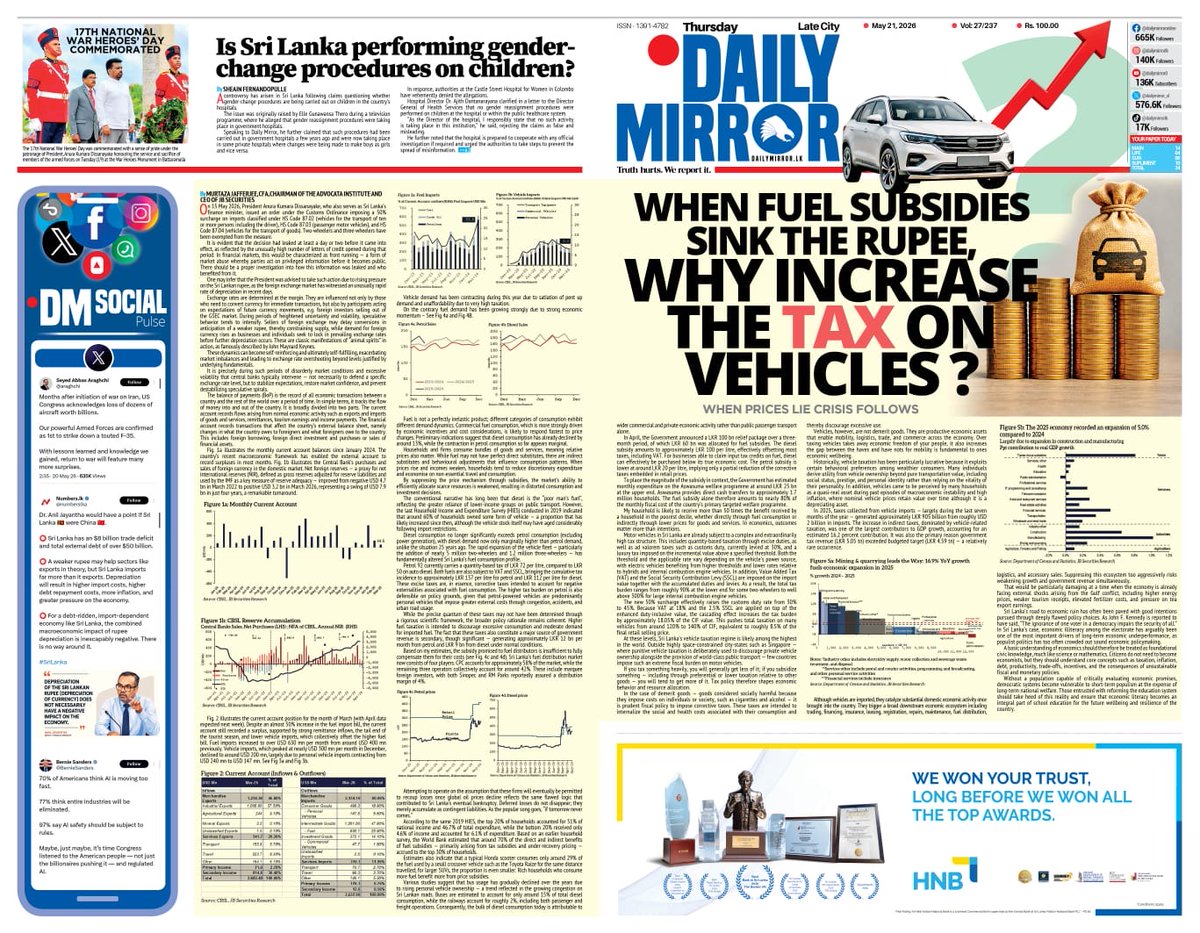
This is my attempt to present a rational argument as to why the government should not continue with fuel subsidies. It is NOT the fault of @CBSL that the LKR is weakening - they are acting as per their mandate; distorting energy prices — particularly fuel, but also electricity through differentiated tariffs across user categories — undermines the market’s ability to curtail demand and allocate resources efficiently. Thank you Jamila Husain and @Dailymirror_SL for giving my piece front-page coverage. Link below.
Generating current account surpluses to build foreign exchange reserves fundamentally requires controlling aggregate demand — particularly consumption and investment demand. This is primarily the role of monetary and fiscal policy. Monetary policy influences demand through interest rates and exchange rates, while fiscal policy operates through taxation, subsidies, and government expenditure.
Higher real interest rates encourage savings and discourage consumption and borrowing. Likewise, higher taxation reduces disposable income available for spending by both households and businesses. The core objective is the management of overall aggregate demand within the economy.
Demerit goods such as cigarettes are discouraged through corrective taxation — taxes imposed above normal levels because of their harmful social and health effects. Vehicles, however, are not demerit goods. They are essential economic assets that enable mobility, logistics, and commerce across the economy.
Although vehicles are imported, they catalyze substantial domestic economic activity once brought into the country. Passenger vehicles currently face average taxation of around 150 percent. Taxes collected from vehicle imports in 2025 — largely during the last seven months of the year — generated approximately LKR 905 billion from roughly USD 2 billion in imports.
The increase in indirect taxes, dominated by vehicle-related taxation, was one of the largest contributors to GDP growth, accounting for an estimated 15 percent contribution. It was also the primary reason government revenue exceeded budgeted targets — a relatively rare occurrence.
Vehicle imports trigger a broad downstream economic ecosystem including trading, financing, insurance, leasing, registration, repairs, maintenance, fuel distribution, logistics, and accessory sales. Suppressing this ecosystem too aggressively risks weakening growth and government revenue simultaneously.
That would be particularly damaging at a time when the economy is already facing external shocks arising from the Gulf conflict, including higher energy prices, weaker tourism receipts, elevated fertilizer costs, and pressure on tea export earnings.
Coalgate update: the bad coal has been causing massive problems at the Lakvijaya power plant, including a fire. And as long as it is in use, there will be headaches. #SriLanka
https://t.co/GYVCRkAGfg
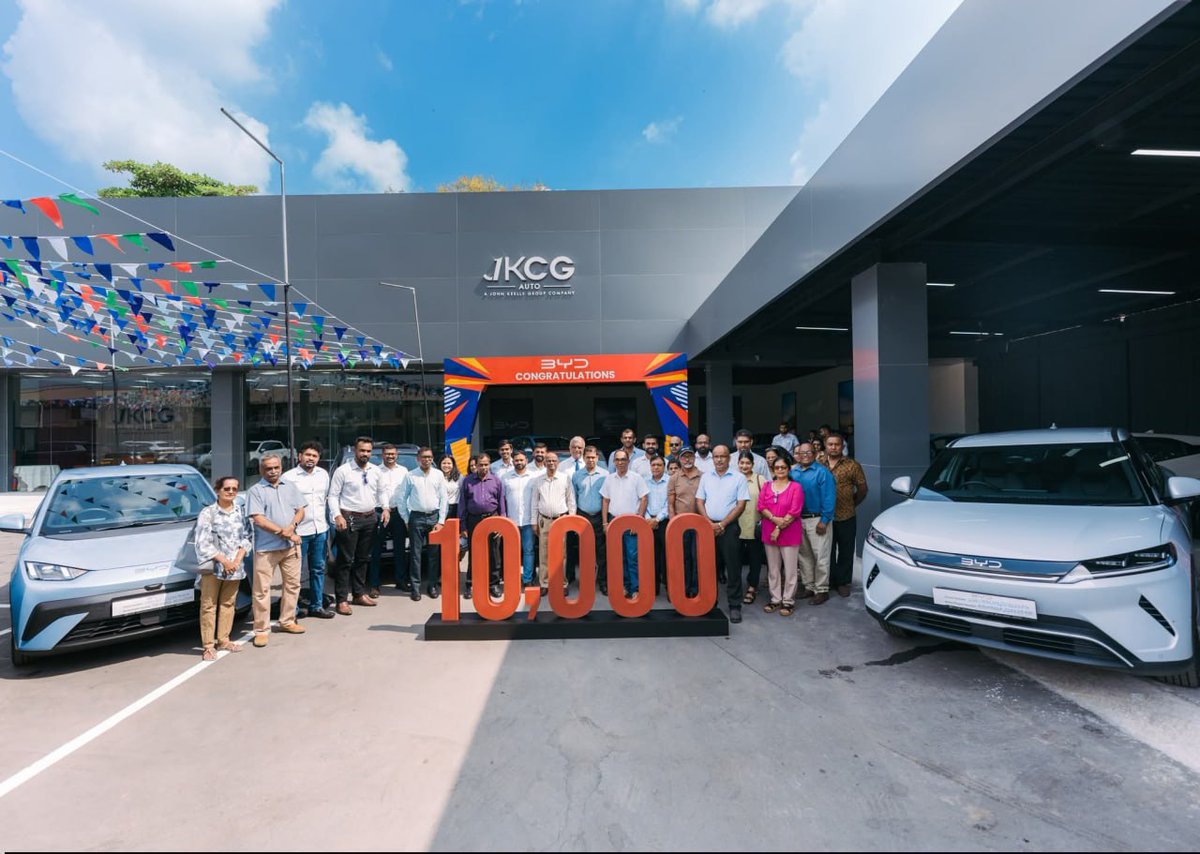
BYD hits 10,000 vehicles sold in Sri Lanka. While Tesla and others were busy talking about entering emerging markets, BYD quietly built the distribution network and captured the mindshare. Sometimes the winner isn't the loudest one in the room…
Nvidia CEO: “you cannot show me a task that is beneath me.”
The enemy of continuous progress and growth is arrogance, zero sum mindset and sense of entitlement.
🧵A Thread
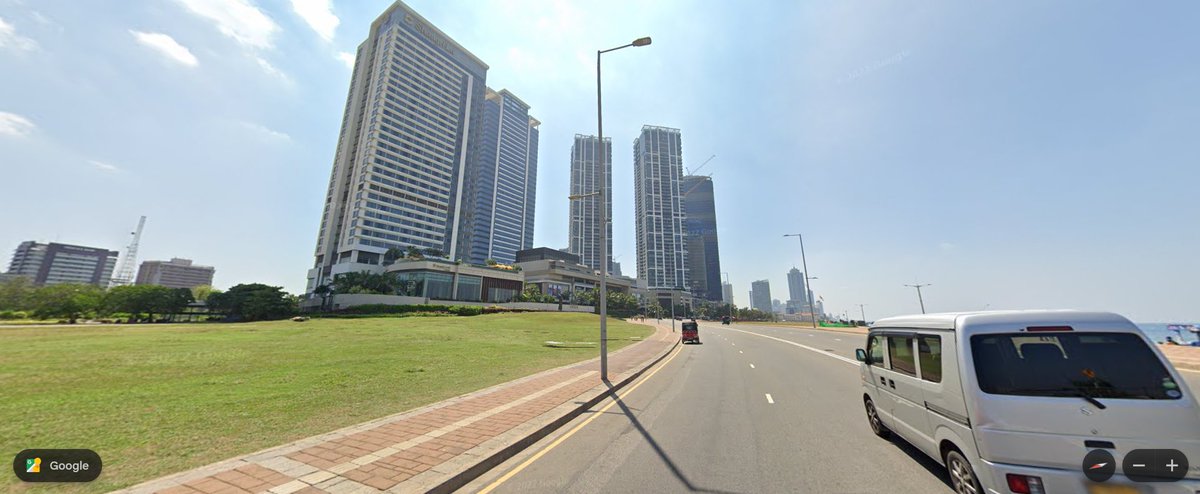
Colombo's 7 Year Transformation: A Google Earth Street View Journey! 🇱🇰
Swipe through to witness the rapid development of Colombo from 2015 to 2022 using Google Earth Street View! You'll see how much the city has changed in just 7 years.
THEN vs NOW (2022)
By stalling the #LTL IPO, we lost more than market confidence, we lost growth.
Profits attributable to LTLH were set to jump from Rs 4.3B (2024) to Rs 15B (2026) ~348%
That’s what real investment could’ve unlocked.
#SriLanka#lka#CSE#IPO#MissedOpportunity#LTLHoldings
2.
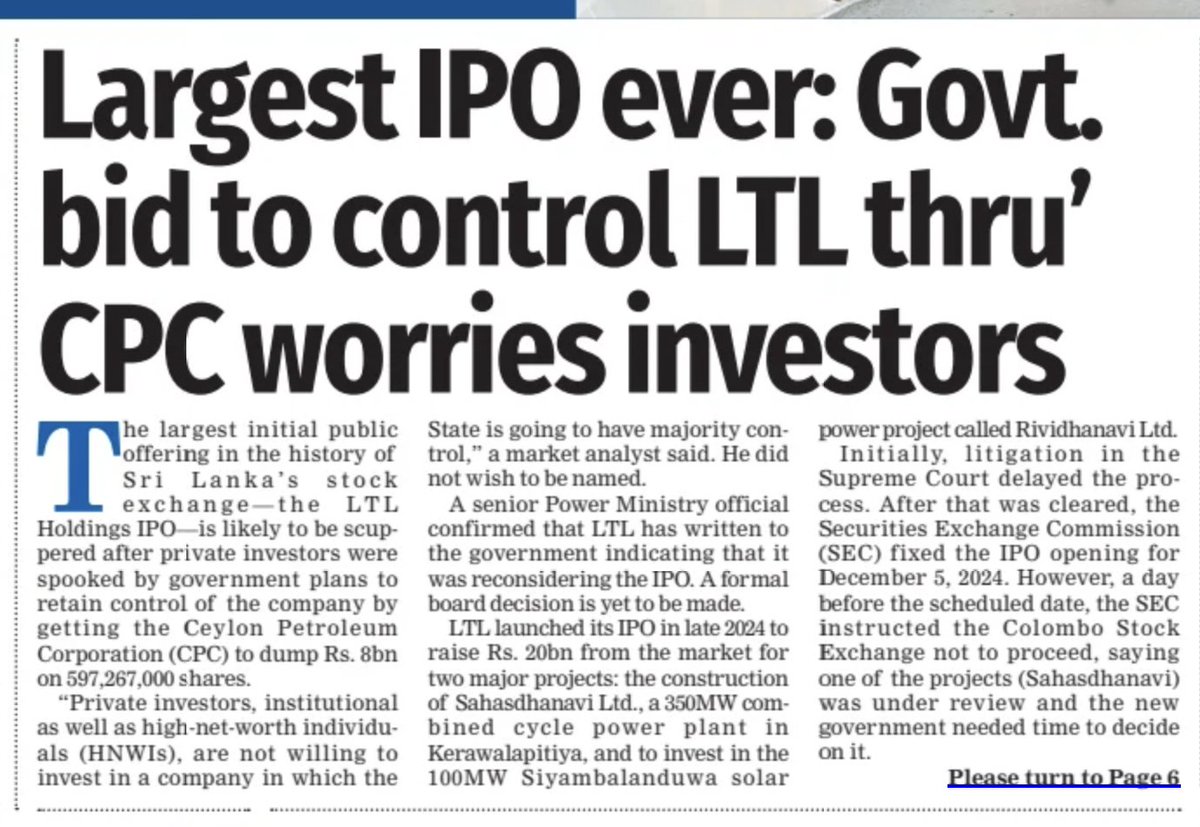
Sri Lanka’s Largest IPO - LTL Holdings officially withdraws after investor backlash over gov’t control via CPC was reported last month.
📉 Cornerstone investors pulled out.
💸 Rs 20B target scrapped.
A major blow to market confidence.
#IPO#Investing#CSE#SriLanka#lka
1.
The NPP government’s communist-style approach of tightening state control over companies—like using CPC to dominate LTL Holdings—sends all the wrong signals to the private sector.
At a time when Sri Lanka desperately needs private investment to revive the economy, this NPP government chooses control over confidence, bureaucracy over business, and political power over productivity.
The role of government should be to regulate, not to run companies. If we keep blocking private capital and market-driven growth, we’re not heading toward recovery—we’re heading deeper into economic stagnation dressed in ideological rhetoric. (Sunday Times Article; https://t.co/kZ9yX2zpic
@Sansajran BTW never pay with lankaqr for this site.
Site refreshes and money will be deducted from the account without a ticket.
And will never receive a refund.
Happened twice.
Useless to call, and the form for compaints on the website is absolute garbage.