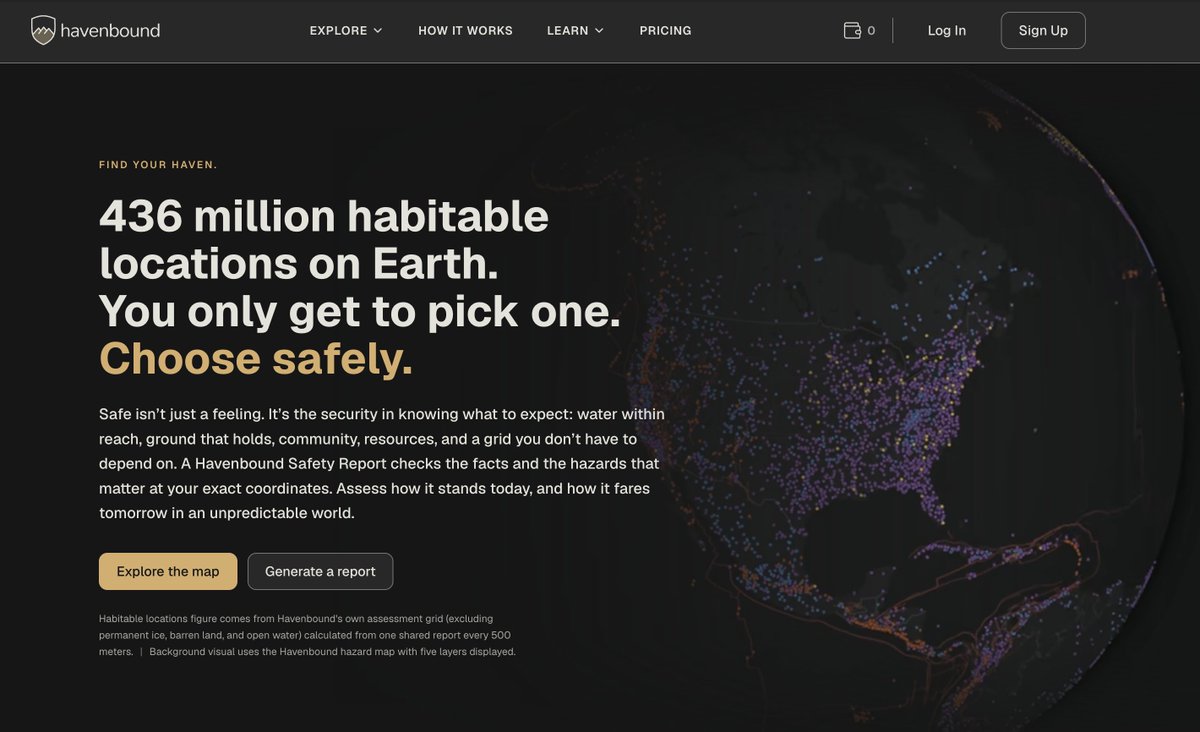
After nearly a year of building, researching, arguing with AI, and validating the physics, we're finally opening Havenbound to the public. The next decade is going to be a wild one... come find your haven.
Our first month is now behind us and it has been amazing. Nearly 500 reports on the map and a special invite we just sent out to over 1k people on our newsletter.
You asked, we listened.
Updates have gone out across the board to make reports printable, to improve map visibility, and make locations even faster.
Thank you for being a part of Havenbound.
We're just getting started.
@Dwayne_Dickslap@sunfellow Hosting a sample report for people to preview is at the top of our todo list, right alongside report printing. Are you subscribed to the newsletter? Once those ship we'll let everyone on our list know and would be happy to hear your feedback.
Hey @sunfellow and Dwayne, wanted to clarify a few things. First, thanks for taking the time to run a report and share your thoughts, David. Reports have a real cost to generate, update, maintain, secure, host, and serve and it took a lot of time and care to make them as quality-oriented (and relevant) as possible. This doesn't take into consideration the additional effort/cost put forward to create and validate the theoretical solver.
The main reason report generation carries a cost is so that the platform can sustain itself and continue to grow. Our vision for Havenbound is not only a place where people can access reports, but where they can plan how to optimize a property and connect with others who have the same aim.
There is no paid membership. With an account anyone can access a report they're interested in for a single credit, and see the overall scores for every location right on the map, leaderboard, or locations catalog. There is only a cost when someone genuinely wants to read/learn more about a specific location, a la carte.
Our estimation is that the majority of visitors do not want access to every location, but rather only a handful that matter to them. As the number of shared reports grow, access makes this economical for a single credit per report.
Hope this is helpful.
close @stephXskystory with one important clarification: we are modelling the land rotating relative to the ocean. We aren’t choosing a speed for the water and sending it across a stationary Earth. Our computational grid stays attached to the land, and the equations account for its rotation.
The land’s motion is an input; the water’s motion is a result.
Keeping the terrain fixed in our coordinates doesn’t remove the ocean’s inertia or the effects of the land moving beneath it. It’s an established way of calculating that interaction without having to move the terrain through the computational grid.
@Winston_104 have been following your work with interest and would genuinely enjoy comparing notes. If you follow @havenboundco would be great to connect via DM
Havenbound is officially live.
We hope you appreciate the effort that went into reaching this point.
And more importantly, that it can become a valuable asset in your search for a haven.
After nearly a year of building, researching, arguing with AI, and validating the physics, we're finally opening Havenbound to the public. The next decade is going to be a wild one... come find your haven.
I had the opportunity to go through the physics behind Havenbound’s simulation in detail.. the axis calculations, energy, timing, and surface speeds.
After working through the numbers with him, I fully endorse the physics in the app and can’t wait for launch on Thursday!
@AlpacaAurelius 100% yes, but where? If you're truly going to make this (for most) change, how will you select the safest location? One that provides for generations and avoids pitfalls most don't consider... How are you selecting a site?
@Tenkan_Sen_@stephXskystory LLSVPs are strange formations in the Earth's mantle that affect the balance of mass at that layer of Earth. Here, Stephanie is modeling those anomalies to see whether they support a new North Pole coordinate theory if the Earth were to undergo a drastic pole shift.
@OMApproach The number one question everyone asks:
"Where on Earth will it be safe?"
Risk of karst subsidence, liquefaction, seismicity, landslides, etc. These are just a few concerns.
Soon, anyone will be able to generate a report for any location across these and 70 other criteria.
@OMApproach We have the opposite problem. We're trying to grow this account from scratch so we're severely throttled due to a lack of followers. Maybe this reply will help some?
@OMApproach We're working on a deterministic way to find safe zones based on a number of theories, beginning with @EthicalSkeptic ECDO for an 18 hour duration event. App will be ready next month.
@OMApproach Where will it be safe? THIS is the question everyone wants an answer for, but only gets a best guess. Better than guessing is modeling potential outcomes for a given set of parameters against specific theories... I'd love to show you what we're working on.