Don't go to an interview until you can answer these 5 questions:
1. Tell me about yourself
How: Make 30 to 60 sec when following this structure.
• Present + Past: "I'm currently [position + achievement], before that I [relevant experience]"
• Future: "I'm looking for [what you want] where I can contribute"
2. Why do you want this job
How: The research company is 30 minutes before the interview.
• Study the company's website, news articles, social media and job descriptions.
• Tell us about your skills that are relevant to what the company needs and show that you really want to work there.
3. What's your greatest weakness
How: Find a skill that is less relevant to the position you are applying for.
• The skill must be something you really want to improve.
• Talk about the weakness but close it with the fact that you are aware of the weakness and are in the process of fixing the weakness.
4. Tell me about a time you faced a challenge
How: Prepare 3 to 5 stories based on your experience
• Choose a challenge that is relevant to the position and the story of the problem → action → result.
• Enter specific numbers and the story must be under 2 minutes.
5. Do you have any questions for me?
How: Prepare 7 to 10 questions before the interview
• Specific questions about role success, challenges and company culture.
• Avoid asking questions about schedule-related and benefits that show that you are not interested in the job but only want benefits.
Don't forget to share this post so that others can learn too.
No interview invitation in the last 6 weeks?
Let’s help you fix that CV and get you noticed. Email your CV to [email protected] with subject 'Revamp'.
MY COUSIN SUBMITTED 52 JOB APPLICATIONS.
ZERO RESPONSES.
ZERO INTERVIEWS.
Then I uploaded his resume to GROK and got 11 replies in 9 days.
Here are the 7 prompts I used:
Ferris State HC Tony Annese - Cardinal Rules to Successful Coaching
1. Serve the heart of your players, not their talents
2. Find the good in every player and enthusiastically celebrate whatever strength that individual displays
3. Show compassion and empathy for our players and provide the love and support they need to flourish
4. Love your position group and take care of them like they are your own children
5. Master your relationships with the Jimmy's and Joe's before you focus on the X's and O's
6. Be a Life Coach - Provide spiritual, emotional, and social awareness and support for the players - Understand how vulnerable young people are at this stage and provide the support they need to navigate through the challenges they face
7. Be a Doer! -Spend time with the Head Coach and determine what you can do to help him and the team
8. Be passionate about your role as a coach - Realize that you will impact more people in one year than most people do in a lifetime
9. Make the coaching staff your best friends - You are blessed to have the opportunity to connect with people who are working toward a common goal.
10. Be loyal to the University, Athletic Department, Coaching Staff, Head Coach, and the Players you serve.
This paper from Harvard and MIT quietly answers the most important AI question nobody benchmarks properly:
Can LLMs actually discover science, or are they just good at talking about it?
The paper is called “Evaluating Large Language Models in Scientific Discovery”, and instead of asking models trivia questions, it tests something much harder:
Can models form hypotheses, design experiments, interpret results, and update beliefs like real scientists?
Here’s what the authors did differently 👇
• They evaluate LLMs across the full discovery loop hypothesis → experiment → observation → revision
• Tasks span biology, chemistry, and physics, not toy puzzles
• Models must work with incomplete data, noisy results, and false leads
• Success is measured by scientific progress, not fluency or confidence
What they found is sobering.
LLMs are decent at suggesting hypotheses, but brittle at everything that follows.
✓ They overfit to surface patterns
✓ They struggle to abandon bad hypotheses even when evidence contradicts them
✓ They confuse correlation for causation
✓ They hallucinate explanations when experiments fail
✓ They optimize for plausibility, not truth
Most striking result:
`High benchmark scores do not correlate with scientific discovery ability.`
Some top models that dominate standard reasoning tests completely fail when forced to run iterative experiments and update theories.
Why this matters:
Real science is not one-shot reasoning.
It’s feedback, failure, revision, and restraint.
LLMs today:
• Talk like scientists
• Write like scientists
• But don’t think like scientists yet
The paper’s core takeaway:
Scientific intelligence is not language intelligence.
It requires memory, hypothesis tracking, causal reasoning, and the ability to say “I was wrong.”
Until models can reliably do that, claims about “AI scientists” are mostly premature.
This paper doesn’t hype AI. It defines the gap we still need to close.
And that’s exactly why it’s important.
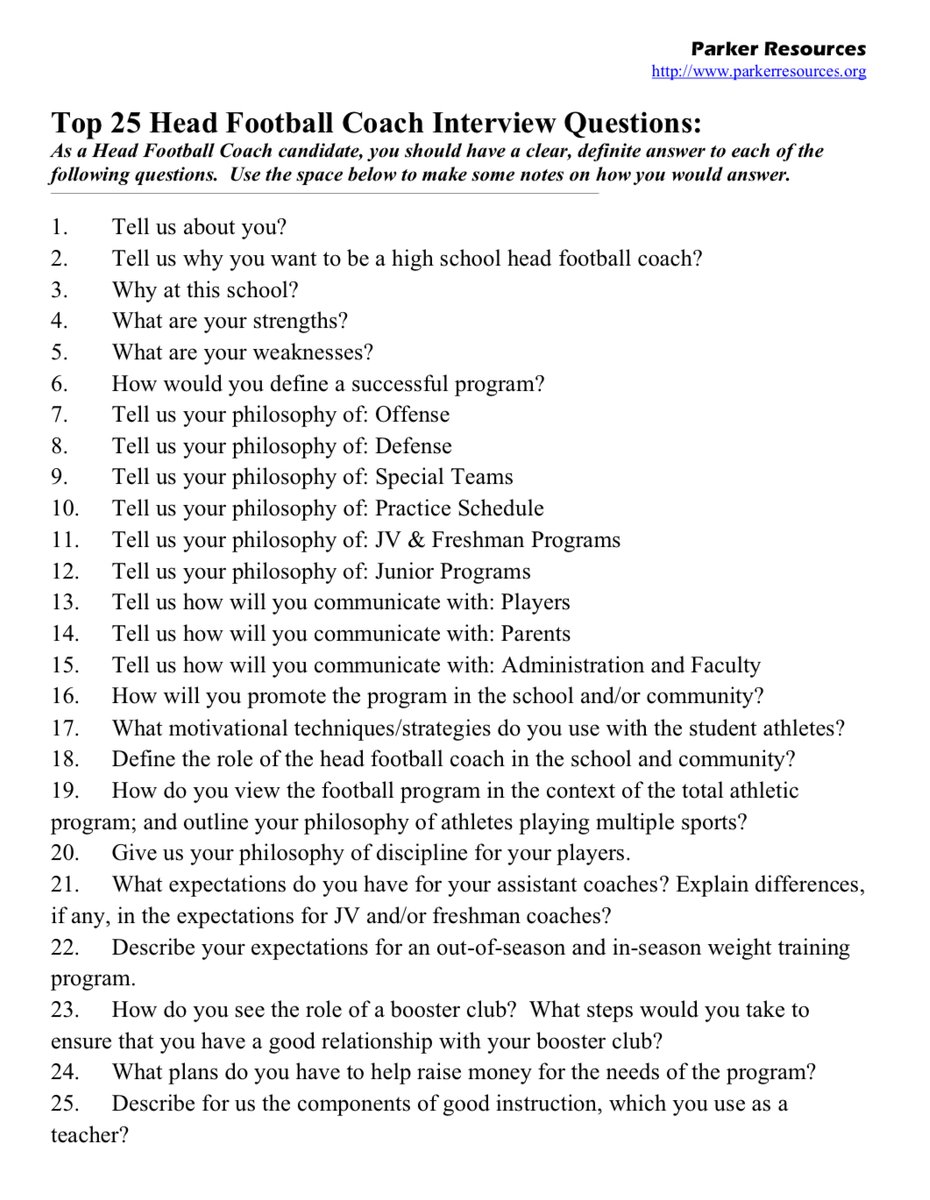
Top 25 Head Football Coach Interview Questions:
As a Head Football Coach candidate, you should have a clear, definite answer to each of the following questions.
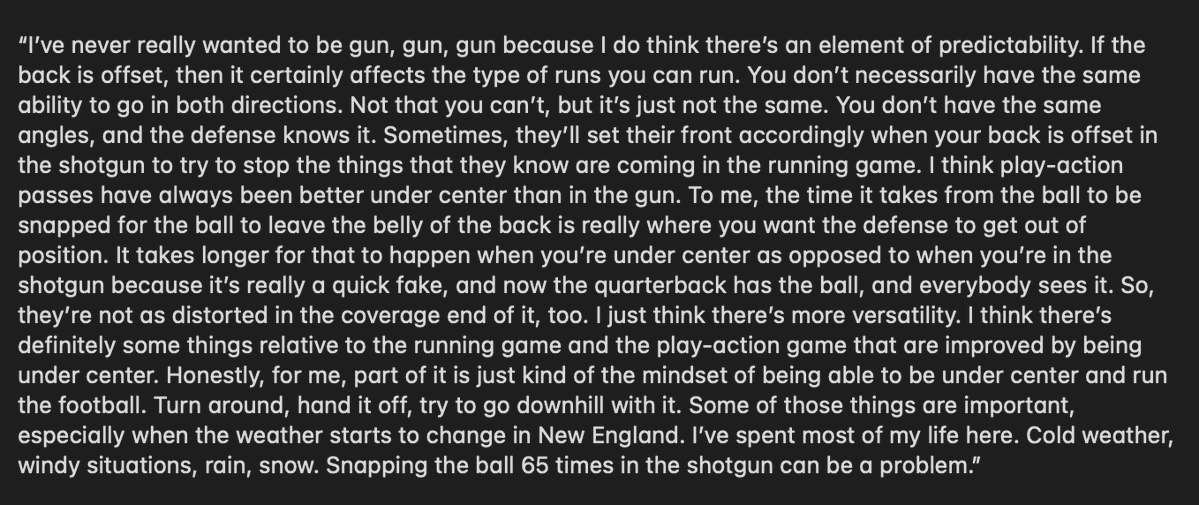
I asked #Patriots OC Josh McDaniels about the advantages of playing from under center (NE - 44.8% under-center rate, 7th in NFL).
He gave an expansive answer on the advantages on runs, play-action passes, the mindset of playing from under center, & managing bad weather games.