Five Charts for Next Week
that $USDJPY move can have repercussion across the macro landscape
like we saw in 2024 with USDJPY carry unwind hitting $NQ and $VIX
as we're seeing now with the 30-year and $USD
next week is big
https://t.co/eUOhcWzzvx
$SPCX shares are priced at $135 for its $2 trillion IPO.
Its return is 100x-200x by 2035.
These 20 companies will benefit the most:
1. $BKSY ~$34
AI-ready Earth observation satellites feed SpaceX orbital intelligence layer.
2. $SPIR ~$20
Space data analytics monetizing SpaceX's growing orbital constellation.
3. $ACHR ~$5
Air mobility networks integrate with Starlink's low-latency infrastructure.
5. $SATL ~$7
High-resolution imaging complements SpaceX orbital AI compute constellation data.
6. $VIAV ~$50
Optical networking components critical for Starlink ground station upgrades.
7. $OUST ~$40
Sensor fusion tech supports SpaceX booster catch reusability automation.
8. $GILT ~$15
Satellite ground infrastructure scales alongside Starlink enterprise deployments.
9. $POET ~$11
Optical interposer chips slash data center power costs inside COLOSSUS AI cluster.
10. $ARQQ ~$12
Quantum encryption securing Starshield government classified orbital networks.
11. $TWST ~$74
Synthetic biology tools accelerate SpaceX long-term Mars life support research.
12. $LUNR ~$30
NASA lunar lander tech directly supports SpaceX Moon base buildout.
13. $AEVA ~$24
LiDAR sensors enable autonomous Starship landing and booster catch precision.
14. $KTOS ~$60
Defense tech partner powering Starshield national security satellite contracts.
15. $IONQ ~$58
Quantum compute layer powering next-gen orbital AI satellites.
16. $RDDT ~$178
Real-time social data feeds Grok's truth-seeking AI via X integration.
17. $RKLB ~$115
Small payload launch fills exact gaps Falcon can't efficiently serve.
18. $ASTS ~$97
Direct-to-phone satellite broadband. Starlink's closest competitor and partner.
19. $MTSI ~$375
RF semiconductors power Starlink phased-array antenna signal processing.
20. $BWXT ~$200
Nuclear propulsion R&D aligns with SpaceX Mars mission power requirements.
I'm definetly a buyer of $SPCX IPO and want to get it super cheap.
♻️ RESHARE this post and write 1 comment, I'll DM you the PRICE I want to buy $SPCX at this month.
#EURUSD. The Enemy Within. 🙂
1/7 Why do FX traders hold losers way longer than winners — even when they get the direction right?
This is one of the most expensive biases in trading. It’s called the Disposition Effect. Here’s why it happens and how it destroys accounts. 🧵
2/7 The Disposition Effect = selling winners too early while holding losers too long.
Classic study by Terrance Odean (1998): Individual traders sold winning positions ~50% more often than losing ones. The winners they sold actually kept going up more than the losers they held.
Same pattern shows up in retail FX trading.
3/7 A 2025 study of over 1 million retail FX trades confirmed it: Traders sell gains faster and hold losses longer — especially on “home currency” pairs.
Losing trades get held significantly longer, and average losses end up much bigger than average wins.
4/7 Why does this happen?
Main reason: Loss aversion (from Prospect Theory).
Losses hurt ~2x more than equivalent gains feel good.
•Closing a loser = admitting you were wrong + real pain
•So you “hold and hope” it comes back
On winners you take profit fast to lock in the good feeling and avoid regret if it reverses.
5/7 Other factors:
•Ego (“I can’t be wrong”)
•Sunk cost fallacy
•Overconfidence in your original analysis
•No hard rules for stops/targets
In leveraged FX markets, these emotions get amplified massively.
6/7 The result? Small wins + big losses = terrible risk-reward.
Even if your direction is correct, you cut the good trades short and let the bad ones run. Your winners never pay for your losers. This is why so many traders stay unprofitable despite decent analysis.
7/7 Fix it: Use mechanical rules. Predefine your stop and target (or trailing stop) before you enter. Track your hold-time ratio in a journal (winners vs losers).
Process > emotion.
The market doesn’t care about your entry price or how “right” you were.
Save this thread if it hit home.
#TradingPsychology #Forex #DispositionEffect
If you’re trading #gold#silver and #FXMarket
London session direction often sets the tone for NY.
📈 London closes green → NY closes green 80% of the time
📉 London closes red → NY closes red 71% of the time
Looking to explore new four-hour chart trading strategies? 🙌
The following video dives into a method for #forex and NQ trading. Check it out 👇
https://t.co/3bU7JMz5zf
🚨 𝗕𝗥𝗘𝗔𝗞𝗜𝗡𝗚: Al-Nassr and Inter Miami will face each other in February 2024 in Riyadh.
The game between the two GOATs is being labelled “The Last Dance” 🐐🐐
What an innings by Fakhar Zaman, by far Pakistan’s best batter. Which brains kept him on the bench for the best part of the tournament, God knows.
Protein ki bhi kami nahin, jajbe ki bhi . #NZvsPak
Understanding the mathematical principles of profitable trading can help a trader understand how to create a positive expectancy trading system with an edge. The understanding of the underlying math can change how you look at your own trading and see what really matters: risk per trade, win rate, losing streaks, drawdowns, positive expectancy, and growth rate.
The math that a trader needs to understand is not complex and can be summarized into a few of the most important core dynamics. Below is the math a trader needs on one cheat sheet. Use these formulas to unlock your own profitable strategy.
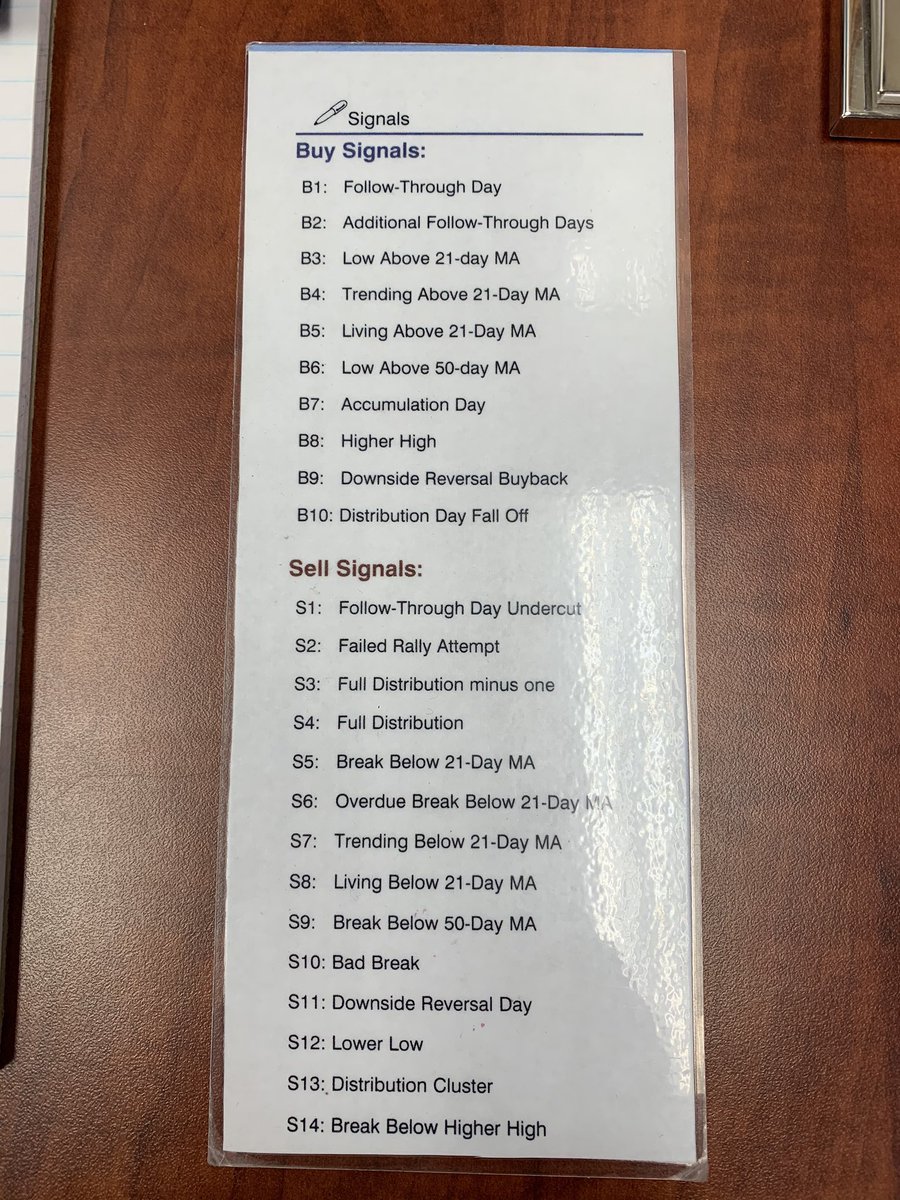
Focus On Signals & Tune Out Noise
Among the mistakes of the new traders that never make it to profitability is the fact that they never develop a filter to enable them to see what really matters in the financial markets. Much of what a new trader is exposed to is just pure noise. Noise does not lead to making money, it leads to confusion and frustration. What the new trader must be in search for is signals.
Signals tell you when to buy & when to sell for a profit. Noise tells you nothing but information & if that information cannot be used to make money in the markets then it is not a signal.
“The instinctual shortcut that we take when we have “too much information” is to engage with it selectively, picking out the parts we like and ignoring the remainder, making allies with those who have made the same choices and enemies of the rest.” – Nate Silver
This is the NOISE:
1. Talking heads on television. They could have no position in their picks, they could be pumping their portfolio holding, or talking down their shorts. Who really knows?
2. Predictions by anyone are not trading signals. The farther out the predictions are for the more the odds are against the prediction. The complexity of the world and the markets and the randomness of so many moving parts and players make predicting a future that does not exist impossible.
3. Known news events are not signals. If there are escalating geo-political risks and the same stories are on the news day after day with no major changes in the situation then that news is already priced in. Continual fear mongering from the media is just noise.
4. The shorter the time frame the more random the prices. The farther you zoom out in time the more patterns and trend are identifiable. If you sit in front of your monitor all day the majority of what you see is noise you have to wait until the signal appears inside all that noise.
5. Short term trading results tend to be random. Someone with a long bias that holds losing trades until they come back in a bull market looks like a profitable trader with skills. It is the long term results of a trader that signals whether they have skills in system development, discipline, and risk management. Many new traders that get lucky at the beginning and seem to be profitable are shocked when they end up giving back their bull market gains in the next bear market. Their winning streak was just noise in the long term as the market changed.
These are Signals:
1. A breakout of a trading range to new highs or new lows in your time frame that holds the new price level.
2. An oversold bounce off support or an overbought reversal against resistance in your time frame that is strong enough to convince you it is a high probability trade set up for a swing trade.
3. When the market rallies on bad news or sells off on good news that is a signal of a possible end to the markets prevailing trend.
4. When popular market sentiment is overwhelming bearish or bullish and there is a strong move against that prevailing sentiment it is a possible signal of a market top or bottom being put in.
5. Many times a gap in the direction of the prevailing trend is a signal of a continuation of the trend in the direction of the gap over the long term.
The real point of system back testing and the study of historical price patterns are to find the principles that are present in the markets historical price action. The principles of fear, greed, and ego along with supply and demand are the key underlying causes of trends and range bound markets. The profitable traders are able to search out and find the signals that give them the edge over the traders caught up in trading the noise off their own emotions.
“The signal is the truth. The noise is what distracts us from the truth.” – Nate Silver
The ability to filter out the noise of what does not matter is a skill just as important as finding the signals.