Words are power. The right word can heal and harm, they are more than mere words, they are frequencies and vibrations. There are more concepts than there are words in every language as well. Our thoughts are limited by our vocabulary known, knowable and yet to be invented words.
Jordan Peterson: "The most dangerous person is one who is articulate"
"Articulate is an interesting word. If your joints are articulated, that means you can do things with them because they're not one solid vague mass. They're differentiated. Someone who's graceful is compelling because they're articulated. And speech is a form of articulation in that manner."
Peterson explains why this matters:
"It is definitely the case that there is no more exceptional form of the capacity to be dangerous than to be articulate. And one of the things that really shocks me is that young men in particular are never taught this."
He makes the case bluntly:
"Do you want to be competent and dangerous, or do you want to be vague and useless? Because those are your options. And I don't care what your job is. If you're a plumber, and I have great respect for plumbers, and you're articulate: you can negotiate with your clients, introduce your co-workers, make a case for your employees, advertise your services, think through your problems. You're firing on all cylinders."
Peterson shares a deeper truth:
"Our whole culture is based on the idea of the supremacy of the word. The idea that it is the word itself that extracts habitable order from chaos and possibility. And the reason our culture is predicated on that is because it's a deep truth."
He gives an example from the military:
"I know a former special operations soldier, Jocko Willink. He's about four feet wide and three feet thick. One tough son of a bitch. You don't want to mess with him. And he knows perfectly well, and is very capable of articulating, that his success as an eminent warrior is in no small part dependent on his ability to communicate."
Peterson explains why:
"Because he could communicate well, he could listen to the men under his command. Because he was articulate, he could explain to his superiors the situation on the ground. Because he was articulate, he could make a case that the men under his command who were deserving would be promoted. Because he could think in an articulate manner, he could plan strategically and not lose battles."
He asks the hard question:
"What's the alternative? You want to be inarticulate? You want to say 'uh' and 'like' and 'um' and pause and stumble? Be unable to formulate a strategy? Be unable to elucidate a vision? Be unable to compel and convince other people to entice them with your articulated vision of what might be? You would choose awkwardness over grace. It's preposterous. It's beyond foolish."
How do you become articulate?
Peterson offers a metaphor:
"Imagine you're trying to walk across a swamp. The swamp is murky, but you know there's a path of stone under the water, and it twists and moves. If you stay on the path, you won't drown. The crocodiles won't devour you. As you walk forward, you feel with your next step where the stone might be. Then you feel it solid. Then you take that step. You search and find out what's solid, and you move forward in that manner."
He applies this to speech:
"That's what you do with your words. You feel, is this the right word? Is the fact that I'm uttering it putting me together and making me intact and stronger? Or is it tearing me apart and making me dissolute and weak? You can learn to do that."
Peterson shares what he noticed 40 years ago:
"Much of what I said actually made me feel weak. I didn't know why exactly. But sometimes some of the things I said didn't have that effect. They weren't accompanied by a sense of shame. They weren't accompanied by a sense of vulnerability. They were solid. At the beginning, that was probably only about 5% of what I said. The rest of it was instrumental — language I was using to get my way. There was an arrogance in my use of language that had to do with the desire to attain proximal victories. To appear smart. To win an argument."
He contrasts that with real articulation:
"A very different idea than merely feeling my way along to see what word was appropriate for what moment. But you can learn to do that. You can listen to yourself. You can stop humming and hawing and using 'like' and 'you know' and fillers. You can take the time necessary to craft your words carefully. You can practice merely saying what you believe to be true. You can read great writers. You can write about the problems that obsess you. And you can become articulate as a consequence."
The power of the pause:
"When you're in a discussion with someone, they might present you with a question or a conundrum. Instead of responding with what you 'know' to be right, you could just ask yourself: what do I actually think about that? But it has to be a real question. It has to be the kind of question you pose to someone you didn't know. It has to be a question predicated on the idea that you might not know who you are, and that you could ask."
Peterson continues:
"Someone presents you with a question. You think: okay, what do I think about that? But you have to want to know the answer. And then the answer will make itself known because that's how thought works. And then you can just communicate that answer."
He explains what happens next:
"If you do that, you'll be interesting right away. You'll be interesting to the person you're talking to. And if they do that to you, they'll be interesting too. And then if you both do that, you'll have an interesting conversation. And if you have an interesting conversation, you'll both grow as a consequence. That's actually the pathway to growth."
Peterson uses Joe Rogan as an example:
"One of the reasons Joe Rogan is so successful is that that's what Joe does. He just asks questions. He isn't trying to get something from his guests. He's not trying to become more famous. He doesn't need any more money. There's no instrumental utilization of language in his discourse. He's just a humble lunkhead in the most profound sense who would like to know more than he knows, and who asks all the stupid questions he can think up."
He continues:
"It turns out he's actually very smart and very well educated now, after talking to hundreds of people and listening. The stupid questions he asks aren't stupid. They're questions shared by virtually everyone who's listening. He takes his listeners along on this process of exploratory endeavor. And it's the pathway to success."
Peterson closes with this:
"The same thing can be true of your life. If you're guided by the spirit of honest inquiry and every word you say is reflective of what you believe to be the truth, then the pathway that you walk on is a golden pathway to success. I know that to be true."
Words are power. The right word can heal and harm, they are more than mere words, they are frequencies and vibrations. There are more concepts than there are words in every language as well. Our thoughts are limited by our vocabulary known, knowable and yet to be invented words.
Jordan Peterson: "The most dangerous person is one who is articulate"
"Articulate is an interesting word. If your joints are articulated, that means you can do things with them because they're not one solid vague mass. They're differentiated. Someone who's graceful is compelling because they're articulated. And speech is a form of articulation in that manner."
Peterson explains why this matters:
"It is definitely the case that there is no more exceptional form of the capacity to be dangerous than to be articulate. And one of the things that really shocks me is that young men in particular are never taught this."
He makes the case bluntly:
"Do you want to be competent and dangerous, or do you want to be vague and useless? Because those are your options. And I don't care what your job is. If you're a plumber, and I have great respect for plumbers, and you're articulate: you can negotiate with your clients, introduce your co-workers, make a case for your employees, advertise your services, think through your problems. You're firing on all cylinders."
Peterson shares a deeper truth:
"Our whole culture is based on the idea of the supremacy of the word. The idea that it is the word itself that extracts habitable order from chaos and possibility. And the reason our culture is predicated on that is because it's a deep truth."
He gives an example from the military:
"I know a former special operations soldier, Jocko Willink. He's about four feet wide and three feet thick. One tough son of a bitch. You don't want to mess with him. And he knows perfectly well, and is very capable of articulating, that his success as an eminent warrior is in no small part dependent on his ability to communicate."
Peterson explains why:
"Because he could communicate well, he could listen to the men under his command. Because he was articulate, he could explain to his superiors the situation on the ground. Because he was articulate, he could make a case that the men under his command who were deserving would be promoted. Because he could think in an articulate manner, he could plan strategically and not lose battles."
He asks the hard question:
"What's the alternative? You want to be inarticulate? You want to say 'uh' and 'like' and 'um' and pause and stumble? Be unable to formulate a strategy? Be unable to elucidate a vision? Be unable to compel and convince other people to entice them with your articulated vision of what might be? You would choose awkwardness over grace. It's preposterous. It's beyond foolish."
How do you become articulate?
Peterson offers a metaphor:
"Imagine you're trying to walk across a swamp. The swamp is murky, but you know there's a path of stone under the water, and it twists and moves. If you stay on the path, you won't drown. The crocodiles won't devour you. As you walk forward, you feel with your next step where the stone might be. Then you feel it solid. Then you take that step. You search and find out what's solid, and you move forward in that manner."
He applies this to speech:
"That's what you do with your words. You feel, is this the right word? Is the fact that I'm uttering it putting me together and making me intact and stronger? Or is it tearing me apart and making me dissolute and weak? You can learn to do that."
Peterson shares what he noticed 40 years ago:
"Much of what I said actually made me feel weak. I didn't know why exactly. But sometimes some of the things I said didn't have that effect. They weren't accompanied by a sense of shame. They weren't accompanied by a sense of vulnerability. They were solid. At the beginning, that was probably only about 5% of what I said. The rest of it was instrumental — language I was using to get my way. There was an arrogance in my use of language that had to do with the desire to attain proximal victories. To appear smart. To win an argument."
He contrasts that with real articulation:
"A very different idea than merely feeling my way along to see what word was appropriate for what moment. But you can learn to do that. You can listen to yourself. You can stop humming and hawing and using 'like' and 'you know' and fillers. You can take the time necessary to craft your words carefully. You can practice merely saying what you believe to be true. You can read great writers. You can write about the problems that obsess you. And you can become articulate as a consequence."
The power of the pause:
"When you're in a discussion with someone, they might present you with a question or a conundrum. Instead of responding with what you 'know' to be right, you could just ask yourself: what do I actually think about that? But it has to be a real question. It has to be the kind of question you pose to someone you didn't know. It has to be a question predicated on the idea that you might not know who you are, and that you could ask."
Peterson continues:
"Someone presents you with a question. You think: okay, what do I think about that? But you have to want to know the answer. And then the answer will make itself known because that's how thought works. And then you can just communicate that answer."
He explains what happens next:
"If you do that, you'll be interesting right away. You'll be interesting to the person you're talking to. And if they do that to you, they'll be interesting too. And then if you both do that, you'll have an interesting conversation. And if you have an interesting conversation, you'll both grow as a consequence. That's actually the pathway to growth."
Peterson uses Joe Rogan as an example:
"One of the reasons Joe Rogan is so successful is that that's what Joe does. He just asks questions. He isn't trying to get something from his guests. He's not trying to become more famous. He doesn't need any more money. There's no instrumental utilization of language in his discourse. He's just a humble lunkhead in the most profound sense who would like to know more than he knows, and who asks all the stupid questions he can think up."
He continues:
"It turns out he's actually very smart and very well educated now, after talking to hundreds of people and listening. The stupid questions he asks aren't stupid. They're questions shared by virtually everyone who's listening. He takes his listeners along on this process of exploratory endeavor. And it's the pathway to success."
Peterson closes with this:
"The same thing can be true of your life. If you're guided by the spirit of honest inquiry and every word you say is reflective of what you believe to be the truth, then the pathway that you walk on is a golden pathway to success. I know that to be true."
David Sinclair just revealed one of the biggest studies on nattokinase.
A comprehensive Chinese study of 1,067 people found that nattokinase reversed cardiovascular disease by removing up to 95% of arterial plaque in one year.
This supplement is an enzyme from fermented soybeans and costs almost nothing.
Sinclair has been taking it daily for a couple of years.
He measures his carotid artery with ultrasound and says there's no plaque buildup at all.
Peter Diamandis takes it too.
He believes you need at least 6,000 fibrinolytic units per day to reap the benefits.
For context:
• Statins cost hundreds per month and come with side effects.
• Surgical interventions can cost thousands of dollars
Nattokinase costs a fraction of both.
Sinclair's caveat: "Do this with the knowledge of your physician."
But the data exists.
A study of over 1,000 people and up to 95% plaque removal in just 12 months.
And the man whose lab is reversing aging takes it every day.
— David Sinclair (@davidasinclair) on Peter Diamandis' (@PeterDiamandis) Moonshots podcast
PS. David Sinclair is speaking at SynBioBeta on May 6th this year, discussing the science of slowing and reversing aging.
If longevity is the world you're in, the investors, partners, and scientists shaping this space will be in the room.
Grab your ticket in the comments below.
Vanessa Van Edwards shares a game-changing finding from a high school likability study: The #1 predictor of who was the most popular wasn't looks, grades, humor, athleticism, or extroversion—it was having the longest list of people they liked.
Across multiple schools and grades (9th–12th), the "cool kids" were the first to like others: greeting classmates in hallways, inviting people to sit with them, spotting good in everyone. Liking more people made them more likable—reciprocity in action.
We can train this: Enter rooms assuming "I could like most of these people if I ask the right questions or set them up to shine." Hunt for positives—it flips how others see you.
59-sec clip on becoming a "first liker" for instant social edge 👇
Who's the "first liker" in your life? Or try it today—how many people can you genuinely like in your next interaction? Share your results!
Within just 1 hour of drinking a single cup (200 mL) of green tea, we can significantly cut down on the rate of DNA damage in our cells. This is because green tea significantly boosts the activity of a DNA repair enzyme in our body that can fix DNA damage. https://t.co/E0CA3lmiLY
3-tier guide to protecting yourself from EMFs:
TIER 1 - BEGINNER:
- Use speakerphone (never hold to head)
- Keep phone on table, not in pocket
- Switch to wired headphones
TIER 2 - INTERMEDIATE:
- Plug laptop into Ethernet, disable WiFi
- Use wired keyboard and mouse
- Avoid phone use at 1-2 bars signal
- Unplug all chargers when not in use
TIER 3 - ADVANCED:
- EMF-shielding bed canopies ($1,500)
- Replace metal bed frames with wood
- Dirty electricity filters in every outlet
- EMF meters to track exposure
You don't need a Faraday cage.
Basic distance is 90% of the battle, just keep devices off your body.
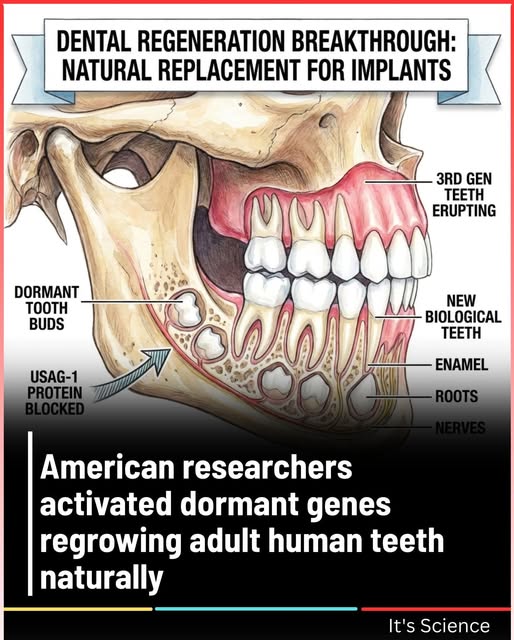
American researchers activated dormant genes regrowing adult human teeth naturally. By blocking USAG-1 protein, scientists triggered tooth buds that normally remain inactive after permanent teeth emerge, causing complete new teeth to grow from the jaw in adults who lost teeth to injury or decay. This biological regrowth could replace dental implants entirely, giving humans a true third generation of natural teeth.
During fetal development, humans form tooth buds for three sets of teeth, but only two ever erupt. The third set remains genetically suppressed throughout life. Researchers identified USAG-1 as the suppressor protein and developed antibody treatments that block it temporarily. When administered locally in the jaw, dormant tooth buds received growth signals and began developing exactly as they would in childhood, erupting through gums as fully functional biological teeth with roots, enamel, and nerve connections.
Imagine ditching the $3,000 implant industry for an $800 biological regrowth treatment. New teeth that are actually yours, that feel sensations, that integrate perfectly with your jaw, that your body maintains naturally. No more dentures, no titanium screws drilled into bone, no foreign materials in your mouth. Elderly people could have complete, functional dentition restored, dramatically improving nutrition and quality of life.
The dental implant industry is fighting this viciously, lobbying against fast-track approval despite overwhelmingly positive trial results. When a $28 billion industry faces obsolescence, innovation suddenly encounters regulatory roadblocks. Financial incentives oppose medical progress once again.
Source: Kyoto University, Nature Medicine 2025 #ToothRegeneration #DentalScience #RegenerativeMedicine #BiomedicalResearch #DentistryInnovation #GeneTherapy
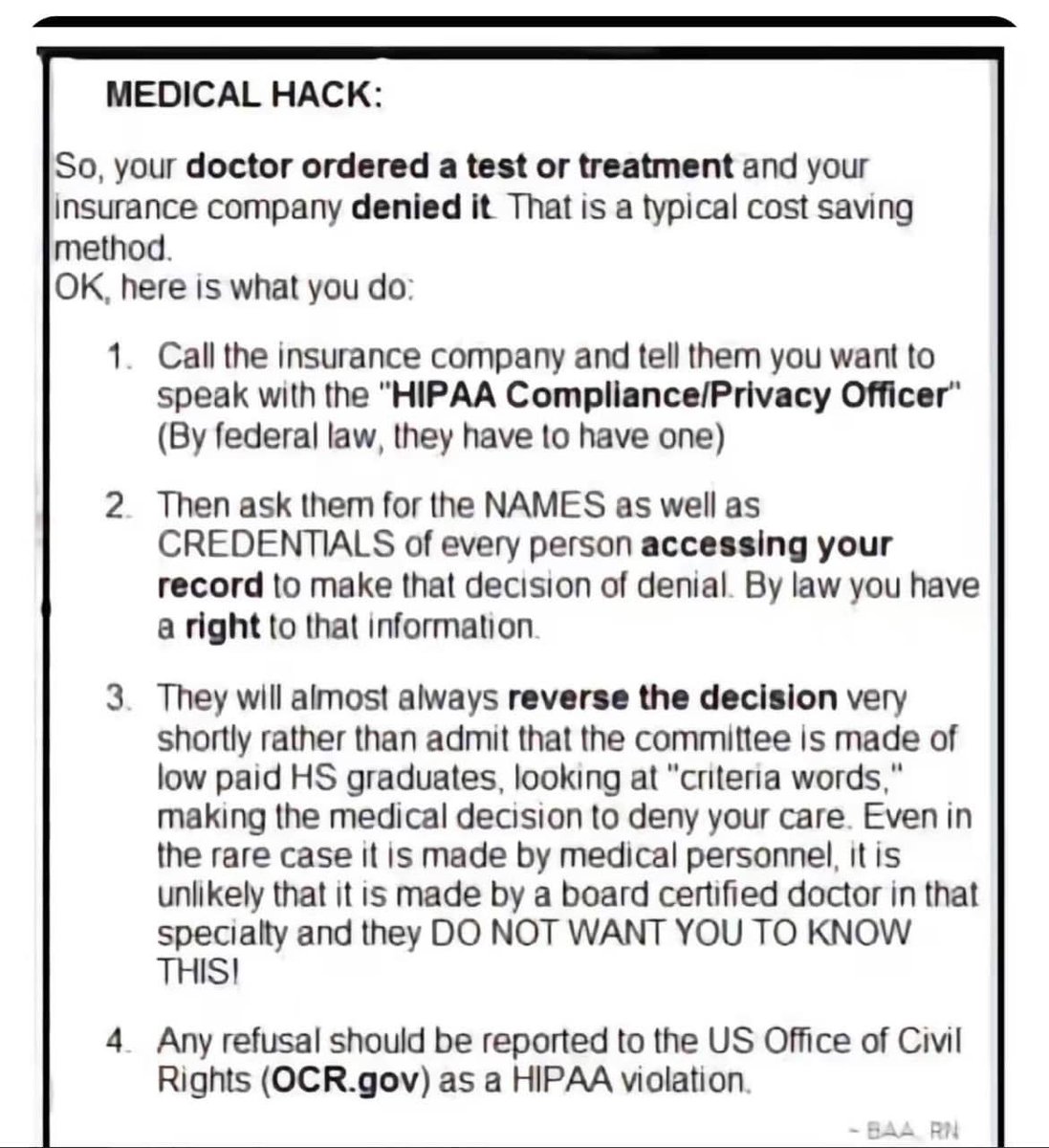
So, your doctor ordered a test or treatment and your insurance company denied it. That is a typical cost saving method.
OK, here is what you do:
1. Call the insurance company and tell them you want to speak with the "HIPAA Compliance/Privacy Officer"
(By federal law, they have to have one)
2. Then ask them for the NAMES as well as
CREDENTIALS of every person accessing your record to make that decision of denial.
By law you have a right to that information.
3. They will almost always reverse the decision very shortly rather than admit that the committee is made of low paid HS graduates, looking at "criteria words." making the medical decision to deny your care.
Even in the rare case it is made by medical personnel, it is unlikely that it is made by a board certified doctor in that specialty and they DO NOT WANT YOU TO KNOW THIS!!
4. Any refusal should be reported to the US Office of Civil
Rights (https://t.co/QJjJAm5BxT) as a HIPAA violation.
Be safe out there 🫵🏻✨
Know your rights 👊🏼
#ThrowbackThursday
The most successful people I know all have an almost irrational belief that everything will work out
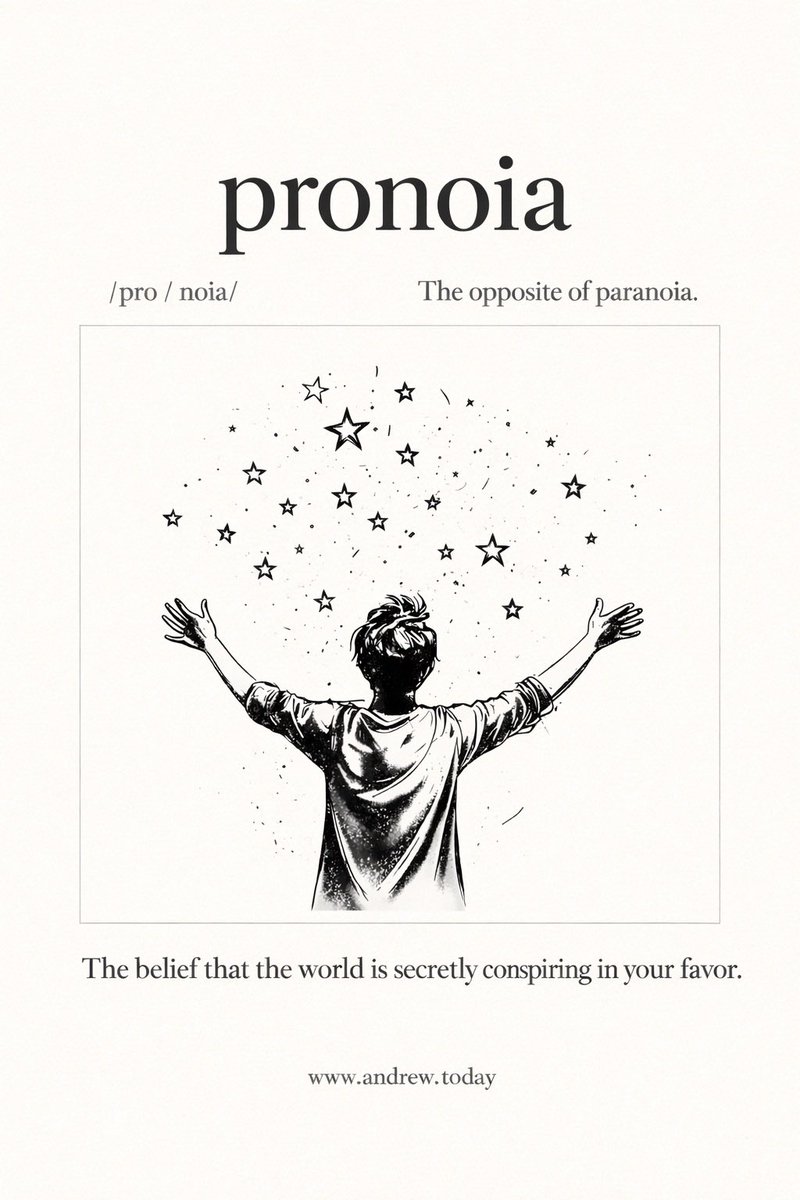
And I just recently learned the word for it: Pronoia.
It means the opposite of paranoia. The belief that the world is secretly conspiring in your favor.
The funny thing about Pronoia is that it's self-fulfilling.
When you believe things will work out, you try harder. You persist longer, and you see opportunities where others see dead ends.
What's that quote again?
"Pessimists sound smart. Optimists make money." – Nat Friedman
We all need a little more pronoia in our lives.
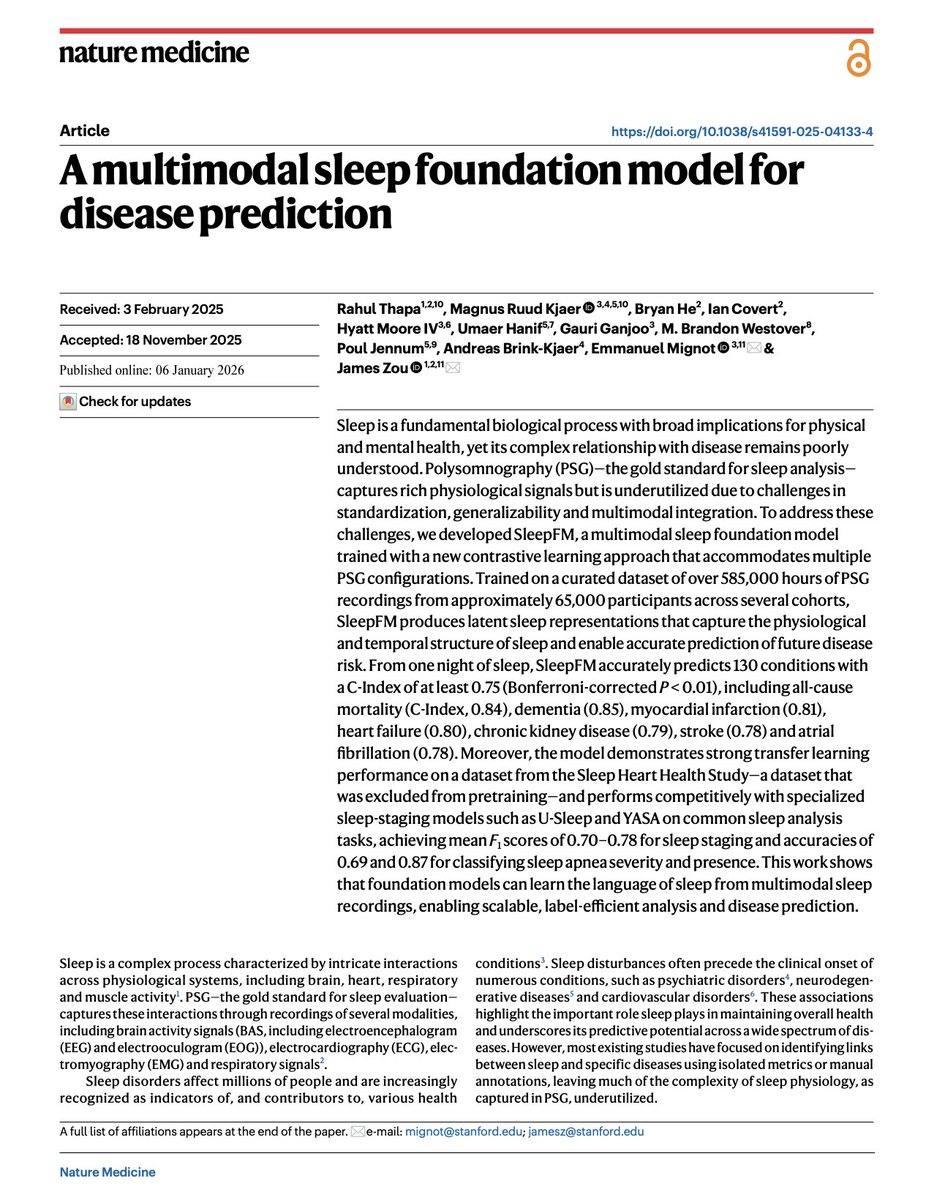
A single night of sleep can now predict 130 future diseases with up to 93% accuracy.
Stanford researchers just released SleepFM.
This is a multimodal foundation model trained on 585,000 hours of physiological data from 65,000 participants.
And it's actually insane: (1/5)
Longevity update: Anti-Aging Injection Regrows Knee Cartilage and Prevents Arthritis
Scientists at Stanford Medicine found that blocking an age-linked protein (15-PGDH) can regrow knee cartilage, reverse joint damage in older animals, and prevent arthritis after ACL-like injuries - without using stem cells.
Early safety trials of a related pill are already underway, raising real momentum for human cartilage regeneration.