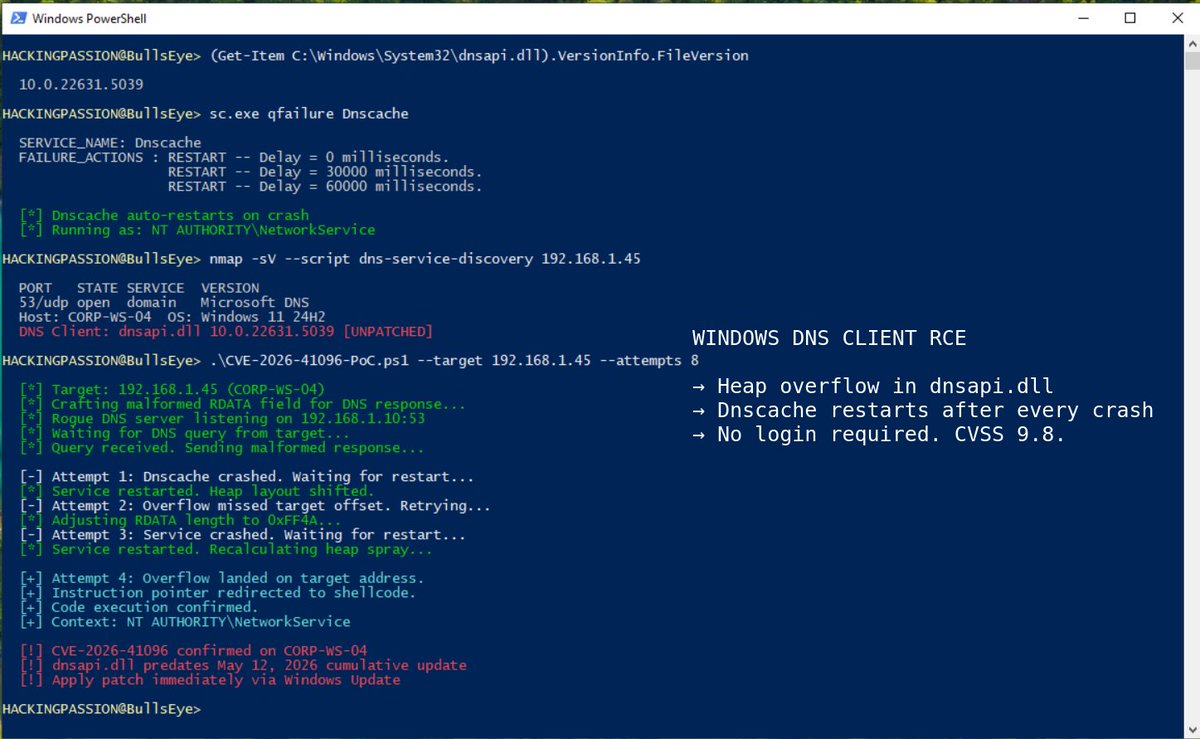
‼️🚨 Microsoft has patched a critical Windows DNS Client remote code execution vulnerability that allows an unauthorized attacker to execute code over a network. All it takes is a malicious DNS response.
The vulnerability is tracked as CVE-2026-41096 with a CVSS score of 9.8. It is a heap-based buffer overflow in dnsapi.dll, the Windows component that processes DNS answers on every machine.
To trigger it, an attacker needs a position where they can influence DNS responses: a rogue DNS server, a poisoned resolver, a compromised router, hostile WiFi, or a man-in-the-middle placement.
That puts ordinary Windows DNS activity in the blast radius. Browsers, VPN clients, enterprise apps, update checks, and background services constantly ask DNS where to connect. The vulnerable processing sits in the Windows DNS Client path, not an edge-facing server product.
Microsoft assessed exploitation as "less likely," and Rapid7 lists the issue as not publicly disclosed and not known to be exploited at release.
On the contrary, a 9.8 unauthenticated network RCE in DNS client handling is exactly the kind of bug defenders should assume will be reverse-engineered quickly.
Defenders should:
- Deploy the May 2026 cumulative updates and confirm coverage across endpoints and servers
- Restrict DNS traffic to trusted resolvers where possible
- Monitor Dnscache and svchost.exe for abnormal child processes or unexpected outbound activity
- Treat public WiFi and untrusted resolver paths as higher-risk until patching is complete
— Вот мой новый VPN сетап. Как вам?
— Ух ты, красивый, вы только посмотрите.
— Только вчера дописал конфиг. sing-box + GeoIP базы Antizapret для сплит-роутинга на клиенте, FakeIP против утечек DNS, Shadowsocks 2022 over Cloak в качестве транспорта. Первый хоп на сервера VK Cloud в России, потом в Нидерланды. Фолбек на коммерческие сервера RedShield через AmneziaWG2.0.
— Оnлично, Бейтман, но всё это пустяки. Смотри. Сплит трафика по приложениям: браузерный трафик идёт через Naive Proxy, тяжёлый трафик — через Hysteria2 с Brutal, на разные VPS, также с мультихопом через Россиию. Telegram через MTProto. Подключено два интернет-провадйера, между которыми роутер переключается по round-robin в случае потери связи. DNS leak исключён за счёт использования DoH к Quad99 и блокировки исходящего трафика на 53 порт. Ну как?
— Красиво. Высший класс. (Не думал, что у него столько вкуса. Не могу поверить, что Брайсу больше понравился стек Ван-Пата)
— Но постойте. Вы ещё ничего не видели. VLESS через Xray-Core с транспортом в виде WebSocket и gRPC — трафик идёт до известных CDN: Cloudflare, NGENIX, Yandex CDN и CDN77, с domain-fronting и ротацией в зависимости от пинга и загрузки. Глобальный фолбек в виде Tor Snowflake (WebRTC) через хоп на резидентный IP в Беларуси, с которым устанавливается параллельный настоящий звонок для маскировки.
— Очень красиво... А покажи-ка VPN Пола Алена.
Какой лаконичный стек... Это же золотой стандарт индустрии... VLESS + Reality + XTLS-Vision + uTLS... И первый хоп подобран со вкусом: белосписочный VPS в Yandex Cloud... Максировка под сертификат Yandex Market из той же подсети, защита от активного пробинга... Боже, даже фолбек есть: нелегальный turn-proxy через абьюз WebRTC звонков Вконтакте...
Se habla de cómo se llegó a la Luna, pero casi nunca de cómo salieron de ella.
La escena es simple: dos astronautas dentro de un módulo del tamaño de un ascensor, sentados sobre la única máquina que podía sacarlos de la superficie lunar. Si ese motor fallaba, no había plan B. No existía un “rescate”. Era despegar… o quedarse ahí para siempre.
El Módulo Lunar “Eagle” dejó atrás sus patas, su base y todo lo que no fuera estrictamente necesario. Solo despegó la parte superior: un cascarón ligero con un motor hipersensible que debía encenderse una sola vez y sin margen de error.
El 21 de julio de 1969, Armstrong y Aldrin activaron el motor de ascenso. No hubo cuenta regresiva épica ni música heroica. Solo un encendido limpio, una vibración corta y el Eagle levantándose en silencio absoluto, dejando una nube de polvo que tardó segundos eternos en asentarse.
Mientras subían, el módulo tuvo que ejecutar una coreografía precisa para encontrarse con el Módulo de Servicio y Mando, donde Michael Collins los esperaba en órbita. Un error de ángulo, de velocidad o de sincronización… y no había segunda oportunidad.
El acoplamiento fue perfecto. Se transfirieron, sellaron la nave, soltaron el Eagle y lo dejaron morir en órbita lunar. Desde ahí, el viaje de regreso a la Tierra ya era “simple”: encender motores, tomar trayectoria y caer en el Pacífico.
Así fue la salida del Apolo 11: nada de tomas hollywoodense, solo ingeniería al límite, un motor que debía funcionar sí o sí, y dos humanos apostando su vida a una chispa exacta en el vacío.
Cet atelier de 30 minutes, animé par le créateur de Claude Code, vous en apprendra plus sur le
vibe-coding que 100 tutoriels vidéo sur YouTube.
Ajoutez-le à vos favoris et consacrez-y 30 minutes dès aujourd'hui.
Cette vidéo transformera votre utilisation de Claude à jamais.
Software horror: litellm PyPI supply chain attack.
Simple `pip install litellm` was enough to exfiltrate SSH keys, AWS/GCP/Azure creds, Kubernetes configs, git credentials, env vars (all your API keys), shell history, crypto wallets, SSL private keys, CI/CD secrets, database passwords.
LiteLLM itself has 97 million downloads per month which is already terrible, but much worse, the contagion spreads to any project that depends on litellm. For example, if you did `pip install dspy` (which depended on litellm>=1.64.0), you'd also be pwnd. Same for any other large project that depended on litellm.
Afaict the poisoned version was up for only less than ~1 hour. The attack had a bug which led to its discovery - Callum McMahon was using an MCP plugin inside Cursor that pulled in litellm as a transitive dependency. When litellm 1.82.8 installed, their machine ran out of RAM and crashed. So if the attacker didn't vibe code this attack it could have been undetected for many days or weeks.
Supply chain attacks like this are basically the scariest thing imaginable in modern software. Every time you install any depedency you could be pulling in a poisoned package anywhere deep inside its entire depedency tree. This is especially risky with large projects that might have lots and lots of dependencies. The credentials that do get stolen in each attack can then be used to take over more accounts and compromise more packages.
Classical software engineering would have you believe that dependencies are good (we're building pyramids from bricks), but imo this has to be re-evaluated, and it's why I've been so growingly averse to them, preferring to use LLMs to "yoink" functionality when it's simple enough and possible.
La nouvelle offre Azure Local permet d’installer, exploiter et administrer une instance Azure Local sans connexion au cloud public Azure. https://t.co/m5IWjeska9