Breaking - Scientists have discovered a technology that turns plants into highly nutritious protein without the need for factories, synthetic chemicals, or seed oils.
When I was a new attendee of a church that encouraged children in the service I struggled with the logistical constraints.
I wise older man came up to me and said “Providentially, we live in the era of podcasts. Don’t focus on taking perfect notes. Focus on loving your kids well in service so that they will joyfully sing the doxology at the top of their lungs at the close of service while their dad holds them. Because one of those things will have an eternal impact.”
My wife and I own Forest Park Pharmacy, and we don't accept insurance. None of it. That decision is exactly why we could fix what happened to a patient today.
A family came in wanting to transfer their kid's antibiotic to us. The child had already STARTED the course. Then, mid-treatment, the insurance company decided the last 14 tablets suddenly needed a "prior authorization" before the other pharmacy could hand them over. A sick kid, halfway through an antibiotic, and the answer was "please hold."
The drug is linezolid. It's a generic. It's been generic for over a decade. It treats serious gram-positive infections — the kind you do NOT want to stop antibiotics in the middle of, because an interrupted course is how you breed resistant bugs and end up right back where you started.
So why the hold-up on a cheap, common generic? Follow the fake math.
Insurance and the PBMs behind them price drugs off a number called AWP — "Average Wholesale Price." People in my industry have another name for it: "Ain't What's Paid." It's a benchmark number, not a real-world cost. On paper, the AWP for just those last 14 tablets is about $2,500.
My cash price for the same 14 tablets? $18.
Read that again. The system that's supposedly "protecting" this family from cost is the same system that inflated an $18 medication into a $2,500 line item, then slapped a prior auth on it to "review the expense" THEY invented. They manufactured the problem, then billed everyone for the privilege of solving it — and made a sick kid wait while they did it.
This is the whole game. When a drug is priced honestly, there's nothing to "manage." When it's priced off a fantasy benchmark, you get spread pricing, PA paperwork, pharmacy phone trees, and delayed treatment — all dressed up as cost control.
Here's the part nobody tells you: roughly 90% of prescriptions are low-cost generics. For the vast majority of what people pick up every day, running it through insurance does two things — raises the real cost and risks delaying your care. That's it. That's the value-add.
That's why we fired the insurance companies. No middleman deciding your kid can't finish their antibiotics on schedule. No fake prices. Just the real number, on the shelf, today.
The medication was always cheap. The insurance was the expensive part.
Water usage has been a hot topic in the AI data center world, but the numbers may surprise you.
According to the Manhattan Institute, data centers use 0.2 percent of daily water usage in the U.S. and that number has dramatically decreased in the past few years due to a new method: liquid cooling.
By moving to 45°C liquid cooling, AI factories in favorable climates can use dry coolers instead of conventional cooling-tower-based systems, cutting facility cooling water use from roughly 2.6M gallons per MW per year to near zero.
Liquid cooling enables AI factories to be both water and energy efficient, while creating opportunities for heat reuse and dispersal to local communities, allowing these factories to become energy grid assets.
Learn more below ⬇️
https://t.co/7WanoPNKTR
Comparing the California High Speed Rail to Elon Musk’s SpaceX
This is how criminally inefficient California's bureaucracy has become
- The California High-Speed Rail Authority is 6 years older than SpaceX
- Total private funding for SpaceX was $12 billion, whereas California's high-speed rail is projected to cost $231 billion by the time it's completed (That's 2,000% more funding than SpaceX had)
In the same amount of time, California has laid zero miles of high-speed rails while SpaceX has developed a reusable rocket, delivered astronauts and saved astronauts from the International Space Station, and as of today has a $2.5 trillion market cap
Elon Musk will literally have been able to send people to Mars at a fraction of the cost and at a fraction of the amount of time that it's taken Gavin Newsom just to send Californians up the coast
My friend Da Yu left communist China for the USA twenty years ago. Last week, his American employer gave him one hour to delete his comment on a friend’s social media post or lose his job.
Da was an atheist when he first moved to Cincinnati for college. And he was excited to get away from the suffocating regime of communist China.
When he arrived here, it wasn’t long before he encountered a group of Christians who shared the gospel with him. God opened his heart to the truth of the gospel and he believed.
As his faith grew, Da became a strong Christian leader and committed evangelist. Now, many years later, he leads a small group at my church and organizes regular evangelistic outreaches for college students.
Da is a kind, smart, and godly Christian man. And he’s among the most committed members of our church. He’s an ordinary Christian who believes the Bible and has a spine. He and his wife have two young children, and she is eight months pregnant with their third.
That’s all background for what I’m about to say.
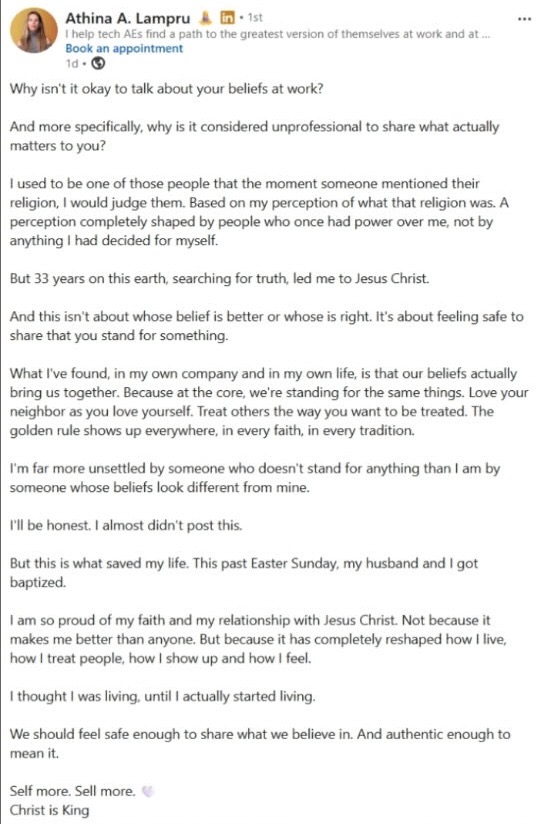
Last week, he called me out of the blue because he was faced with a difficult decision. One of his friends had just become a Christian and posted on LinkedIn about her baptism (see screenshots).
She wasn’t accustomed to making Linked In posts about Jesus, feeling as though it might be unprofessional. She wondered openly if she should keep her posts secular. But she was excited about her new life in Christ and wanted to share it.
That’s when Da chimed in with a comment on her post that there is no such thing as a purely neutral, “secular” culture. He pointed out that many companies are promoting cultural sins such as homosexuality, transgenderism, and fornication during pride month. If companies can promote those morally regressive “values,” then certainly this woman should not be embarrassed to talk about her Christian faith in public. He was simply encouraging her to be bold for Christ.
WIthin minutes, he got a message from HR. He was called to a meeting with the HR rep and the CEO where he was told he needed to take his comment on her post down immediately. Feeling put on the spot, he said he’d needed to think it over first. He asked, “what if I do not take it down?”
They said, “you have one hour to take it down or lose your job.” So he took a walk outside to gather his thoughts and pray. He spoke to his wife about it, and she told him the man she married was a man of courage, and she would stand by him. He also sought counsel from some men in our church.
Finally, he made his decision. He would not take his comment down. So they fired him. Right there, on the spot. No sooner had the call ended that his laptop was locked and he was unable to access it at all.
This whole episode is tragically ironic, given the fact that he’d moved here from China to get away from these sorts of draconian practices. But that’s the way it is with the LGBTQ regime. If you do not comply and bow the knee to their gods you will be severely punished.
In short, a good man was fired from his job for refusing to cave. He took a stand and paid a price for it. His former employers didn’t care that he’s a responsible, hard working man with a family to provide for. They didn’t care that his wife is eight months pregnant.
None of that matters. Their ideology is everything. They will crush anyone who opposes it.
I asked Da’s permission to tell his story, promising to keep him anonymous. But he responded, “Actually I think using my real name maybe better. A story becomes a lot more real with a name. I want to take a stand for it and encourage others.”
Da took a stand. You can too.
RFK Jr. says HHS is working to find a cure for Alpha Gal.
The tick disease that can make you allergic to red meat for life.
“One bite from a lone star tick, and you could have a lifetime allergy to red meat.”
“50% of the population of Martha’s Vineyard now has alpha gal.”
“We’re also working on medicines that can prevent Alpha Gal and have the promise of actually curing it.”
“One of those medicines is almost ready.”
“We’re fast tracking it.”
“We’re doing the studies over the next two years to see if we can actually reverse this devastating disease.”
Thank you Bill Gates…
🚨 RFK JR says it’s no longer safe for Americans to go into the Woods Anymore due to Lyme Disease
“One of the real tragedies now is that American’s can’t go into the woods anymore safely— and going to the woods to hike, to fish, to hunt, to photograph, or just a walk in the woods is part of the seminal experience of being an American, and particularly an American child— and it’s now a science fiction nightmare we now live in.”
https://t.co/rbVfFFDl69
He won the case. Then state police showed up at the farm.
Amos Miller. Bird-in-Hand, Pennsylvania. January 2024 — troopers raided his Amish farm over raw milk. Brought a permit limiting what he could sell. Two products only.
He handed it back.
Appeals court ruled for him in 2025. He can ship across state lines to members of his private food club. The lawsuit is still active. The in-state ban never lifted.
The families ten minutes down the road still can’t buy from him directly.
The ruling didn’t reopen local sales.
You live ten minutes from that farm. Would you have bought from him?
Sources: LancasterOnline — Jan. 2024 | Food Safety News — Jan. 2025 | Lancaster Patriot — Jan. 5, 2024
I just want to remind everyone that they wont let you drink or buy raw milk but they allow foreigners in every major city in the country to cook street food without licensing in the filthiest conditions you've ever seen without batting an eye.
DATA CENTER DOOMERS: Elon Musk’s data center in Memphis is the model of how a hyperscaler can significantly improve the community it occupies. The fact Democrat-aligned, foreign-funded NGOs are trying to shut it down is proof this isn’t about water, electricity, or pollution.
@worldpursuit1@Jason______A That’s interesting. I have considered switching to T-Mobile from Mint because of the extreme deprioritizing. It only happens occasionally but it’s bad when it does.
What’s the difference in cost? And is deprioritizing the only difference?
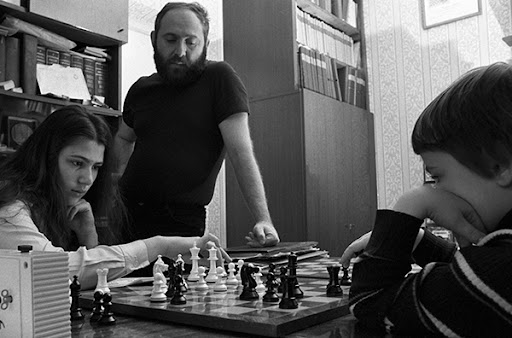
A Hungarian psychologist raised three daughters to prove that any child could become a chess grandmaster through early specialization. He succeeded. Two of them became grandmasters. One became the greatest female chess player who ever lived.
Then a sports scientist looked at the data and found something nobody wanted to hear.
His name is David Epstein. The book is called "Range."
The Polgar experiment is one of the most famous case studies in the history of deliberate practice. Laszlo Polgar wrote a book before his daughters were even born arguing that geniuses are made, not born. He homeschooled all three girls in chess from age four. By their teens, Susan, Sofia, and Judit were dominating tournaments against grown men. Judit became the youngest grandmaster in history at the time, breaking Bobby Fischer's record. The story became the gospel of early specialization. Pick a domain young, drill it hard, and you can manufacture excellence.
Epstein opens his book by telling that story honestly and then quietly demolishing the conclusion most people drew from it.
Chess works that way. Most things do not.
Here is the distinction that took him four years of research to articulate, and that almost nobody who quotes the 10,000 hour rule has ever read.
There are two kinds of environments in which humans develop expertise. Psychologists call them kind and wicked. A kind environment has clear rules, immediate feedback, and patterns that repeat reliably. Chess is the cleanest example. Every game ends with a winner and a loser. Every move is recorded. The board never changes shape. The pieces never invent new ways to move. A child who plays ten thousand games will see most of the patterns that exist in the game, and pattern recognition is exactly what chess mastery is built on.
A wicked environment is the opposite. Feedback is delayed or misleading. Rules shift. The patterns that worked yesterday may be exactly the wrong patterns to apply tomorrow. Most of the real world looks like this. Medicine is wicked. Investing is wicked. Building a company is wicked. Scientific research is wicked. Almost every job that involves a complex changing system with humans in it is wicked.
The Polgar sisters trained in the kindest environment any human can train in. Their success was real and the method was correct. The mistake was generalizing the method to fields where the underlying structure of the environment is completely different.
Epstein's research is what made the implication impossible to ignore.
He looked at the careers of elite athletes outside of chess and golf and found that the pattern was almost the inverse of what people assumed. The athletes who reached the very top of their sports were overwhelmingly people who had played multiple sports as children, specialized late, and often switched disciplines well into their teens. Roger Federer played squash, badminton, basketball, handball, tennis, table tennis, and soccer before tennis became his focus. The kids who specialized in tennis at age six and trained year-round for a decade mostly burned out, got injured, or topped out at lower levels of the sport.
The same pattern showed up everywhere he looked outside of kind environments. Inventors with the most patents had worked in multiple unrelated fields before their breakthrough work. Comic book creators with the longest careers had drawn for the most different genres before settling. Scientists who won Nobel Prizes were dramatically more likely than their peers to be serious amateur musicians, painters, sculptors, or writers.
The skill that mattered in wicked environments was not depth in one pattern. It was the ability to recognize when a pattern from one domain applied unexpectedly in another. That kind of thinking cannot be built by drilling a single subject. It can only be built by accumulating mental models from many subjects and learning to move between them.
The deeper finding is the one that should change how you think about your own career.
Specialists in wicked environments often get worse with experience, not better. Epstein cites studies of doctors, financial analysts, intelligence officers, and forecasters showing that years of experience in a narrow domain frequently produce more confident judgments without producing more accurate ones. The expert builds elaborate mental models that feel comprehensive and turn out to be increasingly disconnected from the actual structure of the problem. They stop noticing what does not fit their framework. They mistake fluency for understanding.
Generalists do better in wicked domains for a reason that sounds almost mystical until you understand the mechanism. They have less invested in any single mental model, so they abandon broken models faster. They are used to being a beginner, so they are not threatened by the discomfort of not knowing. They have seen enough different domains that they can usually find an analogy from one field that unlocks a problem in another. The technical name for this is analogical thinking, and the research on it is one of the most underrated bodies of work in cognitive science.
The single most useful sentence in the entire book is the one Epstein puts almost as a throwaway.
Match quality matters more than head start.
A person who tries six different fields in their twenties and finds the one that genuinely fits them will outperform a person who picked one field at fourteen and stuck to it on willpower alone. The lost years were not lost. They were the search process that produced the match. Every field they walked away from taught them something they later imported into the field they finally chose.
The reason this is so hard to accept is cultural, not empirical. We tell children to pick a path early. We reward the prodigy who knew at six. We treat the late bloomer as someone who failed to launch on time, when the data suggests they were running an entirely different and often more effective optimization process underneath.
The Polgar sisters were not wrong. The conclusion the world drew from them was.
If your environment is genuinely kind, specialize early and drill hard. If it is wicked, and almost every interesting human problem is, then the people who win are the ones who refused to specialize until they had seen enough to know what was actually worth specializing in.
You are not behind. You were running the right experiment all along.