@KathrynPorter26@pippaheylings These people who understand little about markets or supply / demand keep making idiotic comments.
3pct more supply will always move prices lower all else being equal.
Imagine if the Britain they dreamed up after the war had actually got built.
Norway sold us 69% of the gas we imported last year, out of the same North Sea we sit on. France sent us 21.9 TWh of electricity down a cable, most of it nuclear. We opened the world's first commercial nuclear power station in 1956 and now rely on another country to run the tech for us.
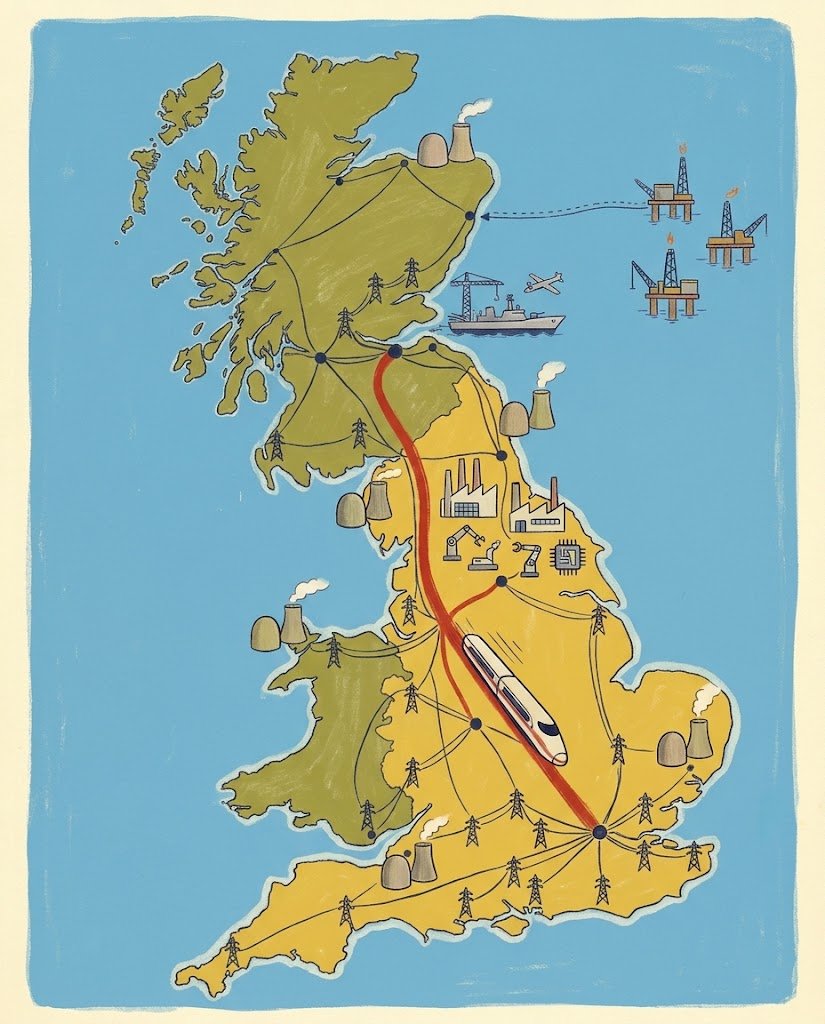
Spent the morning thinking about what the modern version looks like. Edinburgh to London in about 1 hour 50, which is what you'd get running trains at Chinese speeds over 534km. It's 4 hours 10 at best right now. China built the Beijing to Shanghai line, 1,318km, in 3 years. HS2 is 225km, started digging in 2017 and might open in 2037 lol.
Factories back in the north building chips and robots instead of us importing them. Scotland doing military tech out of Glasgow and Rosyth. Enough nuclear that electricity stops being a topic, a grid that can actually carry it, and our own oil and gas paying for it all whilst we get there.
None of this is sci-fi either. Korea builds the same reactor over and over and it gets cheaper every time. We build one, take 20 years over it and it costs £48bn.
@GBPolitcs Of course Jim is right. The U.K. has a cost problem.
1) The human capital cost base
2) The energy input cost
Capital around the world will continue to find a better ROI with less risk.
Britain has an infrastructure costs problem. But what's causing this and how can we fix it?
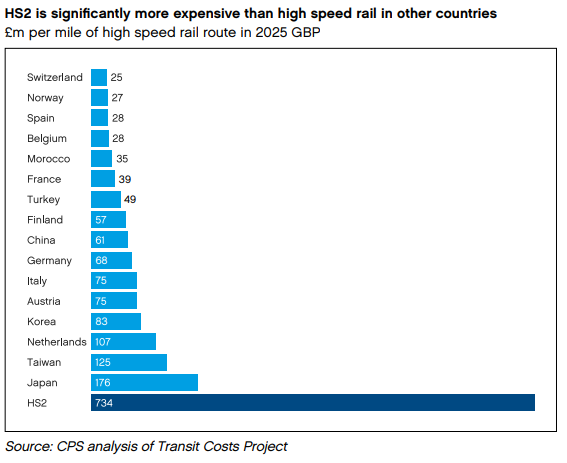
HS2 will cost up to £102.7bn for 140 miles. Spain built the second longest high speed network in the world, 2,500 miles, for less.
It isn't just HS2 though.
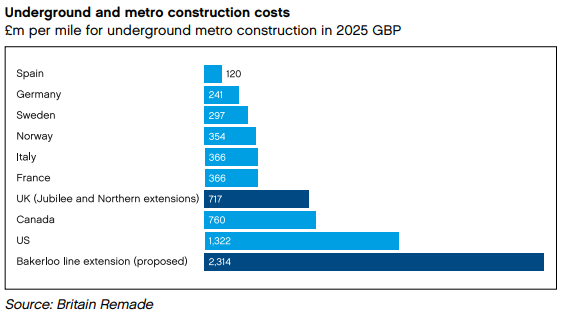
Underground extensions cost twice the per-mile average of France or Italy, and six times Spain's.
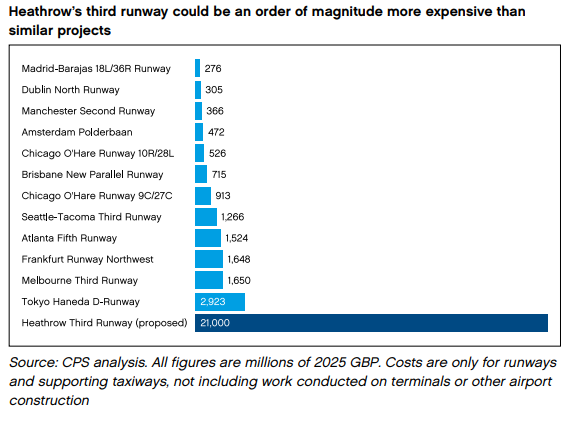
Heathrow's third runway, excluding new terminals, is expected to cost 10 to 70 times more than other runways.
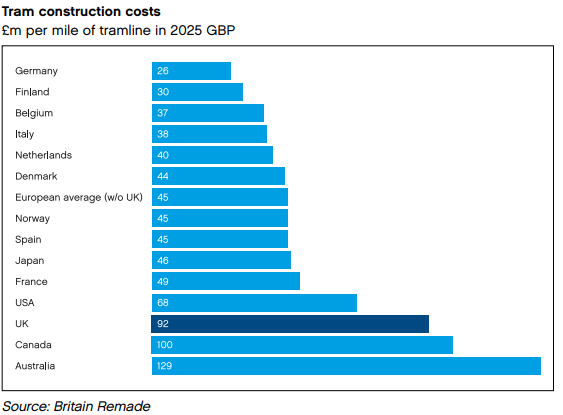
British trams cost more than double the European average.
Why are these projects so expensive? There are eight key reasons:
1. Planning: it took 14 years, £300m, and 360,000 pages for the Lower Thames Crossing to go from being designated a national priority to receiving permission.
2. Environmental and Habitats Regulations: these gave us the £216m bat tunnel and the fish disco, as well as an 18,000 page environmental statement to re-open just 3.3 miles of railway on an existing alignment.
3. Judicial review: of 36 legal challenges to approved major projects, only four forced a re-decision. All four were approved again, but fighting a legal challenge can add £120m+ to a project's cost and mountains of paperwork.
4. Funding: the Treasury pays, but cannot directly control a project's spend, so it instead requires long business cases. Once given funding, promoters don't have the incentive to build more cheaply.
5. Procurement: currently generalist teams rely on consultants and are more focused on social value than past performance and value for money.
6. Regulation: quangos and departments create regulation that they don't bear the costs of. E.g. new tram projects must pay for 92.5% of the cost of moving utilities, which means utility companies demand a completely new set of pipes and wires.
7. Lack of state capacity: Madrid trebled its metro at a tenth of London's cost led by nine in-house engineers. The DfT has the second highest staff turnover of any department and cannot effectively oversee a project from design through construction.
8. Centralisation: Mayors cannot fund and approve their own infrastructure. If they could, they'd have strong electoral incentives to build quickly and cheaply, as seen in France and Spain.
The good news is that every one of these is a policy choice, which can be reversed. Some fixes need only a letter from the right minister and none require significantly more spending.
My new @CPSThinkTank report lays out these fixes and how to lower infrastructure costs. If we implement them, Britain could once again build the infrastructure it desperately needs. https://t.co/GumxPETBEc
Andrew Neil’s Brexit reality check on BBC Question Time.
In a nutshell:
Rejoiners are ignoring the huge political wind of change sweeping Europe and the UK v Germany/ France/ Italy growth rates make a nonsense of their Mickey Mouse economic arguments too.
#bbcqt
With the UK continental shelf running out of oil and gas, the North Sea economy is on life support.
On the North Sea Transition Authority’s projections, combined oil and gas output will fall a further 40 per cent between 2024 and 2030, and by 93 per cent by 2050.
@Frencheconomics And just wait for the jobs data as the “workers rights” bill becomes law in Jan.
Exactly the same motives and I suspect the same outcome.