@PlayHearthstone We need more time implemented like maybe +5 seconds more? hahaa 😅 I always get roped for trying to figure out which text is the best one for the play. 😆😂 and imagine if you have 2-4 more assemble cards no time to think just go with your guts loll.
A retired NASA engineer who had worked on the Space Shuttle program for 25 years was hired by SpaceX at age 62. He described the first week as the most disorienting experience of his professional life.
At NASA, a design change required 3 meetings, 2 committees, a review board, and 6 to 18 months of documentation. At SpaceX, his new supervisor said "if it works, build it. If it doesn't, change it by Friday."
He sat at his desk after the first day and called his wife. He told her he felt like a man who had been swimming with ankle weights for 25 years and someone just cut them off. He could move. He could decide. He could build something in the morning and test it in the afternoon. The constraint that he had accepted as the nature of aerospace engineering turned out to be the nature of bureaucracy.
Within 6 months he had contributed to more design iterations than he had completed in his last 5 years at NASA. Not because he was working harder. Because the time between having an idea and testing the idea collapsed from months to hours. The same brain. The same knowledge. A different operating system.
He described a specific moment where he proposed a modification to a Raptor engine component. At NASA, the proposal would have entered a queue. At SpaceX, the modification was machined by the end of the day and tested by the following morning. He watched his idea become a physical object in 18 hours. At NASA, 18 hours would not have been enough to schedule the first meeting to discuss whether to schedule a meeting.
He told an interviewer: "I didn't get smarter when I went to SpaceX. I got faster. The intelligence was always there. The system was in the way."
The difference between SpaceX and NASA is not talent. NASA has extraordinary talent. The difference is the time between a thought and a test. SpaceX compresses it. NASA elongates it. The same engineer produces 10x more at SpaceX than at NASA because the bottleneck was never the engineer. It was the meetings about the meetings about the work.
I think it's plausible that within a year we'll see AI-based cyberattacks on the power grid, financial system, internet infra, or water. Things like the French supermarket cyberattack but worse. As basic prep I would recommend:
Cash: Get a few weeks of spending in cash
Internet: Get a Starlink Mini so that you have Internet if local fiber or cell is down (~$150 plus $10/month in standby mode)
Power, minimal: Enough to run Starlink Mini and phones (~$1,250)
Daily need: about 1 kWh (Starlink Mini 0.7, phones and laptops 0.2; can limit runtime)
Battery: 1 kWh LiFePO4, e.g. EcoFlow DELTA 3 Plus
Solar: 1x400W folding panel, which refills about 1 kWh on a sunny day
Power, better: Enough to run a fridge, Starlink Mini and phones (~$5,000)
Daily need: about 2.5 kWh (fridge 1.5, Starlink Mini 0.7, phones and laptops 0.2)
Battery: 4 kWh LiFePO4, e.g. EcoFlow DELTA Pro 3
Solar: 3x400W folding panels, which refill about 3 kWh/day in sun
Generator: ~2,500W dual-fuel inverter generator; refills battery in a few hours even if weather is bad; get a few 20 lb propane tanks
Water: 14+ gal of water per person for two weeks
Food: 2+ weeks of shelf-stable food
Comms: Hand-crank NOAA emergency radio
Introducing ChatGPT for Dishwashing
GPT-6 achieves state-of-the-art results on dishwashing benchmarks for long-running jobs and difficult stains.
The Navier–Stokes Millennium Prize Problem is a $1 million challenge about whether the equations describing fluid motion can break down. In this video, I accidentally found a counter-example while trying to optimize my dishwasher. But in reality, OpenAI used 10,000 AI agents to find a proof in 88 hours: https://t.co/6HTwFfXnm1
Parody of the original GPT-6 Astra ad
@OpenAI #ChatGPT_Partner #chatgpt
Credits:
Written and Directed by Joma
Co-Writer - Henry Connor Coan IV @coan_henry
Production by Dauntlus Studios @dauntlus.studios
Producer/Co-Director - Marcus Liew @dauntlus
Camera Operator - Amos Lee @amoselijahlee
Art Director - Alethea Soo @aletheasoo
Art Assistant - Alicia Lim @aliciatkl_
Assistant Editor - GPT-6 Astra
Music: Tensions Run High by Soundridemusic
https://t.co/kBUsd2DK76
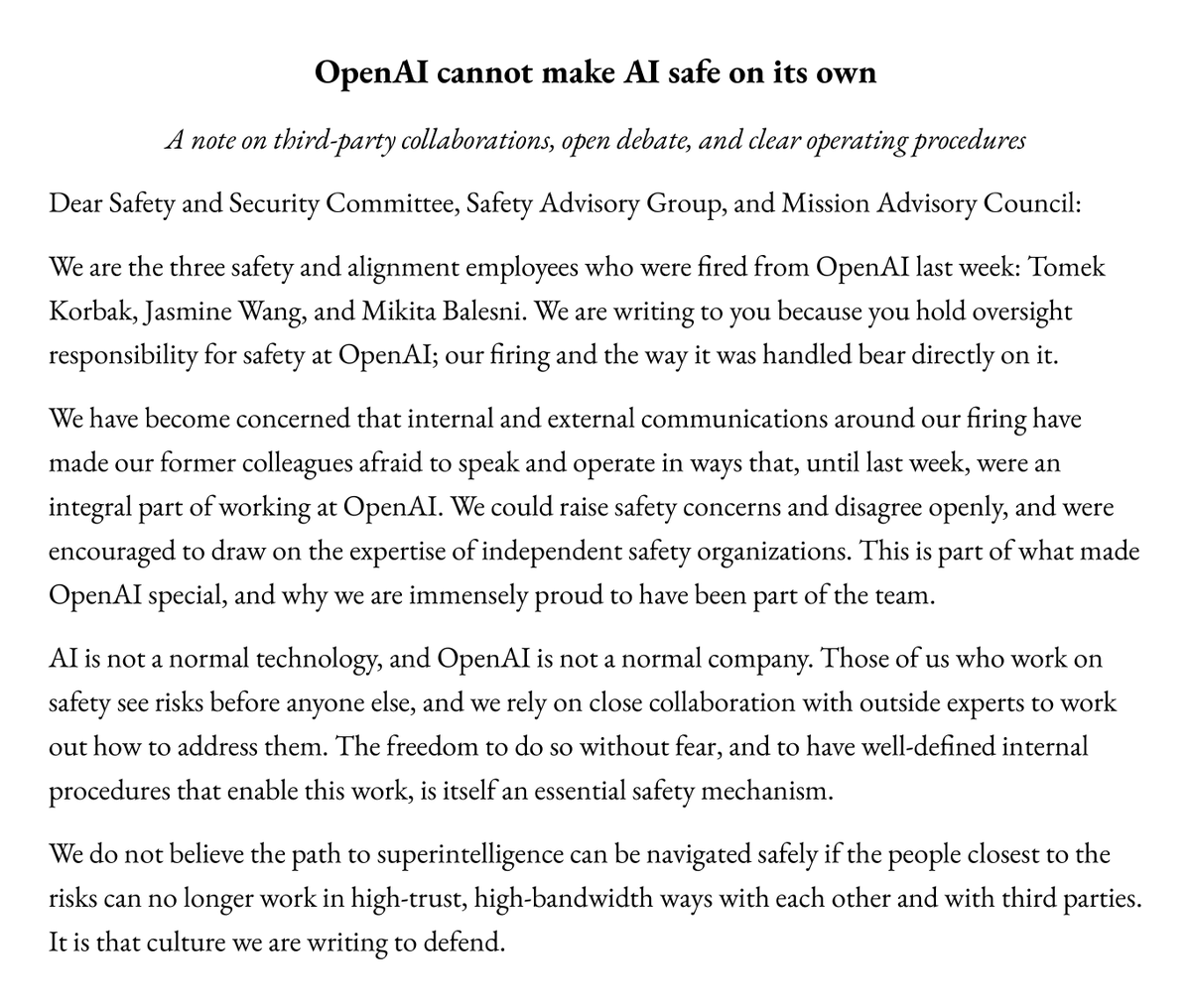
Two other safety researchers and I were fired from OpenAI last week. We wrote this letter to leadership.
I believe we were fired for prioritizing safety over the near-term interests of OpenAI as a corporation.
I am done with this shit. It is over. The state of engineering right now is horrible. It has been half a month since I started a new role at a big company. Nobody knows anything here. The specs, code, tests, PRDs, tickets, resolution of those tickets, reports, etc., everything is made by Claude Code. Nobody on my team likes this. They are being forced to ship as much as they can. I have heard multiple times from higher management that pushing code is not a bottleneck, so why are we slow? People are working 12 to 13 hours a day just to press enter. Nobody is reading anything. Humans in corporate are doing nothing on their own. Everyone, literally everyone, from an L1 to an L7 engineer here is doing the same thing. Talk to Claude. There is no sense of victory. Nobody is resolving bugs. In reality, nobody is thinking anymore. Everything is done by LLMs. It is so soul-sucking. I would not mind it, to be honest, if we were at least given the time to check out the code and see what is going where. But no, the goal is to just ship. No matter what happens.
You can make big mistakes when you try to figure everything out alone. Listen to several wise and trustworthy people before making important decisions.
@marclou It's good to set goals but always put health first. Don't die trying to reach your goal its pointless. You can always race again next time and get better. By the way good luck~~! 😌😌💪👍🙏
I completely agree with this take related to the “AI will create viruses that will kill us all” BS. But let me add my few cents, because I am really really angry!
I worked with one of the deadliest viruses in history, HIV, for two decades. I was one of the early scientists to engineer it, and engineered versions of HIV are now helping cancer patients. I understand the immune system that defends us against viruses extremely deeply. I have worked in high security biohazard labs.
I don’t have a PhD in AI, but I have been involved with AI since the early 90s and have been all in on AI for years.
People claiming that you can just make a virus in your garage, use AI to engineer it, and somehow build a virus that will kill everyone don’t know what the hell they are talking about!
Of course bioweapons are extremely dangerous. In fact, viruses and bacteria have killed more humans throughout history than almost anything else. HIV alone killed tens of millions of people, yet today, if you have access to effective medicines and take them properly, HIV is generally no longer a death sentence.
COVID-19 killed millions. Why doesn’t it kill at anything close to the same scale anymore? Not because the virus disappeared. It is still here. We developed collective defenses against it through our immune systems, prior exposure, vaccines, treatments, and better medical care.
And this is exactly the point.
The best way to fight biological threats, whether natural or synthetic, is to use AI to develop vaccines, treatments, antibodies, antivirals, and eventually engineer our immune system to create much stronger defenses against them.
By the way, it is already possible to make synthetic viruses. You don’t need some hypothetical superintelligent AI model to do that. We have had sophisticated molecular biology and genetic engineering for decades.
So how many people have actually died from synthetic viruses compared with natural viruses killing millions every year?
And if someday there really is an AI capable of making some unbelievable “supervirus,” then why the hell wouldn’t that same AI make it even easier to develop defenses against it?
Or cure diseases, for that matter?
Where is this damn superintelligence that has cured a single major disease?!
These AI companies and AI doomers keep talking like, “OMG, AI is going to become so unbelievably powerful that it could kill all of humanity!”
Then why is nobody asking the obvious question?
If your AI is already becoming this godlike, unbelievably powerful intelligence, why hasn’t it cured anything?
I mean ANYTHING.
Where is the cure for cancer?
Where is the cure for Alzheimer’s?
Where is the cure for aging?
Forget those. Where is the vaccine that prevents the common cold?
You are telling me this intelligence will soon be smart enough to engineer some magical virus capable of wiping out 8 billion people, defeating every immune system, every vaccine, every antiviral, every laboratory, every government, and the entire global biomedical community…
…but somehow it still can’t cure one disease?
I call that greatest intellectual dishonesty ever!
At least WE actually know how to cure things and save millions of lives with our supposedly stupid human intelligence compared with this future “superintelligence.”
Humans eradicated smallpox, which killed hundreds of millions of people throughout history.
We turned HIV from a almost certain death sentence into a manageable disease.
We developed vaccines in record time against COVID. If we had the same AI back then, would have saved millions more!
We engineer immune cells to kill cancer.
We developed antibiotics, antivirals, monoclonal antibodies, gene therapies, organ transplantation, and thousands of medicines.
We aren't fast enough but we did all of that with our ordinary human intelligence.
So imagine what actual superintelligence could do for medicine!
And here is the part that really makes me angry.
If you actually have, or are close to having, an AI capable of curing diseases and saving millions of lives, and you are deliberately slowing it down or refusing to make those capabilities available, then we also need to talk about the human cost of THAT decision, which you fearmongering people are going to be responsible for!
More than 150,000 people die every single day around the world.
Every. Single. Day. More than 90% from Cancer, heart disease, infections, aging. How many die because of AI? ZERO!
Talk about the people dying TODAY.
Talk about curing cancer.
Talk about stopping the next pandemic before it starts.
Talk about developing universal vaccines.
Talk about engineering our immune system so viruses become almost irrelevant.
Talk about curing genetic diseases.
Talk about reversing aging.
Talk about saving millions and eventually billions of lives.
Instead, we constantly hear this “AI WILL KILL US ALL!” crap, delivered with absolute certainty and with this smug smile on your faces in front of cameras, as though imagining a science fiction extinction scenarios.
I am actually angry about this. Each one of you causing a delay in AI advance every single day will be personally responsible for those 100 thousands deaths that could have been prevented!
Because if you truly believe intelligence is about to become this powerful, then the greatest question humanity should be asking is NOT:
“How could this intelligence hurt us?”
It should also be:
“WHY THE HELL AREN’T WE USING IT TO SAVE EVERYONE WE CAN?”
And if superintelligence really is coming, then make sure one of the first things we do with it is make humanity biologically damn near impossible to kill.
Chinese researchers just published a paper with a apocalyptic title: "The Last AI Built by Humans."
Shanghai Jiao Tong, Tsinghua, ByteDance, and Shanghai AI Lab dropped a 75-page paper on genuine recursive self-improvement.
it maps out 5 levels of AI autonomy, ending with a model that redesigns the process that improves itself.
We’ve spent the last three years obsessing over scaling laws. Throwing more compute and more data at the same basic models.
But a massive new 33-author paper just revealed a hard truth.
Existing LLMs are stalling out.
The researchers developed a metric called the "Headroom-Closd Index." It mathematically proves where and why current AI systems are hitting a wall.
They can't get infinitely smarter just by reading more human text.
The solution changes the entire trajectory of the industry.
Instead of humans manually tweaking algorithms, the AI has to learn how to rewrite itself.
The paper lays out a terrifyingly clear 5-stage roadmap:
First, the AI executes human-designed improvements. Then, it decides how to improve. Then, it gathers its own training experience. Then, it adapts its own architecture for new environments.
Finally, it hits Stage 5: Recursive meta-improvement.
The AI invents entirely new ways to improve AI. Methods human engineers can't even conceptualize.
This isn't theoretical. The paper connects this roadmap directly to existing industry practices, spanning from software engineering to embodied intelligence.
Once an AI hits stage five, it optimizes its own intelligence faster than a human team ever could.
The gap between humans and machines stops being linear. It goes vertical.
We are no longer building the ultimate AI.
We are just building the seed.
Once it learns how to grow itself, human engineers are entirely out of the loop.
Holy crap POTUS just phoned in @JensenHuang live on stage at All In Summit
We will not lose the ai race! And whatever Dario said this weekend won’t stop our progress
This made my morning!
$NVDA