The @ceu Cognitive Science Department is recruiting PhD students for Fall 2026! Come apply by February 4th for four years of fully funded studies: https://t.co/QG3oWLB7lR
Impression formation and reputation management take some recursive mind-reading. We easily ascribe reputational motives to others: “they did it to impress me”; and we anticipate that others might interpret our choices as driven by such motives (which takes four recursive steps).
🦉New paper out in Evolutionary Behavioral Sciences with @heintz_c, in which we connect the evolution of recursive mind reading with the task of prosocial reputation management in a partner choice ecology. A quick summary: (1/5)
I am very excited to share with you the news that our book ‘The Evolution of Techniques: Rigidity and Flexibility in Use, Transmission, and Innovation’ is coming out in exactly 2 months.
https://t.co/iyehWl6bvX
1/5
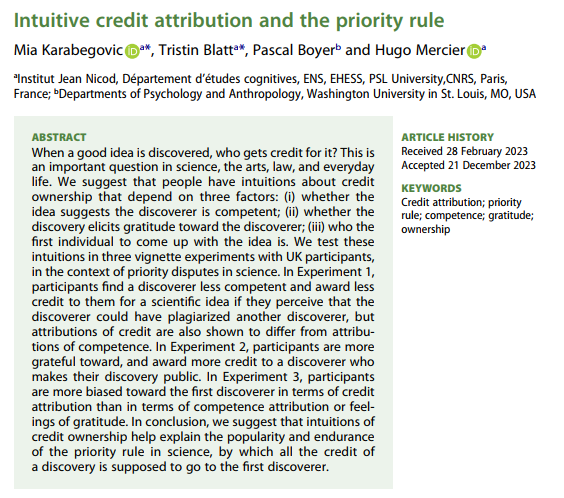
🦉New paper with Tristin Blatt, @PascalBoyerUSA and @hugoreasoning, in which we show that perceived competence of a discoverer, gratitude towards them, and intuitions about ownership (first contact) affect credit attributions in science. https://t.co/B8oQhUoOG4
Sometime, the relevant alternative intention is epistemic. Caring for others sometimes implies paying attention to information with which to make better—more prosocial—choices. (4/4)
Are epistemic actions subject to moral evaluation? At first sight, no: their intended consequences are on beliefs, not on the welfare of others. But in fact, yes: People do express moral disapproval by saying things like: “you should have checked!”.🧵
https://t.co/XbcFHu4RXl
We argue that ascription of responsibility results from counterfactual thinking that reveals what alternative intentions would have caused a better outcome. (3/4)
Happy to share our recent publication with my wonderful co-authors and mentors, Harriet Over and Malinda Carpenter in the Journal of Experimental Child Psychology. Open data, and open access for another 3 weeks! As usual a mini 🧵👇https://t.co/ikAPPEWB7o
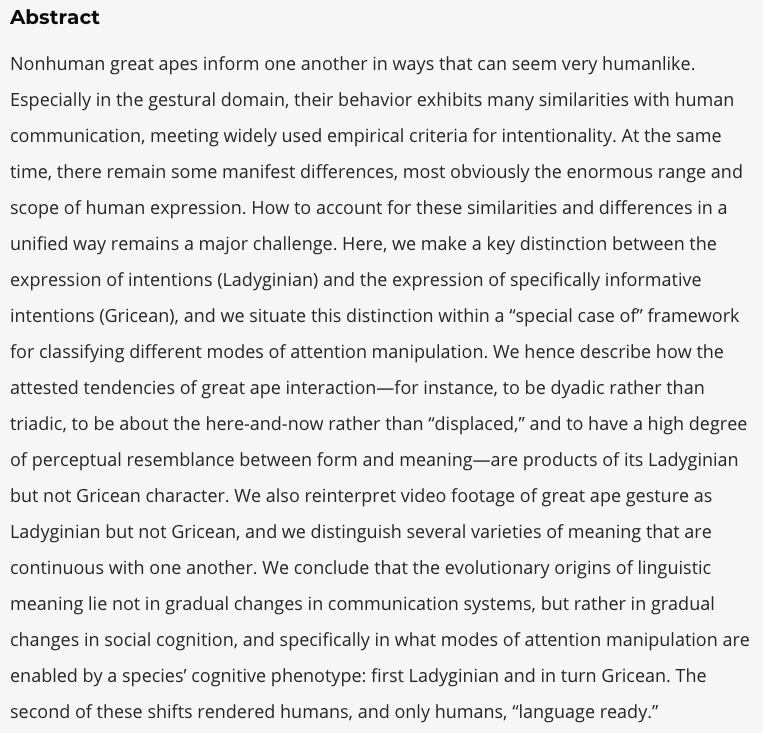
Our review of animal communication is now formally published in Annual Review of Linguistics. Open access :)
We (me & @heintz_c) conclude that evolutionary continuity between humans and great apes lies in social cognition & attention manipulation
https://t.co/FWn19FgfQk
Come study cognitive science in Paris!
The Master program in Cognitive Science of @ENS_ULM, @univ_paris_cite, & @EHESS_fr (so-called Cogmaster) is currently inviting applications until March 10 2023.
https://t.co/NmvA75xOTT
Publication day!
"Communication & deniability: Moral & epistemic reactions to denials"
With @fra_at, Feride Belma Bumin & @heintzc3
People often say, 'That's not what I meant!'. We investigate experimentally when these complaints are & are not credible
https://t.co/rzk2620Oa3
Since a lot of culture involves solving coordination problems and creating conventions, the standardization problem is definitely an important addition. In my view, it should become a key topic for scientists of cultural evolution. (3/3)
What does it take for natural languages to evolve?
Morin’s BBS target paper deal with this big old question in extremely original ways, and it pays.
https://t.co/TNugvvOJ6M
🧵
Bonus tweets (1/2): In “How Traditions live and die” Morin talked about the flop and the wear and tear problems, which can prevent something from achieving cultural success. With this new paper, Morin reveals a new problem of the same type: “the standardization problem”.
Capacities for ostensive communication (aka cognitive pragmatics) are well known to make the most of common grounds. This is why interpretation of utterances is so context sensitive (c.f. linguistic pragmatics). (9/10)