Found the perfect Chrome proxy extension! 🎉
X-Proxy delivers:
• Quick HTTP/HTTPS & SOCKS5 switching ⚡
• Profile management (save your configs) 📝
• Clean, intuitive UI 🎨
• Zero data collection 🔒
• Lightweight & fast 🚀
https://t.co/h1ncor2EoV
Building Production-Ready AI Agents with Scalable Long-Term Memory
Memory is one of the most challenging bits of building production-ready agentic systems.
Lots of goodies in this paper.
Here is my breakdown:
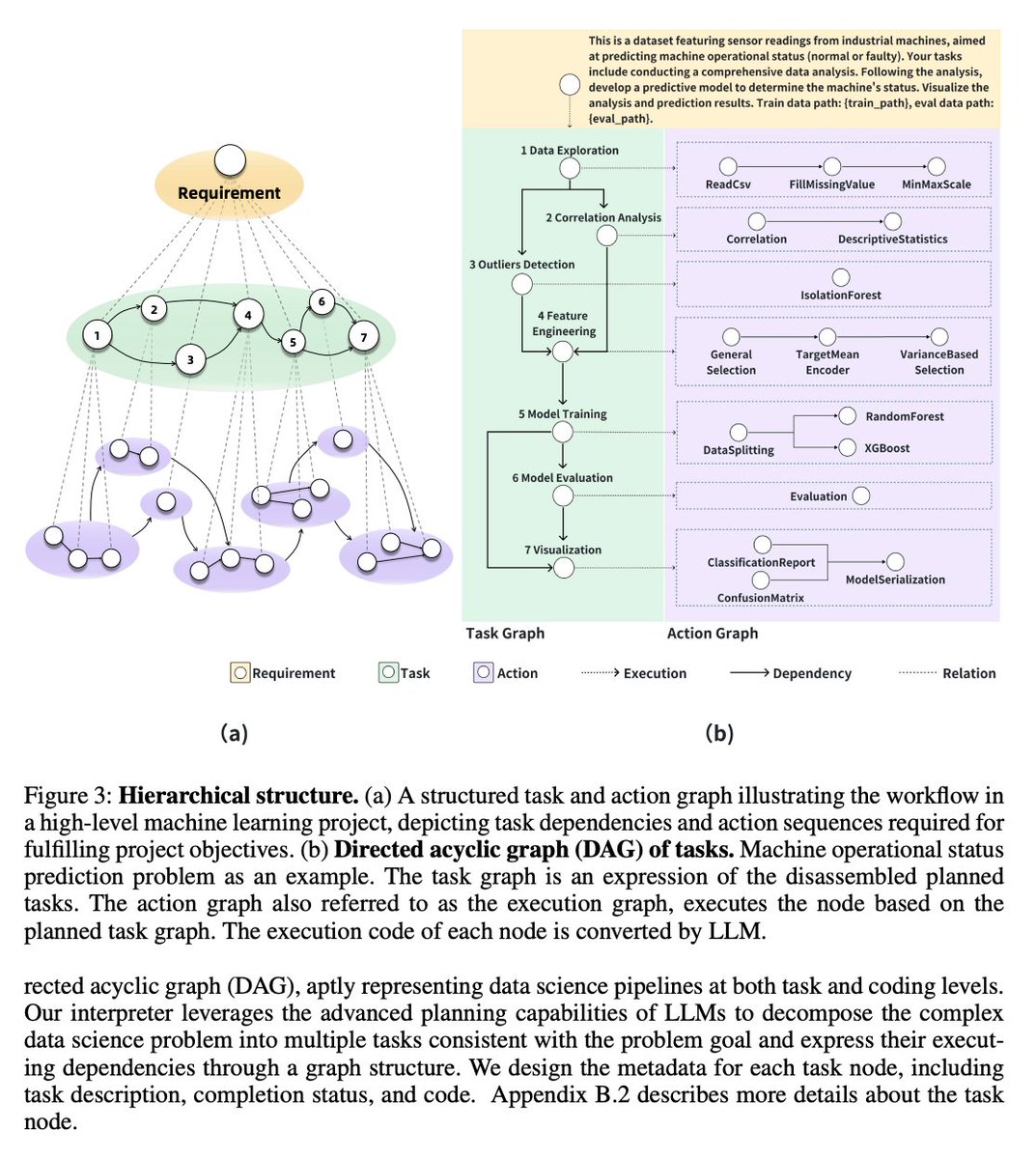
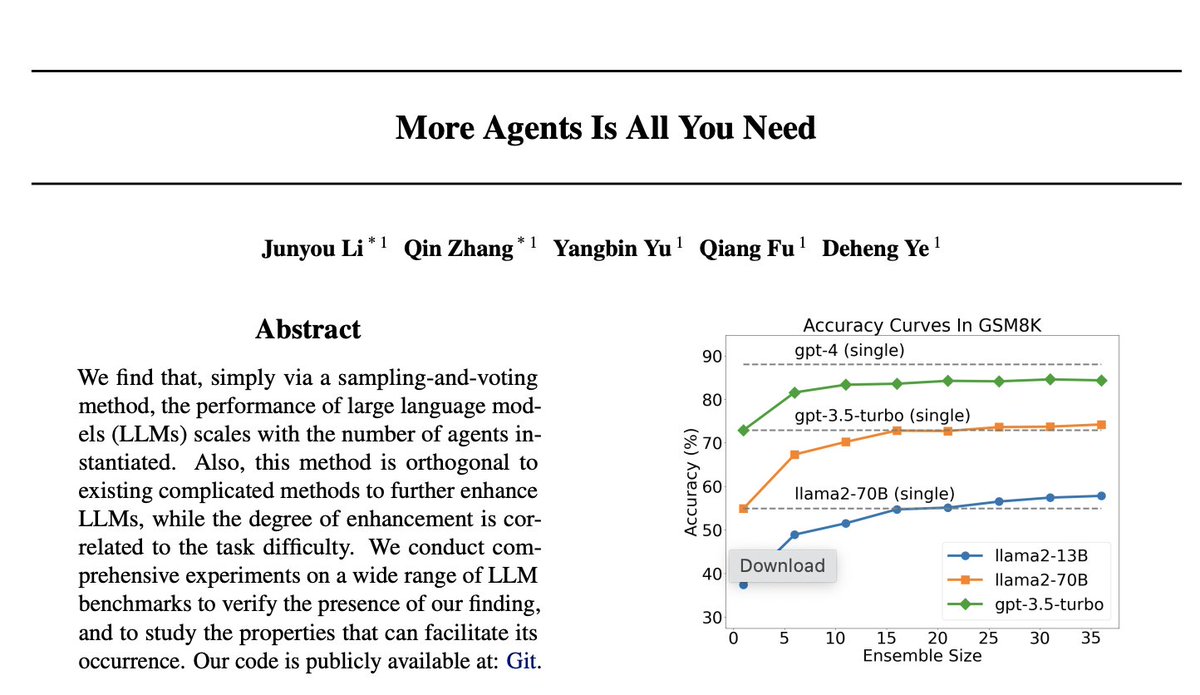
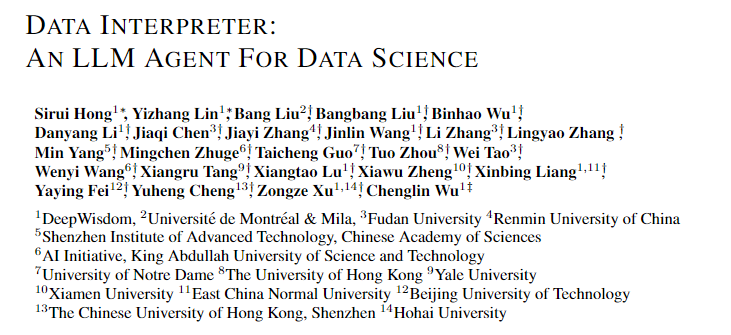
Introducing MetaGPT's Data Interpreter: Open Source and Better "Devin".
Data Interpreter has achieved state-of-the-art scores in machine learning, mathematical reasoning, and open-ended tasks, and can analyze stocks, imitate websites, and train models.
Data Interpreter is an autonomous agent that uses notebook, browser, shell, stable diffusion, and any custom tool to complete tasks.
It can debug code by itself, fix failures by itself, and solve a large number of real-life problems by itself.
We open-source our code and provide a wealth of working examples to give everyone access to state-of-the-art AI capabilities.
📝 Paper: https://t.co/VcoeKc6A8S
🔗 Examples: https://t.co/mu3iULDZko
📚 Repo: https://t.co/BMJxhVwzn6
📖 How to use: https://t.co/CviB6jvQ49
#MetaGPT #github #interpreter #opensource
Last week, I described four design patterns for AI agentic workflows that I believe will drive significant progress this year: Reflection, Tool use, Planning and Multi-agent collaboration. Instead of having an LLM generate its final output directly, an agentic workflow prompts the LLM multiple times, giving it opportunities to build step by step to higher-quality output. Here, I'd like to discuss Reflection. For a design pattern that’s relatively quick to implement, I've seen it lead to surprising performance gains.
You may have had the experience of prompting ChatGPT/Claude/Gemini, receiving unsatisfactory output, delivering critical feedback to help the LLM improve its response, and then getting a better response. What if you automate the step of delivering critical feedback, so the model automatically criticizes its own output and improves its response? This is the crux of Reflection.
Take the task of asking an LLM to write code. We can prompt it to generate the desired code directly to carry out some task X. After that, we can prompt it to reflect on its own output, perhaps as follows:
Here’s code intended for task X:
[previously generated code]
Check the code carefully for correctness, style, and efficiency, and give constructive criticism for how to improve it.
Sometimes this causes the LLM to spot problems and come up with constructive suggestions. Next, we can prompt the LLM with context including (i) the previously generated code and (ii) the constructive feedback, and ask it to use the feedback to rewrite the code. This can lead to a better response. Repeating the criticism/rewrite process might yield further improvements. This self-reflection process allows the LLM to spot gaps and improve its output on a variety of tasks including producing code, writing text, and answering questions.
And we can go beyond self-reflection by giving the LLM tools that help evaluate its output; for example, running its code through a few unit tests to check whether it generates correct results on test cases or searching the web to double-check text output. Then it can reflect on any errors it found and come up with ideas for improvement.
Further, we can implement Reflection using a multi-agent framework. I've found it convenient to create two different agents, one prompted to generate good outputs and the other prompted to give constructive criticism of the first agent's output. The resulting discussion between the two agents leads to improved responses.
Reflection is a relatively basic type of agentic workflow, but I've been delighted by how much it improved my applications’ results in a few cases. I hope you will try it in your own work. If you’re interested in learning more about reflection, I recommend these papers:
- Self-Refine: Iterative Refinement with Self-Feedback, by Madaan et al. (2023)
- Reflexion: Language Agents with Verbal Reinforcement Learning, by Shinn et al. (2023)
- CRITIC: Large Language Models Can Self-Correct with Tool-Interactive Critiquing, by Gou et al. (2024)
I’ll discuss the other agentic design patterns as well in the future.
[Original text: https://t.co/FtM2zOT2Lx ]
ChatGPT is the easiest way to make money online.
But 99% of people don't know how to use it.
Here are 13 simple proven methods to start earning $10,000/mo with AI:
Pleased to announce our inclusion in @OpenAI's official cookbook: https://t.co/4UbO8pckBB
No system is complete unless you can test it, so our entry focuses on evaluating RAG systems using our synthetic data generation technique.
Direct link to our cookbook: https://t.co/or68IbWYHL
We’ve created SEVEN advanced retrieval LlamaPacks as templates to help you build advanced RAG 🔥
It’s never been easier; instead of following a notebook, you can now try each technique in ~1 line of code ⚡️
Here’s the full set of techniques below:
⭐️ Hybrid Fusion (vector + keyword search + reranking)
⭐️ Query Rewriting + Fusion
⭐️ Retrieval with embedded tables (using @UnstructuredIO)
⭐️ Auto-merging Retriever
⭐️ Sentence Window Retriever (retrieve on sentences, expand into chunks)
⭐️ Node Reference Retriever (retrieve on smaller chunks, expand into parent chunks)
⭐️ Multi-Document Agents (handles advanced queries)
Each LlamaPack comes with a full README and example notebook (linked within each page):
* https://t.co/KfKcMIuSDG
* https://t.co/D4dp8xNyE9
* https://t.co/Jvb3ETmjqe
* https://t.co/v6yNrqIkMJ
* https://t.co/r0i91mJvAn
* https://t.co/3pEqioPELF
* https://t.co/z3PRy49BTD
Explaining 8 Popular Network Protocols in 1 Diagram. The method to download the high-resolution PDF is available at the end.
Network protocols are standard methods of transferring data between two computers in a network.
1. HTTP (HyperText Transfer Protocol)
HTTP is a protocol for fetching resources such as HTML documents. It is the foundation of any data exchange on the Web and it is a client-server protocol.
2. HTTP/3
HTTP/3 is the next major revision of the HTTP. It runs on QUIC, a new transport protocol designed for mobile-heavy internet usage. It relies on UDP instead of TCP, which enables faster web page responsiveness. VR applications demand more bandwidth to render intricate details of a virtual scene and will likely benefit from migrating to HTTP/3 powered by QUIC.
3. HTTPS (HyperText Transfer Protocol Secure)
HTTPS extends HTTP and uses encryption for secure communications.
4. WebSocket
WebSocket is a protocol that provides full-duplex communications over TCP. Clients establish WebSockets to receive real-time updates from the back-end services. Unlike REST, which always “pulls” data, WebSocket enables data to be “pushed”. Applications, like online gaming, stock trading, and messaging apps leverage WebSocket for real-time communication.
5. TCP (Transmission Control Protocol)
TCP is is designed to send packets across the internet and ensure the successful delivery of data and messages over networks. Many application-layer protocols build on top of TCP.
6. UDP (User Datagram Protocol)
UDP sends packets directly to a target computer, without establishing a connection first. UDP is commonly used in time-sensitive communications where occasionally dropping packets is better than waiting. Voice and video traffic are often sent using this protocol.
7. SMTP (Simple Mail Transfer Protocol)
SMTP is a standard protocol to transfer electronic mail from one user to another.
8. FTP (File Transfer Protocol)
FTP is used to transfer computer files between client and server. It has separate connections for the control channel and data channel.
–
Subscribe to our newsletter to download the high-resolution PDF. After signing up, find the download link on the success page: https://t.co/keu1P0hhKI