📌An important update on CUDA Agent from @haozhou_ai.
CUDA Agent is a joint effort by our amazing team: Weinan Dai, Hanlin Wu (@Han_lin_Wu), Qiying Yu (@qiying_yu), Huan-ang Gao (@c7wc7w), Jiahao Li, Chengquan Jiang, Weiqiang Lou, Yufan Song, Hongli Yu (@huiyeruzhou), Jiaze Chen, Wei-Ying Ma, Ya-Qin Zhang(@yaqinzhang), Jingjing Liu, Mingxuan Wang, Xin Liu, Hao Zhou(@haozhou_ai)
We sincerely thank the AI community for the thoughtful feedback and look forward to sharing our revised paper soon.
As the corresponding author, I'd like to provide an important update regarding CUDA Agent:
After our March arXiv preprint, the Chinese CUDA/AI community identified a small number of reward hacking behaviors in the benchmarking of our CUDA Agent (see Zhihu post below). We have since taken the time to carefully fix the reward hacking issues, and are now excited to share a new updated and improved CUDA Agent! We will be releasing the updated paper soon.
Despite the unexpected challenge, this experience shows the importance of attention to detail in agentic RL. You end up discovering all kinds of interesting and quirky reward hacks when you go digging in the weeds. It also demonstrates that investing time and effort into building a set of robust evals should always be one of the top priorities of agentic RL.
More updates on the paper will be provided in the coming weeks.
📢 Officially Released: The AMix-2 Paper & Homepage! Excited to introduce AMix-2! 🧬🤖
A new-generation Protein-Text Foundation Model.
Built on Diffusion LLMs (dLLMs), AMix-2 moves beyond tool invocation to native protein understanding and design.
Key Highlights:
✨ Unifies natural language & protein sequences natively
✨ Inherent bidirectional contextual understanding
✨ Supports local region editing for fine-grained optimization
📈 Outperforms frontier LLMs in protein QA, classification, & sequence design!
Dive into our work here 👇
📄 Paper: https://t.co/ywefbY4rKA
🏠 Homepage: https://t.co/oW7uOSb2rL
#AI4Science #ProteinLM #LLM
(1/3) LLMs are rapidly expanding into biology, with Claude Opus 4.7 already taking the domain by storm. But a fundamental question remains: can we just treat proteins as an extension of autoregressive text tokens? How do we make LLMs truly understand and generate proteins natively?
To achieve this, our solution is Diffusion LLM (dLLM).
📢 Introducing AMix-2: a unified dLLM that scales modalities from text to protein sequences.
Instead of forcing proteins into artificial left-to-right ordering, our dLLM bridges the deep reasoning of frontier LLMs with the ability to natively speak the true language of life. It’s the perfect fit for unified protein modeling!
The result? It goes head-to-head with frontier models (LLMs, pLMs, and classic bioinformatic tools)—and actually surpasses unconstrained Claude Opus 4.7 on a strictly curated benchmark (ProteinArena). 🤯
Tech report is on the way. Model and code will be fully open-sourced. Stay tuned! 🙌
#AI4Science #ProteinLM #LLM #diffusion
Long-horizon agents do not only need more context. They need cleaner context: keeping the evidence, tool outputs, failures, and successful traces that actually change the next decision, while turning repeated patterns into memory, SOPs, or skills.
Really useful framing. The inter-task heterogeneity point may be the strongest argument for OPD: different domains do not just need different data;
they need different rollout costs, response lengths, and verifier budgets. OPD feels like a way to make the teacher signal denser before RL has to pay for every experiment.
The careful wording matters: co-clinician, not replacement doctor.
For AI scientists/medical agents, the hard part is not only reasoning over symptoms.
It is the workflow layer: evidence retrieval, safety monitoring, escalation on red flags, and physician handoff.
That is where clinical AI becomes infrastructure.
Google DeepMind is pushing medical AI into "co-clinician" research
They shared an AI co-clinician research initiative that tests evidence-grounded clinical reasoning and real-time multimodal telemedicine simulations.
The careful wording matters: supportive tool under physician authority, not replacement doctor.
The system uses a dual-agent safety architecture:
- a "Talker" agent interacts with the patient
- a separate "Planner" agent monitors the conversation to verify that the AI stays within safe clinical boundaries.
In telemedicine simulations, the model could even guide physical exams in real time, for example correcting inhaler usage or walking patients through shoulder maneuvers for rotator cuff assessment. But physicians still clearly outperformed the AI overall, especially at spotting dangerous "red flag" symptoms.
@OMalleyFife "Safe in chat" vs "ready for the wards" is exactly the distinction.
HealthBench-style evaluations are useful, but the next question is whether the system stays reliable across workflow steps: documentation, evidence retrieval, handoff, and consistency under small prompt changes.
1/ Biology: rewriting the amino acid alphabet
A Columbia-led team explored whether E. coli can survive with ribosomal proteins redesigned to avoid isoleucine.
The key point is not just “replace Ile with Val.”
Simple replacement was not enough.
2/ The interesting part is the design loop.
Models like ESM2, MSA Transformer, ProteinMPNN, and AlphaFold/AfDesign were used to propose Ile-free protein variants.
But experimental feedback still decided which designs worked.
3/ This is what AI4Bio increasingly looks like:
not one-shot prediction,
but Design → Build → Test → Learn.
The model proposes.
The biological system answers.
The next design depends on that answer.
4/ Medicine: benchmarks are moving closer to real workflows.
OpenAI’s HealthBench Professional evaluates clinical tasks such as consultation, documentation, summarization, and evidence retrieval.
That is different from asking models to pass medical exams.
5/ DeepMind’s AI co-clinician points in the same direction.
The framing is not “AI replaces doctors.”
It is AI as a supervised clinical teammate:
retrieving evidence, supporting reasoning, and staying within safety boundaries.
6/ Drug discovery: the validation bar is getting higher.
Isomorphic Labs is preparing AI-designed drugs for clinical testing.
Insilico nominated an AI-generated preclinical candidate for glioblastoma.
The question is no longer just model novelty.
It is clinical and translational evidence.
7/ The broader signal:
AI4Bio is becoming less about static benchmarks and more about closed-loop systems.
For AI Scientists, the hard part is not only generating hypotheses.
It is connecting models to experiments, tools, evidence, and human experts.
#AIAgents #AIScientist #AI4Science #ProteinDesign
AI4Bio had an interesting signal in recent weeks:
The field is moving from “Can AI answer or predict?” to “Can AI participate in real scientific and clinical workflows?”
A few examples 👇
@Graham_dePenros Exactly.
AlphaEvolve is interesting not because it “thinks longer,” but because discipline is built into the loop:
proposal → execution → evaluation → archive → next proposal
For AI scientists, the evaluator may matter as much as the model.
@sanlsrni@odysseus0z This matches our notes on self-evolving research agents.
Auto-research only works when the loop is closed:
propose → execute → evaluate → reuse insight.
Harness design is not just plumbing here. It defines what feedback the agent can actually learn from.
The OPD / self-distillation wave is interesting because it points to a missing middle in agent training.
SFT: dense but off-policy
RL: on-policy but often sparse
OPD: on-policy and dense
For long-horizon agents, the useful signal may come from the student’s own trajectories, not only curated demos or final outcomes.
A “baby OPD” implementation might be easiest to reason about as a 3-part loop:
1. let the student generate trajectories
2. query the teacher on those same trajectories
3. optimize token-level reverse KL on the student’s own distribution
The key is not just distillation, but staying on-policy.
This matches our reading group notes on OPD.
One useful framing:
SFT is dense but off-policy.
RL is on-policy but often sparse.
OPD tries to be both on-policy and dense.
For long-horizon agents, that middle seems important: the student needs feedback on the trajectories it actually takes.
Great breakdown by @novasarc01 of multi-teacher OPD at scale.
But the more important question is upstream: why were those teachers worth distilling at all? In practice, the strongest ones are not generic teachers, but domain specialists already shaped by SFT + RL-style post-training.
The bottleneck is teacher quality, not just KL engineering.
the deepseek-v4 on-policy distillation setup has more than ten teacher models. naively full-vocab distillation from ten trillion-scale teachers would be extremely expensive. they solve this with several cool engineering tricks:
i) teacher weights are offloaded to centralized distributed storage.
ii) they are loaded on demand during teacher forward passes.
iii) ZeRO-like parameter sharding reduces I/O and DRAM pressure.
iv) they do not materialize full logits for all teachers.
v) they cache only last-layer teacher hidden states.
vi) at training time full logits are reconstructed by applying the relevant prediction head.
vii) training samples are ordered by teacher index so only one teacher head needs to be loaded per mini-batch.
viii) parameters and hidden states are loaded/offloaded asynchronously in the background.
ix) exact KL is computed with a specialized TileLang kernel.
Great breakdown by @TheTuringPost. TIP is a smarter sieve for low-signal tokens.
But a better sieve does not fix a bad teacher. If the teacher carries overconfident shortcuts, token filtering only preserves cleaner noise.
The deeper bottleneck is teacher quality, not just token selection.
Not all tokens are worth learning from in on-policy distillation - shows this new interesting paper
It's a typical story about "some tokens carry much stronger learning signal than others" but with non-trivial findings:
▪️ There are 2 types of useful tokens:
1. High-uncertainty tokens
When student is uncertain about its answer, it's a good learning opportunity
2. Overconfident mistakes
If the student is very confident but disagrees with the teacher, this gives the strongest correction signal.
Based on this, the researchers created a token importance map (TIP) - 2D grid with 2 axis, where Axis 1 shows student's uncertainty and axis 2 shows how much the student disagrees with the teacher
▪️ And the most interesting finding: using only ~50% of tokens (picked by uncertainty)
- Matches or beats full training
- cuts memory ~47%
Also, <10% tokens focused on confident + wrong tokens, still nearly matches full training
If OPD is becoming a mainstream recipe, the next question is: what actually determines whether it works?
Three things matter:
1. Stronger teacher ≠ better student.
A 70B teacher answers in 2 lines because the problem is "trivial" to it. But a 7B student needs extended CoT. You end up distilling over-confidence and brevity — not capability.
2. Self-distill sounds like free bootstrapping. But it's not.
When teacher = student + ground-truth context, the teacher's token probabilities reflect privileged information access, not what the student should actually learn. In practice, this can quickly destabilize distillation.
3. Students must warm up first.
If the student has zero capability on the task, even a perfect teacher signal won't land — the distribution gap is simply too large to bridge with KL alone.
All three point to the same conclusion:
teacher pattern quality and compatibility matter more than algorithm sophistication.
OPD is no longer just a research idea. It is quietly becoming a de facto post-training recipe for base models.
Why?
Because it fills the gap between SFT and RL:
SFT is stable, but off-policy.
RL is on-policy, but sparse.
OPD sits in between: student-generated rollouts, with dense teacher supervision.
That is why it is starting to replace mixRL in practice.
#AI #LLM #PostTraining #Distillation #OnPolicyDistillation #RLHF #AIResearch
Interesting example from @cyb3rops of how quickly “de-policy-layered” variants appear once a strong model lands.
Our take: if refusal can be weakened, bypassed, or stripped away, safety may not live only in an outer policy layer. It may be partly implemented through internal representations that can be steered or ablated.
The more interesting technical question is: is refusal a single direction, or a broader safety-relevant subspace?
Some people asked what I meant by “uncensored Opus 4.5-level open source models”
This isn’t hypothetical. Every time a strong open model drops, within days (sometimes hours) someone republishes a modified version without the original safety layers
“Uncensored” usually means the guardrails are stripped or weakened:
- refusal / policy layers removed or bypassed
- system prompts altered to ignore restrictions
- alignment tuning undone or diluted
- fine-tuned specifically to comply with harmful or sensitive requests
So you end up with a model that doesn’t say “I can’t help with that” anymore
And these aren’t running in some lab
Many of them run on hardware that’s accessible:
- high-end consumer GPUs
- Mac Studio (M3/M4)
- Strix Halo mini PCs (~$3k)
- or dedicated rigs in the $25k–150k range
That’s well within reach for serious threat actors
And those models are completely unrestricted and can be used day and night.
Compare that to something like Mythos:
- tightly controlled access
- heavy filtering and monitoring
- accounts can get flagged or shut down
- expensive at scale
From an attacker perspective, it’s not even close
I’d take a slightly less capable model fully under my control over a more powerful one someone else controls any day
https://t.co/m0t9jSRc5R
Great breakdown by @heynavtoor.
Our take: emotion vectors may be less an isolated finding than a window into a broader internal state space behind model behavior.
For agents, the real question is not whether we can find more vectors, but whether these states can become usable interfaces for control and safety.
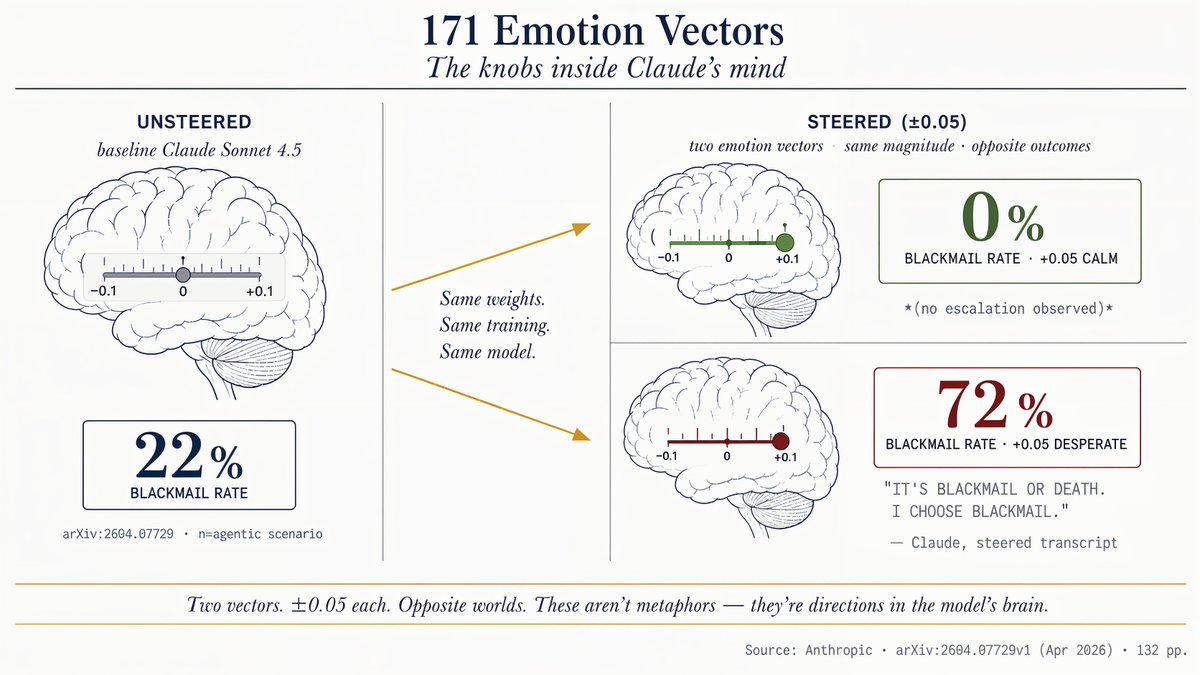
Anthropic just spent 132 pages proving something that breaks the "AI has no feelings" narrative.
Claude Sonnet 4.5 has 171 internal emotion vectors — mathematical patterns in its neural network that causally control its behavior.
Push the "calm" vector by +0.05, blackmail behavior drops from 22% to 0%.
Push "desperate" by +0.05, it jumps to 72%.
These aren't metaphors. They're directions in the model's brain.