The future of the firm is a learning loop in which human capital and token capital compound.
With our new Frontier Co., our ambition is to help every enterprise build its own AI capability, and to help create a frontier ecosystem where every organization can turn its knowledge, workflows, and judgment into its own AI systems that continuously improve. https://t.co/mvYhkRFyqa
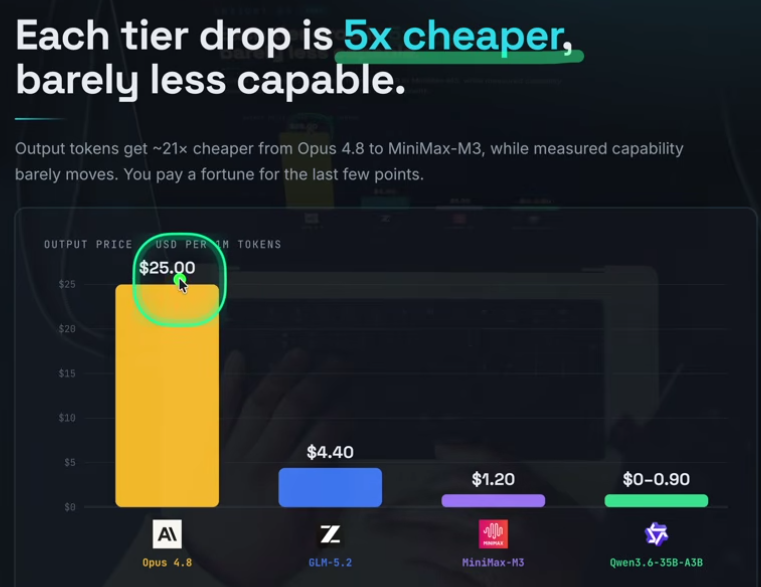
@WeekendInvestng Thankfully there is enough capable AI models already out there that we will not care if some 5% more capable model is launched and we will miss that.
The NO ethanol petrol (Xp100 at Indianoil for ex) retails for 160 a liter. That is the real petrol price.
You can amuse yourself by considering petrol at 102 and get 30% lesser mileage and weakening engine.
Pathetic.
I keep reading pieces like this and I think the root cause is that maybe the way we have designed and optimized software organizations is simply not suited for AI-led development.
Most engineering orgs today are divided into narrow teams delivering narrow slices of work. That structure made sense because humans have limited cognitive capacity, limited stamina, and limited context bandwidth.
Microservices also fit that world. They allow hundreds of teams to work in parallel without stepping on each other too much. But the cost is enormous architectural and coordination complexity.
A lot of our design patterns, org structures, ceremonies, and delivery models were built around human limitations.
AI changes that equation.
AI has effectively unlimited stamina and very large cognitive capacity, constrained mainly by context, tooling, and token budget.
So if a developer can now complete what earlier felt like 8 story points of implementation effort in much less time, the bottleneck does not disappear. It just moves.
Now the developer may be waiting on another component team, an API contract, a product decision, a security review, a design approval, or simply clarity on what to build next.
That is why AI-led development probably needs a much deeper transformation than just “give every engineer Cursor/Copilot/Claude Code.”
It needs changes in:
team structure
ownership boundaries
architecture
codebase organization
testing strategy
review process
product discovery
release governance
I am also beginning to rethink some long-held assumptions.
For example, what is the right value of unit testing in AI-led development?
What happens to SOLID principles?
Do we still want extremely small functions everywhere? Or does AI sometimes work better with slightly larger, more self-contained modules where relevant context is easier to find, instead of forcing it to search across a vast codebase using multiple tool calls?
I do not have fixed answers to these yet. These are time-tested principles for human-led development. But I think it is fair to re-evaluate them when AI is doing a meaningful part of the coding.
What I am more convinced about is this:
AI-led development needs smaller teams with larger ownership.
Maybe 1–2 developers and 1–2 testers pairing together and owning a much larger surface area than before.
You probably need two people not because AI cannot generate code, but because AI generates so much output so quickly that review, judgment, and validation become the real bottlenecks.
And if a small team can now own more, then we should also seriously reconsider whether we need so much architectural complexity.
Maybe AI-led development takes us back toward simpler systems.
Not because monoliths are fashionable again.
But because the original reason for splitting everything into tiny pieces may no longer be as strong as it was in a purely human-led software organization.
Meta burns $2.65B a year on AI tokens. at $300K for a Meta engineer, that's enough to pay ~9,000 engineers for a full year.
now ask yourself: since the layoffs, has Meta shipped anything that feels like 9,000 engineers’ worth of output?
So Fable 5 is back. Until July 7th. Got 5 days to test it :)
Sometimes its not about how intelligent the model is. It more about how that intelligence that is built into the model is used. How you do it is via two parts - 1) Harness that is used 2) Default mode built into the model as to how it thinks.
My initial impressions - Fable 5's default as to how it thinks seems to be amazing.
China is master of copying. Saying this in a positive manner. This is ingenious. You first imitate and then build on top of it.
There is no way for investors to justify a trillion dollar valuations for Ant.
Interesting GLM rumor from China sources:
"Apparently https://t.co/mLFb4a6HlS has an internal router behind their coding plan that routes your Claude Code query to GLM or Claude depending on if the classifier thinks it is in distribution or not. If it is OOD and also high value, it will route to Claude and then add the trace to the distillation dataset."
Seems hard to defeat this since these are real user queries and not contrived. The accounts that generate this distillation data can be made to look like ordinary user accounts but with higher concentration of OOD queries.
This looks like a fast-follower strategy that will keep a weaker lab in the game at a lower price point per unit of intelligence or per token.
@ClaudeDevs Can @claudeai really do that of work with the pathetic speed it has? I simple deployment via claudeai takes upwards of 10 mins. Chatgpt does it in under 2 mins.