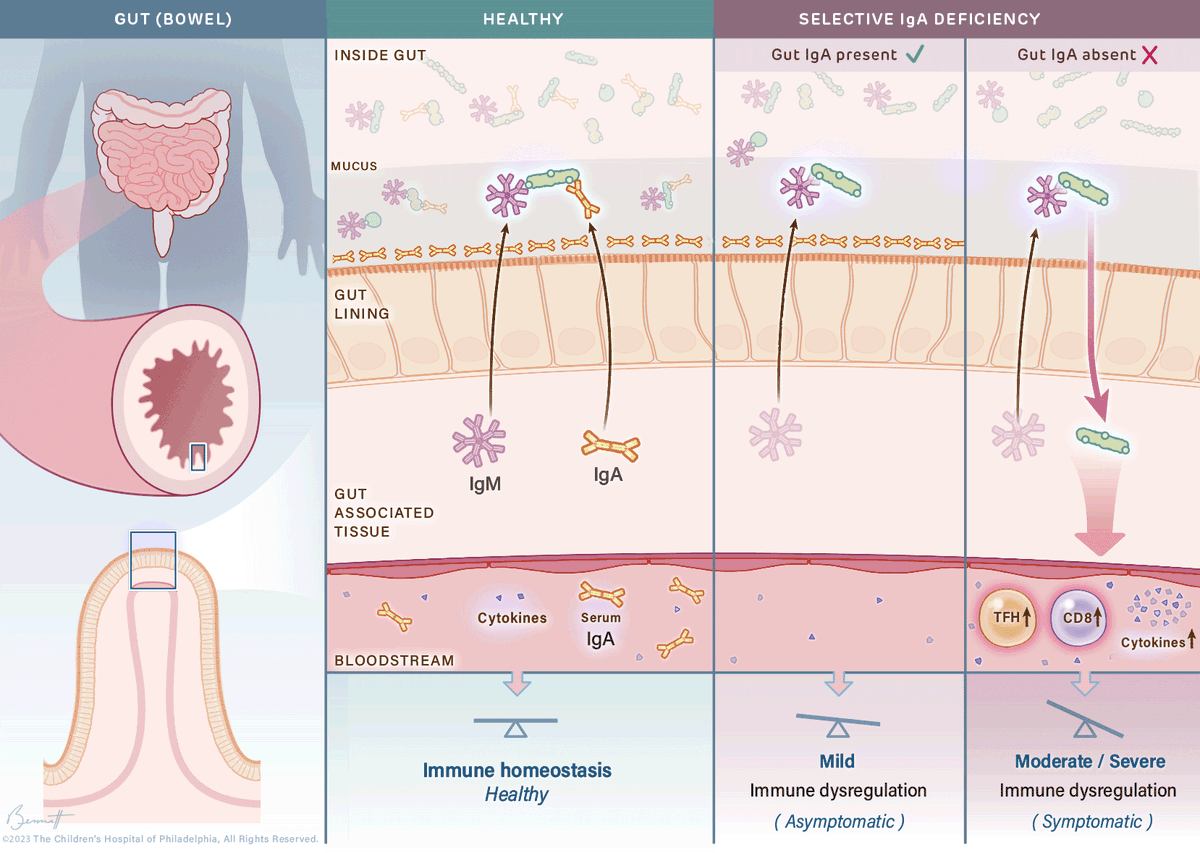
Studying human pediatric and mouse IgA deficiency, in collaboration with @LabSilverman, shows increasing exposure of commensal microbes to the systemic immune response yields immune dysregulation -- helping understand why only some IgA deficient patients are symptomatic!
Deficiency of IgA antibodies influences how well the immune system can maintain control of intestinal bacteria, finds new study involving pediatric patients with varying IgA levels. @henricksonlab@LabSilverman https://t.co/2p8DysQ6BN
So excited that our paper on preTCRa is out! It was a wonderful experience working with this collaborative, international immunology research team. This story emphasizes how much we can learn from our rare patients—both about new diseases and basic immune mechanisms.
1/ Just in! We report the first humans with inherited pre-TCR⍺ deficiency in @sciencemagazine. Dive into our fascinating findings on complete and partial forms of pre-TCRα deficiencies, including a common variant in the Middle East and South Asia. https://t.co/2osWO9YWPQ
@Info4PI Her passion for, and dedication to, the patients, providers and research in our field was inspiring and her kind words have encouraged me and countless others. She will be missed and her work remembered!
It was a privilege to welcome @henricksonlab to Grand Rounds today to discuss genetic testing and interpreting variants of uncertain significance. Thank you for providing a very engaging and informative talk on a very important topic! @ChildrensPhila@PennMedicine@AAAAI_org
In vitro models of CD8 T cell exhaustion make high-throughput interrogation easy, but can they be used to discover real Tex biology with therapeutic relevance?
Read to find out! In our new work from the @EJohnWherry lab, out now at @SciImmunology, we...
https://t.co/fHISKaFcZm
Why do some people have strong immunity after vaccination and others don't? Join our team as a post-doc to study this! https://t.co/4obKKU4hv5 and https://t.co/PwX0KUJLJp for more. Please RT! #immunology#postdoc
In a new @SciImmunology study, our researchers have shown that IgA acts as a “tuner” that regulates the number of microbes the body sees every day. This may explain why some patients with IgA deficiency have symptoms, while others do not. Read more below. https://t.co/k1q7pVtVvx
@BrodinPetter@LabSilverman Thanks Petter! Starting from the questions posed by human immune dysregulatory conditions leads in interesting directions--and there so much left to do!
Studying human pediatric and mouse IgA deficiency, in collaboration with @LabSilverman, shows increasing exposure of commensal microbes to the systemic immune response yields immune dysregulation -- helping understand why only some IgA deficient patients are symptomatic!
Deficiency of IgA antibodies influences how well the immune system can maintain control of intestinal bacteria, finds new study involving pediatric patients with varying IgA levels. @henricksonlab@LabSilverman https://t.co/2p8DysQ6BN