Machines, not models.
HEPH-3D turns one sentence into a printable machine that works when you assemble it: real mechanisms, electronics at their true hole patterns, routed wiring, and every joint checked for collisions before a file is written.
Measure a part once and keep it. Parts you add load for every project, including the planner that picks components, so a later design can choose your part instead of one that nearly fits.
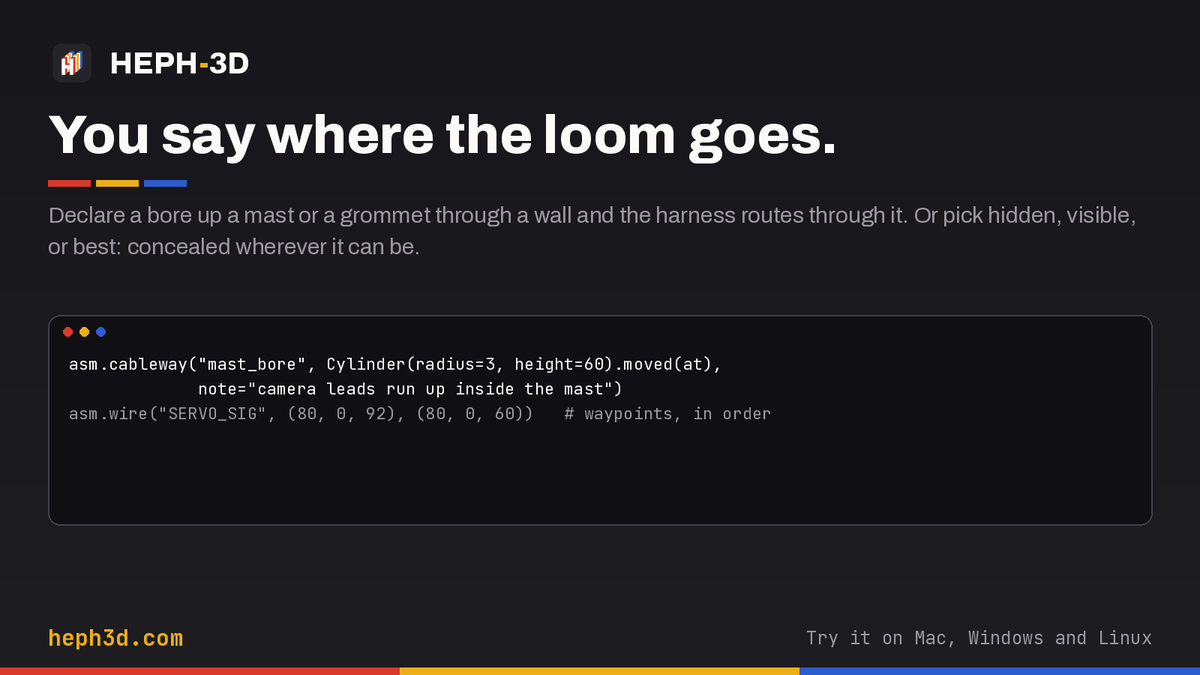
You say where the loom goes. Declare a bore up a mast or a grommet through a wall and the harness routes through it, or pick hidden, visible or best and HEPH-3D conceals the wiring wherever it can.
A machine with a battery and nothing to refill it fails inspection in HEPH-3D. Cells you take out to charge are fine. It just has to be a decision, not something you find out on day two.
Fuses are sized at 1.5x the worst case at the pack, with motors stalled and converters drawing input current, so they survive switch-on. When no standard fuse covers it, HEPH-3D says so instead of rounding up.
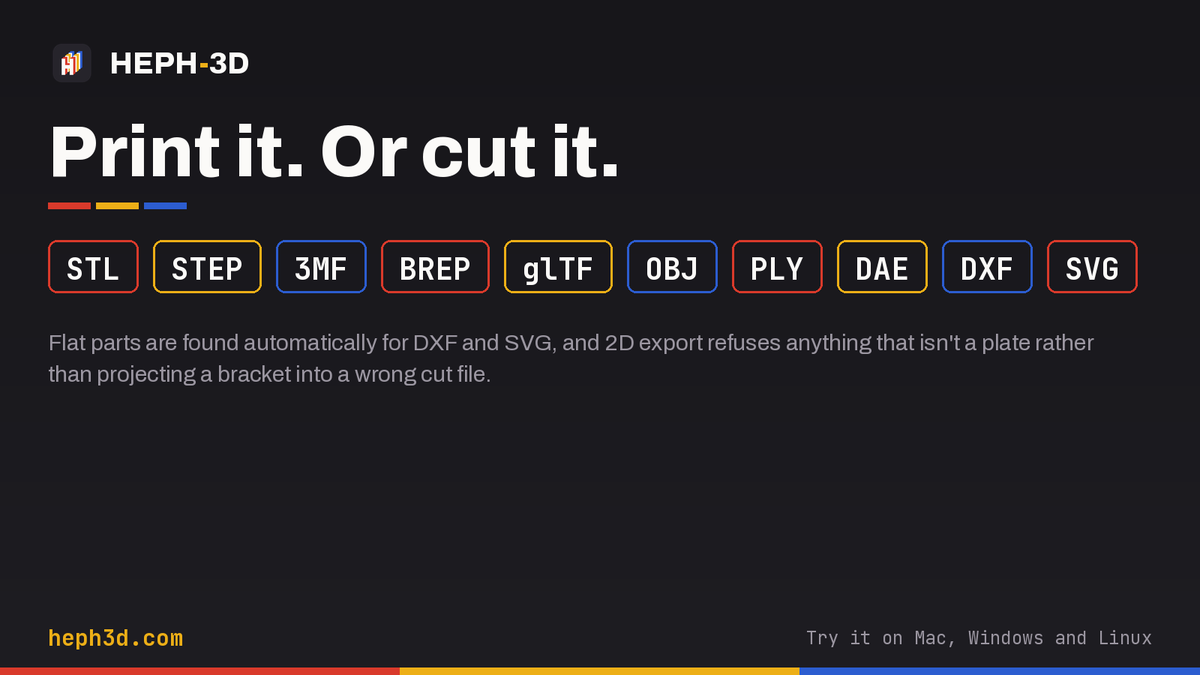
STL, STEP, 3MF, BREP, glTF, OBJ, PLY and DAE. Flat parts also export as DXF and SVG for a laser cutter, and HEPH-3D won't turn a bracket into a wrong cut file. Try it at https://t.co/KXZ0OeHe6l
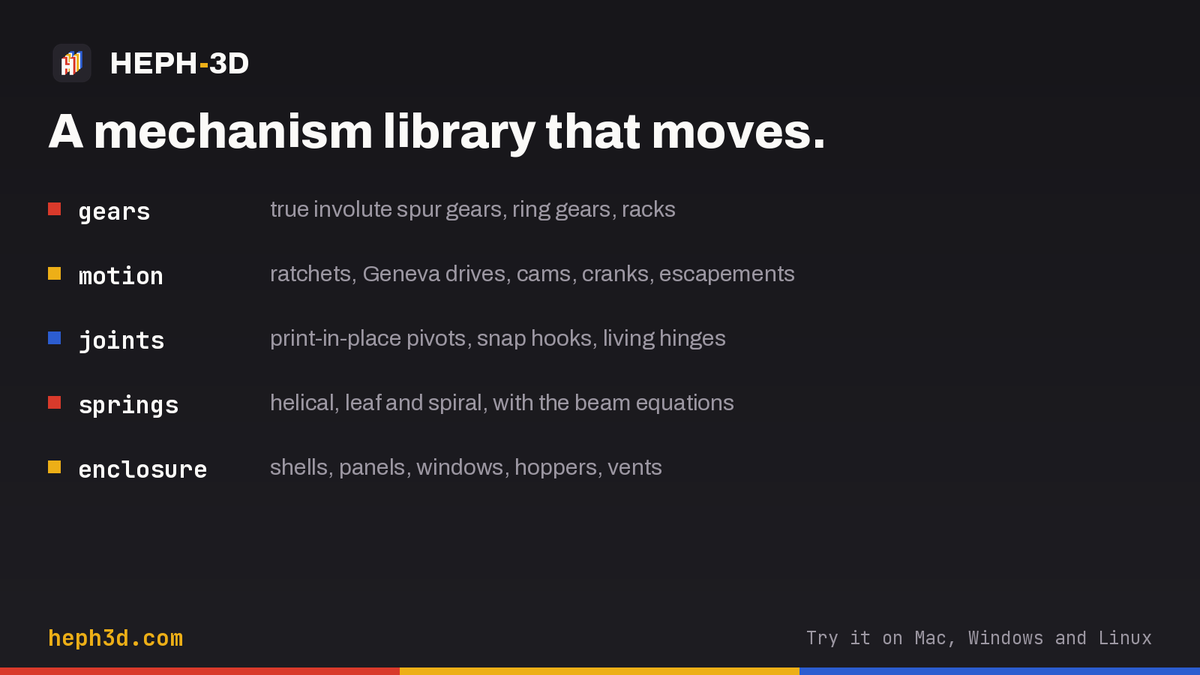
True involute gears, Geneva drives, escapements, snap hooks, living hinges, and springs with the beam equations attached. The parts that make a machine move, built in.
A datasheet describes the part the maker meant to ship. The one in your hand is the one they shipped. Measure it and HEPH-3D marks it measured, which outranks the datasheet.
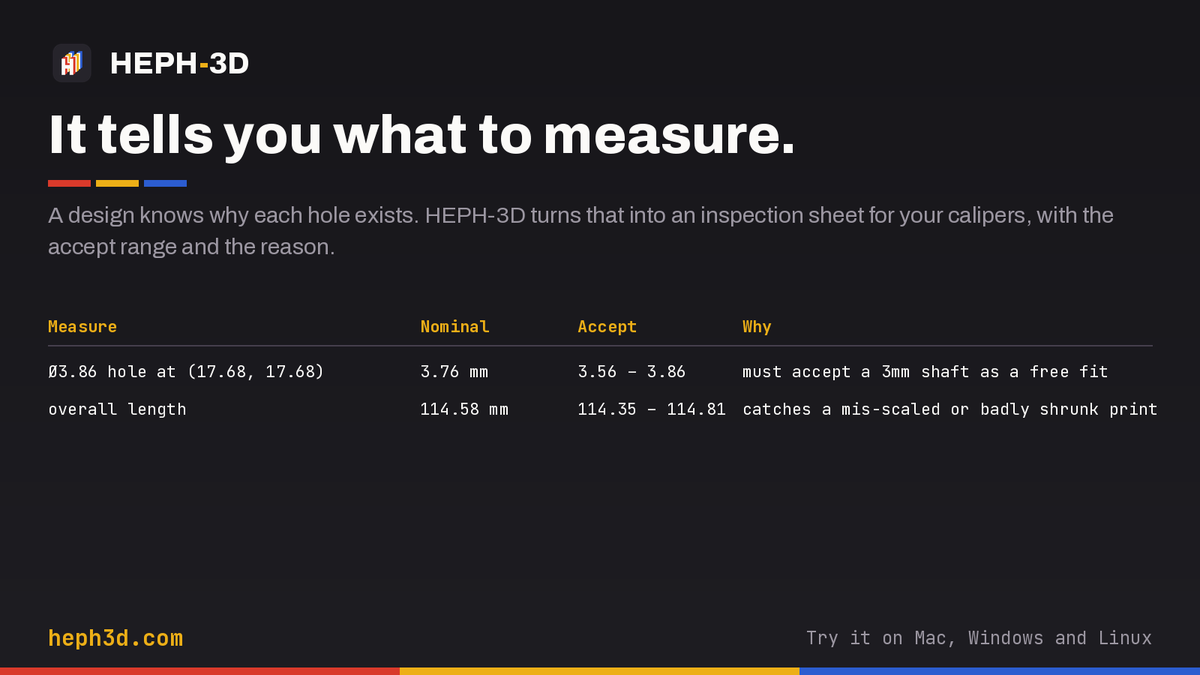
QC says the design is sound. Only calipers say the print came out. HEPH-3D writes an inspection sheet for each part: what to measure, the accept range, and why that dimension matters.
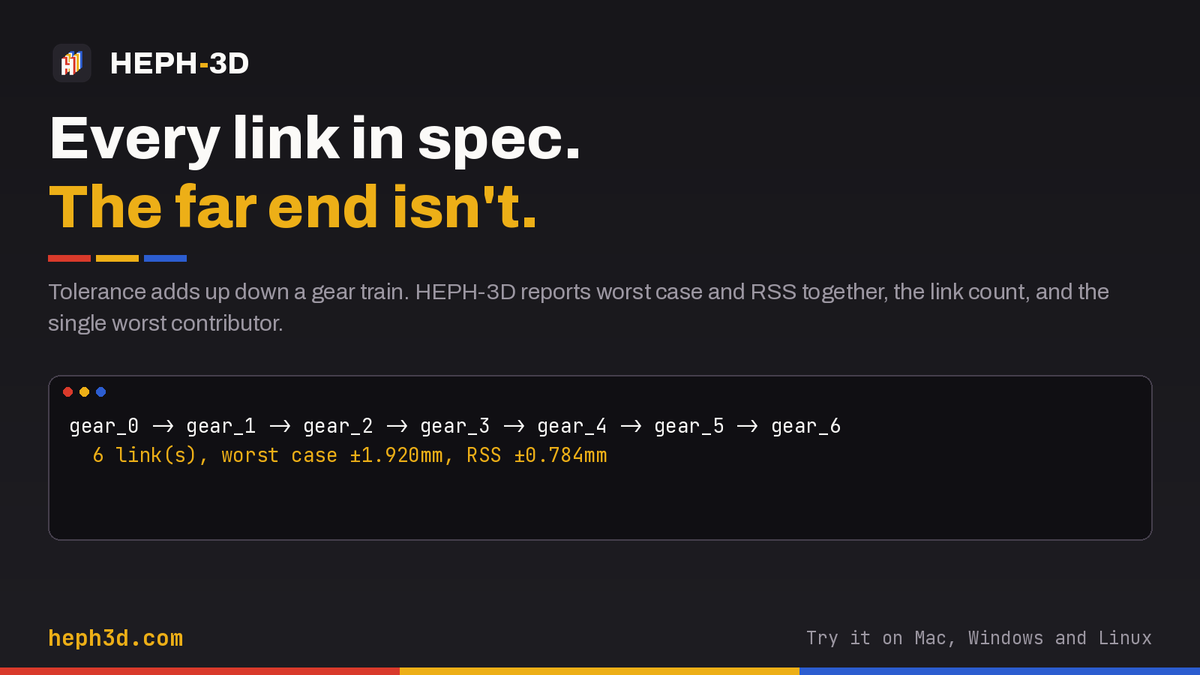
Seven gears, every one in spec, and the far end of the train can still be ±1.920 mm out worst case. HEPH-3D reports worst case and RSS together and names the one part where tightening pays most.
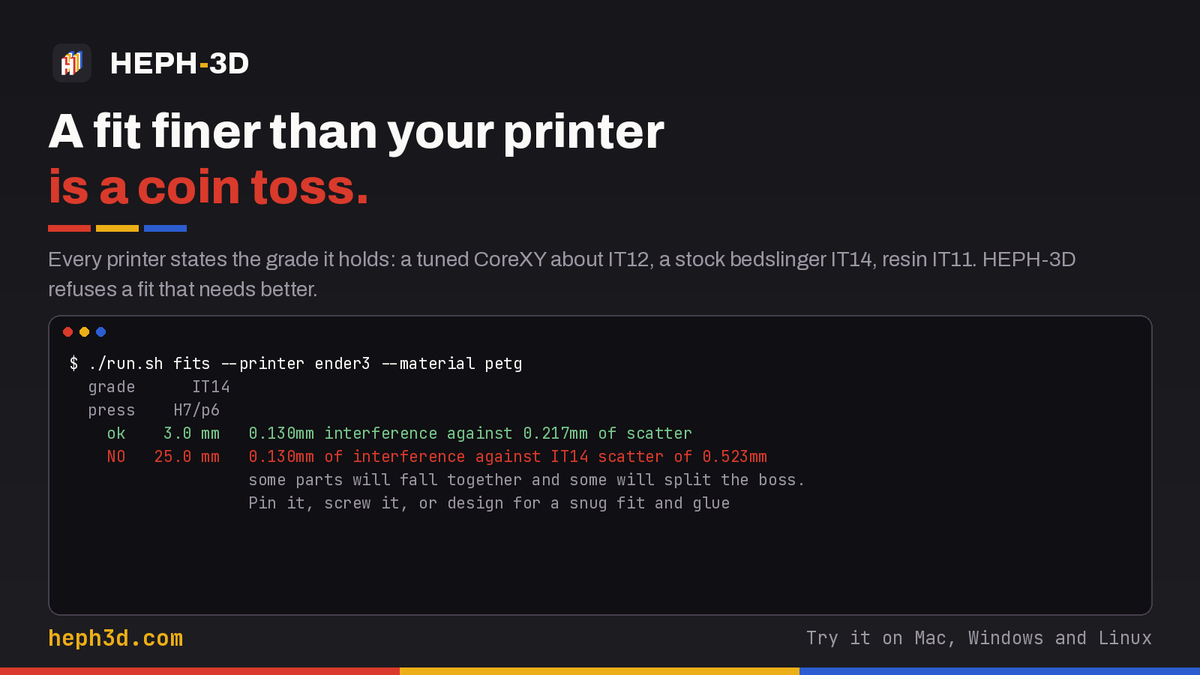
A press fit finer than your printer can hold isn't tight. It's a coin toss: some parts fall together and some split the boss. HEPH-3D knows the grade each printer holds and fails the fit before you print it.
Describe a machine. Get one you can build.
Try HEPH-3D for free with three projects and every export. Come build with us on Discord: https://t.co/vpwQVI9j7c
Ask for changes in plain English, then export the print files and the parts list.
Works with Claude Code, Codex or any terminal. Try it on Mac, Windows and Linux: https://t.co/KXZ0OeHLVT
@RoboRookie Glad it helps. If the coupon holes come out a touch tight, the right size drill bit cleans them up quickly. Would love to see the final print.
@FutureVisualsHQ Right, and the wire back to it carries that same stall current. Count the voltage drop on the supply and the return together, because counting only one halves it.
@jayzhoupro@Google@GoogleDeepMind@antigravity Good question, and it's the part most AI build demos skip. In HEPH-3D every board and servo mounts at its real hole pattern, and the parts list comes out with each bought part priced and weighed, so the custom mounts and the BOM come from the same design.
@OpenAIDevs@Scav A model driving a real arm is a great demo. We work the other end of that with Codex: HEPH-3D lets it design the arm itself, printable parts, servos and wiring, with every joint swept for collisions before the files are written. https://t.co/KXZ0OeHLVT
@10_X_eng Agreed, and the big win is that intent survives. In HEPH-3D a hole written as PROFILE.bore(3.0, Fit FREE) is still a free fit when it reaches the inspection sheet, not a bare number. And the whole machine is a Python module you can diff and test like any other code.