@thecsguy I also use paseo, I found it more organized because it is grouped based on projects/ folder.
while T3 is threats based and i may work differnt one at same time, easily lose attention in T3. @theo
the two look like twins on revenue. they sell completely different things.
@SpaceX sells launch, a satellite network, and compute. all platforms, all on decade-long cycles. nasa and the space force buy programs booked out to 2029 and 2030. airlines, shipping fleets, and defense agencies sign multi-year starlink contracts. its compute is sold the same way, reserved capacity billed monthly. its revenue was signed years in advance, and its cycle is set by procurement and physics.
@AnthropicAI sells the model which lasts about 3 months, until the next release, its customers are buying whoever is on top this quarter, and they re-decide every quarter.
looked at this way, some how @RockstarGames 's moat is even stronger.😂 #gta is a platform product in games, one title operated for over a decade on rockstar's own schedule.
anthropic runs the same hit-driven economics compressed into 3 months, on rented ground. I am not sure anyone can keep that up.
structurally, one is the landlord. the other has to re-earn its tenancy every quarter.
the next thing that replaces mailchimp for its users will be an agent.
at the speed AI is spreading, i'd give that 2-3 years before mailchimp's current "old-fashioned" users abandon it.
most likely bending spoons is not going to turn mailchimp into an AI revolutionized product. they'll squeeze out the last of its value.
Sometimes slow is fast. In brutal business competition, actually living by that line is not easy.
@Google 's latest model releases over the past few days made me see this clearly.
Sometimes you have to make the hard choices. Rebuild from the bottom, rework your own architecture. And from the moment you start, you already know it will take at least a quarter.
In that same window, the competitors who are already faster than you, @Anthropic, @OpenAI , will ship a lot of things in those three or four months.
But you know it is the right decision. Like Google did. I believe they rebuilt a lot of the structure underneath, things like adapting their models to TPUs.
It reminded me of what @elonmusk shared recently. They are rebuilding from the bottom too, training their own #Grok 4.8 and even Grok 5.0 in C and C++. And that is exactly why, in this cycle, their models fell far behind the competitors.
But how do you survive this cycle, and make it to the next one? Knowing it is the right decision is not enough. You need courage, and you need perseverance. The courage is for the distrust inside, the people around you who disagree. The perseverance is for the pressure from the market, watching competitors keep shipping good products and taking your users, while you stay on the thing you chose.
I believe Google had good models in hand over the past few months, versions they could have released. They only started releasing a week before Anthropic goes public. There is their own thinking behind that timing.
Startups are the same. When I work on my company, I know there is quick money to grab. Ship something fast, chase traffic, chase whatever is hot. But do that too often, and you forget your long-term goal and your strategy.
The harder question is whether you can do the opposite. Goal set, strategy decided, then spend long enough polishing the base and making the system solid, before you put energy into distribution.
Plenty of projects die in that stage. You pour resources into a direction, and it goes nowhere. That is the price.
But without the accumulation, what you keep shipping while chasing the hot thing is just a bubble. It cannot take a real market swing, or a real attack from a competitor.
So spend more time seeing the market clearly. Understand the logic. Make the right decision. Then put the time in, and be a friend of time. Sometimes slow is fast. The fast iteration cycle only comes after the base is there.
Anyway, that is what Google's recent moves made me think about. We all know Google is not leaving the table. Over the past few months, it has been practicing exactly this.
@EvanOtero In market competition, sometimes "slow is fast."
Google spent the past four months without shipping anything major, using that as a springboard for RSI.
Very curious to see your next move in this AI game.
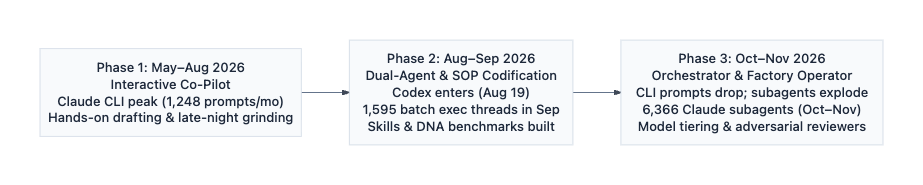
What I got right:
• Fixed the SOP, not just the bad output
• Used top models for strategy/review, faster models for execution
• Used fresh agents to critique work instead of self-grading
• Moved from chatting → multi-agent pipelines
What I need to fix:
• Stop starting sessions with "read this and understand my workflow" (add a 1-page brief)
• Stop nursing 100-turn mega-sessions—handoff & /clear between phases
• Cut late-night grinding ( OK, I did work late and , 27% of my prompts were sent out during 10pm–5am)
Stay on top of the trend and constantly evolve how you work with agents
(Just had #gemini recap my work history and how to improve my working habits)
and here r some advice I learn:
Lauren Tan is someone I’ve been looking into recently, and I wanted to say this properly.
I also went to high school in Singapore before coming to the US.
In Singapore’s system, Junior College is the more mainstream recognized path — only about 30% get in. The other 70% go to Polytechnic.
Lauren took the Polytechnic route, then went to university in Australia, and from there built her way to the US through consistent creation, public sharing, and work that actually held up.
I know how much that path takes. Not because one track is better than the other, but because in that environment, starting from Polytechnic and still ending up where she is today requires extra hard work and clear-headed choices along the way.
I respect how she’s approached her career decisions and where she’s chosen to invest her effort. She’s a strong motivating example.
> be poteto
> real name: Lauren Tan
> discover design at thirteen
> get paid to redesign your school website
> study finance, fall in love with coding
> start a business, run out of money
> one conference talk opens the DockYard door
> move from Australia to America
> nearly four years at Netflix
> six years at Meta, then join Cursor
> Cursor gets bought by Elon Musk's SpaceX
> now help build Grok Bot
she spent years at Netflix and Meta, now give her one hour to change how you work with AI ↓
genuine question, not a dunk.
if the job is replicating an app, who is the user?
someone who wants to clone a piece of software is a builder. and builders already run #claude code or #codex in a terminal. replication is exactly the part those tools are already good at.
i can see replit's edge in everything around the code. hosting, deploy, the workspace. i just don't see it in the replication or similar scenario which claude already covered
Over the past week, I’ve been overwhelmed by the love and support of friends, industry colleagues, and people I've never met. Thank you to everyone who has shown kindness to my family and me. It means the world to me.
I came to the United States 53 years ago, and becoming an American citizen is one of the greatest gifts and proudest moments of my life. NVIDIA has been my life’s work. Building it into the company it is today alongside my colleagues has been a privilege and an honor. Nowhere but in America could a company like NVIDIA be possible. I love our country, and I love NVIDIA.
I did not live up to the standards expected of everyone at NVIDIA, and I have made serious mistakes in my personal life. I created problems for the Board that I deeply regret. I own my mistakes completely, and I am committed to cooperating with the Board’s independent investigation.
Since my departure, I’ve seen an outpouring of calls from NVIDIA’s employees, investors, business partners, and customers for me to return as CEO. Many continue to reach out to me directly as the company navigates complex technology, market, competitive, and geopolitical dynamics. NVIDIA is a once-in-a-generation company. If the Board of Directors decides that my return is in the best interest of our shareholders, our employees, the company, and America, I would be honored to answer these calls and return as CEO.
Thank you again to everyone who has shared their good wishes. I am profoundly humbled by your support. To my family: I love you, and I will spend the rest of my life being worthy of yours.
Jensen