no spot
no port margin
no options
no @tradeparadigm RFQ
no multi-collateral
no borrow-lend
no toxicity based fees
no xusd
no spot VTFs
no video streaming
yet
ADL is a relic of isolated margin systems copied from @BitMEX. It doesn’t work for options, and at best is a terrible experience for cross-margin users.
Paradex deliberately chose not to implement ADL.
It breaks cross-platform hedges, adds a lot of unpredictability to users’ risk management, and fails for complex assets and portfolio-margin setups. There’s also no guarantee of finding profitable ADL counterparties under cross margin, without further amplifying liquidations. @DeribitOfficial also operates without ADL.
Socialized loss (SL) is a far better experience for users and scales easily to more complex assets and margin types 👇
Portfolio-Level Integrity
ADL operates at the single-market level, without considering the user’s overall account exposure. The trader who is high on the ADL queue due to a highly profitable/leveraged position on one market isn't necessarily profitable on an account level.
Example:
BTC = $100,000, ETH = $4,000
Insurance Fund (IF) = $100,000 collateral + short 40 BTC perps.
Alice has a $4M BTC-ETH spread on, i.e. +40 BTC perps (long) and –1,000 ETH perps (short)
→ Both BTC and ETH rally +5%
→ BTC to $105,000, ETH to $4,200.
Under a normal scenario, Alice’s BTC and ETH positions offset, leaving her with flat PnL. But the insurance fund’s bankruptcy price is $102,500. To protect the fund, ADL is triggered and forces Alice’s BTC leg to be closed at $102,500 as it cannot afford a loss that is higher than $100,000. Alice realizes BTC profits based on a 2.5% move while her ETH short continues to lose 5%, leaving her with a $100,000 loss. This can, in theory, lead to an unfair liquidation of Alice's account.
"Ethena" Risk
The same is true for a trader that could be holding the opposite position on a different exchange. If the position is subject to ADL, it closes the profitable leg, leaving the user with a naked losing leg. This destroys the intended hedge and amplifies risk exposure. @ethena smartly negotiated this provision away for it's trading on CEXs but that now means the risk of ADL is being unfairly borne by the exchange's other users. Smart for Ethena but not scalable for the exchange.
Given the potential market exposure imposed on affected accounts, ADL often triggers a forced unwind of positions, leading to fire-sale behavior that further amplifies market volatility and erodes liquidity.
This mechanism is particularly unsuitable for exchanges with options, where users frequently hold multiple correlated instruments on the same underlying asset for hedging or risk-neutral strategies. In such environments, forcibly closing a single profitable leg through ADL can break portfolio hedges, destabilize the portfolio and, by extension, the market.
To our knowledge, NO EXCHANGE discloses how cross-instrument exposures are handled under ADL.
Conditional + Reversible
Under a SL mechanism, losses are conditional, deferred (not immediately realized) and give users a choice. They are applied only upon withdrawal, and only if the platform is still experiencing a solvency deficit at that time.
If the market rebounds, or if the insurance fund grows (either through profitable liquidations or additional allocations) and covers the deficit, the shortfall is erased and no SL is applied.
By contrast, ADL crystallizes losses instantly and doesn’t give the user a choice. If a sudden market move causes insurance fund depletion, the system immediately closes profitable positions via deleveraging. Those users now permanently lose their realized profits.
SL introduces time, and recovery potential into the loss-allocation process while giving users a choice. It penalizes only those who exit during insolvency, while long-term users benefit if solvency is later restored.
Fair + Predictable Risk Distribution
ADL targets specific traders (often highly leveraged and profitable ones), forcibly closing their positions to cover the platform shortfall. It penalizes traders for system-level insolvencies outside their control.
SL by comparison avoids arbitrary targeting and maintains fairness. All users share the risk evenly and only when a persistent shortfall exists.
Transparency
ADL is a complex, queue-based mechanism that is very hard to anticipate for users. In contrast, a SL adjustment is a simple, transparent function of the insurance fund shortfall relative to the platform’s TVL. As it affects users only when they withdraw, it ensures predictability and transparency in the loss allocation.
Compute Efficient = "Chain Friendly"
SL simplicity makes it straightforward to implement on-chain in a trustless manner. There is less compute complexity which means cost and throughput constraints are alleviated. ADL’s dynamic queue logic is computationally heavy as it requires scanning all accounts on the platform, making it very expensive and error-prone. It also adds congestion to a system that is likely to already be congested when ADL is triggered.
October 10 = Wake Up Call
If your CEX can’t guarantee portfolio integrity under stress, it’s the architecture that’s broken. Switch to DEXs with intelligent loss-allocation that protects hedges, distributes risk fairly while staying conditional and predictable.
Paradexio
Paradigm RFQ was built for moments of market stress.
When screen liquidity dries up, RFQ becomes a critical tool for accessing large liquidity with immediacy.
Paradigm handled over $5B in volume yesterday (38% market share) - a new ATH
🎁 Share your XP card 🎁
🏆 WIN exclusive prizes 🏆
Starting now until Oct 1 SGT midnight
Quote this post with your XP card
10 Winners for Token2049 Paradex x MoneyBadgers Community Day Attendees
* VERY Special MoneyBadger Gift
* XP Prize
10 Winners for non-attendees will receive XP
Winners selected based on post engagement, impressions and creativity
🍋Comunidade Citrea: uma breve orientação
Sou suspeita para falar dessa comunidade, porque faço parte a algum tempo e amo está lá. Tanto que pelas minhas contribuições no servidor e com criação de conteúdo, tive a oportunidade de me tornar moderadora em 2024.
Uma coisa que quero destacar é o valor que a equipe dá para os usuários que colaboram com o crescimento da comunidade e do ecossistema, algo que nem todos os protocolos valorizam. E sabemos que dentre outras coisas, COMUNIDADE, é algo fundamental para o sucesso de um projeto.
Sem mais delongas, vamos ao objetivo principal desse post.
Quero apresentar para vocês as funcões (roles) que você pode conquistar na comunidade @citrea_xyz:
1⃣ Citrus Padawan (level 1)
2⃣Rookie Citrus (level 3)
3⃣Aspiring Citrus (level 6)
4⃣Skilled Citrus ( level 9)
5⃣Seasoned Citrus (level 12)
6⃣Citrus Champion Candidate (level 15)
7⃣Citrus Champion (a porta de entrada é a função Citrus Champion Candidate)
Como posso contribuir e conquistar funções?
🍋 Participe das discussões sobre citrea, BTC/crypto no chat geral.
🍋Seja ativo nos games durante as semanas.
🍋Esteja presente nos AMAs feito pela equipe, faça perguntas, deixe sugestões.
🍋Não faça spam.
🍋Engaje nos posts feitos nos perfis @citrea_xyz e @CitreaOrigins.
🍋Faça memes, artes, conteúdos e compartilhe no discord.
Importante:
Citrea está em testnet. Você pode contribuir testando os daaps além de fazer parte da comunidade do discord.
Não dê fade em Citrea, aguardo vocês lá!
Discord: https://t.co/vZcHNs6mhc
Ecossistema: https://t.co/thvnfXoFWH
CM!
CM!
CM!
say again..
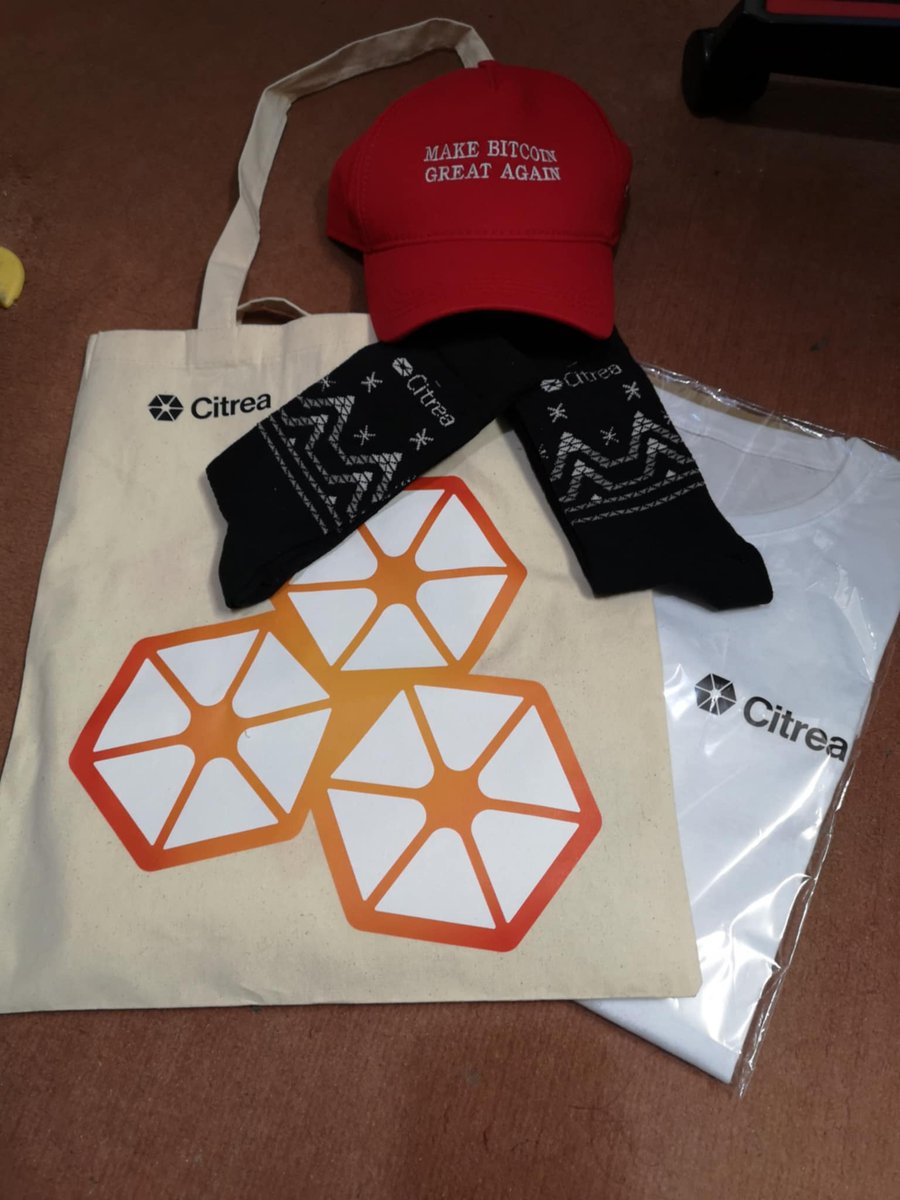
first merch from web3😍😍
thank for @citrea_xyz@citrea_eco bitcoin First Zk rollup .🔥🔥🔥
i like it. can't wait to Kumquat fork.
note: i pick random people to use. LOL.
2025 is the year Citrea will go to mainnet with native applications.
-------------------------
Citrea builder community is real.
The stealth mode of Citrea applications is real.
Citrea mainnet is real.
===> All of it is real.
jOIN NOW: https://t.co/G7EquSCT5a
@citrea_xyz
Some friends questioned me for doing this. But hey, life is about pursuing what you believe in and having fun in the process. This is the beginning of why and how I’m going rogue.
I am going rogue
The original promise of cryptocurrency was simple: decentralization, ownership by the people, and freedom from centralized control. Crypto was born to remove the middleman, and to give power back to individuals. Yet, today, the crypto landscape looks far different from that vision.
Over time, some insiders hijacked the technology. They took control and undermined what was supposed to be decentralized; choosing short-term profits over the core mission. The ecosystem is now overrun with projects launched by the same investors, recycling the same technology without meaningful innovation. This vicious cycle of self-serving agendas and empty wins is suffocating the very spirit of crypto.
Memecoins — often considered not serious — have gained significant traction in the last few months. The reason they have grown is that they allow common people to make money and be part of something early on. Apart from memecoins, which projects let you be a protagonist of the story?
Rogue is our answer to this problem. We’re bringing crypto back to its foundational roots: we are building a decentralized Layer 2 network with no VCs, no team allocation, and a fair launch that ensures equal access for everyone. Just like when Bitcoin and Ethereum were first launched, we’re committed to creating a project that prioritizes decentralization, fairness, and true community ownership. We might fail. We are fine with failure. For us, this isn’t just another project. It’s a movement to recover the values that once made crypto a revolutionary force while also providing useful infrastracture.
Our goal is simple: to create a project that is beyond our control, where ownership and control are truly decentralized, and where the network’s future is entirely in the hands of its users. This is about reclaiming what has been lost and building a future where crypto belongs to everyone again.
How will the token and ownership work?
There won't be an initial airdrop or token allocation to creators or investors. No presale. No premining and no token distribution. There will only be organic growth. Why are we doing this? Because we believe in it. The users should own it. This will outlive us.
Like in Bitcoin and Ethereum, the token will be produced in every new block of the network. Block builders and provers will receive the newly minted tokens.
A real decentralized zk L2 owned by its community
This is a simplified version of the flow:
1. User transactions are propagated via a mempool to the block proposers.
2. Block proposers lock some validity bond capital and bid for the rights to propose the next N blocks.
3. The bid-winning block proposer generates blocks, attested by a TEE (Trusted Executed Enviroment), and sends them to Ethereum.
4. ZK Provers race to generate a proof that all the transactions were correctly executed.
5. The ZK proof gets verified in Ethereum and all the transactions are now considered finalized.
6. Rewards are given to both the proposer and the provers.
If the block proposer proposed an invalid state transition, its locked validity bond will be slashed. (This can be proven via ZK proofs.)
With ZK technology, we can add more hardware to increase proving capabilities. You can have many provers participating in a pool where rewards are split between all the participants.
A fixed time for finality can also be set as a target for the network, making the size of the block dynamic. The size of blocks will be determined by proving capabilities and proving capabilities will grow due to economic incentives. The more proving hardware is available, the more transactions can be included per block.
How does it compare with the alternatives
Rogue is fully decentralized since its sequencing is done by Ethereum. This will have stronger liveness and censorship guarantees than many current L2s. It will not need an escape hatch. It can't censor or lie. And early tests reveal it will do it cheaply. We will release a full cost analysis later, but people all over the world will be able to use this tech, even during periods of high usage. This is a blockchain, unburdened by what has been.
We believe that, long term, an L2 that generates economic incentives for users to propose and prove blocks will be cheaper and more scalable than its alternatives. Provers will have incentives to collaborate to add more computational power to the network and prove bigger blocks. The more hardware is added on the prover side, the more transactions the system can handle and the cheaper each transaction gets.
ZK already solved the scalability problem of blockchains. However, it needs to be used in a way that allows individual economic self-interest to contribute to the greater good. The social, economic, and technical designs of Rogue are interconnected. The fair launch and economic incentives will bring competition and collaboration between provers to add more hardware capabilities to the network. These capabilities will continually improve the network. When a miner is added to Bitcoin, the network becomes more secure. In Rogue, this is done via ZK. Adding more hardware makes the network cheaper and faster.
What does the future look like?
Currently, we are finishing an execution client for Ethereum that will be used in Rogue. Based sequencing, proving, and TEE attestation are being added. This will take some time but we aren't that far away from having a working first version.
Why are we doing this?
We have built multiple relevant core infrastructures for these systems and we understand how the game is played, too. We want to change things. We want to build things we are proud of. We want to create something we would use; just like we use Ethereum and Bitcoin. More importantly, we want people to own it like they own Bitcoin, Ethereum, and memecoins. For this to happen, we need to build something bigger than ourselves.
Failure is almost certain but we will try anyways since we believe in it.
How can you participate?
You can like this tweet, retweet it, answer the tweet, or join our telegram.
In the future, you will be able to propose or prove blocks and build applications on top of it to own the network.