@SatPaper@cassandragoldie A thoughtful piece. A call to make taxation the servant of the social responsibilities of government; instead of the funding of the social wage being subservient to the claimed "incentives" of lower tax rates. We have had this debate arse end up for too long.
Indeed, a must-watch! Let's not forget, as the program notes, governance problems are in part a legacy of successive governments' failure to fund education (along with health and welfare) properly. The dead-hand of corporatism that sees university academic and professional staff as just another 'stakeholder' to be managed; non-transparent kpi's for the executive class performance bonuses; and governance bodies largely appointed instead of elected by those responsible for fulfilling the academic mission. @USydneyEcon
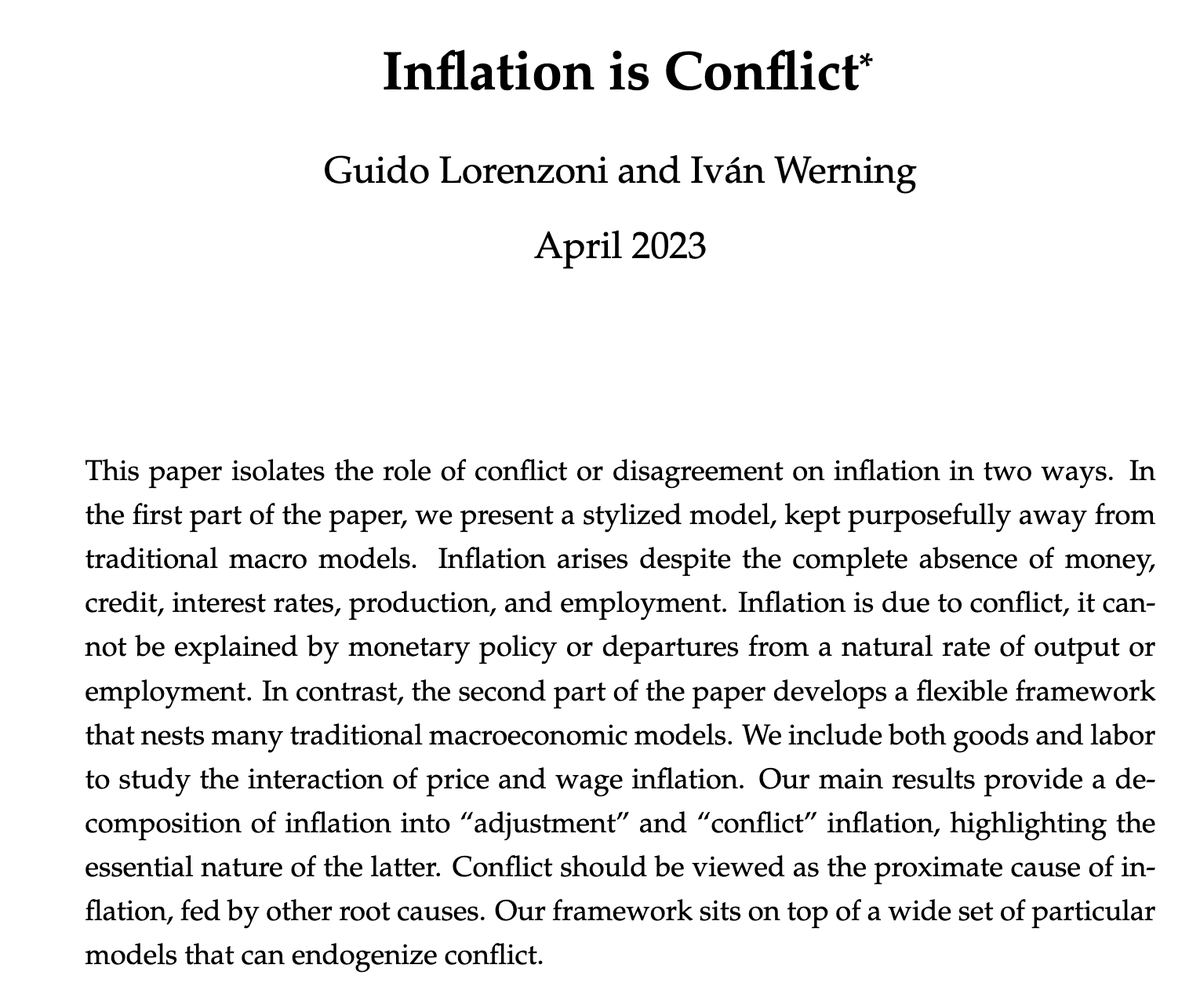
The incompatible claims argument in the heterodox literature would distinguish the initial price "shock" from the process underpinning an ongoing inflation. The former can be many and varied.
The latter is seen to lie in an incompatible real wage - rate of return (on production) combination; incompatible that is, with a stable price level. To my mind, the clearest analytical framework within which to visualise this within the heterodox literature is a Sraffian-classical multi-commodity model of the price system. @USydneyEcon @J_Meanwell @DavidUbilava
@DavidUbilava@heterodox_econs Haha yes, although I think we’ve known that for a while.
Question about the conflict lit: is conflict->inflation thought to be more about supply chain disruptions, or more about sudden increases in gov spending/draw on resources?
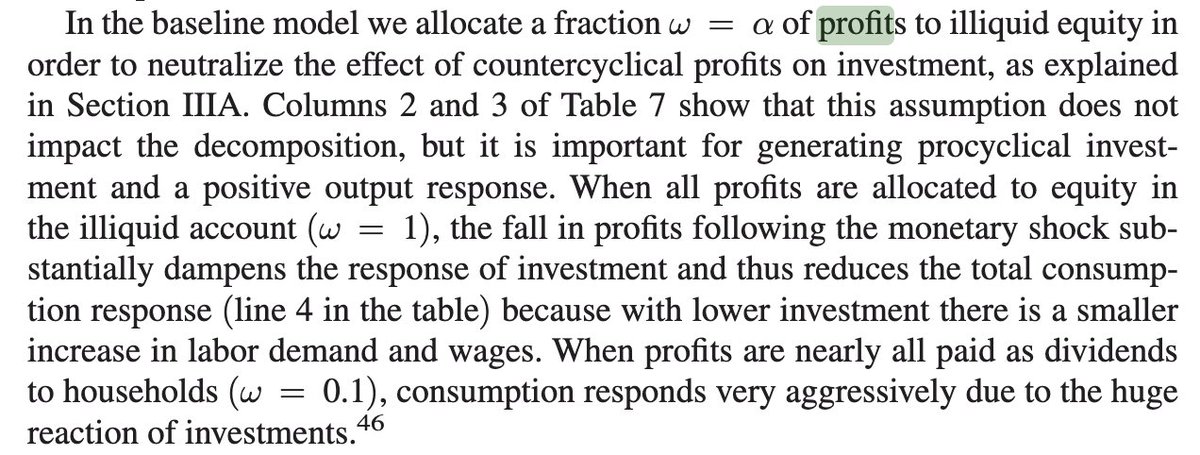
Yes, I gather we are looking at different "distributions"; and certainly when heterodox papers are typically referring to differences between themselves and "the mainstream", on distribution it is predominantly about functional or "factor" distribution. Sorry, I should have clarified in my original post. Reading the blurb you sent me and having a quick glance at the AER paper, the emphasis appears be on the effect of the composition of wealth on the impact of monetary policy, not to downplay the importance of that issue.
I'd be interested particularly in looking at Inflation is Conflict paper which I'm also unfamiliar with. The story of incompatible claims is of course a very old one but it has over the years sought a robust analytical framework in which to house it which is where some of the traditional post-Keynesian and more recently Sraffian analysis has sought to come into play. In any let me know where I can access it. And just on that, another paper from a while ago on the very issue of incompatible claims and inflation was by ur own Tony Aspromourgos, in Economy and Society, 1991. Don't think it's online, but I have a hard copy if you're interested. Thanks. @USydneyEcon
@heterodox_econs Related, but might be a little disconnect, as Kaplan et al. is about the distributions of income/wealth across households. From the abstract, Levrero seems to about the distribution of income across factors of production.
Relatedly, have you come across this?
I'm not familiar with the paper you refer to but will read with interest. A recent paper from a heterodox perspective which gives an indication of what I'm referring to about the connection between inflation and income distribution would be Levrero, in Review of Polit. Econ. 2023. The link is usually made via a Sraffian-type of price system where the nominal rate of interest, governs the distribution of income between wages and profits, for a given set of technical conditions of production. An older version of this idea is Pivetti, 1985 (https://t.co/TGJQTMeH0w) @USydneyEcon
@heterodox_econs How well does this do at addressing your criticism? (https://t.co/4BHpDB4KJ9). In the paper, income and wealth inequality is baked in. And an important part of the paper is about how the distribution of profits matters for the monetary policy transmission mechanism.
The connection between income distribution - specifically, wage-profit distribution - is unfortunately still a matter that the mainstream of the economics profession has difficulty dealing with. The notion that an ongoing inflation presupposes incompatible claims over the distribution of income and that monetary policy response does not in itself short-circuit that incompatibility requires a coherent treatment of distribution. The latter is not something the mainstream has an enviable record on @USydneyEcon
The connection between income distribution - specifically, wage-profit distribution - is unfortunately still a matter that the mainstream of the economics profession has difficulty dealing with. The notion that an ongoing inflation presupposes incompatible claims over the distribution of income and that monetary policy response does not in itself short-circuit that incompatibility requires a coherent treatment of distribution. The latter is not something the mainstream has an enviable record on @USydneyEcon
With inflation in the headlines and with it monetary policy, it's always timely to consider alternative perspectives to that of the mainstream. To that end, 'The Taylor Rule and it Aftermath: An Interpretation Along Classical Keynesian Lines' (Rev. of Polit. Econ., 2023) by Sergio Levrero, is a very useful read.
While rejecting the notion of a traditional benchmark rate of interest governed by 'productivity and thrift' (a story undermined as early as the 1920's by Sraffa in his critique of Hayek; a critique reinforced in turn by the results of the capital debates) Levrero brings distribution to bear on the determination of the price level - a theme well known to those researching in the heterodox (and particularly Sraffian) space.
We end up with inflation fuelled by the interplay of conflicting distributional claims and monetary policy impacting on that very distribution as well as on unemployment. Gone are the traditional notions of gravitation around full-employment and a long-run rate of interest independent of monetary factors and the choices of central banks @USydneyEcon
For those of us who research in the heterodox area, a very useful recent paper - Coronado and Veneziani, 'Heterodox Economics Journals: A Network Analysis', Metroeconomica, 2025.
Importantly, it offers a means of challenging the unfortunate and dubious tendency of the mainstream to see heterodox research as just another 'field' and accordingly to assess it in terms of mainstream journal rankings (notwithstanding the intrinsic problems of associating journals and 'quality') @USydneyEcon
Finally have the time to take a quick breath and catch up on a pile of readings - one of the most interesting being the paper by Dvoskin and Petri in Metroeconomica in 2017. The authors trace the continuing support (sometimes explicit, sometimes implicit) for traditional arguments about capital-labour substitution and thus of the notion of capital "as a single homogenous factor" (and thus susceptibility to the implications of reswitching and reverse capital deepening) in writers within the neo-Walrasian mould. This includes Hayek, Hicks, Malinvaud and Lucas.
In essence, the argument is that the relevance of equilibrium paths - either in terms of continuous intertemporal equilibrium or a sequence of temporary equilibria - seems to require recourse to more traditional arguments about the movement of factor proportions in response to changes in factor prices. @USydneyEcon
Certainly some would argue that the issue of aggregation of capital was to some extent a distraction from the main game (results on the production fu. notwithstanding), though the inability to measure capital independently of the distribution of income was of course important. Rather what is seen as at stake, particularly in view of the possibility of reverse capital deepening, is the explanation of distribution itself e.g. the real wage and the rate of return on capital (rate of profit) and in turn relative prices and ultimately the level of output @USydneyEcon
@JesusFerna7026@MarkusEconomist Im convinced no one actually knows what the cambridge capital controversy was about beyond.
1) aggregate production functions bad.
2) demand for capital does not slope down because of reswitching.
ABCT is a whole other point.
Though, as many others have noted, Keynes's inability to mount an effective critique of the "classical theory of the rate of interest", made it easier for subsequent interpreters to argue Keynes must have been supposing inflexibility in the money-wage relative to the nominal money supply (cf. Garegnani, "Notes on Consumption, Investment and Effective Demand", Camb. Jrnl of Econ, 1979)
Absolutely @dandolfa !
"In this summary we shall assume that the money-wage and other factor costs are constant per unit of labour employed. But this simplification, WITH WHICH WE SHALL DISPENSE LATER, is introduced solely to facilitate the exposition. (Keynes, General Theory 1936, p. 27). my emphasis"
(Quoted in https://t.co/SbDVU189hw)
@FanTastischenDa@JesusFerna7026
Another perspective I found worth reading is that of Heinz Kurz in Homo Oeconomicus, 2010, (Vol. 27, No. 3) "On the Dismal State of a Dismal Science?" @USydneyEcon
This paper by Paul Romer is excellent. It summarizes pretty much everything I have been criticizing about the current state of macroeconomics in my research papers, my books and in a series of X posts on methodology. But the fact that NK economics has its problems does not imply that MMT, marxist economics or some other brand of 'heterodox' economics is an improvement.
Here is an extract from a somewhat tongue-in-cheek piece I wrote in 2018 [Link at the end of this post].
"Howard [Reed] suggests that the classical economists, Smith, Ricardo and Marx, may perhaps have something valuable to contribute [to modern economics].
I disagree. Smith, Ricardo and Marx were privileged members of the bourgeoisie who injected eighteenth and early nineteenth century moral values into economics. They were students of history, familiar with a western philosophical tradition stretching back to Plato and Aristotle, both of whom were European slave owners. Marx may have had some enlightened views on the role of class, but he foolishly tried to formalize his system using elementary mathematics.
No. I believe that our reconstruction must dismiss, not just the mistaken neoclassical ideas of Walras, Pareto and Marshall. To truly reconstruct economics as a relevant social science we must first tear down every part of the existing patriarchal structure which serves as a tool of the ruling elite to suppress the legitimate desires of freedom loving peoples throughout the world to receive their entitled share of global wealth. We must begin, instead, by studying Latour, Derrida and Baudrillard.
Here is a link to the original piece...
https://t.co/O2jRV3z22s
When I wrote that piece in 2018 I did not realize how far the 'long march through the institutions' had already progressed.
@JesusFerna7026@dandolfa
Perhaps to clarify, the two different traditions within economics imply different starting points for economic analysis: one with production as a one-way street from primary "factors" to final goods; the other, with production as a circular process with most inputs being the outputs of a production process. These entail two different ways of looking at income and its distribution for example, not least, profit.
As to scarcity, yes it appears in both traditions - in the latter however it is not the fundamental organising concept. Scarcity - other than from exhaustible natural resources - is not something which automatically follows from having "primary" inputs (i.e. labour, land) in fixed supply (e.g. the classical theory of rents as revived in Sraffa). Nor would this approach see either the prices of commodities or of "factors of production" as indexes of scarcity @USydneyEcon
@heterodox_econs That seems like a misleading contrast. Economics is about *both* scarcity (not having everything we want), and surplus (producing more than we consume in the process so we can at least meet *some* of our needs and wants).
Yet, it should be noted, economics was not always organised around the concept of 'scarcity' (in the sense of given means to be allocated to unlimited wants etc.) in fact, this is a comparatively recent perspective. For the classical perspective from the Physiocrats to Marx, the organising concept is that of a surplus; whether the interest be in its origin, its accumulation or its distribution (e.g. Ricardo); one that begins with a study of production - rather than exchange - as the key to understanding value and distribution @USydneyEcon
There is a deep reason why economics is so maligned.
Economics is about how social resources are scarce and how to deal with this reality: how stuff people want cannot be provided by a simple government decree. In other words, economists show that revolutionary dreams are often unfeasible.
Some other fields are maligned for similar reasons. Realist international relations theorists like John Mearsheimer and Glenn Diesen are currently MORE maligned than any living academic economist because they point out certain geopolitical constraints that many people in the US and Western Europe cannot accept, for the same reason: it invalidates their revolutionary dreams.
The notion of saving driving investment is so ingrained in mainstream thought, it is taken, to borrow Garegnani's words from another context, as an immediate reflection of facts. Yet the onus is on the supporters of this notion, which tells us the demand automatically adapts to output, to provide a robust and logically coherent account of the mechanism involved. This they have failed to do.
Keynes was alert to this failure in the General Theory, (Garegnani, 1978-79) though could not provide an effective critique of the traditional theory of the rate of interest in his book. That critique had to await the revitalization of the classical approach to production in Sraffa and the critique of orthodox capital theory @USydneyEcon
Saving does not lead to investment - it is the other way around.
Taxation does not finance government spending - it is the other way around.
Financial assets do not create financial liabilities - it is the other way around.
I think many in the mainstream could do worse that consider the triangular debate between Keynes, Hayek and Sraffa in the 30's, specifically, Sraffa's critique of the notion of a unique "natural" rate of interest governed by real forces with the presence of money causing divergences between market and natural rates (cf. Heinz Kurz, Journal of Reviews on Global Economics, 2015) @USydneyEcon
The textbook story starts with loanable funds: households save, banks lend those savings, and interest rates tidy everything up.
Nice f#$king story.
Also wrong.
🧵2/12
I think the argument from many on the non-mainstream side - particularly so-called Sraffians - was about the stability of equilibria and the role of the critique in questioning the process by which involuntary unemployment would correct itself. Relevant here also I think is the very occasional interaction between both sides on the subject of capital and general equilibrium @USydneyEcon
Well that’s an argument for multiple equilibria — and I agree with it — but standard microeconomic assumptions — which were accepted by both sides in the debate — lead to a finite odd number of equilibria. It’s also unclear, to me, why any of the equilibria should be associated with what Keynes called involuntary unemployment. My work generates a continuum of equilibrium unemployment rates which is, I think, close to the spirit of the General Theory.
The CC tell us, among other things, that outside of a one-commodity world, one cannot assume that a fall in the relative price of a factor will necessarily lead to a switch to techniques that use that factor more intensively. This cuts across the traditional reasoning linking labour demand and employment - not the only criticism, though - and that linking the rate of interest and investment demand (Cf. Garegnani, REStuds 1970, and Cambr, Jrnl Of Ec. 1978-79) - the traditional elements linking flexibility of markets and the tendential absence of demand-deficient unemployment and also that demand would in the long-period adapt to output. The same theoretical results undermine the new Keynesian view of the aggregate demand function. @USydneyEcon
While I agree with much of this post … I don’t see the connection to the Cambridge capital controversy. Here is a theory of unemployment that reconciles ‘involuntary unemployment’ with microeconomics. @heterodox_econs
https://t.co/dYhto2pCZd