Researching education policy @IOE_London | previously Economics PhD @iseressex, @UniofOxford, @hgse, and five years teaching in UK state schools @TeachFirst
Lastly - given my usual wheelhouse is policy evaluation - if you'd like some quantitative evidence about the impact of the policy and the difficult position that teachers were put in, check out my paper (with
@rabe_b & @LauraFumagall17 ) here: https://t.co/zof8cYOB6W 💛
In 2020 and 2021, the Department for Education in England implemented widely controversial policies on student grading, and in-so-doing laid bare some of the deep tensions and inequalities in our existing system. This week I published a book chapter on it: https://t.co/7E3GeHceRT
The wider book explores the ethical dilemmas teachers face daily. Such discussions are vital, given the hundreds of decisions educators make, often balancing individual students' needs against their peers'. Yet, ed-ethics remains sidelined in our training. This can change.
Gosh this is beautiful. A love letter to teaching and all that good and hard and wonderful and brutal about it.
Do read it. And if you’re pondering becoming a teacher, read it twice, then apply.
⭐️New article alert!⭐️
We look at what happened when teachers like me were given the difficult task of assigning GCSE grades in 2020, particularly on outcomes for ethnic minority pupils. Now in Labour Economics journal, with @rabe_b
and @LauraFumagall17
https://t.co/zof8cYO3ho
Late to the party, but this is really great on the new early years entitlements in England -
Most benefits are expected to come from longer-term effects on the children themselves. Yet, because it targets working families, these will not be the most disadvantaged. 🤯 indeed.
My takeaways from today's @NAOorguk report:
🧮It's really hard to estimate parental demand - we just don't have good evidence for 0-2 yr olds
🤯DfE expects 2/3 of the benefits to arise from kids' participation in early ed not parents' labour supply
Check out my @CEPEO_UCL blog 👇
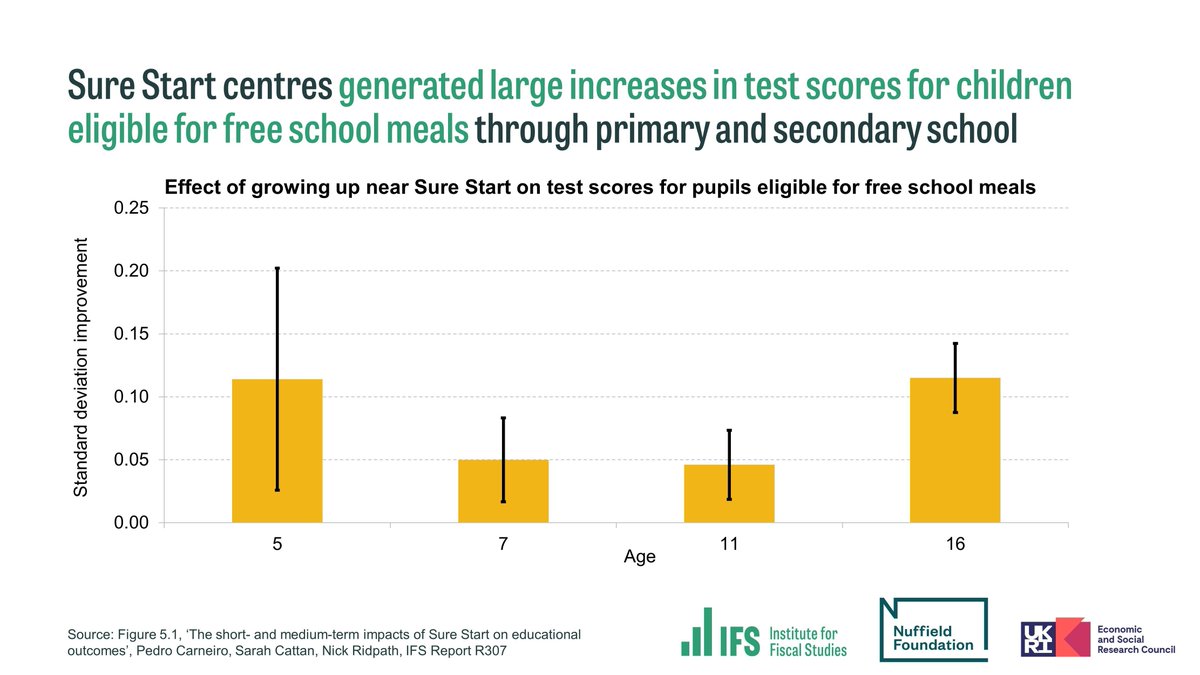
Sizeable effects in standardised tests like GCSEs are rare even for contemporaneous interventions, let alone something that occurred before children were 5 years old. This is important news!
NEW: Sure Start, England’s first large programme to provide holistic support to families with children under five, greatly improved disadvantaged children’s GCSE results.
Read @nridpathecon@Sarah_Cattan@carneiro_econ’s report, funded by @NuffieldFound: https://t.co/NiHZzVES3W
Just published in the AER! Our new paper shows the importance of igniting children's curiosity in the classroom. We show how heightened curiosity boosts knowledge retention and fuels peer learning in the classroom. @EUI_EU@JPAL@BilkentEconDept
'Ethics is no less an issue in education than in medicine, so shouldn’t teachers, like physicians, have a framework that helps them navigate moral dilemmas at work?' Big fan of Meira Levinson's work https://t.co/VHxK6aMsp7
This is *very* related to a paper I am just finishing! Relieved but also saddened that my findings about boys in Wales align closely with these. @lukesibieta I may have a mechanism for you
Response from one of the largest Multi Academy Trusts to government plans to introduce a "minimum service level" re: teacher strikes.
"The policy in its current form is wrong in principle and in its details and likely to be self- defeating in practice."
https://t.co/aPJWaGjbIA
Opinion: Predicted grades erode equity. The UK should reconsider abolishing them
We must research the impact of predicted grades on students’ well-being and learning behaviour at a critical stage in their education, says Luke Ellmers https://t.co/WQFUfKwJOr
Tackling inequalities involves government polices being influenced by robust, world-leading research.
For over 30 years @MiSoC_Essex has been a powerhouse for delivering just that.
Read more here: https://t.co/sx7HySRW8Q
@iseressex@ESRC