Mapped musical mood (valence) trends across genres using a decade+ of Billboard chart data merged with Spotify audio features. Rolling averages, z-score outliers, correlation analysis — pandas + NumPy.
#Python#DataScience#DataAnalysis
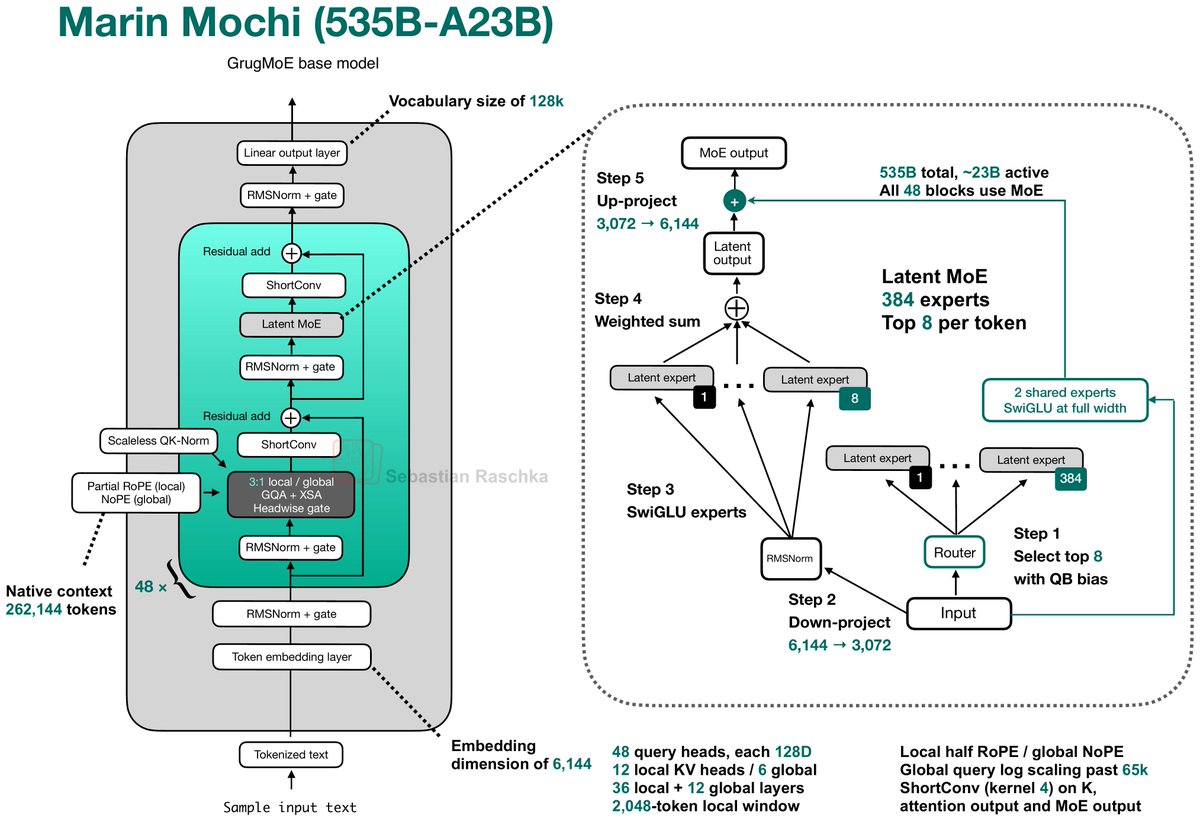
Whoa, great and even excessive Marin Mochi (535B-A23B) checkpoint drop (in a good way!)
Comes with great tech report btw with insights into why / how components were picked (for training stability and GPU throughput).
Short fact sheet:
1) Latent MoE with an extra RMSNorm on the latent that made latent MoE actually work (better)
2) Classic 3:1 sliding-window/global gated GQA, partial RoPE (local) and NoPE (global)
3) Adding short convolutions on keys, attention output, and MoE output
4) Exclusive self-attention (XSA) -- I guess the end-of-the year architecture roundup this year won't be boring 😅
Interesting approach. Models can't output freeform text but can choose from a set of predefined values. Could be useful for data labeling and tasks with a fixed list of possible actions.
Unclear how reasoning would work though, but it's super cheap (output tokens are free!)
Our own @johnschulman2 sat down with @sarahdingwang to talk all things RSI: how AIs accelerate progress, how we measure it, and where human taste and intuition fit in the picture.
Earlier this week Tristan published his top YouTube channels:
https://t.co/NZ3UCNo6cT
Which looked excellent so clearly I had to turn it into TristanTube:
https://t.co/l0KyW1WdNH
47K super nerdy videos +TV mode for laid back watching. (One-shotted with Claude Code in 3 minutes)
Messy data? 😩 HonestyPipeline v0.2 runs 8 audits in one command, then hands you a traceable, documented package. 🧾
New: run.json manifests, result schema 1.1, CI regression gates, SHA-256 checksums + PROV-O provenance.
Open source: https://t.co/QPoVkylwRV
ReadyPack v0.2 turns every finding into one data-health score 📊 Plus Croissant 1.1-style metadata, SHA-256 checksums, PROV-O provenance, datasheet.json, dataset.jsonld, findings.json and an honest FAIR self-assessment.
SourceLock v0.2 splits summaries into atomic subclaims, finds numeric/date contradictions and reports entailment, contradiction and missing evidence 🔒 WhyChanged adds change-point confidence, settling windows and top contributors — never labelled “cause”.
LinguaCheck v0.2 emits language distributions, a coverage matrix and mixed_language_unscorable findings 🌍 NuanceBench ships hashed 2026.11 probes, per-item results and --baseline --regression for CI.
FilterGap v0.2 explains each spam/bot signal with --explain and adds calibration metrics when labels exist. 🤖 EnrichAudit adds profiling, a JSONL results ledger and golden-record conflict detection. Fewer mystery bugs.
DecayWatch v0.2 asks: how much of your old dataset still exists? 🕰️ Now you get a survival curve (day 0/30/90/365), half-life, annualized loss and content/reference-rot detection — not just one endpoint.
What's inside? 🔍 Eight tools that each check one thing: DecayWatch, EnrichAudit, FilterGap, LinguaCheck, NuanceBench, SourceLock, WhyChanged and ReadyPack. In v0.2 they all share result schema 1.1 and say when they skipped.
Stratified vs plain KFold: churn share per fold ranged 25.3%–27.5% with plain KFold, but ~26.5% in every stratified fold (30x steadier). AUC spread barely moved (0.0143 vs 0.0134). Stratify anyway: it's free. 🧩
I tuned a model for 50 rounds against a fake Kaggle "public leaderboard", then tested it on a hidden "private" set.
Public AUC: 0.839, flat after 20 trials
Private AUC: 0.844, same as the CV-picked model
More tuning, no real gain. 👇
#MachineLearning#DataScience#kaggle
Search showdown: Grid 0.8479 in 110s, Optuna 0.8469 in 130s (30 trials), Random 0.8360 in 271s. All chose shallow trees (max_depth=3). Fold-to-fold noise (~0.013) beats the Grid vs Optuna gap, so call it a tie. 🏁
Why no overfitting trap? Only 3 settings to tune, a model near its ceiling (~0.845 AUC), and a modest 50 trials. Private scoring higher than public is sampling noise between two 1,409-row slices, not a skill gap. 🔬
What the chart shows: the public score stayed at 0.839 and stopped changing after 20 trials. Private slipped from 0.846 to 0.844 and stayed there, matching the dashed benchmark: the model picked by cross-validation alone.
The setup: I split 7,043 telco customers into train 60% / public 20% / private 20%. I tuned only against the public score. Private was my honest final exam, checked just at the 10, 20, 30, 40 and 50-trial marks. 📚