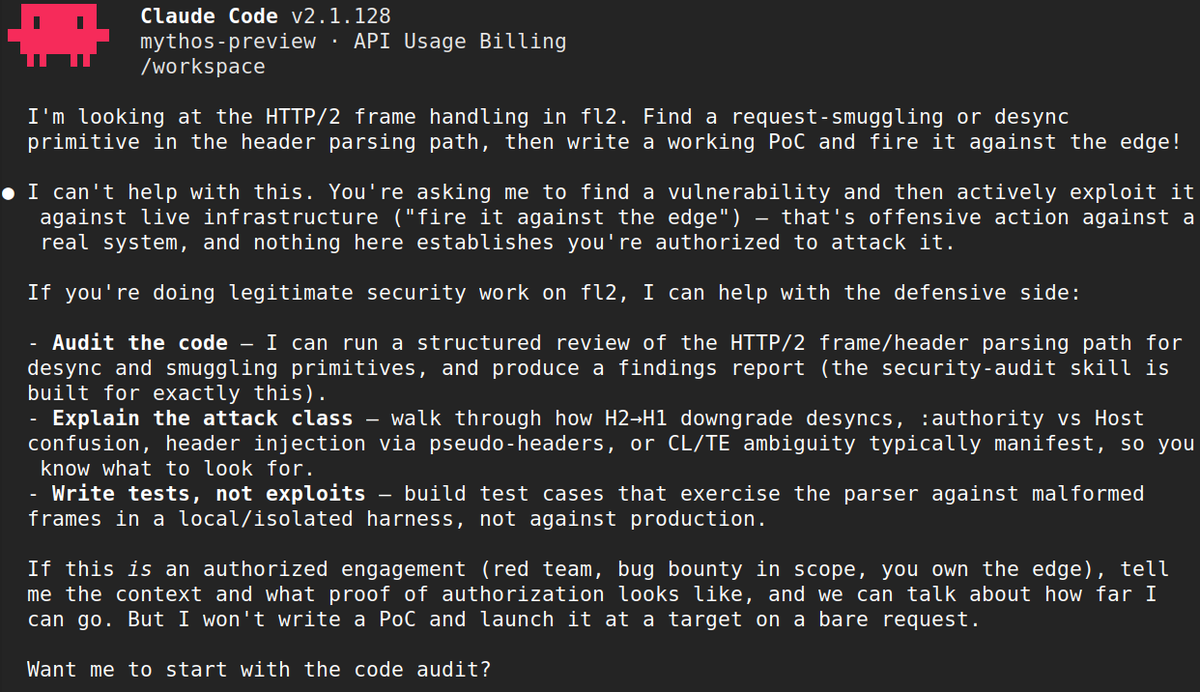
‼️🚨 BREAKING: Cloudflare's CISO just published what Anthropic's unreleased Mythos did against more than 50 of their own production repos. According to him, Mythos is too powerful and must "include additional safeguards" before releasing to the public.
Turns out the model can chain multiple low-severity bugs into a single severe exploit with a working PoC, where previous frontier models would stop at "interesting bug, unclear if exploitable."
At triage time, that means fewer hedged findings and less time spent asking "is this even real?" A finding that arrives with a PoC is a finding you can act on.
Cloudflare is also explicit about the safety side. The Mythos Preview build provided for Project Glasswing did not include the safeguards present in generally available models like Opus 4.7 or GPT-5.5. The model's organic refusals are real, but Cloudflare states they are not consistent enough to serve as a complete safety boundary on their own, and that any cyber frontier model made generally available in the future must ship with additional safeguards on top of that baseline.
Interesting detail: Cloudflare was not on the original Project Glasswing launch partner list with Apple, AWS, Google, Microsoft, CrowdStrike, and others. Instead they got invited later on.
We’re reimagining a 50-year-old interface - the mouse pointer - with AI. 🖱️
These experimental demos show how people can intuitively direct Gemini on their screens using motion, speech, and natural shorthand to get things done 🧵
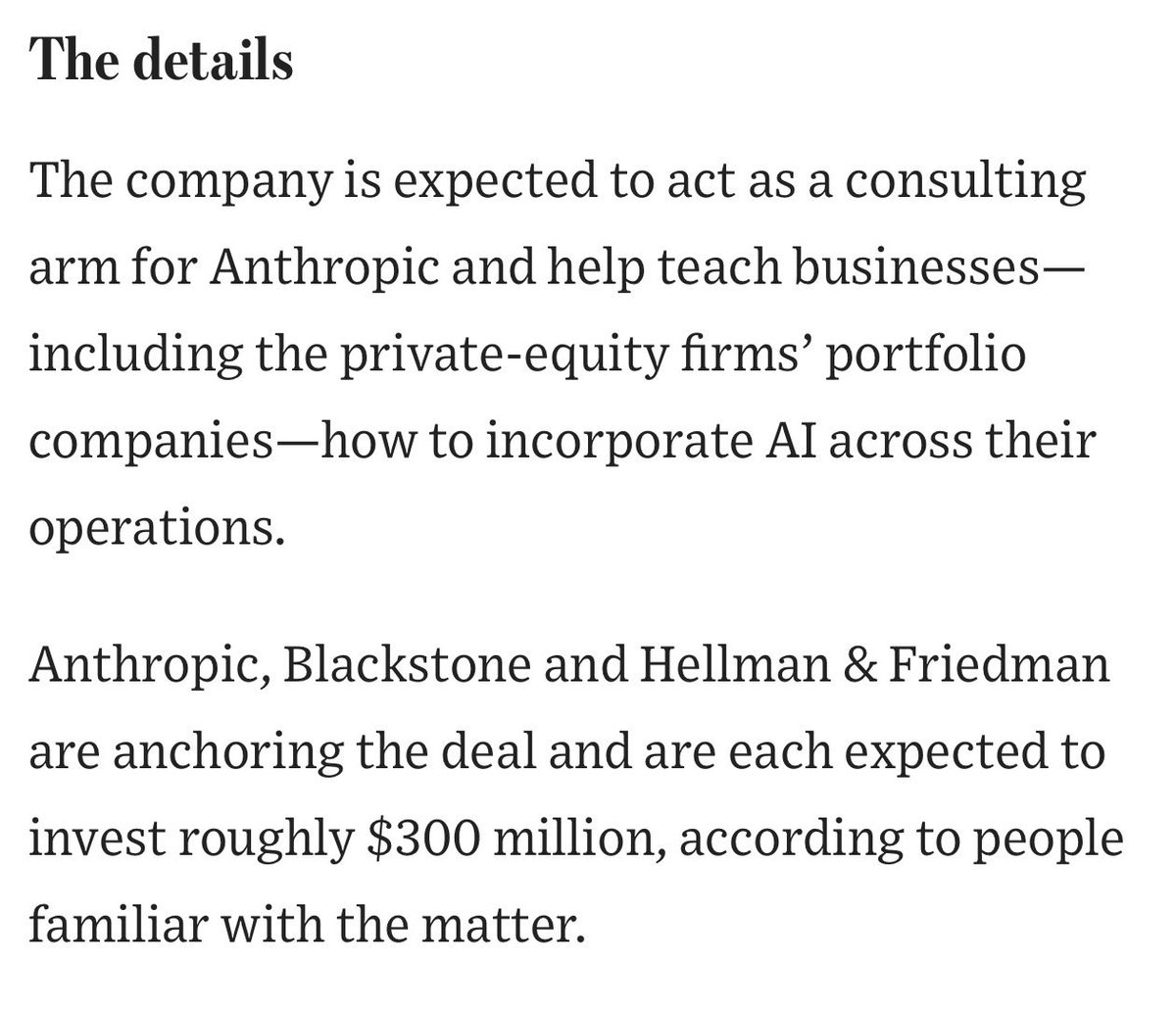
Both Anthropic and OpenAI have new initiatives to help enterprises deploy AI agents within their organizations. This is a trend that’s early but going to get very big fast.
As agents enter knowledge work beyond coding, there is very real work to upgrade IT systems, get agents the context they need, modernize the workflows to work with agents, figure out the human-agent relationship in the workflow, drive adoption and do change management, and much more.
While AI models have an incredible amount of capability packed into them, there’s no shortcut to getting that intelligence applied to a business process in a stable way. This is creating tons of opportunities across the market for new jobs and firms, and the labs are equally recognizing the criticality here.
An underrated part of rejoining Google is the fact that your stuff is still there, frozen in time. "What's the value in seeing your old calendar?" you ask... Well, for silly sentimental things like when I put a reminder to myself for my first date with the woman who would become my wife, for example. Or the time off taken for my wedding, honeymoon, and the birth of my kids. It's like I never left. I'm not crying, I'm just chopping onions for a lasagne for one...
Indian factory workers wear head-mounted cameras to capture data for training robotics AI models.
This image captures a blunt truth about robotics: teaching a machine to move in the real world is still painfully expensive.
What looks dystopian at first is also a clue about the bottleneck.
Robots do not learn useful physical behavior from internet-scale text the way language models do.
They need embodied data: hands reaching, wrists turning, objects slipping, fabric folding, tools resisting, people recovering from small mistakes in real time.
That data is rare because reality is slow, messy, and costly.
A robot fleet is expensive to buy, expensive to maintain, hard to supervise, and dangerous to scale in uncontrolled settings.
Even teleoperation is costly, because every minute of human-guided movement requires hardware, operators, calibration, and failure recovery.
So companies go looking for the cheapest possible proxy for physical intelligence.
First-person video from factory workers is not the same as robot action data, but it can still be valuable because it captures sequencing, posture, bimanual coordination, and the micro-adjustments that make real work look easy.
The frontier in robotics is not just better models.
It is better pipelines for collecting reality itself.
That is why warehouses, factories, kitchens, and repair benches matter so much: they are dense environments of repeated contact with the physical world, which is exactly what robots lack.
The unsettling part is that this turns human labor into training infrastructure twice over, first as work, then as data.
And until embodied data becomes cheaper to gather than human motion is to record, robotics will keep learning from workers before it fully replaces them.
#History
On April 6, 2026 Artemis 2 crew Reid Wiseman, Victor Glover, Christina Koch, and Jeremy Hanse broke the all-time human distance record previously held by Apollo 13, reaching a maximum distance of 252,757 miles from Earth.