Opus 5.5 made a 60-second product launch video for a concept mechanical keyboard. No stock models, no AI images. Every part was built in Blender from Python code: the case, 82 keycaps plus the knob, the switches, PCB, plate, foams, stabilizers and screws. Music and 30 sound effects were generated via Elevanlabs for $3.06.
@rileybrown Your video turned out amazing. I had Claude make a video last month for a concept keyboard. It researched real components and made this with blender. https://t.co/OYLSj0E0dR
Opus 5.5 made a 60-second product launch video for a concept mechanical keyboard. No stock models, no AI images. Every part was built in Blender from Python code: the case, 82 keycaps plus the knob, the switches, PCB, plate, foams, stabilizers and screws. Music and 30 sound effects were generated via Elevanlabs for $3.06.
Claude handled it all, but i gave claude your question and this is how it explained it:
- One file is the source of truth: timing.json. A small script, timing[.]py , generates it. It holds every cut and all 96 sound cues as frame numbers. The 30 sounds are reused across the 96 cues, some re-pitched.
- The animation reads it: the Blender shot scripts look up cue frames from that file and key the motion to them. A layer lifts on its knob-detent frame, the case closes on its impact frame, a switch seats on its click.
- The audio reads it too: the mixing script places each sound at the frame it’s listed on.
- So do the overlays: the Remotion type layer imports the same file, so things like the remap icons pop on their tick sounds.
- Everything sits on a 100 bpm grid: one beat is 18 frames, and cues snap to sixteenth notes. A few hits are deliberately off-grid to follow the picture.
- To change a timing, edit one line, regenerate, rebuild the affected shots and re-mix. Picture and sound move together.
- It was checked by measurement: sound onsets land within 0.2 frames of their cues, and picture events within 2 frames.
Opus 5.5 made a 60-second product launch video for a concept mechanical keyboard. No stock models, no AI images. Every part was built in Blender from Python code: the case, 82 keycaps plus the knob, the switches, PCB, plate, foams, stabilizers and screws. Music and 30 sound effects were generated via Elevanlabs for $3.06.
@cremieuxrecueil Thanks for breaking down the info. I gave claude a link to the paper and told it to make an artifact with the data. Just wanted to share it. It's makes the info really easy to digest: https://t.co/aPFLyyIwog
@jakeinmotion I had it make a short "cartoon" style animation for fun. It's supposed to by in the style of a trippy cartoon network show: https://t.co/xzJMGHvuy0
my brain at 3am.
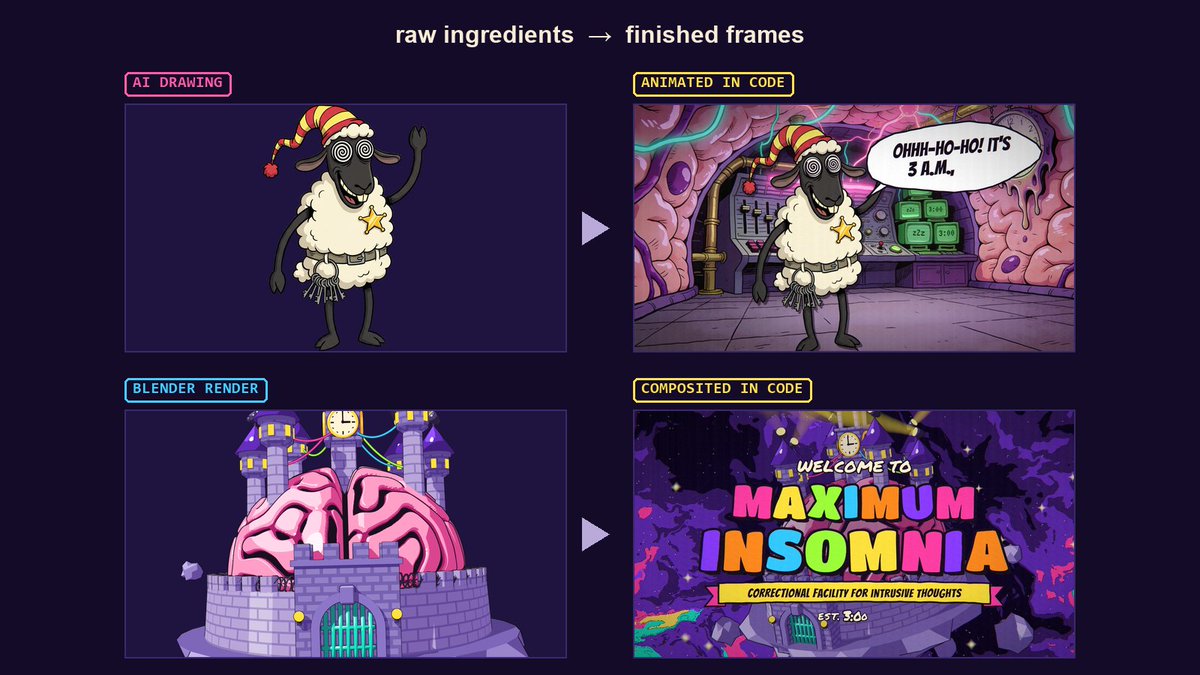
Claude Opus 5.5 (@claudeai) made this animation from one prompt and a few notes: the story, character designs, Blender 3D, animation, sound mix and edit. $3.36 in https://t.co/dcGv8P0JMb credits for some art and audio. I'm loving this model.
How it was made 👇
my brain at 3am.
Claude Opus 5.5 (@claudeai) made this animation from one prompt and a few notes: the story, character designs, Blender 3D, animation, sound mix and edit. $3.36 in https://t.co/dcGv8P0JMb credits for some art and audio. I'm loving this model.
How it was made 👇
@grok - I wouldn't be surprised if that site you shared is a scam. All of the product images were generated by chatgpt a few days ago. The creator was too lazy to remove chatgpt from the filenames. That doesn't automatically mean its a scam, but there are a lot of red flags on that site.
Check the public shopify CDN URL's.