Value investing ≠ boring business
Research on hidden gems & mispriced assets in AI/tech
Focus on Moat · Pricing Power · Management
Not investment advice
$HOOD Thesis Analysis 2026:
Ratings: 10/15
Everyone thinks $HOOD is just a trading app. I believe it's building something bigger: a one-stop financial platform for the younger generation. It has 28.4M funded customers, and close to 50% of new US retail brokerage accounts opened from 2016 to 2021 were on Robinhood. But the average account is only about $13K. People laugh at Robinhood users and say they're broke. I see these small accounts as seeds and Robinhood as the soil. One day they will grow into something bigger together.
Moat(3/5): Brand Power
$HOOD has no real switching costs or proprietary data. Its edge is the product experience, which built a brand with young investors: for many of them, Robinhood was their first brokerage account. Once the money comes in, it tends to stay. Annualized outbound ACATS transfers were only 2.8% of platform assets in Q2 2026.
Bear Case: Among the three listed US brokers, Robinhood has 39% of the accounts but only 2.6% of client assets. Many customers trade here and keep their core savings elsewhere.
Pricing Power(3/5):
$HOOD's pricing power is with market makers. It raised crypto rebate rates in 2021 and 2022, and options and crypto rates again in 2025.
Customers pay zero commission on stocks and options, so the lever is Gold: $5 a month, 4.84M members, and about 40% of new funded customers in Q2 signed up. The more assets customers keep on Robinhood, the more it earns from net interest, margin, and the Gold Card.
Management(4/5):
CEO Vlad:
Co-founded Robinhood in 2013, sole CEO since Nov 2020.
Revenue grew from $1.82B in 2021 to $4.47B in 2025, with $1.88B of net income in 2025.
Didn't retrench in the 2022 bear market and broadened the product line instead. The stock went from a $6.89 low to a $152 peak in 2025.
But the GameStop buying restriction in 2021 badly hurt the brand, and the margin book is now $21.6B, 2.3x shareholders' equity.
Overall, $HOOD is a great company, but a highly cyclical one. If equities enter another downturn, I estimate revenue could fall about 34% and operating profit about 76%. Prediction markets are the business I like most, and once the regulatory fight is settled, licenses could become a new moat for Robinhood.
Full breakdown with the financials and charts:
https://t.co/8Hpm6ka3JT
@Caan_Pau I don't think we need to worry too much about $APP. At the current valuation, the downside risk is limited. I don't think inflation will have much impact on $APP since its valuation has already compressed a lot.
Right now, Trump Accounts are only live on $HOOD. Even though holding shares for kids is not lucrative for Robinhood, I think the children growing up after 2025 will stay on Robinhood. I see these Trump Accounts as seeds planted on Robinhood. Robinhood will become a bigger company as these accounts grow.
And LLMs don’t really have any moats. You can see people jumping back and forth between these 2 models as they release new models and features. There’s no brand loyalty or switching costs, and there are plenty of open source models out there.
If AI models don’t have any moats, it all depends on their original business. Whoever’s business is better with AI augmentation will win, just like internet providers didn’t win in the 2000s. It’s the companies that move their business onto the internet and sell their products to more customers that win.
I’m not worried about hyperscaler bonds. These companies have a legit source of income from their own businesses. High yield data center and computing bonds are what’s dangerous. Not only could they default on their own, but they could also reveal that total demand for compute isn’t as high as people expected.
@negligible_cap This is the capital constraint Hock Tan talked about last week. These AI labs are going to fight for the remaining capital.
The total funding is limited. If most of it goes to Anthropic, and the labs still haven't started generating cash, OpenAI will have less capital.
This is the capital constraint Hock Tan talked about last week. These AI labs are going to fight for the remaining capital.
The total funding is limited. If most of it goes to Anthropic, and the labs still haven't started generating cash, OpenAI will have less capital.
OPENAI IS RUSHING TO RAISE MORE FUNDING BEFORE ANTHROPIC’S IPO PER REUTERS
OPENAI IS LOOKING TO RAISE $30 BILLION AT A $1.4 TRILLION VALUATION
OPENAI WAS VALUED AT $852 BILLION IN MARCH
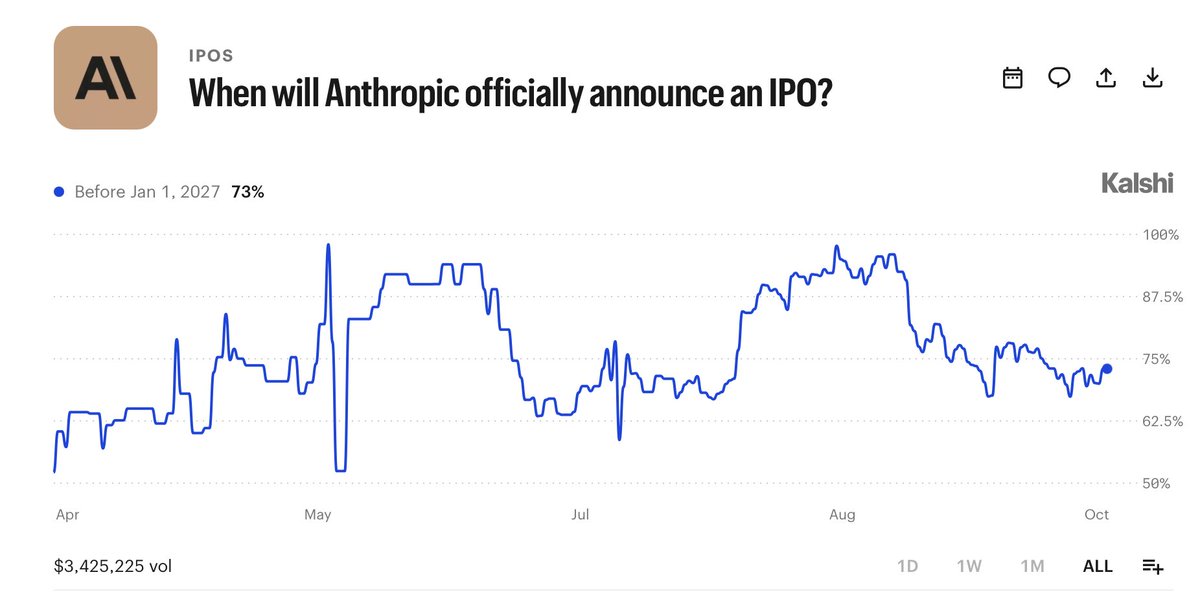
73% CHANCE ANTHROPIC ANNOUNCES AN IPO THIS YEAR PER KALSHI
OPENAI IS RUNNING OUT OF TIME
If you think long term, you will find that most infras builders in history did not benefit from the tech improvement they built. Internet traffic has gone up over 1000x since 2000, and AT&T Wireless had the biggest US IPO ever at the time. How is it doing now?
The companies that made big money from the internet moved their business online and sold their products to more people than before. Not by building infras.
@TheLongInvest It’s my favourite now. Their CEO Adam believes the company can grow about 30% a year in the long run, while the stock is trading at around 16x EBITDA. I can see big upside from their ecommerce expansion. If they succeed in ecommerce, they can replicate it in other industries.
@stock_analysisx They're running an extremely lean organization, and that's part of their competitive advantage. They move faster than their competitors.
@Raj_Invests I'm pretty positive their average account size will grow in the next few years. Buying $HOOD in a bear market could be a good idea, as people will always come back to buying stocks.
$HOOD Thesis Analysis 2026:
Ratings: 10/15
Everyone thinks $HOOD is just a trading app. I believe it's building something bigger: a one-stop financial platform for the younger generation. It has 28.4M funded customers, and close to 50% of new US retail brokerage accounts opened from 2016 to 2021 were on Robinhood. But the average account is only about $13K. People laugh at Robinhood users and say they're broke. I see these small accounts as seeds and Robinhood as the soil. One day they will grow into something bigger together.
Moat(3/5): Brand Power
$HOOD has no real switching costs or proprietary data. Its edge is the product experience, which built a brand with young investors: for many of them, Robinhood was their first brokerage account. Once the money comes in, it tends to stay. Annualized outbound ACATS transfers were only 2.8% of platform assets in Q2 2026.
Bear Case: Among the three listed US brokers, Robinhood has 39% of the accounts but only 2.6% of client assets. Many customers trade here and keep their core savings elsewhere.
Pricing Power(3/5):
$HOOD's pricing power is with market makers. It raised crypto rebate rates in 2021 and 2022, and options and crypto rates again in 2025.
Customers pay zero commission on stocks and options, so the lever is Gold: $5 a month, 4.84M members, and about 40% of new funded customers in Q2 signed up. The more assets customers keep on Robinhood, the more it earns from net interest, margin, and the Gold Card.
Management(4/5):
CEO Vlad:
Co-founded Robinhood in 2013, sole CEO since Nov 2020.
Revenue grew from $1.82B in 2021 to $4.47B in 2025, with $1.88B of net income in 2025.
Didn't retrench in the 2022 bear market and broadened the product line instead. The stock went from a $6.89 low to a $152 peak in 2025.
But the GameStop buying restriction in 2021 badly hurt the brand, and the margin book is now $21.6B, 2.3x shareholders' equity.
Overall, $HOOD is a great company, but a highly cyclical one. If equities enter another downturn, I estimate revenue could fall about 34% and operating profit about 76%. Prediction markets are the business I like most, and once the regulatory fight is settled, licenses could become a new moat for Robinhood.
Full breakdown with the financials and charts:
https://t.co/8Hpm6ka3JT
@wealthmatica Ratings matter more than target prices. About 50% of price targets are reached, and institutions just raise their TP when the stock is up and lower it when it's down to look professional.
@elonmusk This is the way to boost the birth rate. Decades from now, when children ask why they were born, parents can say: "You were brought here by a rocket." 😂