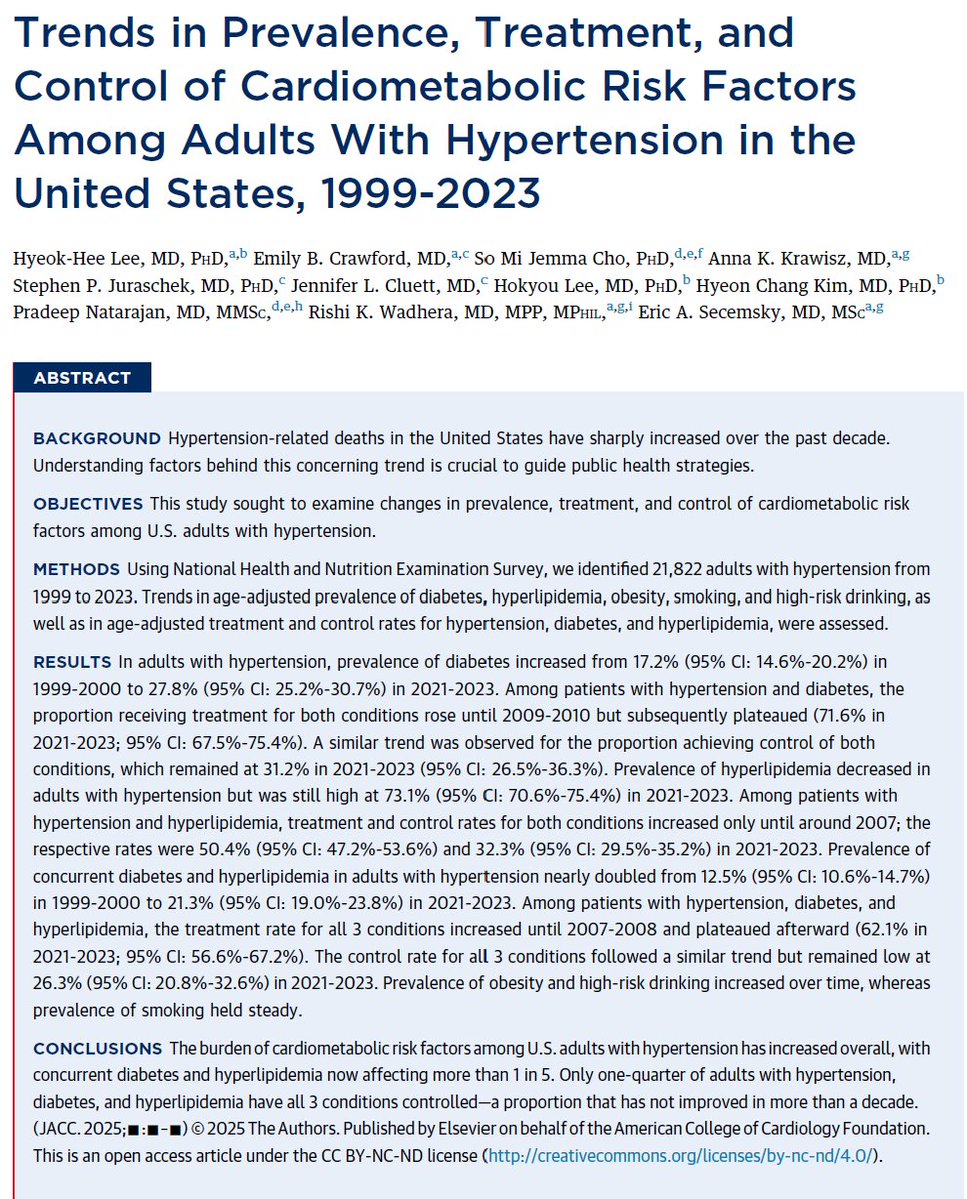
1/ In lieu of 🦃, super excited to share our work on the prevalence, treatment, and control of cardiometabolic risk factors (CMRFs) among US adults with hypertension—now out in @JACCJournals!
https://t.co/PheGg4V5fo
The new NCDR Renal Denervation Module from @ACCinTouch, developed with the Smith Center, is open for enrollment!
Learn more about this collaboration and join more than a dozen sites already enrolled in the RDN Module: https://t.co/vWOFX6mWsO
@EricSecemskyMD@AKrawisz
Some take aways from what we know about HORIZONS phase 3 trial of Lp(a) lowering
1. We know very little. We only know the primary endpoint in the entire population.
2. We do not know if some subgroups may have benefited more like those with a higher baseline Lp(a).
3. Do those who were not on dual or single anti platelet therapy benefit?
4. Did efficacy vary by baseline and on treatment LDL?
5. Did efficacy vary by achieved Lp(a)?
6. We need more sophisticated analyses of the particle composition and oxidizing potential of the patient’s Lp(a) particle to assess for heterogeneity in response.
7. Were the results different in MI patients vs stroke vs PAD patients? These vascular beds behave differently in response to therapeutic interventions.
8. Were the results different in patients with single vessel disease vs multivessel disease where there were more targets for modification.
9. This was a time to first event analysis and not a time to any event analysis (a multiple event analysis). A multiple event analysis captures disease burden and may be more highly powered.
10. For those who were on dual antiplatelet therapies, once these were discontinued, was there an event reduction which would suggest optimal antiplatelet therapy may have reduced residual risk so much it could not be modified?
11. Much has been made of observational data suggesting aspirin may modify risk in patients with an elevated Lp(a). Was there an interaction with aspirin therapy ?
12. Mendelian randomization / genetics captures lifetime exposure and not several years of exposure as in this trial. Were the KM curves diverging late suggesting prolonged therapy might have been needed?
13. Were the assumptions regarding the magnitude of the potential efficacy signal too optimistic and was the trial underpowered?
14. In a trial this long patients may go missing. How good was the follow up? Was there informative censoring?
15. The results of primary prevention trials where LDL lowering and antiplatelet therapy may not have been as aggressive may still show benefit.
16. This ONE trial does not negate the potential causal role of Lp(a). The LDL and antiplatelet therapy may have reduced residual risk so much that there was very little risk to be modified. A trial Lp(a) lowering only would share more light on this question (a trial will never be done). What would happen if all patients were on Lp(a) lowering therapy. Would LDL lowering further improve outcomes? We don’t know for sure.
17. Was there an interaction with CRP, gender age risk score?
18. Obviously there are more questions than answers at this point. I raise these questions as exploratory hypotheses, to further our understanding of the biology, not to salvage a neutral trial.
We all anxiously await the full recitation of results and answers to these questions as well as others.
Thank you to the patients who participated.
Breaking and MASSIVE:
Lowering Lp(a) with #pelacarsen in patients with elevated Lp(a) and heart disease does NOT improve cardiovascular outcomes in Phase 3 trial https://t.co/QrN5I3NNlc
Wow!
Unexpectedly, #LpaHORIZON P3 global CVOT of pelacarsen (ASO) does not show reduction in 4-point MACE in 8,323 patients with elevated Lp(a) and established CVD.
https://t.co/JNRApyUYAB
SWITCH-SWEDEHEART is a comparison between policies, not between drugs. The policy-recommended agent was dispensed to 75.8% of patients in the ticagrelor-policy group and 60.6% of those in the prasugrel-policy group. Why did patients in the prasugrel-policy group experience less bleeding? Among the 40% of patients who did not receive prasugrel, 10% received ticagrelor and 30% received clopidogrel (so, a de-escalation). But there was also a whole range of treatment switches and dose adjustments among patients who did follow the assigned policy during the trial. In my opinion, the comparison between the two drugs is very interesting (in some respects, it helps demystify some concerns about ticagrelor’s efficacy), but because of issues arising from secular trends in a stepped-wedge, cluster randomized trial and the imperfect concordance between the assigned policy and the treatment actually received, this is anything but a pure head-to-head comparison. #ESCCongress https://t.co/9XCuEszIB5
Prasugrel versus Ticagrelor in Acute Coronary Syndromes: @NEJM#ESCCongress2026#ESCCongress
🥸 So many good trials - and STAREE is coming - SWITCH-SWEDEHEART
😱 Effient vs Brilinta in ACS - take a look
👇👇👇👇
Good summary of A-CLOSE comparing clooidogrel monotherapy to DAPT high ischemic risk patients.
Big lesson: NACE is not a meaningful endpoint when there are tradeoffs.
And unless you're willing to take on mortality risk to avoid minor bleeding, dapt was a lot better.
He was 51. LDL 62 on a statin. Never smoked. A1c 5.3.
He ran a half marathon eight months before his anterior MI.
His father died at 55. His brother had a stent at 49.
Nobody in three generations of that family had ever had an Lp(a) drawn. 🧵
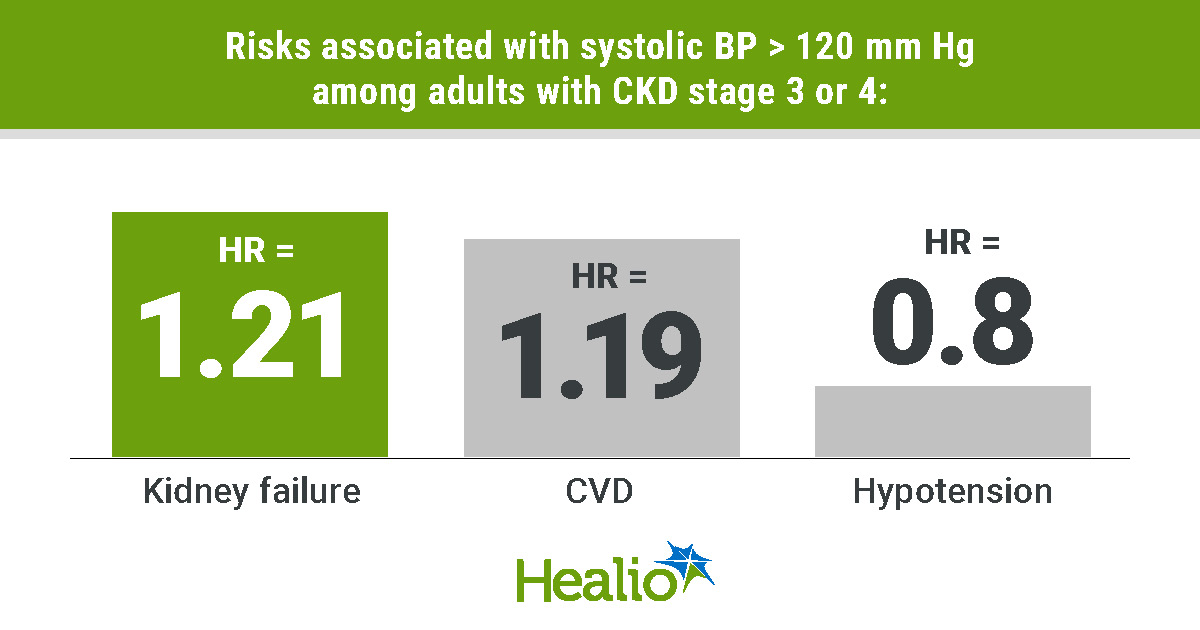
As of 2024, only one in five patients with #CKD had systolic blood pressure within the 2021 KDIGO BP target, according to @harvardmed researchers.
Learn more @GoHealio
https://t.co/WI4K4PuKpK
1/ My fastest paper took one week from draft to done. My slowest is still unpublished 7years on. The difference: a ten minute feasibility check. Trainees I work with earned 6 Merit Awards in 3 years, every project passing it early. Few programs seem to teach this. Let me try
Since everyone has been having fun these days with a syncope management algorithm published in the NEJM, deemed overly simplistic and now turned into a meme, it’s time to resurrect my all-time favorite flowchart, which is just a little more complex.
‼️ The most anticipated trial of the year
#ZEUS IL-6 inhibitor ziltivekimab does not reduce MACE in >6,300 people with ASCVD, CKD, and inflammation
hazard ratio 0.99; 95% confidence interval 0.88 to 1.11
https://t.co/f0jIXdgyvx
End of a really good chapter. On to the next better one!
Thank you @pnatarajanmd for enabling my vision. The last 1852 days were the biggest learning curve and the happiest moments of my life.
For years, Circulation: Population Health and Outcomes has published research that helps shape cardiovascular health across communities and health systems. We're excited to announce Dhruv S. Kazi, MD, MSc, MS, (@kardiologykazi) as the next Editor-In-Chief.
Extending DAPT beyond 12 months reduces ischemic events, and, in the right population, may not increase bleeding events.
We've known this since the publication of the DAPT Study a decade ago, and it still holds true, as shown in this new RCT.
https://t.co/mpUsoKf878
In my view, the result is perfectly logical: in a population at high ischemic risk and low bleeding risk, prolonged DAPT works. The real question is: works compared with what? Today we have several de-escalation strategies and alternative approaches that reduce ischemic risk without the same bleeding burden. The DAPT-MVD trial reinforces a key concept: patient selection is what ultimately determines the net clinical benefit of antiplatelet therapy. https://t.co/iEb48IAwyW
CKM health is worsening in the US, contributing to rising CV morbidity & mortality
Among adults w/ CKM syndrome, only ~1/2 with HTN or hyperlipidemia receive treatment and <1/2 of those treated achieve BP or glycemic control
@JACCJournals | @Gong2Jingyi https://t.co/2oUl1KoCBI
📢 New publication in @JACCJournals led by Christina Lalani, MD
Using transportability methods, this study examines how COAPT trial results translate to real‑world U.S. practice.
🔗 https://t.co/abFrYQsAAu
#OutcomesResearch#Cardiology
There hasn't previously been a treatment vs pancreatic cancer this successful. Striking improved (a > doubling) survival results @NEJM and @ASCO today with daraxonrasib, which also became available via an FDA approved early access program and began shipping to physicians this week @RevMedicines
https://t.co/e04jqJMPw0