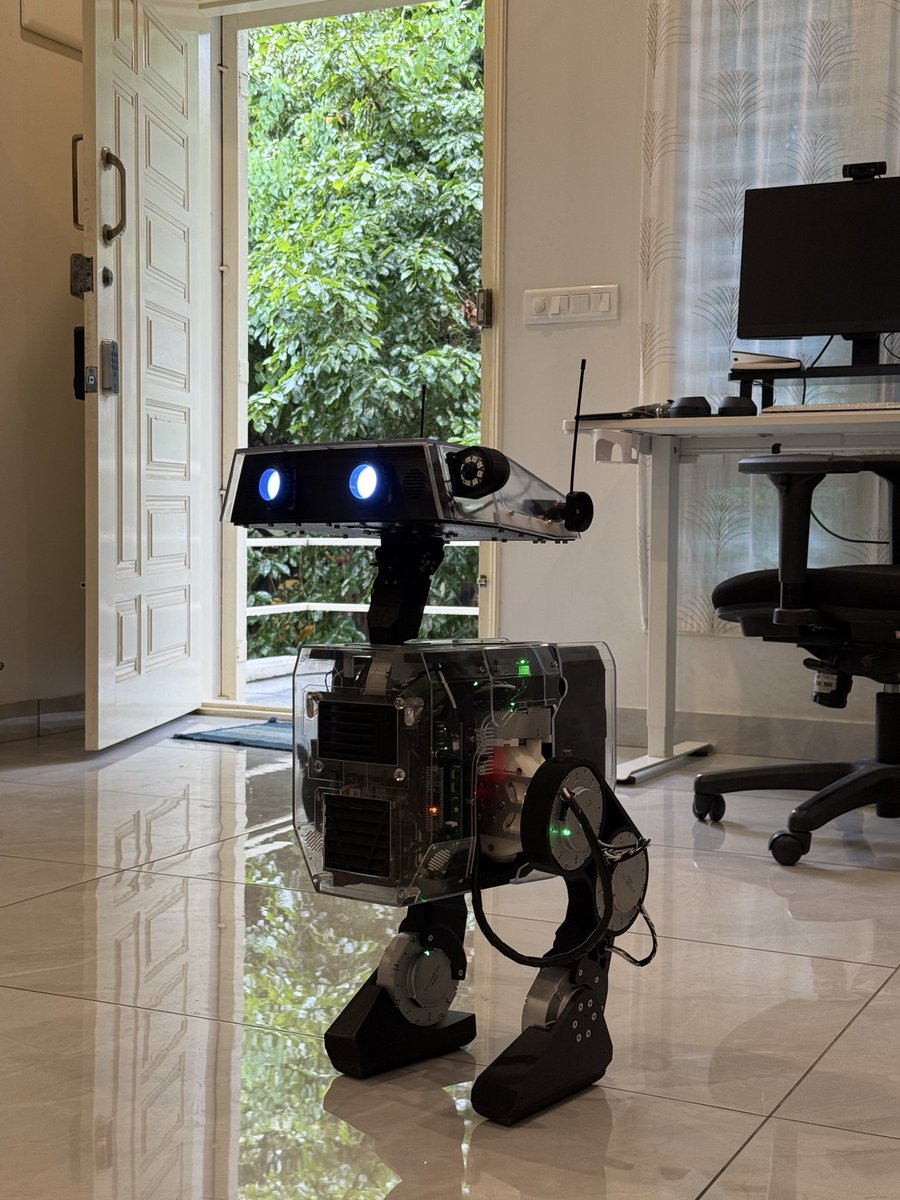
Rise of the robot pets! 🐕🤖
We’re entering the cutest era of robotics.
Engineers are working day and night on the physical AI problems: control, contact, sim-to-real, hardware reliability and getting learned behaviors to survive outside the lab.
And somewhere along the way, we get this.
@_raghuvamsi filmed one of @eyecandyrobots’ characters wandering around the Presidio, where a little girl spotted it and immediately started laughing and playing with it.
There’s something joyfully familiar about that reaction. Before we learn what something is, what it costs or what it’s supposed to do, sometimes we just want to meet it.
@eyecandyrobots is building physical AI characters,
robots designed around entertainment, personality and interaction rather than industrial work.
Founded by @_raghuvamsi, @Mankaran32 and @pr0t0_01, the team brings robotics engineers, animators and designers together to turn animated characters into physical ones.
Underneath the cute exterior is serious robotics work:
☑️Animation-based reinforcement learning for character motion
☑️ Artist-centric human-robot interaction
☑️Mechanical, electronics and AI systems designed to scale across different characters
☑️ Simulation, SLAM, deep learning and control-policy deployment on real hardware
The transparent little robot really looks like that.
I asked Eyecandy engineer @hi_gpaul how they made its clear body: it’s 3D printed using transparent resin, followed by “a bunch of post processing.”
Eyecandy is backed by @fdotinc and Lightspeed India, and the team is already thinking beyond a single character.
The robots are becoming useful.
I’m also very happy that some of them are becoming friends. 🦖
🔗 https://t.co/odDpP6uvLY☑️
⭐️ @BotNewsAI stay connected to emerging tech
For robotics x AI, @eyecandyrobots is most excited about animated characters entering the physical world.
A lot of pushing boundaries around RL, human-robot-interaction, mechanical designs.
I still remember the day when Abhishek (@levelheaded_94) told me to design, build and deploy this device, and I said its not possible. But somehow, we were able to pull this off!
Building the capture device has been one of the highest points of growth and learnings for me. And I’m finally glad that we are now able to showcase this to the world.
Huge thanks to @levelheaded_94, @satpalsr and the entire @fpv_labs team for giving me the oppurtunity to work on this. My time with FPV Labs has since wrapped - but seeing this released to the world is something that I would be proud of forever ✌️
🚨 New Open Source Release
Today we are releasing Ego-OSCAR, an open-source head-mounted stereo-inertial capture device for egocentric data collection in the wild, together with a corresponding dataset of 550 hours captured across 100+ environments.
Egocentric data is still an active research problem, and we believe an open and accessible foundation will empower everyone to participate, experiment, build, and contribute to this space.
This continues our past efforts, where we open-sourced Stera, a full-stack capture and processing pipeline for RGB-D data. Ego-OSCAR builds on that lineage and offers a fully open-source stereo-inertial capture stack for anyone working on human-to-robot transfer.
We make three core contributions today with Ego-OSCAR:
1. An open-hardware capture device with full CAD, wiring, and assembly documentation, with a complete bill of materials under USD 200 and using commercially available components and 3D-printed parts.
2. An open-source capture pipeline (recording daemon, IMU sampler, time-sync tooling, watchdog firmware).
3. The Ego-OSCAR-550h dataset, approximately 550 hours of egocentric stereo video per camera with synchronized IMU, released to validate the device at deployment scale.
Everything is open-source, including the hardware designs, capture pipeline, firmware, and the downstream dataset.
Read the full blog at: https://t.co/qbEm8unXjw
EVEREST — India’s first full-flow staged combustion (FFSC) rocket engine.
80-tonne class. Fully integrated. Designed and manufactured in Bengaluru, India.