👁️The most dangerous AI failure in the DoW will not look like a hallucination.
👁️It will look formal, defensible, and audit-ready.
👁️Then it will be approved, inherited, and believed.
👁️I call that pathway the Reliability Kill Chain
👁️Why "human in the loop" is not enough:
A glimpse into the designer’s mind, and the very human thinking behind @1x NEO @radbackwards.
Things you probably didn't know about @1X:
👻 NEO Beta used to scare children.
🛋️ NEO’s design was inspired by @radbackwards couch.
✍️ NEO’s head is removable and can be 3D printed.
👵 The grandparents in their commercials are real family members.
🪵 They built their own wood shop to furnish NEO’s world.
At @TheHumanoidHub conference, Dar revealed how Astra and recent AI advancements are dramatically accelerating 1X’s creative and industrial design processes.
Read the article to find out how they are expediting those workflows ⬇️
Follow @BotNewsAI for the latest on emerging tech
Robots keep losing information in translation.
▪️A camera frame can tell a hand where an object is, but not necessarily where it will be 200 milliseconds later. Human fingers can demonstrate a grasp, but that motion has to survive conversion into a robot hand with different joints and limits. A photorealistic scan can look right while still being useless for physics if its collision geometry disagrees.
Those were three versions of the same problem at @NianticSpatial × @RLWRLD_ai.
▪️RLWRLD showed teleoperation from a Quest 3S into two different dexterous hands, then RLDX-1 handling a conveyor task after training only on the slowest and fastest of four belt speeds. Its Motion Module uses information across frames so velocity remains available to the policy instead of being reconstructed from a still image.
▪️Niantic preserves a different kind of information. Its real-to-sim pipeline derives a Gaussian splat and collision mesh from the same reconstruction, keeping what the robot sees aligned with what the simulator says it can hit. The result can go directly into @nvidia Isaac Sim / Isaac Lab.
🔹Both companies are building with NVIDIA from different directions. That doesn’t make them an integrated stack, but it does put the representation boundary in a useful place:
physical world → simulation → policy → different physical body
Every arrow is an opportunity to throw away something the robot later needs.
🤖 Melania Trump Put LeRobot in School. Then the Map Got Bigger.
On Sept. 15, kids at Mountain View Elementary were learning beside @NVIDIA Jetson Nano-powered robotics kits and arms that appear to be @huggingface SO-101s.
Two weeks later, the surrounding strategy had moved fast.
🇮🇱 Israel’s Ministry of Education signed with @intel on AI + STEM education.
🌍 @FLOTUS Fostering the Future Together grew to 57 countries.
💰 Its tech partners committed $23M +.
🇺🇸 Federal AI language became “SI.” @realDonaldTrump@elonmusk@finkd@JensenHuang@sundarpichai@LisaSu
Those elementary students reach 18 around 2033–2039.
By then, the valuable robotics work may sit beyond today’s software friction: electrical repair beyond a humanoid’s dexterity, fleet recovery, safety systems, deployment architecture, and infrastructure robots cannot rebuild for themselves.
@SphoenixAI 👩🏼💻I followed one classroom robot into the workforce these kids may inherit.
⭐️ https://t.co/yBu9LN2eOH
It Feels Through Joints 🤖
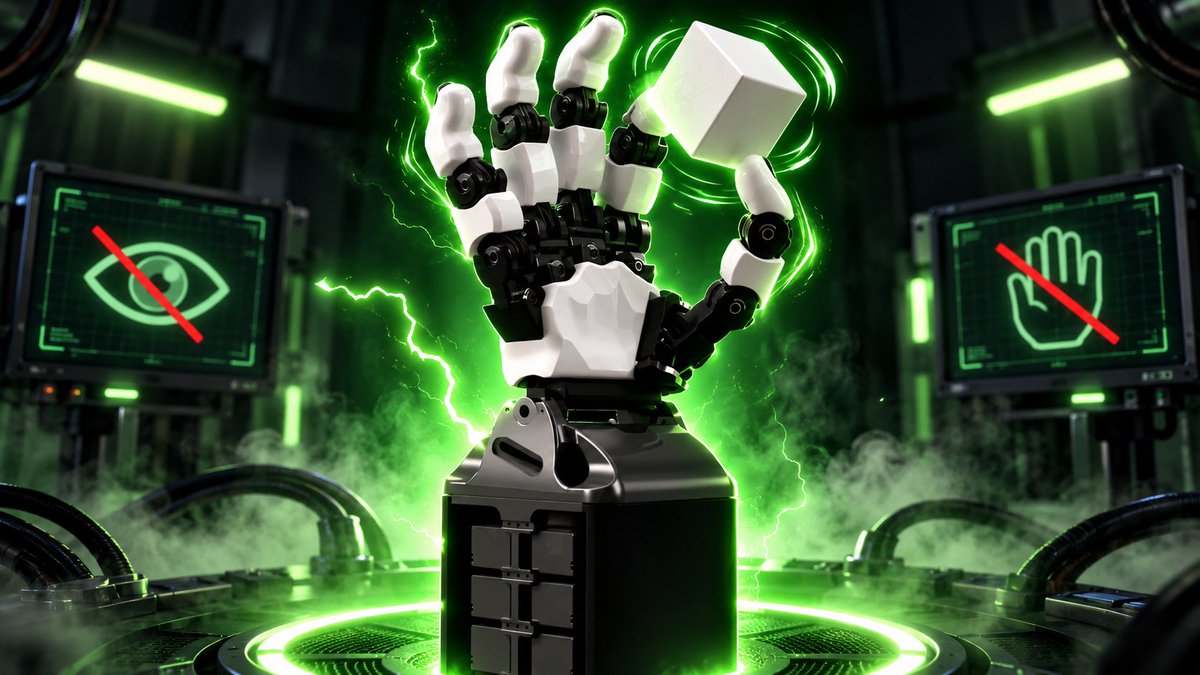
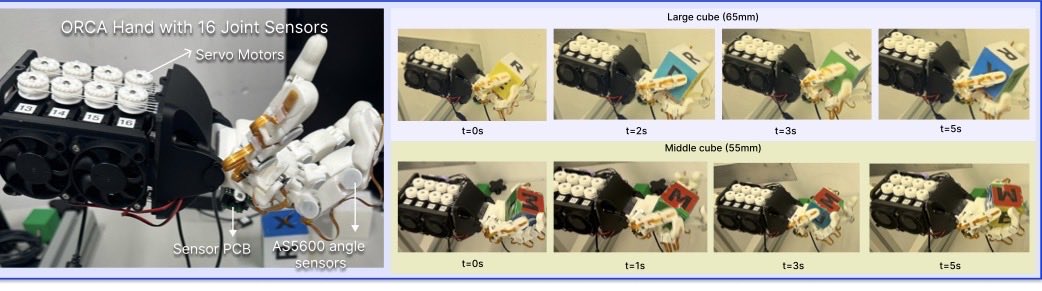
A robot hand is rotating a cube without seeing it and without tactile sensors.
Researchers at ETH Zürich trained the ORCA hand to infer what is happening to the object from something every robot already has: its own joint motion.
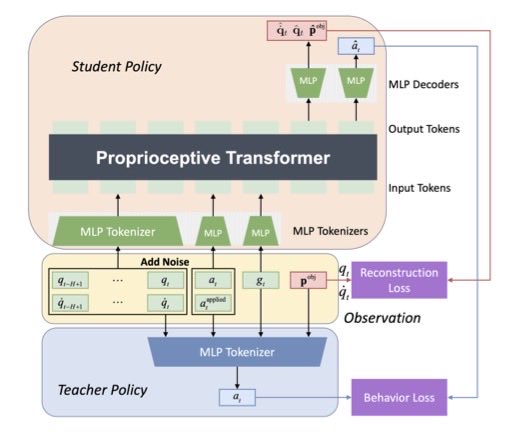
🕙The Proprioceptive Transformer works by looking backward in time.
A teacher policy is first trained in simulation with access to the cube’s actual state. That knowledge is then distilled into a Transformer that gets only a history of joint positions and velocities.
No camera input.
No tactile skin.
No object pose at deployment.
Instead, the model learns that the robot’s mechanics contain clues.
When a finger loads against the cube, its measured position changes.
When the cube shifts, joints deflect differently.
Tendon transmission, compliance and contact alter the relationship between commanded motion and what the fingers actually do.
Across time, those changes become a signal.
On the real 17-DoF ORCA hand:
➡️ 11.83 rotations/min on the 55 mm cube
➡️ 3.1× the rotation speed of the proprioceptive PPO baseline
➡️ 100% rotation accuracy with zero drops in the reported evaluation
➡️ Direct joint sensing was 26.8% faster than using motor encoders
The Transformer could even reconstruct cube position from proprioception alone with 13.7 mm RMSE, versus 17.9 mm for an MLP in the reconstruction experiments.
There’s a useful idea here for physical AI.
We usually improve robot perception by adding another way to observe the world: better cameras, tactile arrays, force sensing, depth.
But physical interaction also writes information back into the machine itself.
The body can become part of the observation system.
That becomes especially interesting as simulation and world-model training get faster. Better models may not only let robots consume richer sensor data. They may also extract considerably more state from sensors already embedded in the hardware.
The boundary is notable: this is continuous cube rotation on one tendon-driven hand, not evidence that vision or tactile sensing can be discarded across dexterous manipulation.
But it gives us a much better question to ask before adding another sensor:
How much of the outside world is already encoded in the robot’s own motion?
Senlan Yao, Chenyu Yang, Jaehoon Kim, Aristotelis Sympetheros + @katzschmann
Research @srl_ethz
Article: https://t.co/wNl5QLxjiS…
Paper: https://t.co/4aCGxEH31i
@theworldlabs shipped a world model you can aim. 🎯🌍
Most video models still treat camera movement as language. You describe a crane shot, cross your fingers, and pull the lever again when the drift ruins it.
🤳Atlas, out today from World Labs, takes camera geometry as a native input type. Position, angle, path. Up to one minute of video at 1440p that holds together for the whole run.
Under it: a multimodal autoregressive diffusion transformer, pretrained from scratch on text, images, video, and 3D.
An LLM builds its context out of tokens in a row. Atlas builds its context out of images pinned to positions in space. Every frame it has seen knows where it stands, so whatever comes next has to agree with the geometry and not just the vibe.
📸Drop two unrelated photos into that spatial context, place them apart in 3D, and the model invents the hallway between them.
➡️ Reconstruction from one to dozens of images, no capture rig, no hundreds of dense views
➡️ Two or three views already give faithful reconstructions, and on sparse-view benchmarks the generalist beats open-source models trained only to reconstruct
➡️ Depth maps are native, so worlds come out as point clouds or Gaussian splats, the same representation already running in Marble
➡️ Third-party human raters picked Atlas over recent video models on camera following in 75 to 94 percent of head to head votes, and the advantage grows as the trajectory gets more complex
Then the robotics layer:
Two large environments, captured on a cell phone, 24 frames each. Atlas reconstructs the space, then generates the RGB and depth a simulated robot's body-mounted cameras would see as it moves through.
The room and the robot's view of the room come from one model, so nothing gets handed off to a second system that can disagree with the reconstruction.
Manipulation goes further.
From a few casual recordings, Atlas helps build a scene where rigid, articulated, and deformable objects behave, then lets you swap the objects, the lighting, the positions, the motion.
Scanning spaces like these traditionally required elaborate and expensive equipment. Now it is a phone in a backpack.
Robots were never short on ambition. They were short on rooms to practice in.
🔗 Full technical post: https://t.co/aqwCpBbtFL
🔗 Real-to-sim background: https://t.co/ixcXtB7CL5
🔗 Early access: https://t.co/cpxYseFSrE
🔗 Marble: https://t.co/gRG8bjKsSW
Congratulations to @drfeifei, @jcjohnss , @chlassner , @BenMildenhall,@KeunhongP, @ychngji6, @XRarchitect and the World Labs team, and to @YunzhuLiYZ and Changxi Zheng on the robotics side.
⭐ @BotNewsAI https://t.co/vLb0M4lKHc for the latest in emerging tech
You’ve heard the Microducks sing, but have you heard them sing Bohemian Rhapsody?🎶
Try the Repo: https://t.co/Y8jfsHwuVi
Laureen Fabre Sinègre with the help of AI used the Microduck simulator to create this masterpiece.
@theworldlabs shipped a world model you can aim. 🎯🌍
Most video models still treat camera movement as language. You describe a crane shot, cross your fingers, and pull the lever again when the drift ruins it.
🤳Atlas, out today from World Labs, takes camera geometry as a native input type. Position, angle, path. Up to one minute of video at 1440p that holds together for the whole run.
Under it: a multimodal autoregressive diffusion transformer, pretrained from scratch on text, images, video, and 3D.
An LLM builds its context out of tokens in a row. Atlas builds its context out of images pinned to positions in space. Every frame it has seen knows where it stands, so whatever comes next has to agree with the geometry and not just the vibe.
📸Drop two unrelated photos into that spatial context, place them apart in 3D, and the model invents the hallway between them.
➡️ Reconstruction from one to dozens of images, no capture rig, no hundreds of dense views
➡️ Two or three views already give faithful reconstructions, and on sparse-view benchmarks the generalist beats open-source models trained only to reconstruct
➡️ Depth maps are native, so worlds come out as point clouds or Gaussian splats, the same representation already running in Marble
➡️ Third-party human raters picked Atlas over recent video models on camera following in 75 to 94 percent of head to head votes, and the advantage grows as the trajectory gets more complex
Then the robotics layer:
Two large environments, captured on a cell phone, 24 frames each. Atlas reconstructs the space, then generates the RGB and depth a simulated robot's body-mounted cameras would see as it moves through.
The room and the robot's view of the room come from one model, so nothing gets handed off to a second system that can disagree with the reconstruction.
Manipulation goes further.
From a few casual recordings, Atlas helps build a scene where rigid, articulated, and deformable objects behave, then lets you swap the objects, the lighting, the positions, the motion.
Scanning spaces like these traditionally required elaborate and expensive equipment. Now it is a phone in a backpack.
Robots were never short on ambition. They were short on rooms to practice in.
🔗 Full technical post: https://t.co/aqwCpBbtFL
🔗 Real-to-sim background: https://t.co/ixcXtB7CL5
🔗 Early access: https://t.co/cpxYseFSrE
🔗 Marble: https://t.co/gRG8bjKsSW
Congratulations to @drfeifei, @jcjohnss , @chlassner , @BenMildenhall,@KeunhongP, @ychngji6, @XRarchitect and the World Labs team, and to @YunzhuLiYZ and Changxi Zheng on the robotics side.
⭐ @BotNewsAI https://t.co/vLb0M4lKHc for the latest in emerging tech
Human acts → robot sees → robot acts 🤖
A clean interface for robot training.🦾
@nvidia Hydra-0 uses action flow to place human hands, UMI grippers, single arms and bimanual robots in one action space: camera-plane trajectories showing where visible points move.
The world model does not need their native joint or end-effector coordinates.
Hydra-0 was trained on 2,202 hours of filtered multi-embodiment video. In a controlled Cosmos 2.5 comparison, replacing relative 6D actions with action flow improves PSNR, SSIM, gripper EPE, FID and FVD across all five held-out datasets; object EPE improves on all four where measured. VLM preference is mixed.
Best configuration:
➡️ 90.4% lower robot-motion error
➡️ 60.2% lower object-motion error
➡️ 16× generation-only speedup after few-step distillation
The interface also runs backward.
A held-out HUMAN demonstration supplies desired object flow:
human moves object
➡️ object flow conditions Hydra-0
➡️ model generates compatible robot motion
➡️ supervised readout produces executable 14-DoF YAM commands
No embodiment flow is supplied to the inverse model.
The readout is still trained on paired real-world robot rollouts containing successes and failures.
Human video is not replacing robot data 💡 It replaces task-specific expert robot demonstrations as the task specification.
🔁 RoboLab is open-loop replay.
Hydra-0 starts from the first observation of an already-recorded episode and replays the trajectory the robot actually achieved. The policy is never queried on generated observations.
Across 300 episodes / 5 policies / 6 tasks:
- Pearson r = 0.96
- 93% per-episode agreement, κ = 0.82
These results test whether generated rollouts preserve recorded outcomes, not whether a policy can act on generated observations while model error compounds.
The ~1 cm grasp miss exposes the representation’s current boundary.
Limited depth awareness is one hypothesis, not an established cause. Generated rollouts can leave grasp state ambiguous: fingers may appear closed around an object without establishing that it is secured.
Metric depth, tactile contact and force are not inherent to image-plane flow. Depth could recover geometry; tactile and force conditioning could disambiguate grasp acquisition, slip and force closure.
The wrist-camera DROID result is qualitative. Broader camera motion, mobile manipulation and closed-loop policy evaluation remain future work.
Human demonstrations specify what should happen to an object. Hydra-0 tests whether a robot can infer the motion of its own body required to produce that trajectory.
@NVIDIARobotics
Research: @Hongyu_Lii, @bowenwen_me, @zhu_xinghao, @YXWangBot, @du_yilun, @YunzhuLiYZ, George Konidaris, @BirchfieldStan, @SohaPouya, @80gg_overmind & @Dr_YanChang — @NVIDIARobotics with Brown, Columbia & Harvard.
🔗 https://t.co/xYP7L4kjzy
📄 https://t.co/hpB3P3v56l
⭐@BotNewsAI the latest in emerging tech
They overlap at the human-demo layer, but they are solving different parts of the stack.
GEN-1.5 is policy learning: demonstrations are used to learn/adapt robot behavior.
Hydra-0 is a world/action model: it represents motion as action flow and shows that a human demo can supply desired object motion, from which compatible robot motion can be generated.
@Hongyu_Lii put it well: “Policy learning is not the focus of this work… We indeed show some one-shot manipulation from human demo capability.”
So Hydra-0 is not really a GEN-1.5 competitor yet. It is closer to a representation/world-model layer that could eventually feed a policy learner.
Human acts → robot sees → robot acts 🤖
A clean interface for robot training.🦾
@nvidia Hydra-0 uses action flow to place human hands, UMI grippers, single arms and bimanual robots in one action space: camera-plane trajectories showing where visible points move.
The world model does not need their native joint or end-effector coordinates.
Hydra-0 was trained on 2,202 hours of filtered multi-embodiment video. In a controlled Cosmos 2.5 comparison, replacing relative 6D actions with action flow improves PSNR, SSIM, gripper EPE, FID and FVD across all five held-out datasets; object EPE improves on all four where measured. VLM preference is mixed.
Best configuration:
➡️ 90.4% lower robot-motion error
➡️ 60.2% lower object-motion error
➡️ 16× generation-only speedup after few-step distillation
The interface also runs backward.
A held-out HUMAN demonstration supplies desired object flow:
human moves object
➡️ object flow conditions Hydra-0
➡️ model generates compatible robot motion
➡️ supervised readout produces executable 14-DoF YAM commands
No embodiment flow is supplied to the inverse model.
The readout is still trained on paired real-world robot rollouts containing successes and failures.
Human video is not replacing robot data 💡 It replaces task-specific expert robot demonstrations as the task specification.
🔁 RoboLab is open-loop replay.
Hydra-0 starts from the first observation of an already-recorded episode and replays the trajectory the robot actually achieved. The policy is never queried on generated observations.
Across 300 episodes / 5 policies / 6 tasks:
- Pearson r = 0.96
- 93% per-episode agreement, κ = 0.82
These results test whether generated rollouts preserve recorded outcomes, not whether a policy can act on generated observations while model error compounds.
The ~1 cm grasp miss exposes the representation’s current boundary.
Limited depth awareness is one hypothesis, not an established cause. Generated rollouts can leave grasp state ambiguous: fingers may appear closed around an object without establishing that it is secured.
Metric depth, tactile contact and force are not inherent to image-plane flow. Depth could recover geometry; tactile and force conditioning could disambiguate grasp acquisition, slip and force closure.
The wrist-camera DROID result is qualitative. Broader camera motion, mobile manipulation and closed-loop policy evaluation remain future work.
Human demonstrations specify what should happen to an object. Hydra-0 tests whether a robot can infer the motion of its own body required to produce that trajectory.
@NVIDIARobotics
Research: @Hongyu_Lii, @bowenwen_me, @zhu_xinghao, @YXWangBot, @du_yilun, @YunzhuLiYZ, George Konidaris, @BirchfieldStan, @SohaPouya, @80gg_overmind & @Dr_YanChang — @NVIDIARobotics with Brown, Columbia & Harvard.
🔗 https://t.co/xYP7L4kjzy
📄 https://t.co/hpB3P3v56l
⭐@BotNewsAI the latest in emerging tech