La interpretación de “La Vie en Rose” por la cantante italiana Giulia Falcone se ha convertido en un fenómeno viral en redes sociales, acumulando millones de reproducciones y elogios por devolverle la frescura a este icónico himno de París.
Con una voz sumamente dulce, elegante y un dominio técnico impecable, Falcone logra capturar la profunda melancolía y el romance de la obra original de Édith Piaf sin perder su propio estilo contemporáneo.
A diferencia de otras adaptaciones modernas que alteran demasiado el ritmo, la versión de Giulia Falcone en su canal de YouTube mantiene la instrumentación acústica y un tono íntimo que evoca las calles parisinas.
Su interpretación ha sido compartida masivamente en plataformas como Instagram y Facebook, donde amantes de la chanson française destacan su perfecta pronunciación y su emotividad.
Lanzada originalmente en 1947 por "El Gorrión de París", esta canción sigue siendo el símbolo definitivo del optimismo amoroso ("ver la vida en rosa"), y voces jóvenes como la de Giulia aseguran que siga conquistando a nuevas generaciones.
El arte detrás de la versión de The Animals de "The House of the Rising Sun" (1964) es uno de los hitos más fascinantes de la historia de la música.
Lo que hicieron no fue simplemente grabar una canción, sino transformar un lamento folclórico antiguo en la primera obra maestra del folk-rock moderno.
Su genialidad artística radicó en tomar una melodía acústica del siglo XIX y vestirla de una oscuridad eléctrica, densa y teatral que cambió el rumbo de la música popular.
La canción abre con un hipnótico arpegio en la menor tocado por una guitarra eléctrica Gretsch.
Esta figura melódica, circular y melancólica, establece inmediatamente una atmósfera de fatalidad.
Es uno de los inicios de guitarra más reconocibles del mundo y se convirtió en la lección obligatoria para millones de jóvenes que aprendían a tocar el instrumento.
Originalmente, la banda quería usar un solo de guitarra en el puente, pero el espacio era tan reducido en la furgoneta de la gira que solo cabía el órgano de Price.
Esa limitación técnica creó magia pura. El solo de órgano, inspirado en el jazz y el gospel, ruge en una progresión dramática que eleva la canción a una intensidad casi religiosa y fantasmal.
Burdon, que tenía solo 23 años, cantó con la madurez y el dolor de un viejo bluesman. Su interpretación es un aullido de desesperación, rabia y resignación que hiela la sangre.
El productor Mickie Most grabó la canción en una sola toma en un pequeño estudio de Londres; la crudeza de esa interpretación es lo que le da su cualidad eterna.
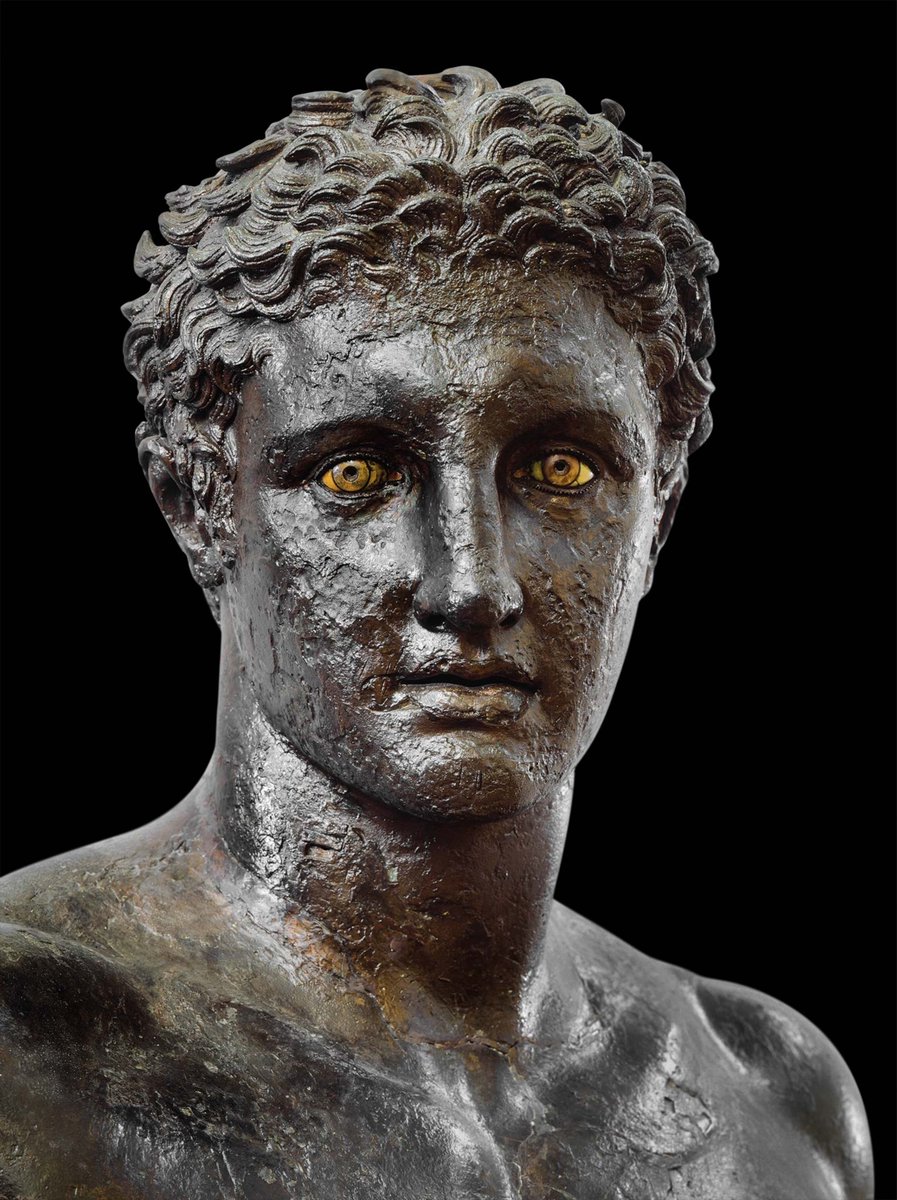
This statue is over 2300 years old.
It's one of the very few ancient sculptures left with its original eyes, and I can’t get over how real they look...
The statue is the Antikythera Ephebe, a Greek bronze of a young man made around 340 to 330 BC, and strangely enough, the reason it survived is because it sank. In antiquity, bronze statues were constantly melted down for their metal, turned into weapons and coins, which is why almost none survive.
This one went to the bottom of the sea in a shipwreck around 60 BC and lay there for nearly two thousand years, until sponge divers found it in 1900.
But let’s go back to my favorite detail: the eyes.
When a bronze statue is made, the eyes are often set separately, inlaid with glass, stone, and colored paste to make them lifelike, and over the centuries almost every ancient bronze has lost them, leaving those hollow, blank sockets we think of as classical.
The Ephebe still has his original eyes, made of glass paste, one of only a handful of ancient Greek bronzes in the world that do. And it changes everything because he does not gaze blankly into nothing, he seems to be looking, intently, at something that vanished more than two thousand years ago...
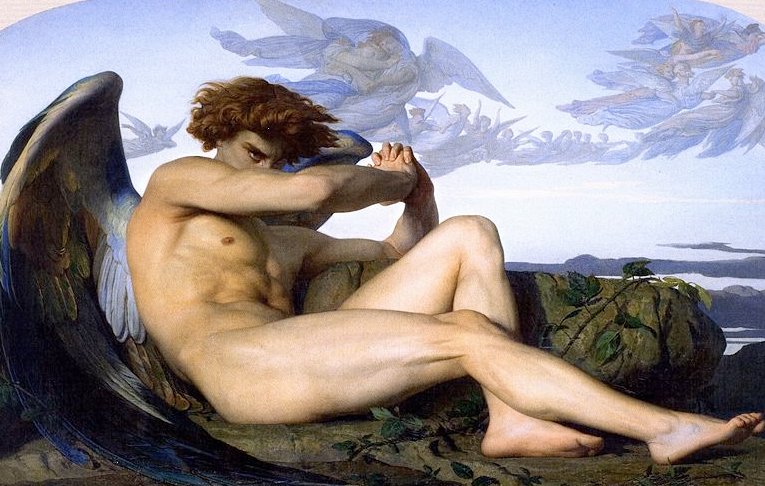
What if evil arrives wrapped in beauty, pride and perfection?
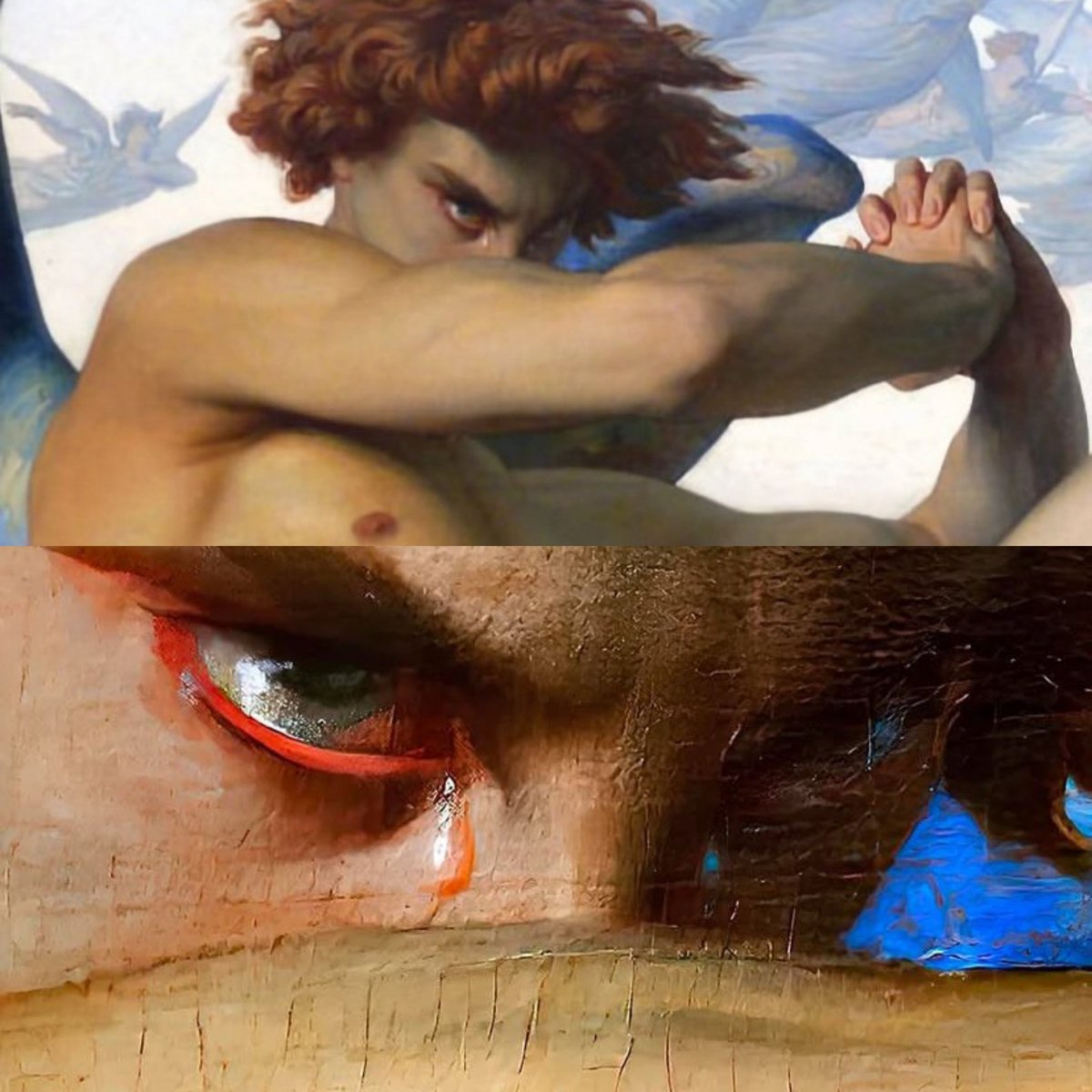
At 24, Alexandre Cabanel painted The Fallen Angel breaking every rule.
He refused to draw a deformed monster. Instead, he rendered Lucifer with classical grace and flawless anatomy.
And a tear of pure rage.
Making absolute evil look physically divine felt like a dangerous provocation.
We expect evil to look ugly. But what if it doesn't?
Does beauty make evil harder to resist?
¿Y si el mayor peligro para nuestra sociedad no fuera la maldad, sino la estupidez?
La alarmante teoría de Dietrich Bonhoeffer que explica el mundo de hoy.
La Teoría de la Estupidez de Bonhoeffer:
El peligro silencioso
Durante los años más oscuros de la Alemania nazi, el teólogo y pastor Dietrich Bonhoeffer reflexionó desde su celda sobre cómo una sociedad culta y moderna había caído en la barbarie colectiva.
Su conclusión fue revolucionaria y alarmante:
la estupidez es un enemigo del bien mucho más peligroso que la maldad misma.
👉 ¿Por qué es más peligrosa que la maldad?
Contra la maldad se puede luchar:
se puede denunciar, combatir e incluso legislar en su contra.
El malvado, en el fondo, suele tener conciencia de que está rompiendo las reglas.
Con la estupidez, en cambio, estamos completamente indefensos.
La persona dominada por ella es impermeable a los argumentos lógicos y a los hechos objetivos.
Si se le presentan pruebas que contradicen sus dogmas, simplemente las ignora o las tacha de irrelevantes.
Al sentirse completamente segura de sí misma, se vuelve agresiva y sumamente peligrosa al ser confrontada.
No es un defecto intelectual, sino moral
Bonhoeffer aclaró que esto no tiene nada que ver con el coeficiente intelectual o el nivel educativo. Existen mentes brillantes que operan bajo una profunda estupidez y personas sencillas que desbordan sabiduría moral.
La estupidez ocurre cuando un individuo renuncia voluntariamente a su capacidad de juicio propio.
👉 El contagio social y el rol del poder
Para el pensador, la estupidez es un fenómeno sociológico.
Observó que el ascenso de una fuerte estructura de poder (política o religiosa) infecta de estupidez a gran parte de la población.
Al integrarse a un grupo o adoptar ciegamente una ideología, el individuo sacrifica su independencia interior.
En este estado, la persona ya no piensa por sí misma:
se convierte en un repetidor de eslóganes, consignas y narrativas prefabricadas.
Al delegar su conciencia al colectivo, se transforma en una herramienta dócil capaz de cometer o justificar las mayores atrocidades sin experimentar remordimiento alguno.
👉 La conclusión de Bonhoeffer
La estupidez no se cura con más instrucción o datos, sino con un acto de liberación interna y coraje moral.
Hasta que el individuo no recupere la valentía de examinar sus ideas de forma autónoma y de tolerar la incomodidad de contradecir a su propio grupo, seguirá atrapado en este peligroso letargo.
Picasso was 15 years old when he painted this.
It looks nothing like a Picasso, and the reason why is one of the most beautiful things he ever said...
It's called First Communion, made in 1896, and it was the first large canvas he ever completed. There are no strange angles here, no fractured faces, none of the wild reinvention his name now brings to mind. It is a stunning and technically flawless scene: a young girl kneeling at the altar in a white dress, about to take her first communion, the moment a child is meant to step toward adulthood.
The translucence of the girl's veil, the altar boy's surplice, the light falling from a source outside the frame, all of it revealing a command of paint startling for his age. He built the whole picture around whiteness, linking the white of Lola's dress to the white of the altar cloth and the candlelight, so the eye reads the whole scene as a passage from one life into another.
He was only 15, and he understood that...
It was shown at a major exhibition in Barcelona, where the local press marveled that a boy not yet old enough to shave had painted like a master of the academy.
At fifteen Picasso could already do this, the thing that thousands of trained artists spend their entire lives trying and failing to do. He had it as a boy. And he would spend the rest of his life trying to get back the one thing this perfect painting does not have: the freedom of a child, who paints without fear, without rules, and without yet knowing what is supposed to be impossible...
He said it himself: "It took me four years to paint like Raphael, but a lifetime to paint like a child."
This isn't a simple summer study, it's a record of wealth and local power.
This is Woman Bathing at Sandhamn by Anders Zorn, 1906.
Look at the water on her skin, the sun, the wet reflections, the posture of a village girl posing nude in freezing waves, and the gap between a rural girl and a rich artist.
Behind these nudes was an uneasy dynamic. Zorn was a wealthy, famous painter. His models were not professionals from Stockholm. They were local village girls.
To prevent scandal, his wife, Emma, scouted and chaperoned them. She used her family name to convince rural parents to let their daughters pose nude outdoors.
Critics in 1906 disliked the raw nudity. Zorn ignored them. He was charging clients like Andrew Carnegie up to $20,000 for a single portrait. That money gave him the freedom to keep his favorite island paintings in his private estate at Mora, where this canvas hangs today.
I only recently discovered this painter, and I cannot stop looking at his work. Every single time, I have to remind myself i am looking at oil paint, and not a photograph of real silk...
The artist is Vittorio Reggianini, an Italian painter born in Modena in 1858. He belonged to a group so obsessed with one thing that they earned a nickname for it: the "Silk and Satin School." These painters competed to see who could render luxurious fabric most convincingly, and Reggianini is widely considered the best of them all.
There is a reason silk is so hard to paint, and it makes what he did even more astonishing. Most surfaces catch light in a way the eye can predict. Silk does not. Its sheen shifts as the cloth bends, throwing bright highlights along every ridge and dropping into near-black in the hollows, so a single fold can travel from white to deep shadow in the space of an inch. To make it convincing you have to get hundreds of those shifts exactly right, in exactly the right places, or the whole thing collapses into a smear. Reggianini got them right every time, across an entire career, until the gowns look smooth enough to reach into the canvas and touch.
And today he is almost invisible: no major museum retrospective, barely a Wikipedia page. His paintings surface at auction and vanish again into private collections, admired by the few who own them and unknown to everyone else. He may be the finest painter of silk who ever lived, yet most people have never heard his name...
The astonishing part of Burtons’s painting is that this intensity is watercolor and gouache, not oil. Burton built the blue and red through precise layering.
It is so light-sensitive that as @phantomdialogue mentions, @NGIreland only brings it out for two hours a week.
In Japanese, "tsundoku" means collecting books and letting them pile up, not for neglect, but for the joy of knowing they're there, full of untold stories.
Hice un juego donde tienes que dibujar las líneas del metro de la CDMX de memoria y te va puntuando de acuerdo qué tan bien lo hiciste.
Lo más padre es que al final te enseña un croquis de cómo es para ti el mapa del metro.