📢📜 Commemorating the 512th Anniversary of the Yarkent Khanate (1514–1705)
The East Turkistan Government in Exile solemnly commemorates the 512th anniversary of the founding of the Yarkent Khanate by Sultan Said Khan in late May 1514.
For nearly two centuries, the Yarkent Khanate stood as a sovereign Turkic state governing the overwhelming majority of East Turkistan. From its political capital in Yarkent, the Khanate administered a flourishing civilization whose major cultural, economic, and intellectual centers included Kashgar, Khotan, Keriya, Aksu, Kucha, Turpan, Qarasheher, Qumul, Dukhan, and Uzgen. These historic cities formed a vibrant network of trade, scholarship, governance, and Islamic civilization along the Silk Road.
The eastern frontier of the Khanate extended to the historic Jiayu Pass (Jiayuguan), long recognized as the traditional boundary separating East Turkistan from China, underscoring the Yarkent Khanate’s geopolitical independence and distinct civilizational identity.
The Yarkent Khanate represented one chapter in East Turkistan’s more than 3,000-year history of statehood and its ancient civilization stretching back thousands of years. Throughout history, East Turkistan has been home to numerous sovereign Indo-European and Turkic civilizations and states, including the Tocharian city-states, the Xiongnu (Hun) Empire, the Kushan Empire, the Hephthalites, the Kök Türk Khaganate, the Uyghur Khaganate, the Kara-Khanid Khanate, the Idiqut Uyghur State, the Chagatai Khanates, and the Yarkent Khanate.
In the modern era, this enduring tradition of sovereignty continued through the State of Yette Sheher (1864–1877), the First East Turkistan Republic (1933–1934), and the Second East Turkistan Republic (1944–1949). Together, these states reflected the enduring aspirations of the East Turkistani people for independence, national dignity, and self-rule.
Like every nation throughout history, East Turkistan’s sovereignty has periodically been disrupted by foreign occupation and colonial domination, including rule by the Dzungar Khanate (1705–1759), the Manchu Qing Empire (1759–1863; 1877–1912), Chinese warlords (1912–1933), KMT-aligned Chinese warlords (1934–1943), and the Chinese Communist occupation (1949–present).
Despite these occupations, the political will of the East Turkistani people to reclaim their national sovereignty and independence has never been extinguished. That struggle continues today through the work of the East Turkistan Government in Exile and the collective efforts of East Turkistanis worldwide.
The Yarkent Khanate maintained diplomatic, cultural, and commercial relations with neighboring powers, including the Mughal Empire, Ming China, the Kazakh Khanate, and the Khanate of Bukhara, affirming its recognized place within the regional and international order of its time.
On this solemn anniversary, the East Turkistan Government in Exile honors the enduring legacy of the Yarkent Khanate as a pillar of our national history and identity. We reaffirm our unwavering commitment to the restoration of East Turkistan’s independence and national sovereignty in accordance with international law, historical continuity, and the inalienable right of all peoples to self-determination.
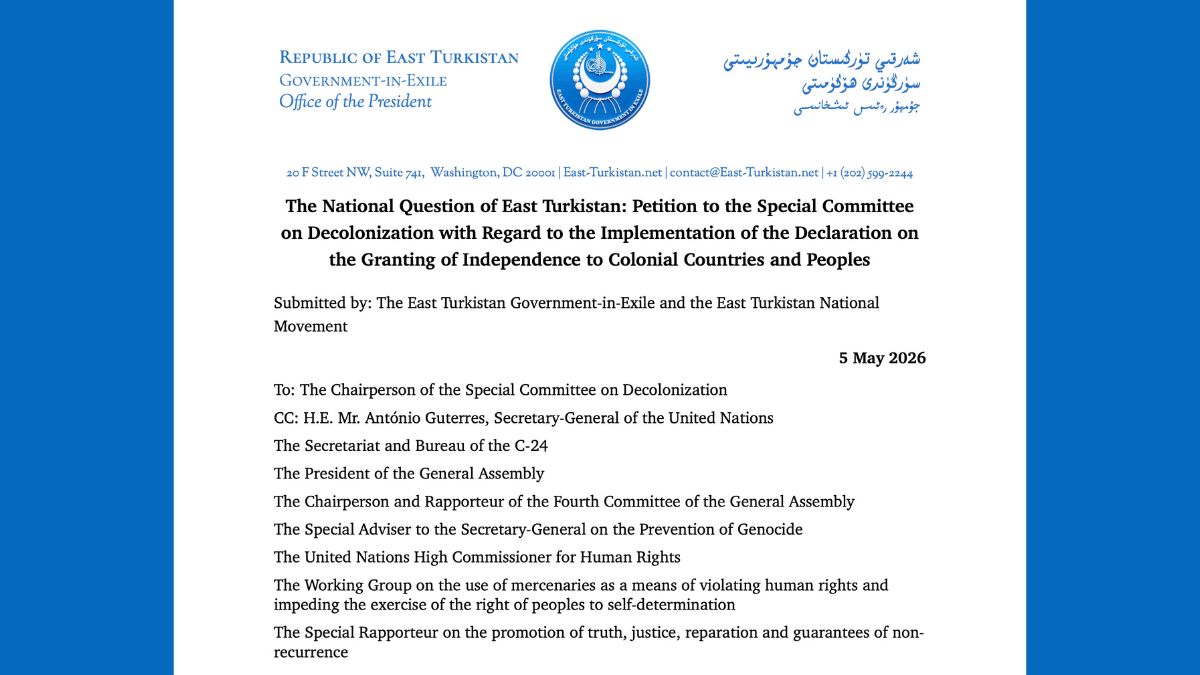
🇺🇳East Turkistan Confronts China as Colonial Power in UN Decolonization Petition
WASHINGTON, D.C. — The East Turkistan Government-in-Exile (ETGE) and the East Turkistan National Movement (ETNM) today submitted a petition to the United Nations Special Committee on Decolonization (C-24), formally requesting for the first time that the Committee recommend to the General Assembly the inscription of East Turkistan as a Non-Self-Governing Territory. Inscription would trigger a binding international framework obligating the United Nations to oversee East Turkistan’s path toward self-determination. No state or entity has ever formally challenged China as a colonial power before any UN body. Until today.
East Turkistan, which the Chinese government designates “Xinjiang,” meaning “New Territory,” had a functioning independent state, the East Turkistan Republic, when China invaded and occupied it in late 1949. No treaty of cession, no plebiscite, and no instrument reflecting the free and genuine will of its peoples has ever legitimized Chinese control. In seventy-six years of occupation, Chinese settlers grew from under 5 percent of the population to over 42 percent, while the native Turkic population fell from over 90 percent to roughly 55 percent.
“More than eighty nations achieved their independence through the decolonization framework,” said Dr. @MamtiminAla, President of the ETGE. “Today, the peoples of East Turkistan formally assert that same right before the United Nations.”
The genocide of Uyghurs, Kazakhs, Kyrgyz, and other Turkic peoples is entering its thirteenth year later this month. Every existing human rights accountability mechanism has failed:
The UN Office of the High Commissioner for Human Rights concluded in August 2022 that the abuses “may constitute crimes against humanity.”
The United States Government and a dozen Western parliaments have recognized the atrocities as genocide and crimes against humanity.
The International Criminal Court has failed to open a formal investigation despite four submissions of evidence since 2020.
Mass internment, credibly documented organ harvesting, forced sterilization, and the separation of nearly one million children from their families continue.China’s own five-year plan for the occupied territory projected 13.75 million forced labor transfers between 2021 and 2025. In January 2026, UN Special Rapporteurs warned that actual numbers have exceeded even that projection and that the transfers “may amount to enslavement as a crime against humanity.”
“The ongoing genocide is rooted in China’s colonial occupation of East Turkistan,” said @SalihHudayar, Foreign Minister of the ETGE and President of the ETNM. “Decolonization and the restoration of our independence is the only effective guarantee of our people’s survival.”
China is not only committing genocide, it is working to make its colonial domination irreversible. On March 12, 2026, the National People’s Congress adopted the “Law on Promoting Ethnic Unity and Progress,” codifying the erasure of distinct peoples and cultures into a single Chinese identity. As the 25-page petition declares: “The era of colonialism has not ended. It is being legislated.”
The petition makes eight formal requests, including that the General Assembly:
1. Designate the PRC as the occupying power over East Turkistan, which the petition establishes is the largest colonial territory on earth by both population and area;
2. Affirm the inalienable right of the peoples of East Turkistan to self-determination and independence; and
3. Address China’s conflict of interest as a permanent Security Council member and participant in the very committee mandated to oversee decolonization.
The full petition is available here: https://t.co/mnDBND9tsn
Sovereignty Never Surrendered: Why East Turkistan Remains an Occupied Nation, Not a “Disappeared” One
Recent analysis published by the Uyghur Human Rights Project (UHRP) has sparked important debate within the diaspora. In her article, writer Asiye Uyghur @AsiyeUyghur argues that #EastTurkistan ’s statehood effectively “disappeared” as a result of post-Yalta great-power arrangements and the adoption of UN General Assembly Resolution 2758 in 1971. While the piece is masked with historical grievances and sympathy for the Uyghur cause, the core framing risks deliberate reinforcing a narrative that undermines the legal and political basis for East Turkistan’s right to external self-determination.
East Turkistan is not a historical footnote or a “disappeared” entity. It is a nation with deep roots in statehood traditions, whose sovereignty was interrupted by military occupation in 1949 and remains suppressed today. True resolution requires recognizing this reality rather than treating the current situation as a settled internal matter of China. #UyghurGenocide
1⃣. Conceptual Flaw: “Disappearance” vs. Illegal Occupation
Sovereignty is an inherent attribute of a people with a defined territory, permanent population, effective governance, and capacity for international relations—not something that can be erased by decisions made in rooms where its representatives had no voice. Framing East Turkistan’s status as a “disappearance” is an attempt to legitimize the status quo as a legal fait accompli rather than what it is: the ongoing consequence of military conquest and subsequent administration without the consent of the people. Under the principle ex injuria jus non oritur (no legal right arises from a wrong), acts of aggression do not create legitimate title. The 1949 invasion and occupation of East Turkistan by the People’s Republic of China constitutes an interruption of sovereignty, not its lawful extinction.
2⃣. Historical Context: The East Turkistan Republics and Paths to Chinese Occupation
The people of East Turkistan asserted independence on multiple occasions in the modern era. One of the most significant was the Kashgaria (Yettishar) state established by Yakub Beg in 1865, which maintained effective independence and conducted diplomatic relations with regional powers for approximately 11–12 years — the longest modern period of self-rule — before being invaded and occupied by Qing forces in 1877.
However, our struggled did not stop. In the 20th century, East Turkistanis again declared independence with the first East Turkistan Republic (1933–1934) and the second East Turkistan Republic (1944–1949). Both republics were established well before the founding of the People’s Republic of China in 1949 and even before the creation of the United Nations in 1945. All of our independent states exercised effective governance, maintained armed forces, issued currency, and engaged in foreign relations — satisfying core criteria of statehood under international law long before the current Chinese regime came into existence.
The latter (the Second ETR) initially received Soviet support for strategic reasons but faced a dramatic shift after the 1945 Yalta Conference and the subsequent Sino-Soviet Treaty. The Soviet withdrawal of support and pressure on ETR leaders to negotiate with the Chinese Nationalist government represented a geopolitical betrayal, not a legal termination of statehood.
The eventual PRC military invasion into East Turkistan in late 1949 occurred against the backdrop of an existing functioning administration that met standard criteria for statehood. Tragic events, such as the 1949 plane crash that killed key ETR leaders, compounded the loss but hold no legal weight in extinguishing sovereignty. Historical precedents—such as the Baltic states under Soviet occupation or East Timor under Indonesian rule—demonstrate that foreign military control does not erase underlying rights to external self-determination.
3⃣. Legal Analysis: The Limits of UNGA Resolution 2758
UN General Assembly Resolution 2758 (1971) addressed the question of which government—the People’s Republic of China or the Republic of China—should hold “China’s” seat at the United Nations. It did not determine the territorial boundaries of China, endorse specific claims over non-Han regions, or adjudicate the status of peoples such as the Uyghurs, Tibetans, or others. Legal interpretations consistently affirm that the resolution concerned representation alone and remains silent on self-determination claims or border questions.
Treating 2758 as having “codified” an indivisible China that permanently subsumes East Turkistan therefore overstates its scope and echoes Beijing’s preferred interpretation. International law, including the UN Charter’s emphasis on self-determination (Article 1(2)) and decolonization principles, supports the view that East Turkistan constitutes a case of colonial occupation rather than an internal minority issue. The Montevideo Convention criteria for statehood were satisfied by the ETR, and prolonged occupation does not automatically extinguish remedial rights, particularly amid credible allegations of systematic repression and demographic engineering.
4⃣. The deliberate Defeatist or “Minority Rights” Framing
Portraying East Turkistan’s statehood as foreclosed by Cold War realities can discourage international engagement and normalize the occupation. While great-power politics undeniably shaped mid-20th-century outcomes, they do not represent permanent legal barriers. Many independence and decolonization movements succeeded despite initial international indifference or opposition.
Equally important is rejecting the reduction of a distinct nation to a “minority group” within an indivisible China. The framing of "“minority group” shifts the debate from rightful ownership of the land and political destiny to questions of treatment within a preordained Chinese framework. East Turkistan’s people are not demographic guests in their ancestral homeland; they possess collective rights as a nation under occupation.
While UHRP’s human rights advocacy could be valuable if it prioritized reporting the physical destruction of our nation—rather than downplaying genocide as mere 'cultural erasure'—and took sexual harassment involving elite diaspora activists seriously, it must not come at the expense of our fundamental right to independence and promote surrendering narratives. Advocacy confined within the framework of Chinese sovereignty not only misrepresents our struggle, but also becomes part of China's overseas United Front Work propaganda machine. The people of East Turkistan need genuine voices, not defeating, self-sabotaging voices and misrepresentation.
Conclusion: Toward Recognition and Decolonization
The people of East Turkistan deserve more than sympathy for past geopolitical bargains. They require acknowledgment that their homeland was never lawfully integrated into the People’s Republic of China. Policymakers and international institutions can support this reality by:
🔷Distinguishing clearly between human rights advocacy and the separate question of territorial sovereignty.
🔷Applying a consistent standard of justice: just as Tibet is recognized by many as an illegally annexed territory, so too must East Turkistan be recognized as an occupied country.
🔷Vigilance Against Narrative Infiltration: Remain hyper-vigilant against the infiltration of our narrative by Chinese agents and compromised elites. Just as pro-Beijing, pro-reunification KMT politicians sell out Taiwan’s independence in exchange for perceived economic benefits and personal status.
The struggle for decolonization continues, and genuine analysis must bolster the nation’s survival rather than declaring its existence "disappeared" to suit the comforts of a compromised organization. East Turkistan’s sovereignty was never surrendered—it persists as a legal and moral claim awaiting restoration through peaceful, internationally supported means. Only by addressing the root issue of occupation can lasting justice, stability, and external self-determination be achieved for the people of East Turkistan.
@ETExileGov@StateDept@SecRubio@HouseGOP@CECCgov@TomTiffanyWI@RepTiffany@HouseForeign@RepMcCaul@USCIRF@ChairmanG@RepMoolenaar@RepWaltzPress@SpeakerJohnson@UyghurProject@BoardOfPeace
The $40 → $20,000 challenge is LIVE.
42 people already in.
+$14,953 profit so far.
Adding 4 more today.
Drop a comment if you want in — I’ll send the invite.
50 spots total. Then it’s closed.
While the world is focusing on the war in Iran, #China unveiled its 15th Five-Year Plan at the National People’s Congress on 5th March.
China’s 15th Five-Year Plan (2026–2030) prioritises high-quality development, self-reliance, and security.
AI: Core driver via “AI+ action plan”; widespread integration across industries, embodied intelligence, humanoid robots to boost productivity and counter aging population and challenge the US critically.
Chinese military: Advances modernisation, strategic deterrence, and unmanned/intelligent warfare; accelerates the adoption of emerging technologies through military-civil fusion; strengthens border security (e.g., East Turkistan/Tibet corridors).
Chinese Communist Party leadership: Affirms CPC’s absolute leadership; guides all priorities, ensures socialist modernization under Xi Jinping Thought.
Rare earth materials: First explicit focus; pledges to maintain global lead, upgrade industry, strengthen export controls, and build (and gradually control) reserves for supply chain security and tech/defence leverage.
East Turkistan (called Xinjiang in the plan): Emphasises border fortification, strategic corridors linking to China, ethnic stability, and integration to enhance resource/security resilience.
Taiwan: Reaffirms the One-China principle; opposes independence and external interference; promotes peaceful reunification through economic/exchange ties for national unity.
The US: Indirectly addressed via rivalry; stresses self-reliance to overcome tech chokepoints, counter sanctions/export controls in AI/semiconductors/critical minerals amid a turbulent environment.
In short, the plan outlines China's blueprint to replace the US and assert its global dominance through high tech, particularly the integration of AI across all economic, social, and military domains, and the control of global supply chains.
China is moving quickly to fill any void left and weaknesses shown by the US, both now and in the future, aiming to reorient the global order.
https://t.co/vOagrnOHC2
In the shadowed streets of Urumqi, the ghost of Lei Feng—a fabricated revolutionary icon, once exalted as a cult figure second only to Mao—rears its head once more. Engineered to personify the archetype of the “New Socialist Man,” a common propaganda trick across many socialist states, Lei embodied the regime’s demanded “virtues”: absolute self-sacrifice, tireless labour, the spirit of collectivism, and blind devotion to the party-state.
His infamous declaration—“I want to be a rustless screw in the revolutionary machine”—turned this ethos into a chilling metaphor, reducing human agency to mechanical subservience, a proud tool for complete state control, devoid of autonomy, individuality and critical thinking.
While the mass media hysterically propagated the image as public inspiration, it tricked millions into following in his footsteps and sacrificing themselves for the party-state, imposing a tyrannical norm that compelled millions to emulate his mythic, indeed deceptive, selflessness under relentless psychological duress and re-engineering campaigns.
Dissenters faced isolation or worse, as Lei’s legend turned obedience into a weaponised political virtue that justified unleashing ideological violence on the “impure”, the enemies of the socialist revolution.
In Mao’s era, it fueled the Cultural Revolution’s madness, both psychological and ideological, mobilising Red Guards—youthful zealots indoctrinated in his mould—to perpetrate purges, political terror, and cultural erasure, all justified as a historical necessity, implying that any resistance meets a merciless dictatorial crush.
Today, in occupied #EastTurkistan, colonial authorities summon this demon not out of nostalgia, but as a veiled instrument to reforge loyalty amid a dwindling sense of loyalty to the party state.
Beneath all the old dramas of “volunteer service” and “ethnic unity,” it subtly calls on young people to be absolutely loyal to the colonial party-state, ensuring the machine grinds on, rustless and remorseless, and people are as blind to their fate as before.
https://t.co/ZuF9koP4iN
The Native Roots of #Uyghurs in East Turkistan
These ancient mummies, often noted for unique physical traits categorized as “Caucasoid,” have been genetically identified as a distinct Ancient North Eurasian population native to #EastTurkistan.
Discovered in the deserts of #Chinese-occupied East Turkistan, within areas historically associated with the ancient Kingdom of Kroraina (“Loulan”), they provide irrefutable evidence of the native origins of the Uyghur people. Archaeological, anthropological, and genetic research establishes that these ancient inhabitants of East Turkistan are the foundational ancestors of today’s Uyghur people, proving an unbroken native presence in the territory since the end of the Ice Age [1, 2].
The earliest ancestors of today’s Uyghurs include the isolated Little River (“Xiaohe”) culture, whose genetic lineage has been present in the Tarim Basin for more than 9,000 years [3, 4]. Genetic and historical records further indicate that admixture between these isolated Tarim Basin populations and the Indo-European (Tocharian), Hun ("Xiongnu"), and early proto-Turkic lineages that comprise today’s Uyghurs began more than 2,500 years ago in East Turkistan [6].
The documentation of Uyghurs’ deep native roots was first formally articulated in the modern context by the Uyghur historian Muhammad Emin Bughra in his seminal 1940 work, Sherqiy Türkistan Tarixi (History of East Turkistan). Writing eight decades before modern genetic science confirmed the 9,000-year timeline, Bughra’s work provided a comprehensive analysis of East Turkistan’s history from ancient times up until 1940, serving as the first modern general history of the territory written by a native Uyghur scholar [6].
Taken together, archaeological, anthropological, genetic, and historical records refute Chinese imperialist and revisionist claims that falsely portray the Uyghurs as “late arrivals” or “foreigners” in East Turkistan. Such revisionist Chinese-state-backed propaganda claims persist among Chinese imperialists, whether communist, nationalist, or so-called “pro-democracy,” and are consistently used to legitimize the Chinese colonization, ongoing occupation of East Turkistan, and the genocide of its native people.
By contrast, the totality of the empirical record establishes that Uyghurs have an ancient, deep native foundation in East Turkistan that negates imperialist revisionist Chinese claims, including those referencing the Han Dynasty, whose activities in East Turkistan consisted only of intermittent military invasions and temporary, loose protectorates over sovereign foreign city-states and kingdoms, constituting actions that never represented administrative rule or sovereign ownership of the territory [7].
References:
[1] Mallory, J. P., & Mair, V. H. (2000). The Tarim Mummies: Ancient China and the Mystery of the Earliest Peoples from the West. Thames & Hudson.
[2] Li, C., et al. (2010). "Evidence that a West-East admixed population lived in the Tarim Basin as early as the early Bronze Age." BMC Biology, 8, 15.https://t.co/5JcXdqPrRJ.
[3] Zhang, F., et al. (2021). "The genomic origins of the Bronze Age Tarim Basin mummies." Nature, 599(7884), 256-261 https://t.co/ZfSoTaP5bM.
[4] https://t.co/MLKy7DQAm1.
[5 ] https://t.co/jCA9NquOLe.\
[6] Bughra, Muhammad Emin. (1940). Sherqiy Türkistan Tarixi [History of East Turkistan]. 1st ed., Srinagar. (Republished 1987, Ankara).
[7] Di Cosmo, Nicola. (2002). Ancient China and Its Enemies: The Rise of Nomadic Power in East Asian History. Cambridge University Press. In the section "The Han Campaigns" (pp. 236–252), Di Cosmo clarifies that Han "protectorates" were strategic military tools for "conducting relations with foreign peoples" (p. 246) and did not constitute sovereign ownership or administrative rule over the independent city-states and kingdoms of the Western Regions.
The Human Rights Watch World Report 2026 has been published.
As in previous years, the report briefly mentions the human rights situation of @Uyghurs in @EastTurkistan. Still, the coverage feels superficial, more like a checklist than a real analysis. It only acknowledges a few known cases and fails to highlight the ongoing severity of issues such as organ harvesting, persistent imprisonment and lack of accountability, cultural destruction, widespread mass surveillance, transnational repression, and the systematic eradication of Uyghur identity.
The report describes the @Uyghurgenocide as a 'range of crimes against humanity,' but does so in a vague way, missing the reality of what is happening. Its discussion of Uyghur slave labour is also brief and tokenistic, raising questions about whether it is better to stay silent to show courage, not to distort or dilute the truth. That is, if you cannot speak honestly, it may be wiser to say nothing rather than risk distorting the truth, misleading others and embarrassing yourself.
In fine, this report clearly fails to offer a professional or objective view on human rights issues related to the Uyghur case. It is, frankly, a very disappointing piece of work.
@hrw
https://t.co/T5mIbDQFgy
Approximately 2000 spy organisations of #China’s United Front operate worldwide.
At least 1000 are located within the US, infiltrating all levels, from the White House to remote strategic locations.
They are a massive intelligence operation network that the Soviet Union, in the height of the Cold War, would have been envious of.
Their activities go beyond gathering intelligence and influencing networks; they aim to weaken the US from the inside.
The enemy resides within the gates. But they don't act alone. They are supported and guided by insiders, faceless and insidious, who could help them seize power someday.
While their existence is acknowledged and operations are monitored, those who enable their destructive efforts behind the scenes remain undisclosed.
Ultimately, the US faces itself as the enemy within, with few aware of who their true enemy is.
If these organisations achieve their goals, it is not because they outsmart all in the US, but because of the extraordinary controlling power of this enemy from within supporting these organisations.