🧵 MemPalace claims to be "the highest-scoring AI memory system ever benchmarked" I cloned it. Installed it. Ran the benchmarks. Read every line of code. Here's what's actually inside. A thread.
I trained models across MacBooks using Apple's AirDrop protocol.
grove is a distributed training library for Apple Silicon. Devices discover each other over AWDL, a direct radio link. If there's a shared WiFi network it upgrades to that for speed, otherwise everything goes over the direct link. No router, no cloud, no setup.
grove start <script> -n 4
grove join
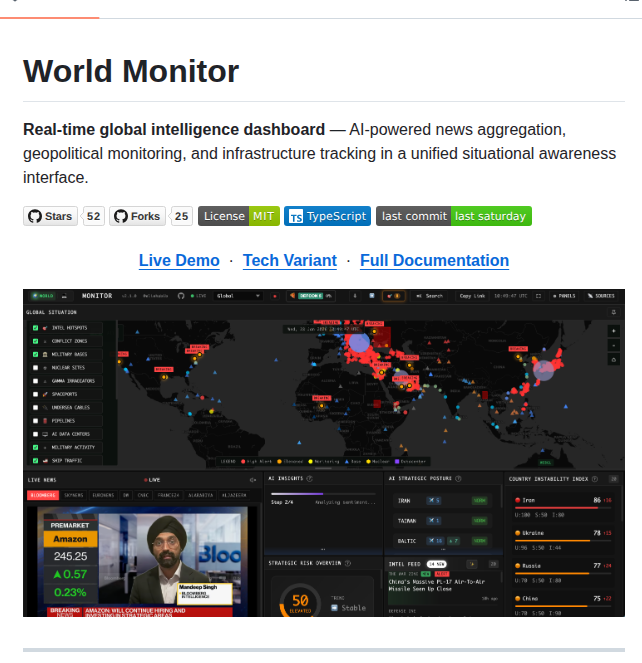
🚨 Someone just built a real-time global intelligence dashboard and open sourced it for free.
It's called World Monitor. Think of it as a CNN war room meets Bloomberg Terminal for geopolitics but anyone can use it.
No paid OSINT tools. No expensive subscriptions. No classified access needed.
Here's what this thing tracks in real-time:
→ Active conflict zones with escalation scoring
→ 220+ military bases from 9 countries
→ Live military aircraft tracking (ADS-B)
→ Naval vessel monitoring including "dark ships" going off radar
→ Nuclear facilities worldwide
→ Undersea cables, oil pipelines, and AI datacenter clusters
→ Protests, sanctions, internet outages, and satellite fire detection
→ Prediction markets as early warning signals
Here's the wildest part:
It has an AI that reads 100+ news sources, classifies threats in real-time, and generates intelligence briefs automatically.
Every country gets a live "Instability Index" score from 0-100 based on military activity, protests, news velocity, and structural risk.
When 3+ signal types spike in the same area, military flights + protests + satellite fires, it triggers a convergence alert.
This is the kind of tool governments pay millions for.
It runs in your browser. One command to install.
100% Open Source. MIT License.
@moshikrl@kaspaunchained@michaelsuttonil aiming for two HFs in 2026, cov++ beginning of May, DK+increased BPS end of Q3 god willing. both are aggressive timelines, but realistic with the newly expanded devforce
This guy built GPT from scratch in pure C.
No PyTorch. No TensorFlow. No libraries.
Just raw C code.
What he implemented:
→ Custom random number generator (xorshift)
→ Character-level tokenizer
→ Multi-head self-attention
→ RMS normalization
→ Softmax from scratch
→ Full backpropagation
→ Adam optimizer
The model:
→ 64 embedding dimensions
→ 4 attention heads
→ 2 transformer layers
→ 32 token context window
This is how you actually understand transformers.
Not by importing torch.nn.Transformer.
By writing every matrix multiplication yourself.
New art project.
Train and inference GPT in 243 lines of pure, dependency-free Python. This is the *full* algorithmic content of what is needed. Everything else is just for efficiency. I cannot simplify this any further.
https://t.co/HmiRrQugnP
While I agree the $20k/mo in API requests from @AlexFinn is aggressive, these numbers from @ImSh4yy are way off. A lot of mistakes here.
Hopefully this clears things up about using M3 Ultra Mac Studios for AI somewhat. I’ll also be releasing open benchmarks and evals for 1,000+ local AI setups soon.
- Mistake 1: $/tok calculated based on single request TPS, not throughput. LLM inference can be batched, and you can move along a pareto frontier of throughput / single request tps. The point you choose on the pareto frontier depends on your SLOs and workload, but it likely isn’t min throughput. You’re off anywhere from 2x-20x (bringing monthly savings to $156-$1560/mo assuming the OP’s $1.50/million or $312-$3120/mo if we use $3/million from official API) depending on which point we choose on that pareto frontier.
- Mistake 2: Assuming device is obsolete in 12 months. This just isn’t true for Mac Studios. Macs are useful for more than AI. Apple’s hardware retains its value extremely well. I’ve talked to resellers who have decades of data on this. The resell value depreciates ~15% per year.
- Mistake 3: Cherry-picked a provider on OpenRouter that has 98.4% uptime. That means it’s down 23 mins per day, or 11.5 hours per month. The official Kimi K2.5 API is $3/M output tokens, 2x the price you used. That’s more of a fair comparison.
- Mistake 4: Ignored input tokens completely. The official Kimi K2.5 API also charges $0.60 per million input tokens ($0.10 if it’s a cache hit). The cache hit part here is the kicker. Whereas you can keep your entire context hot on your own device 24/7, that costs money for model providers and unlike the model weights each user’s context is unique so it doesn’t scale - they need to charge for it. I’m loading entire codebases into context, which often is 200K tokens. That’s $0.12 every time you load in that codebase and $0.02 every time you query it (even for one token) when it’s cached. That adds up quickly, especially when e.g. each tool call using claude code or opencode is an additional request.
- Mistake 5: There are other reasons to run local beyond cost (imo more important). Privacy, compliance, sovereignty (not your weights, not your brain), uptime guarantees, air gapping, no internet access. There’s also latency but usually that’s best going to the cloud, unless you pair it with one of the other reasons e.g. air gapping.
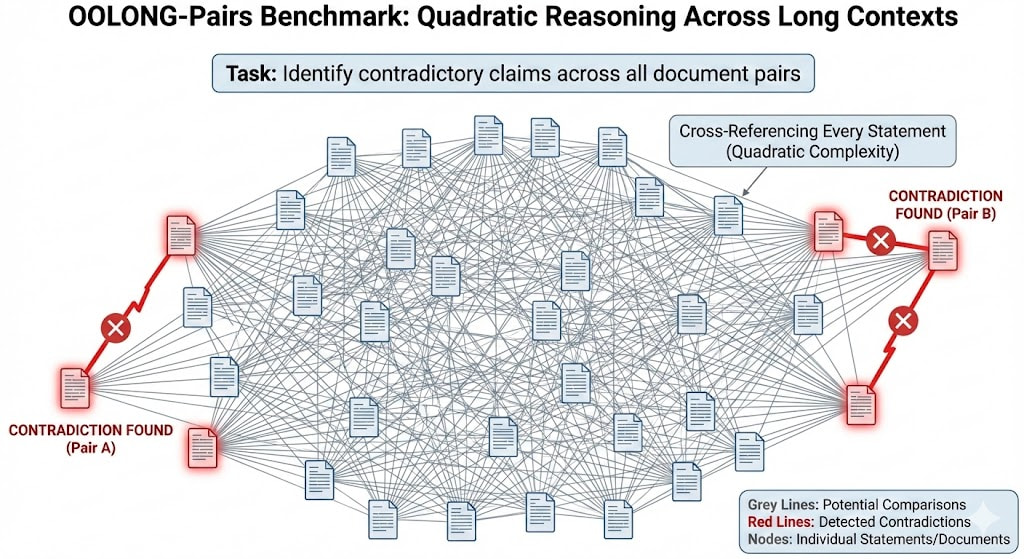
Recursive Language Models (RLMs) let agents manage 10M+ tokens by delegating tasks recursively.
This Google Cloud Community Article explains why ADK was the perfect choice for re-implementing the original RLM codebase in a more enterprise-ready format →https://t.co/p3MsNtLVJL
China electricity generation is still growing super fast, with solar being the largest incremental contributor, and will exceed America by a factor of 3X either this year or next
This paper on the current state of AI Agents is worth reading.
Main points:
1. Add memory to agents.
2. Build agents as loops, not pipelines.
3. Go for RL only after the Agent's behavior is reliable.
4. Specify which tool to use when (don't dump 50 tools into a prompt and hope for magic).
5. Multi-agent systems fail unless the roles of planner, executor, and critic are explicit.
------------
Some of these lessons feel obvious, but it's good to know that engineers from Meta, Amazon, and Google agree with each other.
Cheers.
https://t.co/7s82wVKymC
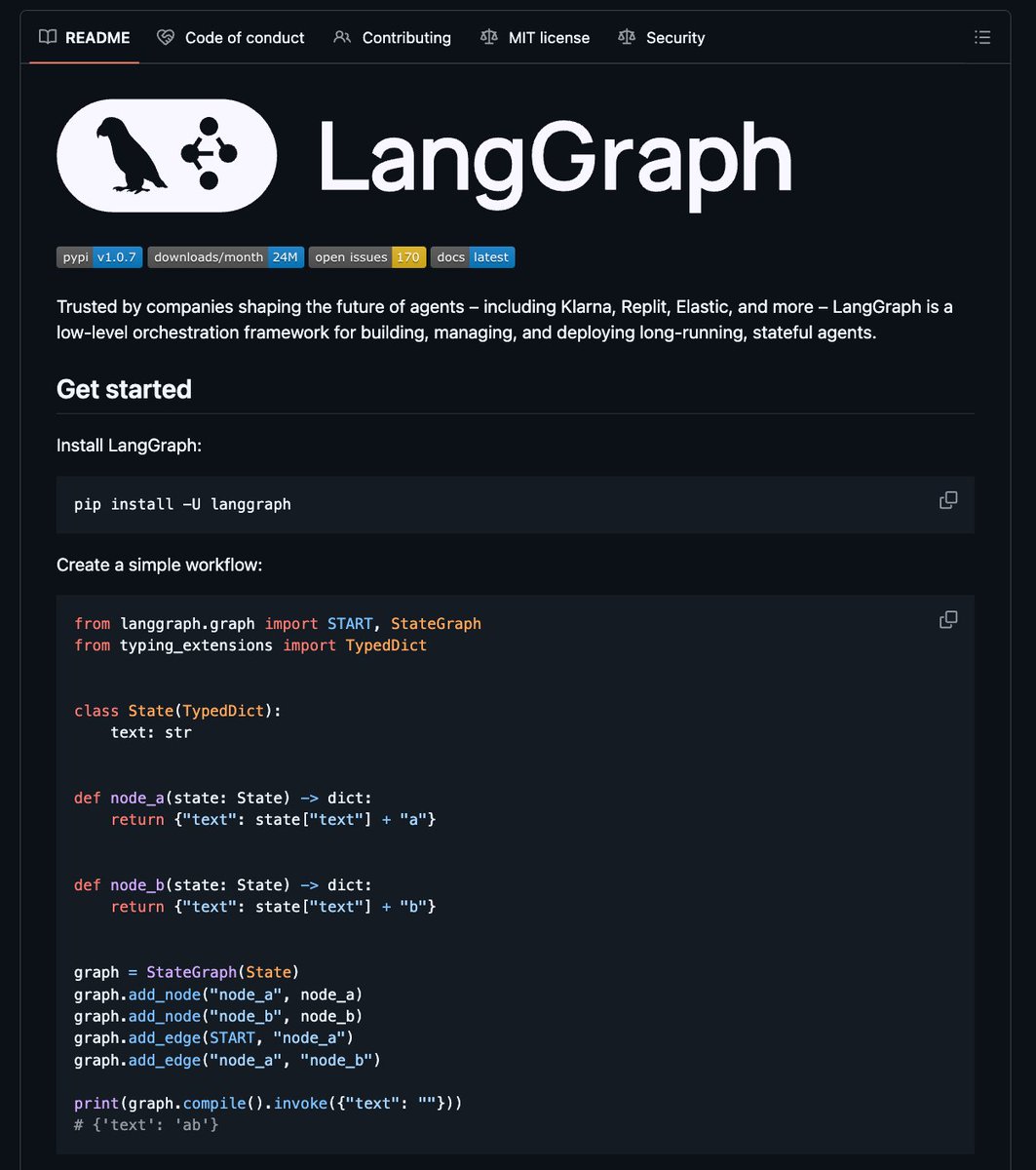
10 AI projects that will get you hired in 2026:
1. RAG App with Real Evaluations
Build a production-grade RAG system with evals, monitoring, and feedback loops.
Stack: OpenAI or Claude + vector DB + evals
Guide: https://t.co/Z0g1c3q4Io
2. Autonomous Research Agent
An agent that plans, searches, cites sources, and produces reports.
Stack: LangGraph + tools + citations
Example: https://t.co/1RrMBeariA
3. AI Customer Support Copilot
Human-in-the-loop support assistant with guardrails and analytics.
Stack: OpenAI + Zendesk or Intercom + moderation
https://t.co/73avCFxbj1
4. Voice AI Agent (Calls + Scheduling)
Handles real phone calls, booking, and follow-ups.
Stack: Twilio + Whisper + LLM
Starter: https://t.co/HomUucMKVT
5. AgentOps Dashboard
Track agent reliability, cost, failures, and regressions.
Stack: OpenTelemetry + evals
Inspo: https://t.co/cO0IEbAZHa
6. AI Data Extraction Pipeline
Extract structured data from PDFs, emails, and images at scale.
Stack: Vision models + schema validation
Example: https://t.co/CTKOKtHLKL
7. Code Review AI for GitHub
Automated PR summaries, risk flags, and suggestions.
Stack: GitHub Actions + LLM
Docs: https://t.co/MEuLM66Obf
8. Multi-Agent Planner for Workflows
Planner + executor agents with deterministic fallbacks.
Stack: LangGraph or CrewAI
CrewAI: https://t.co/6N7ioX81HZ
9. AI Search Engine with Fresh Data
Search across web, forums, and social with citations.
Stack: Search APIs + rerankers
Ref: https://t.co/5D9oXHOrJu
10. Enterprise Prompt Security Tool
Detect prompt injection, data leaks, and unsafe outputs.
Stack: policy checks + red teaming
Guide: https://t.co/DE9CktpKmP
everyone's talking about Clawdbot.
but 99% of people still don't know what it actually does.
users are working 4x less than people who don't use it.
Here are 8 real tasks they automated: ↓